
Translated material
Astronomy news: Crystal Ball nebula, single black hole, eclipsing “triplets”... - Trinity option - Science
Crystal ball NGC 1514
A new image taken by the 8.1-meter Gemini North telescope on top of Mauna Kea, Hawaii, reveals additional details of the planetary nebula NGC 1514, known as the Crystal Ball Nebula [ 1 ]. The object is located about 1,500 light-years from the Sun in the constellation Taurus, and the light captured in this image was emitted as early as the 5th or 6th century AD. e. The temperature of the luminous gas in the nebula reaches 15,000 K, which ensures its bright multicolor glow.
The term “planetary nebula” has a long origin; these objects are actually not connected in any way with planets. It was introduced by the discoverer of NGC 1514, William Herschel, in 1790, because in the telescopes of that time, such nebulae looked like round disks and resembled planets. The key difference between NGC 1514 and other such objects is the structure of the central region. The optical spectrum of the nebula's core indicates the presence of two stars: a cooler one, spectral class A, and a hot subdwarf, the ultraviolet flux from which ionizes the envelope. The orbital period of this pair is estimated at nine years. As estimates show, it is the gravitational interaction of stars that is responsible for the formation of the asymmetric and layered shells of NGC 1514. Spherical symmetry is more typical for single central stars.
The image was obtained using the GMOS spectrograph installed on Gemini North. The NSF NOIRLab, which operates the observatory, made the image publicly available as part of a campaign to image bright and complex objects in the southern and northern skies.
For Herschel, the nebula NGC 1514 was the first object that refuted his earlier assumption that all such structures consist of stars that are indistinguishable from observation. A bright pointlike nucleus in the center of the gas cloud gave him grounds to assert that the glow is not of a stellar nature, but is generated by a single source. Modern data have revealed that this source is double.
Observations of NGC 1514 show that even in the final stages of stellar evolution, orbital interactions continue to play a significant role. The complex asymmetric structure of the shells provides direct observational evidence that the double central star actively influences the surrounding nebula, mixing and redistributing the ejected material. Although the crystal ball is traditionally associated with fortune telling, this cosmic object gives astronomers a chance to peer into the past, study the mechanisms of stellar death that occurred 1,500 years ago, and better understand how gravity continues to control matter even after the star has ceased to exist.
1. Gaze into the Crystal Ball Nebula and See the Light Emitted by a Dying Star 1500 Years Ago. noirlab.edu/public/news/noirlab2613/
Census of the Sun's Nearest Neighbors
Our Sun is a single star, but many stars in the Galaxy have gravitationally bound companions. The study, covering a region with a radius of 10 pc (about 32.6 light years) from the Sun, provided the most comprehensive map to date of binary and multiple stars in our immediate environment [ 2 ].
The catalog combines data from the Gaia Space Telescope (DR3 release) [ 3 ] and the Washington Binary Star Catalog, which contains long-term measurements of radial velocities (i.e., the speed at which an object approaches or moves away from the observer). The final sample included 424 stars and brown dwarfs located inside a sphere with a radius of 10 pc. Of these, 215 objects turned out to be connected in 92 multiple systems: 68 double, 19 triple, three quadruple and two quinary - rare and extremely complex configurations. Another eight systems could not be resolved visually due to their extreme compactness.
One of the key discoveries was a clear correlation between the mass of a star and its “marital status.” For stars with a mass greater than half the Sun, the probability of being part of a multiple system is 41 ± 11%. For the lightest objects—red and brown dwarfs with masses less than 0.1 solar—this figure drops to 9.3 ± 7.4%. In other words, massive stars prefer to “travel in groups,” while lightweight stars are more likely to lead solitary lives.
The range of orbital periods in these systems is amazing: from close pairs that orbit each other in a few days, to extremely wide ones whose orbital periods can reach tens of millions of years. The research also has practical significance. The presence of a companion star is a serious obstacle for exoplanet hunters. The gravitational influence of the second star distorts the signals used in the radial velocity method, and its own glow creates noise that interferes with direct observations.
The result of this work will be a filtered catalog of targets for future space observatories such as NASA's Habitable Worlds Observatory (HWO) and ESA's Large Interferometer For Exoplanets (LIFE), helping to direct their valuable observing time to the most promising candidates.
2. Characterization of All Known Multiple Stellar Systems Within 10 pc. arxiv.org/abs/2605.04094
3. Gaia Data Release 3. cosmos.esa.int/web/gaia/data-release-3
Black hole without galaxy
Supermassive black holes are usually found at the centers of large galaxies and make up only a small fraction of their mass: in the modern Universe it rarely exceeds 0.5%. The object Abell 2744-QSO1, which existed 700 million years after the Big Bang, demonstrates a different nature [ 4 ]. Its mass is estimated at about 50 million solar and is at least 2/3 of the total mass of the entire system. Such an object belongs to the class of “little red dots”—compact sources that astronomers are increasingly finding at high redshifts [ 5 ].
The researchers exploited the gravitational lensing effect of the massive galaxy cluster Abell 2744 (also known as the Pandora cluster), creating three images of QSO1 and increasing its brightness by about six times. Without this “magnifying glass” it would be impossible to see such a distant and compact object. Using the NIRSpec spectrograph installed on the James Webb Space Telescope, a detailed map of the movement of gas around the central object was compiled. The key discovery is that the gas rotates in Keplerian orbits—that is, its speed decreases with distance from the center, according to the same law that planets orbit around the Sun. Such a motion clearly indicates the presence of a compact central mass and excludes the possibility that the mass would be distributed among many stars.
Chemical analysis also confirms the unusual nature of QSO1. The system's "metal" content (elements heavier than hydrogen and helium) is less than 0.5% of the sun's, one of the lowest levels ever recorded. The gas is practically not enriched with the products of supernova explosions, which indicates an almost primary composition of the substance. In such an environment, star formation processes have either not yet begun in full force or are at a very early stage.
The data obtained are of fundamental importance for cosmology. They provide evidence that some supermassive black holes in the early Universe could have formed without a stellar stage. This could occur either during the direct collapse of giant gas clouds, or in the first second after the Big Bang (primary black holes). In such scenarios, the black hole predates its galaxy and can serve as a “seed” around which the stellar population subsequently gathers. QSO1, apparently, we are observing precisely in this phase - the supermassive black hole already exists, and the surrounding galaxy is just beginning to form.
4. NASA's Webb Reveals Black Hole that Formed Before Its Galaxy. science.nasa.gov/missions/webb/nasas-webb-reveals-black-hole-that-formed-before-its-galaxy/
5. A Direct Black-Hole Mass Measurement in a Little Red Dot at High Redshift. nature.com/articles/s41586-026-10579-4
TIC 295741342 - triple eclipsing binary system
The TESS (Transiting Exoplanet Survey Satellite) space telescope, designed to search for exoplanets, discovered a rare triple star system TIC 295741342. It is located at a distance of about 3 thousand light years from the Sun, and its age is estimated at 1.46 billion years. The discovery was reported in a paper published on the preprint server arXiv.org .
At the center of the system is a close double (designation TIC 295741342 A). It consists of two main sequence stars, similar in mass, radius and temperature to the Sun. The period of their mutual circulation is about 4.75 days. The third component orbits this pair in an orbit with a period of 1.13 years - the giant star TIC 295741342 B, whose mass is 1.7 solar, and whose radius is 10.6 times the solar radius.
What makes the system particularly valuable is its exceptionally successful configuration: the orbits of all three components lie practically in the same plane (mutual inclination is from 0.25° to 0.33°). Thanks to this, TESS was able to record a triple eclipse - a rare event when a binary system successively passes behind the disk of a giant star. The shape of the light curve, called “head and shoulders,” made it possible not only to confirm the triple nature of the system, but also to measure the contribution of each component to the total emission. It turned out that about 95% of the light is provided by the giant star, while the inner pair creates only 5%.
Evolutionary models show that in 50–130 million years the giant star will overfill its Roche lobe, and matter will begin to flow into the inner binary system. Depending on the scenario being implemented, this will lead either to a stable mass exchange or to the formation of a common shell and subsequent merging of components. The closest external eclipse in the system is expected on September 1, 2026, and astronomers are calling on colleagues around the world to organize synchronous observations of it within an interval of ±3 days.
6. TIC 295741342: A Triply-Eclipsing Triple Star System with a Giant Tertiary. arxiv.org/abs/2605.20080
Room image: South Vertushka
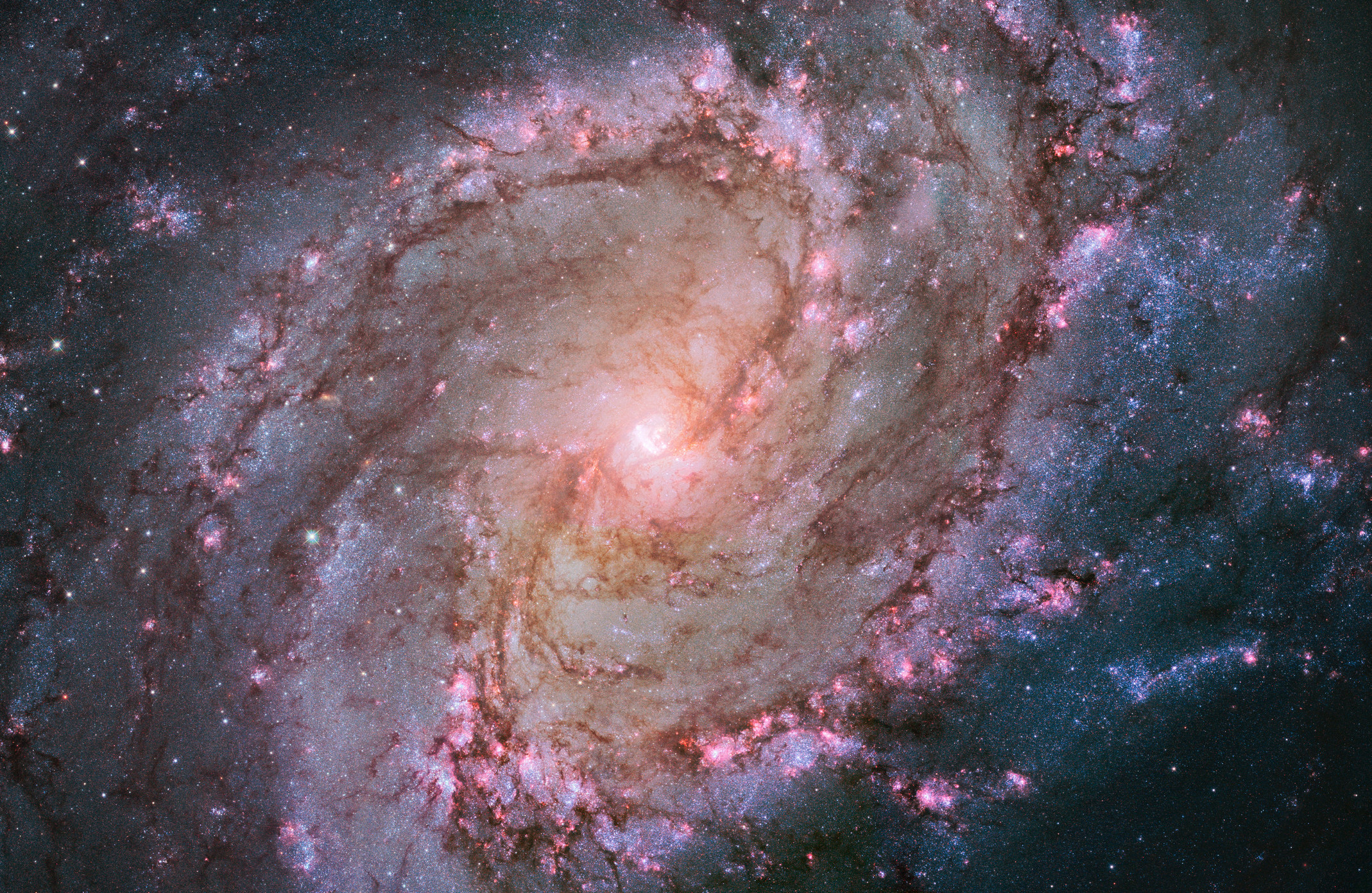
One of the favorite targets of amateur astronomers is the photogenic spiral galaxy M83 (NGC 5236), also known as the Southern Pinwheel Galaxy. She appears in all her glory in a mosaic image from the Hubble telescope. Vibrant purples and blues indicate that the galaxy is actively forming stars. Hubble has imaged thousands of star clusters, hundreds of thousands of individual stars, and "ghosts" of dead stars called supernova remnants. The galactic panorama is a canvas with a length of 50 thousand light years, which captures the drama of the births and deaths of luminaries. New generations of stars form mainly in clusters on the outskirts of dark spiral dust lanes. These bright young star clusters, only a few million years old, generate a powerful stream of ultraviolet radiation that is absorbed by the scattered gas clouds surrounding them, causing them to glow with a pinkish “hydrogen” light.
Alexey Kudrya