Date
Author
Алена Ицкова; Соня Рихтер; Дмитрий Сидоров
Source

Preserved copy
Translated material
The United Russia primaries are over, 61 war participants won. But these results do not affect the formation of the list. Review of "New-Europe"
But these results do not affect the formation of the list. Review of "New-Europe"
On Sunday, United Russia completed internal party voting for future candidates in the Duma elections - primaries. 61 people who won these internal votes were participants in the war in Ukraine, New Europe calculated. At the same time, they are not guaranteed a place on the party list, since it is compiled in a non-transparent manner, without taking into account the results of the preliminary voting.
Read more about why these primaries of the party in power are actually needed and how the votes were distributed in the material of “New Europe”.
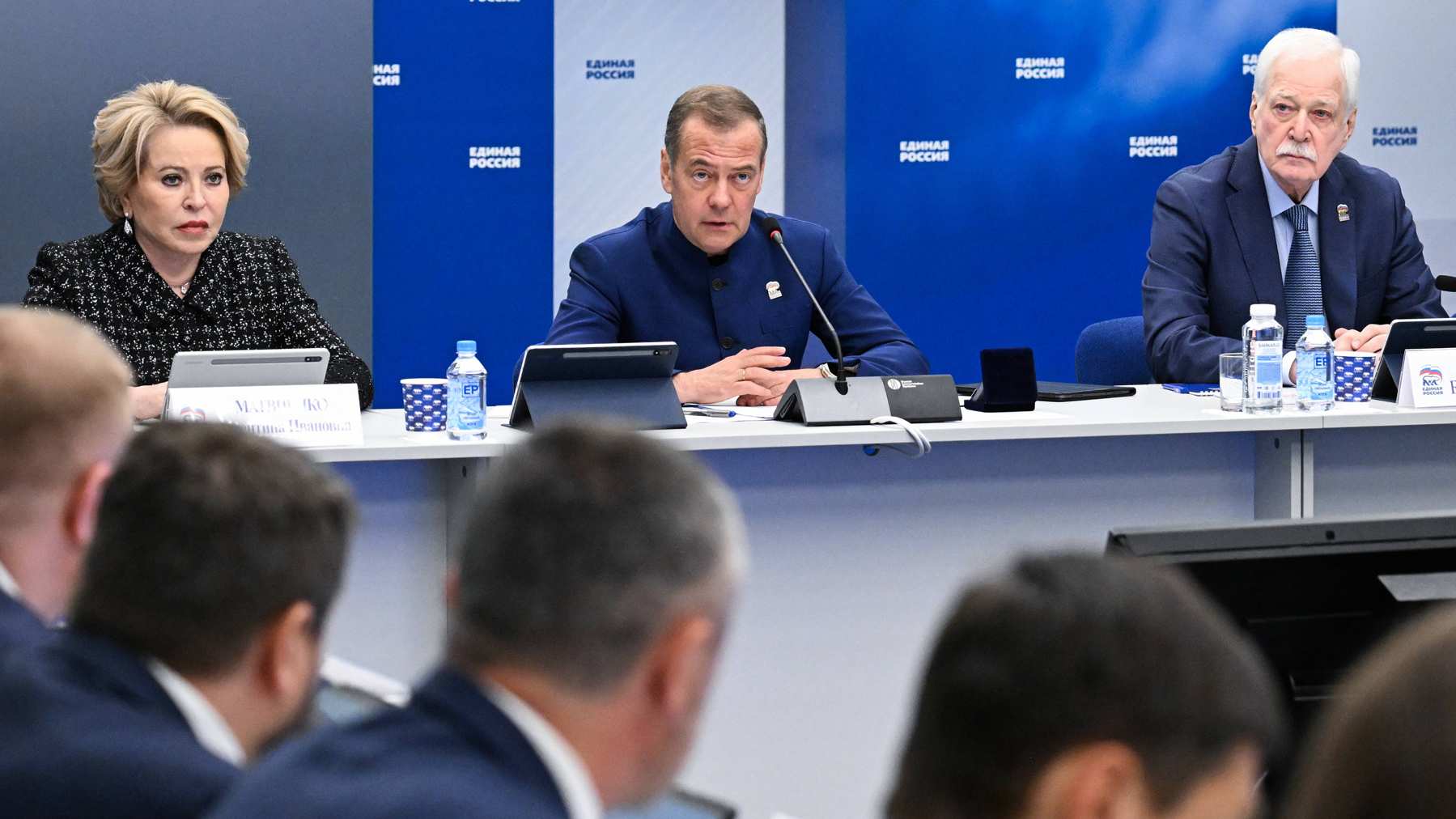
Chairman of United Russia (UR) Dmitry Medvedev, in a speech on the occasion of the end of the primaries, highlighted the special internal democracy of United Russia compared to other parties. According to him, their political opponents make key decisions behind the scenes, while the party in power relies on the democratic mechanism of primaries.
“Voters are given every opportunity to determine in advance who will fight for the right to represent their interests in the highest legislative branch. This is our position, it has been tested by time. It presupposes the special responsibility of candidates to citizens. This approach means the political maturity of the party, its willingness to work in the interests of millions of people,” said Dmitry Medvedev.
But in reality, the United Russia primaries are hardly democratic.
According to a former United Russia functionary , “[the] results of the primaries are not binding on the party; in the end, anyone can be nominated.” This also applies to the winners: victory in the primaries does not guarantee them entry into the party list or nomination in single-mandate constituencies. According to him, the party uses these results as indicators of the popularity of a particular candidate.
An interlocutor who worked with United Russia and another current party functionary also agreed with this assessment of the role of primaries (and other theses presented below) in a conversation with New Europe.
If the party’s planned favorite suddenly loses in the primaries to a little-known candidate, the leadership understands that he cannot mobilize voters and will probably also lose the “big” elections - they are sent to less competitive regions. This happened, for example, with the informer-deputy Mikhail Romanov (who complained about the singer Naoko): he lost the primaries in his native district to the judoka Anatoly Rakhlin, who trained Putin.
Often such situations are associated with the fact that an unknown candidate is specially lobbied by party functionaries in order to create problems for those who “stayed too long.”
- It happens in different ways. Without outside support, it’s hard for a noname to move. However, there are also occasional excesses, when someone is ahead by a couple of votes and is forced to either leave the race or nominate someone else,
- says the ex-United Russia.
The primaries were conceived as a mechanism that should create the appearance of competition, give new people a chance to express themselves and add a little dynamics to the system, the interlocutor says. But in practice, he notes, they arouse little interest among anyone other than United Russia functionaries. So we have to use various tricks to lure voters there.
— It’s always been like this, there were different roulette competitions in the regions. For example, “register for the primaries - get a ticket - on voting day we will draw money and prizes,” says the ex-United Russia.
As a rule, state employees and people dependent on the state are brought to the primaries. All this requires resources: organizational, personnel, financial, and sometimes administrative.
In this regard, the United Russia primaries are a grand rehearsal for the mobilization of voters and a review of the mobilization capacities of individual candidates, the interlocutor formulates. The ex-functionary shared screenshots of a chat where “mobilizers” were hired for the primaries in one of the Siberian regions. The interlocutor suggests that for such a monthly part-time job you can get about 30 thousand rubles.
Political scientist Ivan Preobrazhensky also believes that the key role of primaries is to mobilize the population.
“The main goal of this event is to gather a certain number of people and force them to do something,” says the expert. — Plus, remember that United Russia exists at all, because in ordinary life it is still a party of bureaucrats, it merges with the administration.
In May, the RBC publication wrote that the party in power plans to bring about 40 SVO veterans to the Duma. The results of the primaries show that this is still quite possible. According to New Europe estimates, at least 61 participants in the war in Ukraine may run for the State Duma elections from United Russia.
In single-mandate constituencies, 29 participants in the war won (12.9% of the 225 winners) in 23 regions, including Moscow and St. Petersburg.
In the party list voting, first and second places following the primaries were given to 34 people with a military background (19.1% of 178). These candidates will be able to enter the State Duma if United Russia as a party receives enough votes.
We do not know what proportion of candidates from each region will be included in the general list of United Russia in the elections in September, but in previous parliamentary elections at least two people from each region were included in the party’s general list .
In total, at least 61 members of the SBO can represent the party in single-member districts and be included in the federal list. Two ex-military men were nominated both on lists and in single-mandate constituencies.
The largest number of candidates - war participants who can run in the State Duma elections - are registered in Moscow - six people. In second place are St. Petersburg, “DPR”, Krasnoyarsk and Primorsky territories, Novosibirsk and Pskov regions. Two veterans each won.
In percentage terms, the share of war participants is highest in the Pskov region - in this region, two-thirds of the candidates who won the primaries indicate their military experience. In the Trans-Baikal Territory and Ivanovo Region, every second candidate is a participant in the war. At the same time, not a single SVO veteran won the primaries in 39 regions.
At the same time, data on the results of the primaries should be taken with a healthy dose of skepticism. Victory in the United Russia primaries still does not guarantee mandatory nomination or inclusion on party lists. Even from the party’s internal documents it follows that after the primary elections, all candidates undergo additional approval and someone may be excluded from the final lists for formal reasons.
“Sometimes, potentially, the results of primaries can influence the choice made in the Kremlin,” Preobrazhensky believes. “Although it is clear that the lists of those who should participate in the elections have been lying in [AP employee] Alexander Kharichev’s desk drawer for a long time.