
Translated material
The main thing about the transfer of prisoners
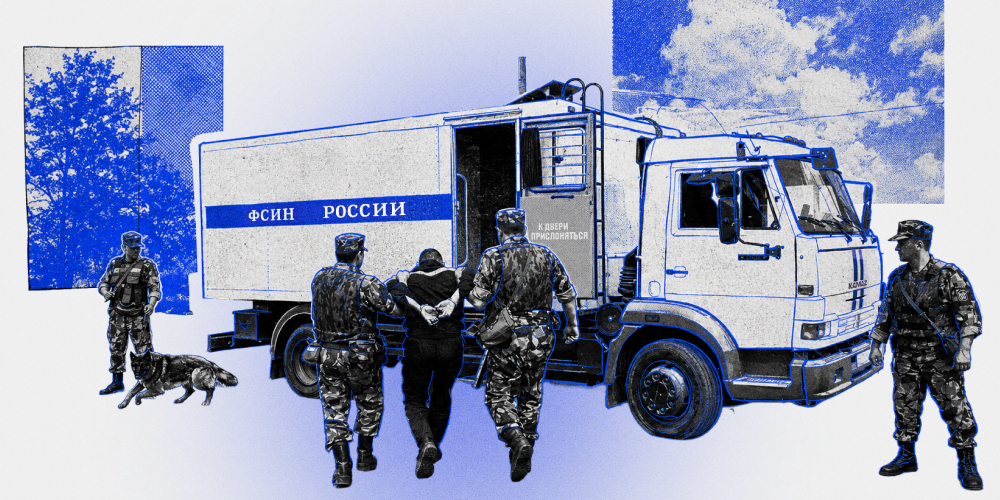
By law, those sentenced to imprisonment must serve their sentences in correctional institutions in the region where they lived. At the same time, some people are deprived of the opportunity to be closer to relatives, including foreigners and those convicted of “extremism” and “terrorism.”
Who can ask for a transfer closer to their family? What to write in such a statement and where to complain in case of an unreasonable refusal? How does the stage go and how can you prepare for it? We explain in a new memo.
1
Where is the prisoner transferred after sentencing?
Those sentenced to imprisonment, as a rule, serve their sentences in correctional institutions on the territory of the constituent entity of the Russian Federation in which they lived or were convicted ( Clause 1, Article 73 of the Penal Code ).
However, this rule does not apply to some categories. Thus, those convicted of treason and a number of other articles serve their sentences in institutions determined by the central office of the Federal Penitentiary Service ( Clause 4 of Article 73 of the Penal Code ). However, they can request a transfer closer to relatives. The exception is those convicted of terrorism and extremism.
2
What happens if there is no required institution in the region or if there are no available places in it?
Then the FSIN sends the convict to a colony/prison in another subject of the Russian Federation.
For example, if a court sentences a person to a special regime colony, but there are no such colonies in his region, he is sent to the nearest one where there is such an institution.
3
Can I request a transfer to another institution?
Yes, but only in cases prescribed by law. A convicted person can be transferred if:
- it is necessary to ensure his safety - for example, if he is regularly exposed to violence from other prisoners;
- he requires medical care, which cannot be provided in the current place of serving his sentence.
The convicted person can also send an application for transfer closer to relatives. The relative himself can send him - then the prisoner’s consent will be required. If there is no institution of the required regime in the region, the convicted person is transferred to the closest relative.
It is important to understand that the FSIN often neglects these rules and ignores the needs of convicts. The possibility of transfer directly depends on the attitude of the administration towards the person.
4
Can any convicted person request a transfer closer to home?
No. In 2025, the State Duma adopted a law that prohibits those involved in “terrorist” and “extremist” cases from asking for transfer to other colonies. The ban also applies to foreigners and stateless persons.
Amendments were made to articles 73 and 81 of the Penal Code. As Sitting Russia noted , earlier the Supreme Court of the Russian Federation adopted the exact opposite cassation ruling. It states that the inability of a convicted person, even under “extremist” and “terrorist” articles of the Criminal Code of the Russian Federation, to maintain family ties while serving a sentence refers to the exceptional circumstances specified in Part 2 of Article 81 of the Criminal Code of the Russian Federation. And on their basis, he is allowed to be transferred to another institution closer to his family.
The Ministry of Justice explained the changes by the fact that in some high-security colonies the share of convicts from Central Asian countries reaches almost half of all prisoners. One of the reasons for this concentration is the right to transfer closer to the place of residence of relatives. According to the Ministry of Justice, some of these convicts may “have stable criminal ties and spread extremist or terrorist views, which complicates the situation in institutions and complicates correctional work.”
5
How many times can a person be transferred from one institution to another?
The PEC does not set a limit on the number of transfers of a convicted person.
6
What should I write in the application if I want to independently request that a close relative be transferred closer to me? Who should I send it to?
The application must indicate:
- Addressee (director of the Federal Penitentiary Service of Russia or the head of the corresponding territorial body of the Federal Penitentiary Service).
- Your details and degree of relationship with the convicted person.
- Details of the convicted person (full name, date of birth, institution where he is being held).
- Request for transfer to a correctional facility located closer to your place of residence.
- Justification for the request: the difficulty of long trips, the health status of relatives, the need to maintain family ties, the presence of minor children and other circumstances.
- List of attached documents confirming the relationship and circumstances to which you refer.
- Articles of the Code of Criminal Procedure, which confirm the right of a convicted person to be transferred closer to relatives (Part 2.1 of Article 73 and Article 81 of the Code of Criminal Procedure).
7
Where to complain if the Federal Penitentiary Service refuses to transfer you closer to relatives? Does this make sense?
Complaints can be sent to:
- POC;
- the prosecutor's office;
- Federal Penitentiary Service for the region;
- Central office of the Federal Penitentiary Service;
- Commissioner for Human Rights.
It is important to send complaints to departments in the region where the convicted person is serving his sentence.
A written complaint is drawn up with the most detailed description of the details and circumstances of the violation (names, dates, time, place, contact information) so that the inspector can confirm the information about the violation. If you have documentary evidence (photos, video and audio recordings, documents, etc.), you must attach them to the complaint (if you file a complaint in paper form, it is important to keep the originals). One complaint can report several violations at once.
If there are witnesses willing to confirm information about a violation, please provide their full names and contact information.
It is also worth referring to the laws that are being violated. You can indicate specific articles of the Constitution if the rights specified in it are violated.
Is there any point in complaining? The First Department lawyer answers:
"Yes. It happens that the request of a convicted person or his relatives for a transfer or their complaints are formally left unsatisfied, but in fact they are transferred to another colony (for example, closer to home or to one where the convicted person seems safer). This happens “by itself,” but the convict is satisfied with the result, and he stops writing complaints.”
8
When exactly, after a verdict is passed, is the convicted person sent from the pre-trial detention center to a colony/prison?
If the prosecution or defense is not satisfied with the judge's decision, they can file an appeal within 15 days and appeal the decision to the appellate court (court of second instance). If an appeal is filed against the verdict, it does not come into force until the appeal court considers the appeal.
After the verdict comes into force, the person is transferred from the pre-trial detention center to another institution. Sometimes the prisoner is notified in advance, sometimes he is forced to quickly pack up without warning.
9
How to find a person who has been sent to the stage?
- Art. 394 Code of Criminal Procedure and Art. 75 of the Penal Code oblige the administration of the pre-trial detention center to notify the relatives of the convicted person about where he is going to serve his sentence. If this does not happen, you need to submit an application to the pre-trial detention center to clarify your location.
- Art. 17 PEC and art. 333 of the PVR of the correctional institution oblige the administration to send a notification to one of the relatives within 10 days from the date of arrival of the convicted person.
Despite the rules, transfers to another institution are not always reported to relatives or lawyers. The prisoner himself cannot always tell about this: for this, the person must have a response form if the pre-trial detention center is connected to electronic services for correspondence. All forms are personal, so the loved one must pay it to the prisoner in advance, indicating his full name and email address where the response will be sent. If not, then you will have to write a regular letter - for this you need a blank sheet of paper, an envelope, stamps. Often there is no time to write a letter. For example, Artem Kamardin, a defendant in the Mayakovsky case, was informed about the stage 10 minutes before.
The stage can last from several days to several months. All this time, the prisoner is without contact with the outside world and has no idea when the stage will end and where he will be taken.
The stage takes place with stops - prisoners are placed in a pre-trial detention center, where they wait to continue their “journey”. It is unclear how many days the shutdown will last. According to the law, the maximum time of detention in a transit pre-trial detention center is 20 days. This norm is not always observed.
Uncertainty makes it difficult to contact loved ones and find someone who can donate necessary items. A paper letter will take a long time; to send an electronic letter, two conditions must be met: one of the online services for correspondence was working in the transit detention center, and the prisoner had a form for a response from this particular service. By law, the censor checks the letter within three working days. During this time, the prisoner may be taken further along the stage.
“The stage is one of the most unpleasant and unpredictable periods in the life of a completed person, despite the fact that it can last for months. During the trip, a person is actually deprived of the right to communicate with loved ones; throughout the entire route he is in difficult conditions, deprived of the right to correspondence, transfers and additional food. In my practice, the longest stage was from Krasnodar to Vladivostok; a person was transported for more than three months,” says First Department lawyer Evgeny Smirnov.
In fact, all that remains is to wait for notifications from the administration and letters from the prisoner himself.
10
How to prepare your loved one for the stage?
Food is required to be provided, but it is not always of good quality, so it is better to provide in advance a supply of food, cigarettes, water, necessary things (for example, thermal underwear, if the stage takes place in winter), answer forms and an envelope with stamps. You also need a good travel or sports bag for personal belongings and, preferably, an empty plastic bottle that will be convenient for going to the toilet, as the staff allows you to do this several times a day. At other times you cannot leave the compartment.
Viktor Filinkov, person involved in the Network case:
“There are two types of coupes inside: with three bunks and with 6+ bunks. Why “6+”? Shkonki in the compartment in three rows. In large compartments they are on both sides, but on one of the bunks of the second tier there is... a door. And now it opens, forming one plane with the other two boards. In small compartments the bunks are only on one side. Shkonki are just painted boards, they don’t give out bedding, and they don’t spare the prisoners’ butts and sides. I believe there should be three in small and seven in large. In practice, there were four of us in the small one, and 12 people in the large one. Boiling water is given four times a day, and the toilet is taken the same number of times: at 6, 12, 18 o'clock. It’s almost impossible to go additionally; experienced people take a bottle with them. <…> Depending on the carriage, you can see either nothing or little through the window. At stations, the windows are usually closed - camouflage. There are old carriages and there are new ones <…>. They differ rather in appearance. Well, some old ones have a wood-burning boiler - then the convoy is given neat bundles of firewood. It's the 21st century."