
Translated material
Deferred denunciation
In the trial of the “fake” case of Maxim Kruglov, the defense went on the offensive. Grigory Yavlinsky spoke at the trial

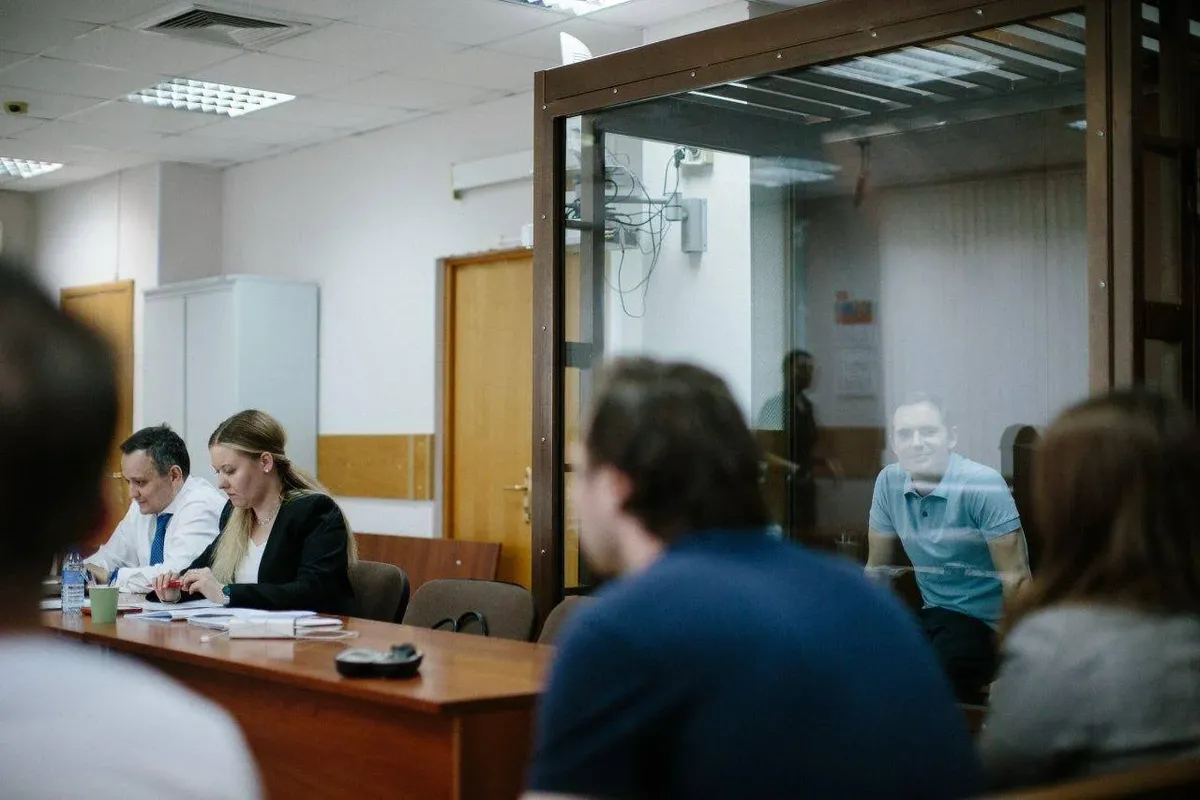
Maxim Kruglov in the courtroom. Photo: Daria Kornilova
In the Zamoskvoretsky Court of Moscow, the trial continues against the deputy chairman of the Yabloko party, Maxim Kruglov, accused of distributing military “fakes” due to four publications on social networks. Over the course of several weeks of proceedings, the court managed to listen to prosecution witnesses - who introduced himself as a political scientist, but turned out to be an employee of the State Budgetary Institution "Zhilischnik", and a Young Guard volunteer who decided to write a statement against the politician months after reading his posts and after the initiation of a criminal case, as well as witnesses who appear in the case materials, but never appear at the hearings.
The trial noticeably changed its tone: after several days devoted to the prosecution's evidence, the court began to listen to defense witnesses.
Against this background, the testimony of specialists sounded particularly contrasting; they found no signs of political hatred or attempts to pass off their own statements as facts in Kruglov’s publications.
At the last hearing, Grigory Yavlinsky also came to court, and the hall was so crowded with Kruglov’s supporters that there were barely enough seats for everyone.
“I call everyone in the authorities “chief”
On April 22, the case began to be considered on its merits. One of the first witnesses for the prosecution in court was Valery Somov, who introduced himself as a political scientist, but turned out to be an employee of the State Budgetary Institution “Zhilishchnik”. According to the witness, he “stumbled upon” Kruglov’s posts three years after publication, and then told a “randomly encountered” FSB officer about them.
Another key witness was 22-year-old Young Guard volunteer Alina Matveeva. She explained that she became interested in Kruglov’s telegram channel thanks to her profession as a journalist. According to her, she read the defendant’s publications at the end of 2025, but wrote a statement against the politician only a few months later.
“One post really resonated with me...” Matveeva continued.
- What do you mean hooked? — Judge Elina Babayants was indignant at this formulation.
— One post caused bewilderment - about Bucha.
According to the witness, these posts “criticize the authorities, that something is being done wrong and something needs to be changed.” Matveeva said that during her studies she received an assignment to research political accounts dedicated to SVO, and then she came across the defendant’s channel. Later, she traveled to “new territories” as a volunteer for United Russia, talked with local residents, and after that decided to contact law enforcement agencies. “I came back later, killed, and talked to the children. And then I realized that it was worth writing [a statement]. It was, let’s say, some kind of impulse,” added Matveeva.
When asked by the defense whether Matveeva had anything to do with United Russia, she admitted that she works in the Young Guard of United Russia. The judge rejected the question of whether she is a party member. “This is my position. Others may read his [Kruglov’s] posts and misunderstand something about what is happening,” says Matveeva.
The circumstances surrounding the application raised even more questions. Matveeva clarified that she wrote a statement to the police department in the Central Administrative District of Moscow, next to which she “was walking at that moment after work.” According to her, in February 2026, friends told her about Kruglov’s case, when he was already under investigation.
For several days she debated whether to contact law enforcement agencies, after which she went to the police department. There, as follows from her story, immediately after submitting her application, she was interrogated by a certain “chief”.
“For me, everyone who works in law enforcement agencies is “the main one,” the witness explained. There was laughter in the hall. Judge Babayants covered her smile with her palm.
As a result, it turns out that the “chief” is an employee of the Investigative Committee, and not the Ministry of Internal Affairs, where she wrote the statement.
"Disagreement is not about hatred"
On June 3, the initiative in the process passed to the defense. That day, the courtroom was filled to capacity: some who came to support Kruglov simply did not have enough seats. The bailiffs provided them with additional seats. Almost 50 people came to support Kruglov. One of the seats was vacated for Yabloko leader Grigory Yavlinsky. He was the defense's first witness.
The appearance of the politician seemed to come as a surprise to the court. Judge Babayants listened carefully to his testimony and did not interrupt, although Yavlinsky from time to time went beyond the scope of questions on the case.
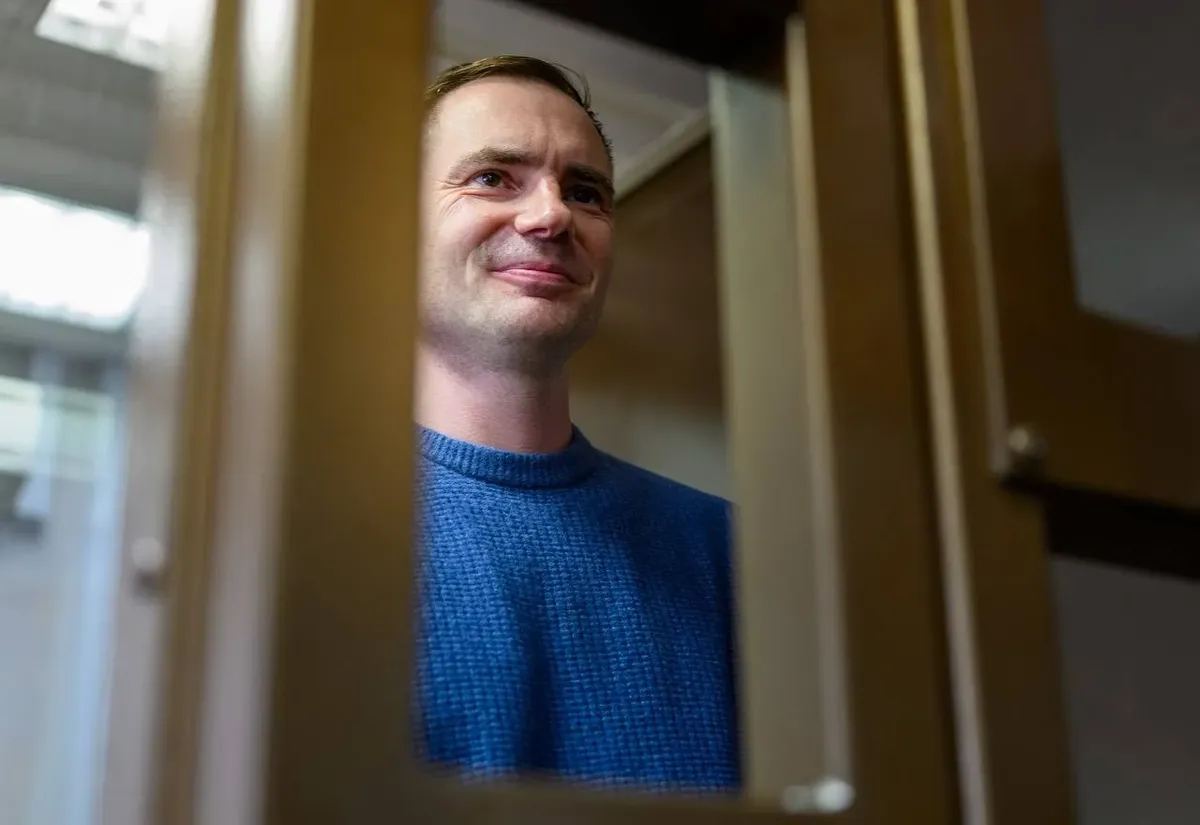
Approaching the podium, the politician first turned to the glass “aquarium” where Kruglov was and silently greeted him with a wave of his hand. Yavlinsky said that he had known the defendant for about 18 years. According to him,
All this time, Kruglov was engaged exclusively in legal political activities and always complied with the law.
“He is a calm, self-possessed person, a patriot of his country,” Yavlinsky said. He recalled that Kruglov joined Yabloko as a student in 2003, and in 2021 he was elected deputy chairman of the party.
“Our party always stands against hostility and for the preservation of human life. We are for dialogue and respect for people. We have a worldview. Our common task is to build a peaceful, free life in a state where human rights and freedoms are valued above all else,” Yavlinsky said, noting that he did not follow Kruglov’s publications and did not notice any hostile statements from him.
Regarding the attitude to “what is happening today,” Yavlinsky quoted Putin: “Russia has always sought to resolve the conflict in Ukraine peacefully and wants this now.” “This is the president’s statement! This is the position of Yabloko, Kruglov’s position, our position. All these years. This is its meaning, this is its essence,” the politician continued.
When the interrogation actually ended, the judge herself unexpectedly invited the witness to say something final. “I want the decision made to be open and honest, so that later there will be no shame,” Yavlinsky added and took a seat in the hall.
Next, the defense presented two specialists who, at its request, prepared a comprehensive psychological and linguistic study of four of Kruglov’s publications on Telegram and VKontakte.
Linguist Igor Zharkov and psychologist Veronika Konstantinova came to the conclusion that Kruglov’s texts do not contain statements about specific actions of the Russian military, and the author himself does not tell the reader any of his own facts, but only refers to existing sources.
In addition, experts did not find any signs of political hatred or hostility in the publications.
“The information is presented in such a way that there is a specific source. And then the reader decides for himself whether to trust him or not. The speaker himself does not report any facts on his own,” Zharkov explained.
These conclusions were noticeably at odds with the prosecution's position. The prosecutor tried to question the status of the experts and the circumstances of the study. She clarified several times which organization Zharkov was representing.
— Are you assigned to any organization? - asked the state prosecutor.
“We are free, we are not assigned to any organization,” the expert grinned.
— Did I just ask something funny?
After the judge intervened, Zharkov explained that he was conducting the research at the request of a lawyer, and not on behalf of any institution. Then the prosecutor asked whether he had signed a non-disclosure agreement regarding the case materials. The defense objected, noting that such signatures were not even taken from lawyers. The specialist himself confirmed that he did not sign any non-disclosure obligations.
Psychologist Konstantinova said that she did not examine the content of the author’s political views, but his psychological orientation and possible intention to mislead readers. She did not detect such an intention.
According to the specialist, Kruglov’s publications rather indicate a desire to share his own experiences about the information he read.
“There is a very careful, very correct expression of the author’s own feelings,” noted Konstantinova.
She added that over the years of practice she has repeatedly encountered texts in which signs of political hatred are immediately visible. In her opinion, there are no such signs in Kruglov’s publications.
Answering the prosecutor’s questions, Konstantinova explained that she had studied, among other things, the resolution to initiate a criminal case, which mentioned that Kruglov distributed “fakes”, being in disagreement with the government’s policies. However, this thesis itself was not the subject of her assessment. “Agreement or disagreement has nothing to do with hatred,” the expert emphasized. This concluded the interrogation of the specialists.
Even earlier, the defense asked to summon Alexander Shushval and Anastasia Krishtaleva to court. The name of the first appeared in the testimony of one of the prosecution witnesses, who claimed that Shushval did not participate in the procedural actions. However, it is Shushval and Krishtaleva who appear as witnesses when examining Kruglov’s publications on Telegram. “The defense has doubts about the disinterest of members of the public,” explained lawyer Natalya Tikhonova.
The defense noted that Krishtaleva’s namesake received an award from the United Russia volunteer center in 2022, and in 2025, as chairman of the youth chamber of the Levoberezhny district, she participated in collecting humanitarian aid for SVO participants. Shushval is also a member of the youth chamber of the same district. Both were served with summonses, but they did not appear in court. As a result, the judge decided to summon them again and postponed the hearing of the case until June 17.