
Translated material
Data on treason and espionage cases for 2025
Minimum 478 convicted, total secrecy: the most complete data on cases of treason and espionage for 2025

On April 20, according to its own regulations, the Judicial Department under the Supreme Court of Russia was supposed to publish judicial statistics for 2025, but did not do so. Moreover, data for previous years also disappeared from the department’s website. By June 2026 the situation had not changed.
At the same time, Russian courts are increasingly hiding information about those involved in political cases, and it is becoming increasingly difficult for journalists and researchers to follow what is happening at the hearings.
Especially for the “First Department” , Parubets Analytics analysts collected and studied data for 2025 on cases of “high treason”, “espionage”, “confidential cooperation with foreigners” and “assisting the enemy” - one of the most closed and opaque areas of Russian criminal proceedings.
Today we are publishing these materials.
Disclaimer: On December 20, 2025, the First Department already published a study on state security cases during this period. However, since then we have become aware of new defendants, cases and sentences under Articles 275, 275.1, 276 and 276.1 of the Criminal Code of the Russian Federation, and many details of these decisions have also become clear. Often, the full name, corpus delicti and other information about the convicted become known only months after the verdict is announced.
What we thought
Since a centralized database of court decisions no longer exists, this study examined the websites of 98 Russian courts, including the system of military courts and courts established by Moscow in the occupied territories of Ukraine. To combine disparate information, analysts created their own database. It included:
- court records and official press releases;
- publications of independent media and human rights activists;
- profile Telegram channels and archived copies of deleted web pages;
- other open sources (OSINT).
The main difficulty was that most cases related to state security are classified. To establish the identities of the defendants, the researchers used a cross-analysis method: they compared case numbers, dates of hearings, articles of accusation, names of judges and press leaks. A fuzzy matching algorithm was also used to help find people by initials, scraps of data, or different spellings of last names.
Then the array of information was cleared of repetitions (taking into account the peculiarities of Russian and Ukrainian spelling) and double-checked manually.
An important caveat: due to the unprecedented secrecy of Russian courts, all figures given in the study are only a minimum estimate. The actual number of convicts may be significantly higher. Nevertheless, the collected data allows us to see in detail the geography, dynamics and structure of sentences.
Final figures: two verdicts every working day
In 2025, Russian courts handed down at least 458 verdicts in cases of treason and espionage, and the number of people convicted was at least 478. That is, throughout the year, courts handed down an average of two verdicts every working day.
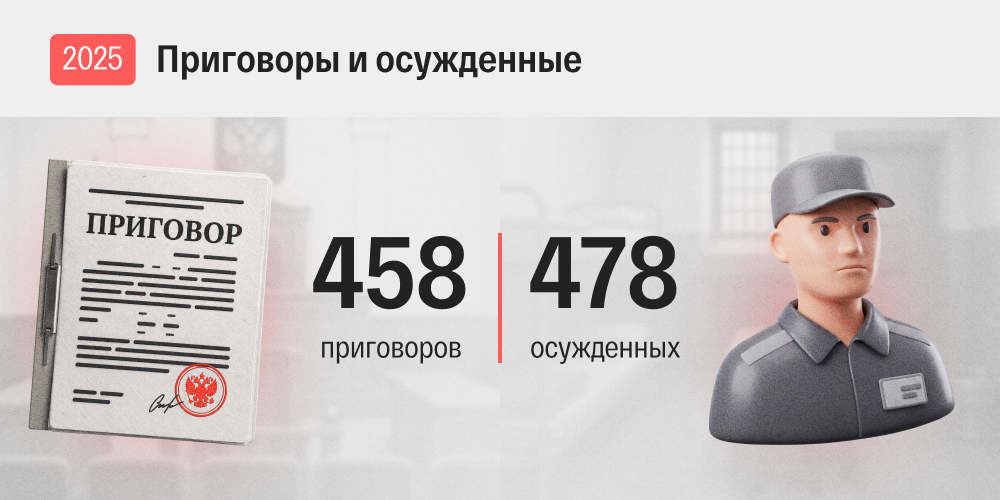
For comparison: in 2024, we found at least 385 people convicted under similar articles. Thus, in just one year, the scale of prosecution in this category of cases increased by 24%.
In total, in 2025, 378 convictions in cases of treason, espionage and related articles entered into legal force. Of these, 292 sentences were pronounced and entered into legal force during 2025, while another 86 were pronounced by the courts in 2024, but entered into legal force already in 2025.
- The courts applied compulsory medical measures against at least eight defendants (there were five in 2024). The identity of only one of them was confirmed - auto mechanic Evgeny Grigoriev .
- In two cases, the prosecution was terminated due to the death of the accused. One of the dead was Yekaterinburg resident Vasily Raskov , the identity of the second is unknown, but the decision to terminate the case was made by the Supreme Court of the Republic of Sakha (Yakutia) on March 5, 2025.
- In seven cases, the materials were returned to the investigative authorities or the prosecutor's office to eliminate violations.
It is noteworthy that in five of these seven cases, the courts directly noted: the plot of the case points to a more serious offense - full-fledged “treason” instead of the originally imputed article on “confidential cooperation with foreigners.” Returning the case to the prosecutor does not mean the end of the prosecution; As a rule, materials are returned to court with more severe charges.
This trend is confirmed by the number of appeals. In 2025, there were at least four cases of overturning of sentences on appeal, and none of them were associated with acquittal or mitigation of the fate of the convicted. The initiator of the review was always the prosecutor's office, which demanded that the qualifications be tightened from Article 275.1 to Article 275 of the Criminal Code of the Russian Federation.
An exception was the case of Sergei Silantiev , convicted on July 21, 2025 by the Central District Military Court. The court applied the law allowing a person to be released from serving a sentence due to a serious health condition, and the convict was released right in the courtroom. The verdict was not acquittal—the defendant’s criminal record remains intact.
This is the first such case in modern practice in this category of cases.
There have been no acquittals under articles of treason and espionage in Russia since 1999.
Increase in sentences throughout the year
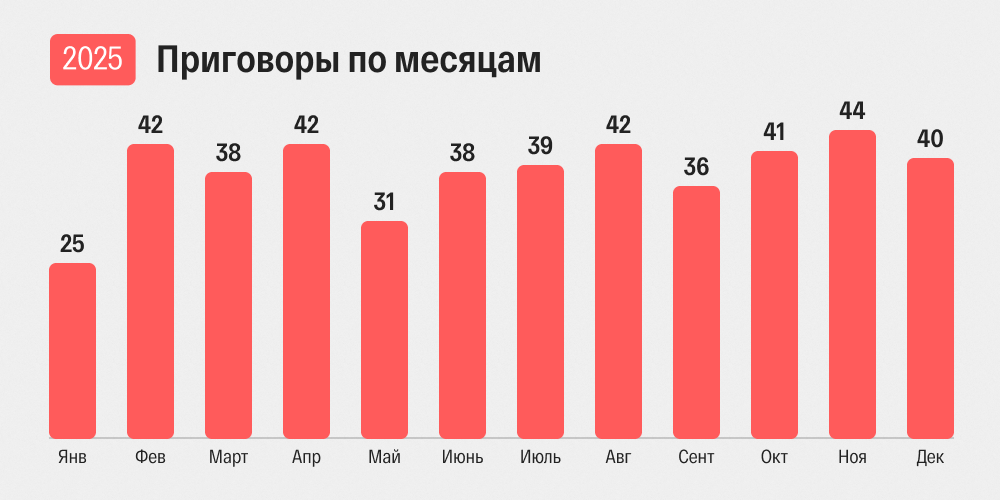
Every month the courts handed down from 25 to 44 sentences. Peak values were recorded in November (44 sentences), as well as in February, April and August (42 sentences each). The lowest intensity was observed in January (25 sentences) and May (31), which is solely due to the large number of non-working days due to the New Year and May holidays. These statistics prove the systemic, conveyor-belt nature of persecution.
If we look at the dynamics by quarter, during 2025 a consistent increase in the number of sentences was recorded:
- I quarter: 105 verdicts;
- II quarter: 111 verdicts;
- III quarter: 117 verdicts;
- IV quarter: 125 verdicts.
In the first half of 2025, the courts handed down 216 verdicts, while in the second - already 242. The number of cases and decisions on articles related to state security is growing not only from year to year, but throughout the year itself.
The role of military courts
The most important trend in 2025 was the sharp increase in the role of military courts: almost 40% of all sentences (178 decisions) were made by them. This is an absolute record in the entire history of observations - in 2024, the share of military vessels was about 30%.
This increase in indicators is associated with the practice of “doubling” charges: cases of treason and espionage began to be massively combined with cases of a terrorist nature - under Articles 205–205.5, as well as Article 361 of the Criminal Code of the Russian Federation (“Act of International Terrorism”). In 2025, at least 166 convicts were charged with this combined classification.
Terrorism cases are legally required to be tried exclusively in military courts.
At the end of the year, the overall distribution of sentences looks like this:
- Civil courts of general jurisdiction: 280 verdicts (61.1%);
- Military courts : 178 convictions (38.9%).
Trials of Ukrainian citizens
The full names of 140 Ukrainian citizens convicted in 2025 in cases related to state security have been identified. The names of another 24 people remain unknown. That is, during the reporting period, Russian courts handed down at least 164 sentences to Ukrainian citizens.
At the same time, the actual number of Ukrainian citizens among those convicted is probably significantly higher, since a significant part of such cases are considered by courts in the occupied territories under conditions of complete information blockade. In addition, lawyers from the First Department note that Ukrainians are often included in general statistics as Russian citizens due to forced passportization.
It is noteworthy that 72 Ukrainian citizens convicted in 2025 are listed as missing. Some of them were in this status even before the start of a full-scale war - in particular, one person has been missing since 2019, and another since 2021.
Distribution of charges according to articles of the Criminal Code
The most widespread of the articles related to state security remains Article 275 of the Criminal Code of the Russian Federation (“Treason”). In 2025, 376 people were convicted under it (78.7% of the total number of defendants).
Judicial practice shows that security forces began to perceive Article 275.1 (“Confidential cooperation with foreigners,” introduced in July 2022) as “too soft.” Cases related to it were regularly reclassified as full-fledged treason.
At the same time, the share of cases under Article 276 (Espionage) is falling - in 2025, 58 people (12.1%) were convicted under it. As noted above, this is directly related to the practice of forced passportization in the occupied territories of Ukraine. Ukrainians who have received Russian passports are no longer judged as foreigners (under the article “Espionage”), but as citizens of Russia - for treason.
During the year, 38 people (7.9%) were convicted under Article 275.1. Article 276.1 (“Providing assistance to the enemy”, introduced at the very end of 2024) has not yet become widespread - only one conviction was recorded under it (0.2%). Another five defendants (1.0%) went through the so-called mixed lineups.
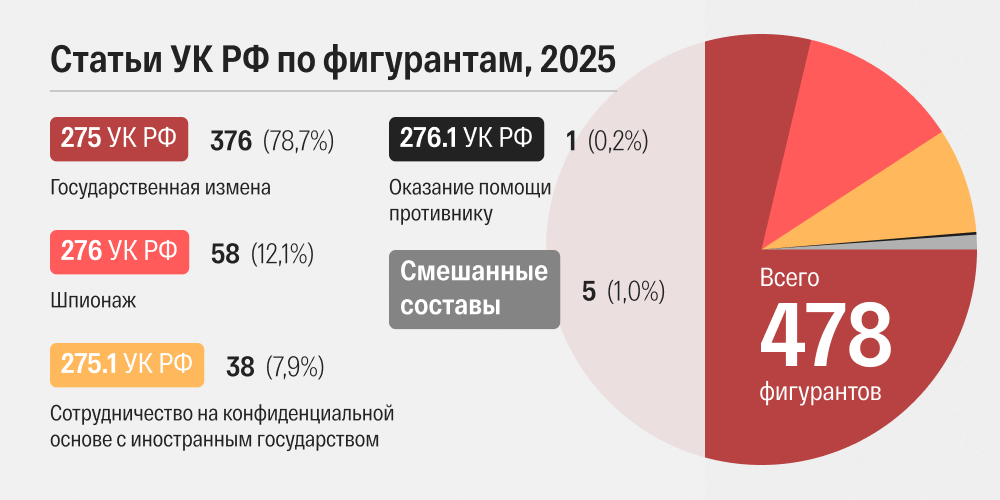
Within these mixed cases, researchers identified a legal paradox: in at least four cases, the defendants were simultaneously charged with Article 275 (“High Treason”) and Article 276 (“Espionage”). Legally, these articles are considered mutually exclusive, since the first applies only to citizens of the Russian Federation, and the second - exclusively to foreigners.
According to the lawyers of the First Department, this incident is connected with the fact that some foreigners were forcibly imposed Russian citizenship: accordingly, the “spy” squad is charged for an act committed before acquiring citizenship, and “treason” is charged for something committed after.
Geography of repression and “leader” courts
In 2025, the geography of sentences covered 64 of the 89 constituent entities of the Russian Federation (including the occupied Ukrainian regions). In 11 regions such decisions were made for the first time in the entire period of available observations. Thus, today there are only 13 regions left in Russia where not a single verdict in “spy” cases has been recorded.
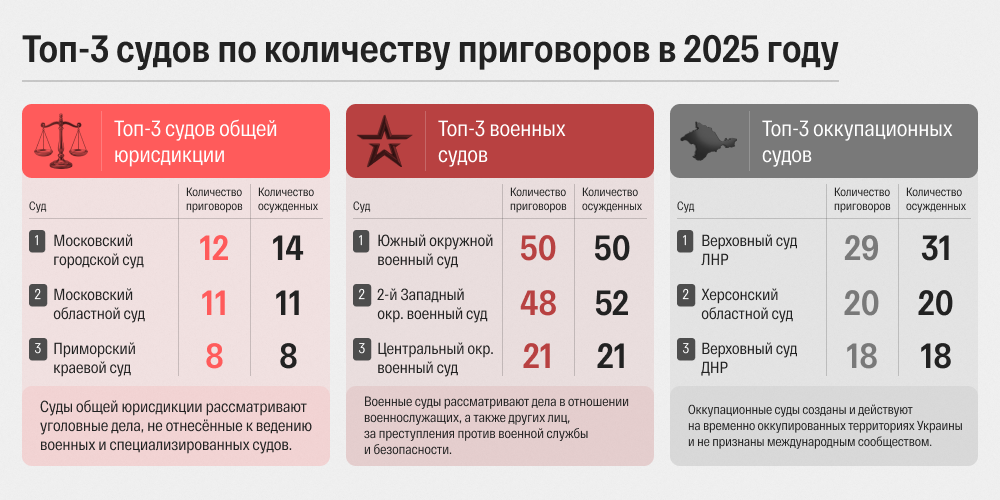
Almost half of all sentences in the country in 2025 occurred in eight courts:
- Southern District Military Court: 50 verdicts / 50 convictions.
- 2nd Western District Military Court: 48 sentences / 52 convictions.
- Supreme Court of the LPR (unrecognized): 29 verdicts / 31 convictions.
- Central District Military Court: 21 verdicts / 21 convictions.
- Kherson Regional Court (occupation): 20 verdicts / 20 convicted.
- Supreme Court of the DPR (unrecognized): 18 verdicts / 18 convictions.
- 2nd Eastern District Military Court: 17 sentences / 19 convictions.
- Zaporozhye regional court (occupation): 17 verdicts / 17 convicted.
Unprecedented data hiding
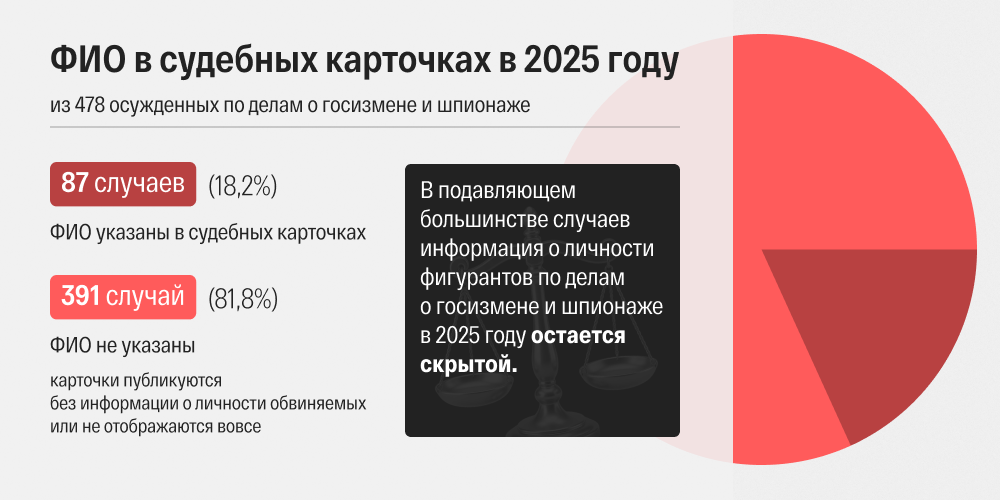
Despite the fact that during the year the courts pronounced sentences on 478 people, their names were almost completely erased from the official chronicle. Publicly, the names of the defendants were indicated only in 87 case files (18.2%). In the vast majority of cases—391 cards (81.8%)—anonymous data was published.
Moreover, Russian courts began to clear information retrospectively. Thus, in March 2026, the Southern District Military Court removed the names of the defendants from the previously published cards, including the data of Ukrainian prisoners of war.
Nevertheless, analysts were able to identify 383 people out of 478 (80.1%), establishing at least their full name, and in some cases, dates of birth and circumstances of persecution.
Demographic profile: more and more women and teenagers
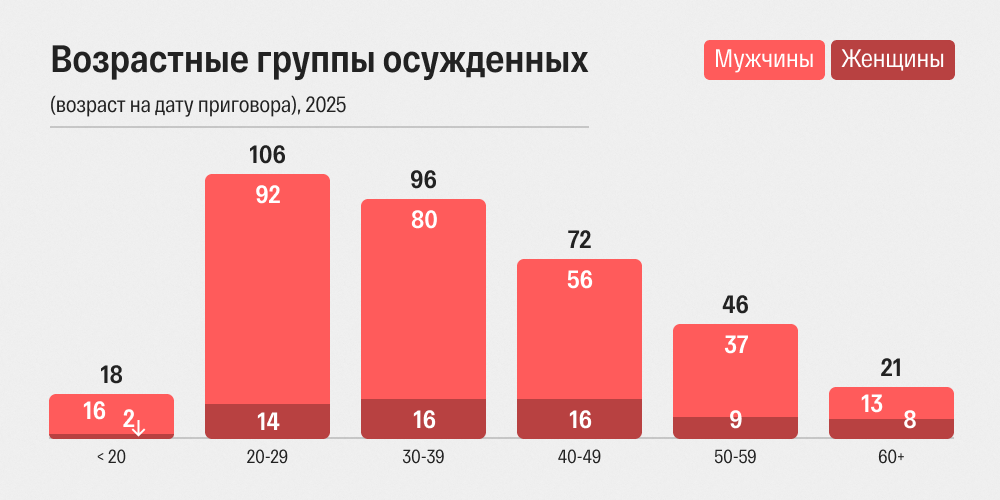
The median age of those convicted under the articles under study was 36 years.
- At least 18 sentences were imposed on defendants under 20 years of age. The youngest person convicted was 18-year-old Ukrainian citizen Yulia Sokolova (she was only 17 years old at the time of her arrest).
- Twenty-one of the convicts were 60 years or older at the time of sentencing. The oldest “state traitor” was 73-year-old Ukrainian citizen Alexander Markov - he died while being transferred to a colony after a court decision.
Among the identified persons involved, there were 315 men (82.2%) and 68 women (17.8%). The proportion of women convicted has more than doubled: in 2024, 30 such convictions were known.
Punishment terms: course to isolation
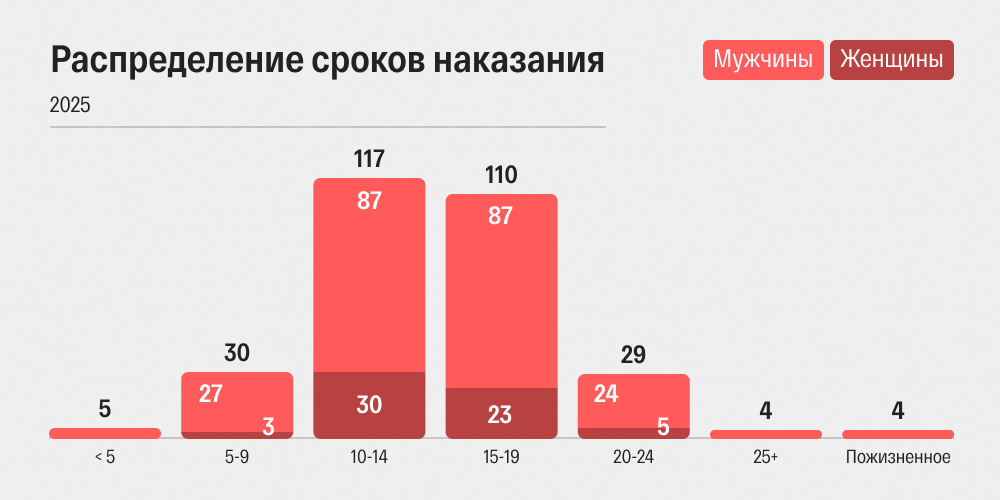
Information about the assigned sentences was obtained for 299 convicts, and these data record a sharp tightening of punitive practices:
- Under Article 275 (“High Treason”), the median was 15 years of imprisonment.
- Under Article 276 (Espionage), the median was 14 years of imprisonment.
- Under Article 275.1 (“Confidential cooperation with foreigners”), the median was five years in prison.
- The only known sentence for 2025 under the newly introduced article 276.1 (“Providing assistance to the enemy”) was 11 years in prison. It was proclaimed in relation to the driver from Moldova , Gheorghe Maroglo .
- At least four people were sentenced to life imprisonment - two under Article 275 (“Treason”): Yegor Semyonov and Mikhail Repin ; and two under Article 276 (“Espionage”): Nikolai Jos and Sergei Semenets
- The most severe sentence, not counting life sentences, was imposed on a citizen of Russia and Ukraine, a native of the village of Starolukyanovka in the Kherson region , Vyacheslav Popovich - 27 years old.
The legal punishment for treason is from 12 to 20 years in prison or life imprisonment. However, if a person is tried on several charges at once, the terms are partially or fully added up - in this case, the final punishment can be up to 25 years in prison. If one of the articles is “terrorist”, then the upper threshold increases to 30 years, and if a person has already been convicted and a new punishment is imposed under a terrorist article, the maximum sentence can be up to 35 years.
The punishment under the article on confidential cooperation with foreigners is much more lenient and ranges from three to eight years in prison.
Main conclusions
The collected data allows us to draw several key conclusions about the practice of applying articles on treason and espionage in Russia in 2025:
- An increase in the number of cases and tougher sentences. The prosecution of high treason and espionage in Russia has finally turned into a well-functioning conveyor belt. The number of people convicted under these articles increased by 25% over the year, repression became harsher, and average prison terms became longer.
- A set of compositions. More and more sentences are being pronounced on two or more charges at once - most often on charges related to public and state security.
- Total closedness of the judicial system. The main result of the year was the almost complete immersion of justice in secrecy. Courts purposefully and even retroactively hide information in order to make any external monitoring by human rights activists, independent observers and society impossible.