
Translated material
Well, what kind of “autocracy”? And what “nationality”?
They decided to establish a new ideology in Russia on three pillars of the old, still “Uvarov” ideology, which has already failed more than once

Monument to Count Uvarov. Photo: Fontanka
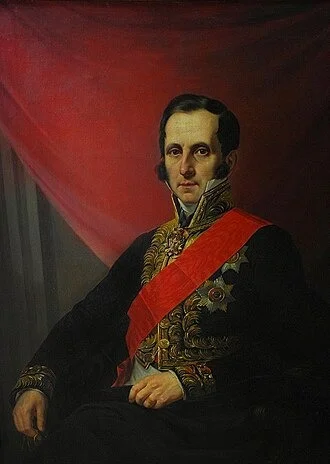
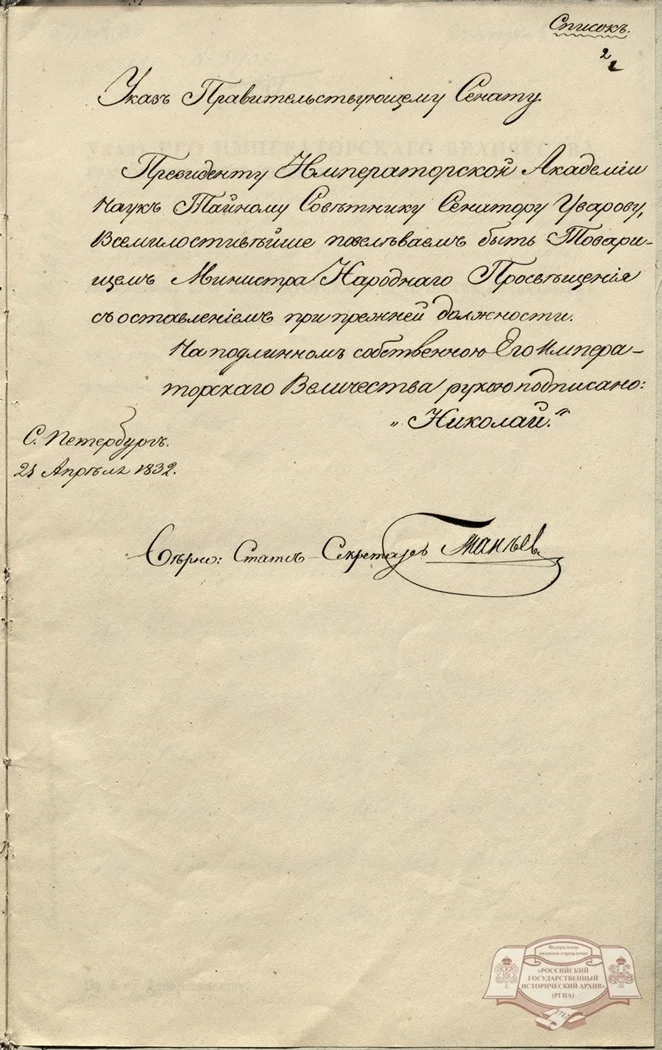
Still, in a difficult moment for the country, Sergei Semenovich Uvarov (not yet a count or even a minister of education, but just his “comrade,” his deputy, that is), gave birth to this formula in what was perhaps his first official report in his new position: “Orthodoxy, autocracy, nationality.”
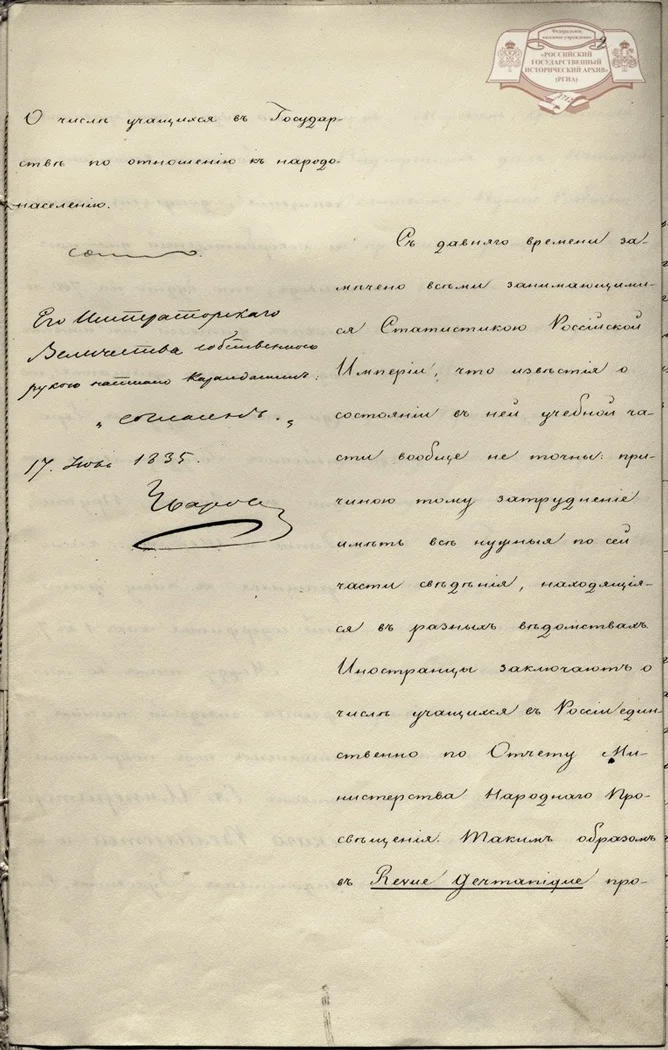
In 1832, Uvarov went on a business trip to inspect provincial universities and other educational institutions and to find out how the new educational charter of 1828 was being implemented and what further transformations were desirable in the field of public education. It was in the report on this business trip sent to the emperor that the famous “Uvarov triad” first appeared.
“Asserting that, in a general sense, the spirit and disposition of the minds of young people await only a deliberate direction in order to form in a greater number of these useful and zealous instruments of government, that this spirit is ready to accept the impression of loyal love for the existing order, I do not want to absolutely assert that it will be easy to keep them in this desired balance between the concepts that are tempting for the minds of immature and, unfortunately, Europe, who have taken possession of it, and those solid the principles on which not only the present, but also the future well-being of the fatherland is based; I don’t even think that the government has every right to judge too harshly the mistakes made, perhaps, on the part of those who were once entrusted with the supervision of this institution (Moscow University), but I firmly hope that we have the means not to repeat these mistakes and gradually, having captured the minds of youth, bring them almost insensitively to the point where they should merge, to the solution of one of the most difficult problems of the time, education is correct, thorough, necessary in our century, with deep conviction and warm faith in the truly Russian protective principles of Orthodoxy, autocracy and nationality, which constitute the last anchor of our salvation and the surest guarantee of the strength and greatness of our fatherland.”
In this verbose and eloquent text, the three unfortunate words were by no means lost, but became a formula, a spell for the Russian authorities, like “Mom washed the frame” from the “Primer” for first-graders of my generation.
Why did mom wash this frame? What is soap, after all? And most importantly: did you wash it?
“The name of the Emperor is constantly on his lips”
Andrey Borisovich Zubov* - Doctor of Historical Sciences, professor, one of the most highly educated people I know. From 1994 to 2012 - Head of the Department of Religious Studies of the Philosophical and Theological Faculty of the Russian Orthodox Institute of St. John the Theologian. Since 2001, he has been a professor at the Department of Philosophy at MGIMO, as well as the general director of the university Center for Church and International Relations. One of the authors of “Fundamentals of the Social Concept of the Russian Orthodox Church.”
On June 29, 2009, by order of Patriarch Kirill, he was included in the editorial council and editorial board for writing a textbook and teaching materials for the educational course “ Fundamentals of Orthodox Culture ” for high school.
In the 2000s, he became the executive editor of the book “History of Russia. XX century". The team of authors united more than 45 authors from Russia, Russian diaspora and Western Russian scholars (for example, Vittorio Strada, Richard Pipes). The project was initially created under the leadership of Solzhenitsyn, and Alexander Isaevich read and edited most of the manuscript (until about 1956), but “then Solzhenitsyn distanced himself from it.” The book was published in two volumes in 2009.
In March 2012, Zubov spoke to the press in connection with the Pussy Riot case **. In his opinion, the punishment for the group members was inappropriately harsh, and even in the Russian Empire such actions were treated more leniently.
In March 2014, he was fired from MGIMO for criticizing the actions of the Russian government in Ukraine and Crimea (an article published in Vedomosti) - with the wording “for an immoral act.” However, the Commission of the Presidential Council for Labor Rights declared the dismissal illegal, and the decision to dismiss was canceled on April 11. Dismissed from the university on June 30, 2014 after the expiration of the next two-year contract.
In the fall of 2022, he accepted an invitation to teach at Masaryk University in Brno (Czech Republic) and left Russia. On February 17, 2023, the Ministry of Justice of the Russian Federation included it in the register of “foreign agents”.
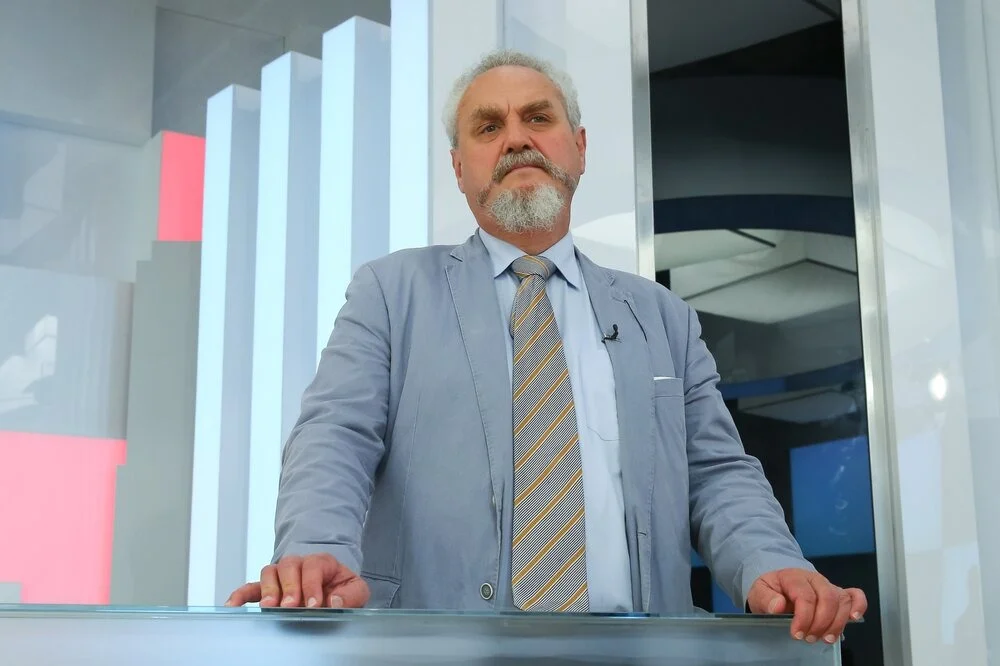
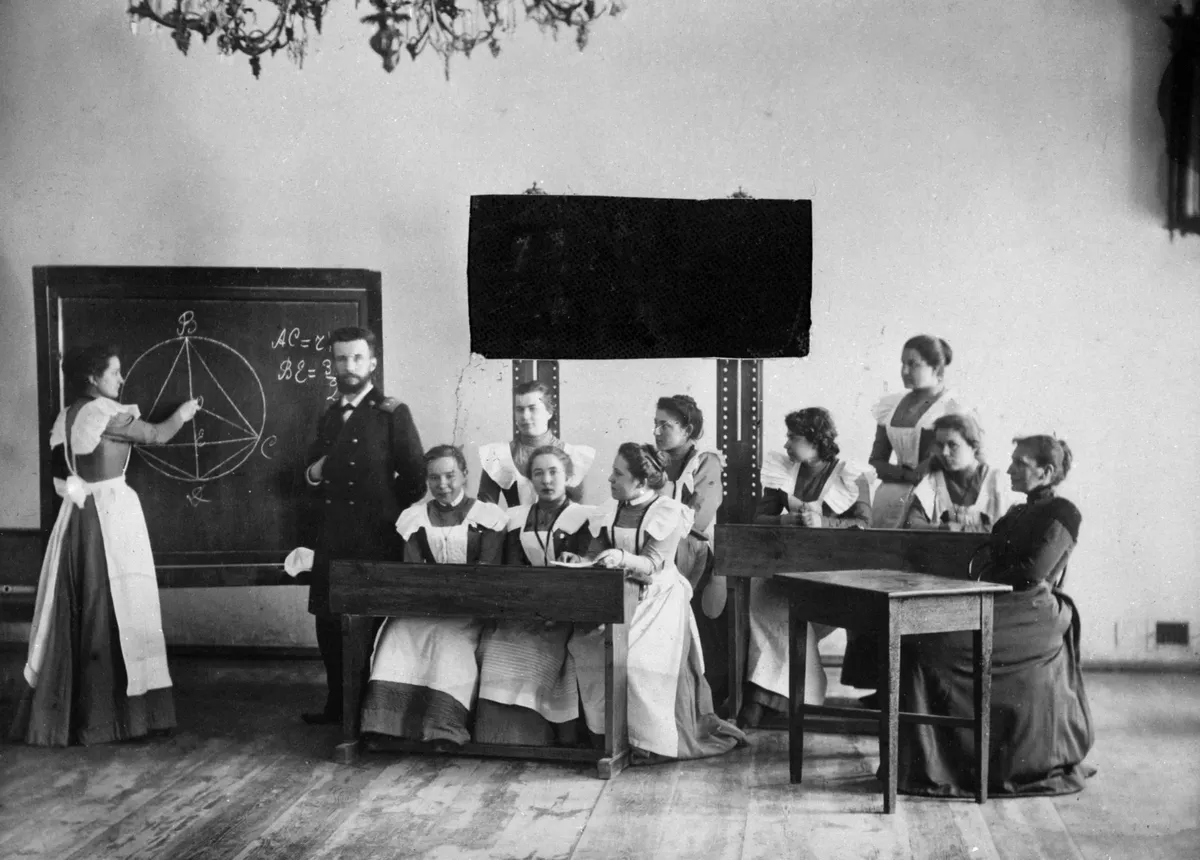
Andrei Borisovich sympathizes with Uvarov and interprets his legacy as flatteringly as possible. Uvarov, Zubov believes, was a very good Minister of Education and President of the Academy of Sciences. It was with his active support that the famous Pulkovo Observatory was opened, the staff and funds of the Academy of Sciences were increased, a number of general and special educational institutions were founded, including the famous Lazarev Institute in Moscow - a center of oriental education. The number of gymnasiums during the years of his management of the ministry increased from 48 to 64. And if at the beginning of his reign 7 thousand people were studying in gymnasiums at the same time, then in 1850 - 18 thousand.
From his early years, inspired by European examples, Uvarov, in the best company of that time, created the “Arzamas Society of Unknown People.” So that young ladies and young people learn to speak a natural language, and not a common one, but a cultural one, such as the languages of the peoples of Western Europe were - German, French, English.
It is enough to list these people to understand: the creators of society were by no means “obscure people.” Nikolai Mikhailovich Karamzin, Vasily Andreevich Zhukovsky, young Pushkin, Konstantin Nikolaevich Batyushkov, Sergei Semenovich Uvarov, Dmitry Nikolaevich Bludov, Dmitry Vasilyevich Dashkov, brothers Alexander and Nikolai Ivanovich Turgenev, General Mikhail Fedorovich Orlov, Pyotr Andreevich Vyazemsky.
“During the reign of Nicholas, the people of Arzamas worked not for him, and not for a career, leases, titles and orders, but for that future Russia, which Tsar Alexander dreamed of and which he bequeathed to his brother Nicholas to build. All of them, these former Arzamas residents, were smart and experienced, did not contradict the Emperor, but at the same time pursued their own line. And, we must pay tribute, Nikolai Pavlovich knew how to appreciate this devotion to the fatherland, this high selflessness of service. Let us remember the people of Arzamas who became statesmen during the reign of Nikolai Pavlovich,” writes Andrei Borisovich Zubov, unwittingly confirming, unfortunately, the indisputable truth: the same words spoken by different people lead to sadly different results.
Zubov is convinced that it was not Uvarov who proposed and implemented prohibitions and restrictions (with which Nicholas’s reign was filled).
“On the contrary, he resisted them to the best of his character and temperament, sometimes very effectively and skillfully. And even Benckendorff in 1839, in the report of the III Department, reported to the Emperor:
“No minister acts as autocratically as Uvarov. The name of the Sovereign is constantly on his lips, and yet with his ministerial instructions he weakened the power of many laws approved by the Supreme Authority. The censorship regulations have been completely changed by the regulations...”
Well, Benckendorff treated Uvarov jealously, biasedly and not always, it seems to me, fairly.
But not only Benckendorff - a former comrade in Arzamas, Pushkin, towards the end of his life, became an enemy of Uvarov, suffered from his unfair censorship and wrote murderous epigrams against him. I am not inclined to consider this a decisive argument in assessing the minister; Pushkin used to give free rein to his stormy temperament (let’s take his relationship with General Vorontsov, one of the best people of the era, in my opinion), but it’s still worth keeping in mind the point of view of the great poet.
And it is worth recalling the opinion of Uvarov himself, who instructed his censor to severely reprimand Kraevsky, who dared to publish an “inappropriate” obituary for the poet (“The sun of Russian poetry has set... Pushkin died, died in the prime of his life, in the middle of his great career...”). “Writing poetry is not going through a great race. So Count Sergei Semenych, Minister of Education, deigned to remark.”
Whatever you want, this alone gives, it seems to me, a better idea of Uvarov’s ideas about what the Russian people need and don’t need.
Zubov admits: Uvarov was a “not very brave” man, Nikolai terrified him, he was shaking with fever every time he had to report to the Tsar. Uvarov himself admitted to Professor Timofey Granovsky that “while managing the ministry, he was in the position of a man who, running away from a wild beast, throws to him one after another all the pieces of his clothing in order to occupy him with something, and is glad that he himself, at least, remained intact.”
“Intact” Uvarov remained. But he was bitten.
And I myself (don’t forget!) wrote that first report about “loyal love for the existing order” and about the need to “form more useful and zealous government instruments.” The fact of the matter is that he considered educating the people as the only way to achieve this goal.
And the monarch’s demands became more and more severe. After the relatively free 1830s, the pressure on education intensified in the 1840s. In 1844, statistics was eliminated from the courses at gymnasiums and universities - a discipline that gave an idea of the real state of Russian society, the trends in its development, which made it possible to compare it with other countries and peoples. Many statistics were classified, others were kept for official use only. Alas, this is the disease of all authoritarian regimes.
In 1847, separate teaching of logic was prohibited. “In 1848, the Emperor prohibited free travel abroad without the personal permission of the Emperor, all professorial internships were canceled, and the fee for a foreign passport became so high that only very rich people could afford trips even with the highest permission - an eternal attempt, in eras of setbacks and degradation, to separate Russia from Europe, unfortunately, more and more familiar to us today.”
In May 1849, a new blow followed: the Emperor introduced a quota for studying at universities of three hundred people each, whereas before that up to a thousand students studied at the same time at Moscow University, seven hundred at St. Petersburg University, and six hundred at Dorpat University.
For Uvarov, this quota of three hundred people was the last straw. He tried to cause public outrage by inspiring an article against reducing the number of students at universities, but public opinion remained silent, and the Emperor became furious: “You must obey, and keep your thoughts to yourself,” Nikolai Pavlovich rudely announced to Uvarov. And in October 1849, Uvarov was dismissed.
Professor Zubov believes that Uvarov invested in each of the words of his “triad” some kind of “special” meaning that was useful for Russia. But for some reason the slogan was immediately picked up and invariably remains on the banner of the most reactionary, vile forces that existed in the country, pulling it back.
Meanwhile, Uvarov sincerely said (to Professor Alexander Vasilyevich Nikitenko, the author of a wonderful diary) that he would like to delay the development of Russia for fifty years. First, he said, the development of a deep and correct education of the people under the control of absolute power - then reforms of social and political life.
Well, Uvarov achieved his goal: he delayed the development of Russia for fifty (but only fifty?) years.
Maybe irrevocably?
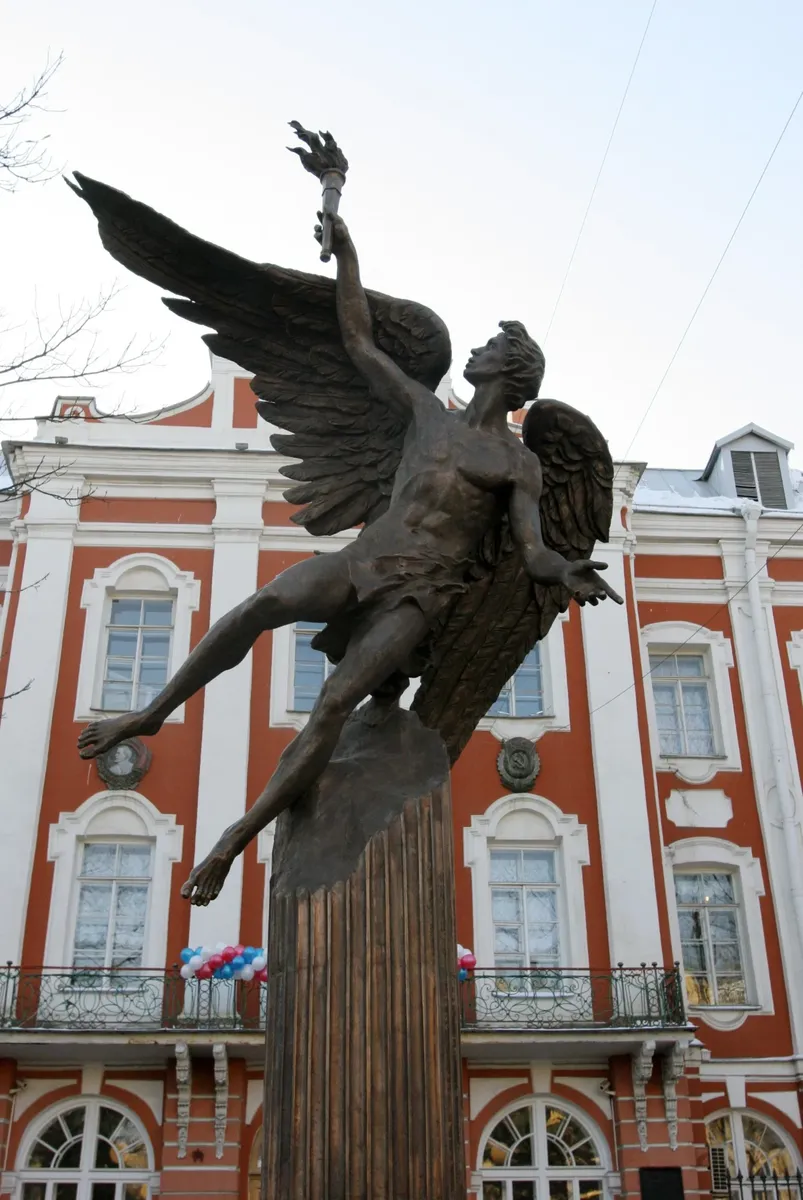
What was wrong with the “Winged Genius”?
On November 24, 2023, Presidential Assistant Medinsky and Education Minister Kravtsov unveiled a monument to Count Uvarov. He is now called the “founder of the university,” although under Uvarov only the renaming of the pedagogical institute took place, while the founder was and remains Emperor Peter I. I add this solely from the same sense of justice.
At the main entrance to St. Petersburg University, by that time, for 15 years there had already been a monument to the “Winged Genius” - dedicated to university students. Already in August, the pedestal was covered with black polyethylene, and after dismantling the “universitet” was “pushed into the bushes.” The committee for the protection of monuments to the deputy of the St. Petersburg Legislative Assembly Boris Vishnevsky* then reported that the monument was “moved by its copyright holder.”
Formally, the author of “Genius,” sculptor Mikhail Belov, told Fontanka, the monument is not the property of the university. “In 2007, when we installed it, the rector was Lyudmila Verbitskaya. The city refused to take the sculpture, Verbitskaya was going to put it on the balance sheet of the university, but didn’t have time - the rector changed, and then everyone forgot about it. And so our Genius found himself between heaven and earth,” says Belov. He recalls that at first the Genius held a laurel wreath in his hands, but during installation it turned out that it was very easy to reach if you climbed onto the pedestal and hung, so already in the process it was decided to replace the wreath with a torch. “I still have the bronze hand with a wreath in my studio. The sculpture itself is all made of bronze - it probably took about a ton. Expensive".
And the “university student” was sent to the courtyard of the university, where there are already two dozen various sculptures and monuments - from Ho Chi Minh and Vladimir Nabokov to the Experimental Cat and Second Lieutenant Kizhe; The “winged genius” is now in this glorious company.
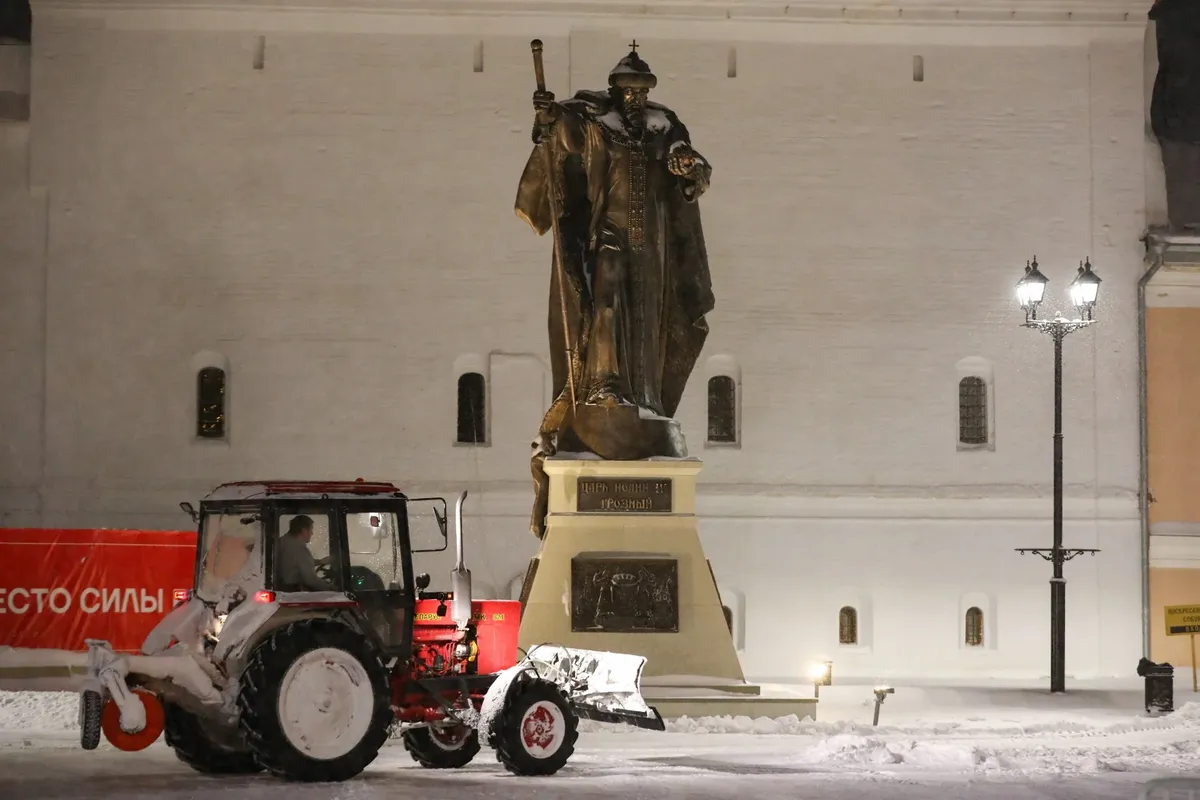
In general, the monument to Uvarov, suddenly erected with the diligence of the Russian Military Historical Society (RVIO), is completely standard, reminiscent of typical grave statues. Like, for example, the monuments of the Novodevichy cemetery in Moscow - to Alexander Lebed, Fyodor Chaliapin, Anatoly Ivanov.
The pedestal, experts write, is richly and too excessively decorated with bronze plaques with texts and bas-reliefs. Here is an excerpt from the decree of Peter I on the creation of the Academy and University in 1724 (which is fully consistent with historical truth). And waiting in the wings, there was information that it was Count Uvarov who initiated the “recreation” of St. Petersburg University. And His Excellency’s message to future generations (it turns out there was one too?).
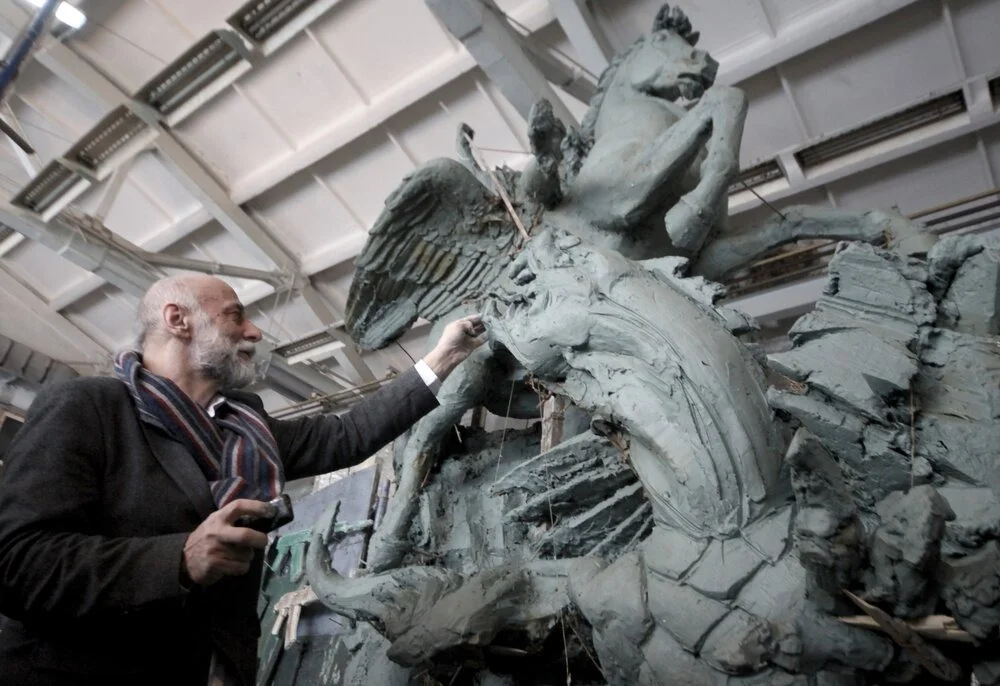
However, this is the style of the incredibly prolific sculptor Salavat Shcherbakov: the person involved in the monument must necessarily hold something in his hands, and there must be “written evidence” of his activity nearby. Small arms designer Kalashnikov, for example, is holding (quite predictably) a machine gun. Princess Louise of Baden - book. Engineer Franz Anton von Gerstner, builder of the first Russian railway, is a model of the English steam locomotive “Agile”, one of two purchased for this very railway...
Wikipedia lists a disconcertingly large number of master Shcherbakov’s creations. Perhaps even more than the late Tsereteli. The collaboration between the sculptor and RVIO is striking.
It’s funny that a typo was discovered on the monument to Uvarov just before its opening. The text of the Decree of Emperor Peter the Great dated January 28, 1724 stated:
“The university is a collection of learned people who teach high sciences, such as theology and jurisprudence, medicine and philosophy, that is, to what state they have now reached, to young people.”
Instead of “now reached” the inscription was sculpted as “did not reach”. The error was quickly corrected, but it doesn’t look very good.
What can we do, they were in a great hurry to erect the monument somewhere. But the same sculptor gave Kalashnikov a slab with a diagram of an assault rifle by the German Schmeisser, from whom the self-taught Soviet designer, according to spiteful critics, borrowed his machine gun.
At the monument “Farewell of a Slav” near the Belorussky railway station, a militia leaving for the front is armed with a German Mauser rifle. Two bas-reliefs of the monument-stele “City of Military Glory” in Tuapse depict a Pe-8 aircraft, which was not used during the Tuapse defensive operation, and an image of the construction of the Agoy airfield from concrete slabs. In fact, the airfield was unpaved...
The head of the Military Historical Society, Professor Medinsky, is an active advocate of the study of myths as the most important component of true history. So these mistakes don't count.
“It is difficult to find words to describe this wickedness.”
The first proposals to canonize Ivan the Terrible came from Metropolitan of St. Petersburg and Ladoga Ioann (Snychev). In his essay “Autocracy of the Spirit,” which was published back in 1995, he says that Ivan the Terrible was the ideal monarch, and recalls all (no, not “all,” unfortunately) of his merits. But, according to historians, it was Ivan’s reign that led Russia to defeats in endless wars, to the Time of Troubles, and the unprecedented ruin of the country...
As for the huge list of the tsar’s personal sins (from the murders of Metropolitan Philip of Moscow and his son to the approval of the most sophisticated torture), the Metropolitan resolutely rejects this information, saying that it is the machinations of the West. Allegedly, all data about the autocrat’s cruelty is nothing more than an “anti-Russian myth.”
Here, as you can see, the attitude towards myths is much more strict than that of Doctor of Historical Sciences Medinsky.
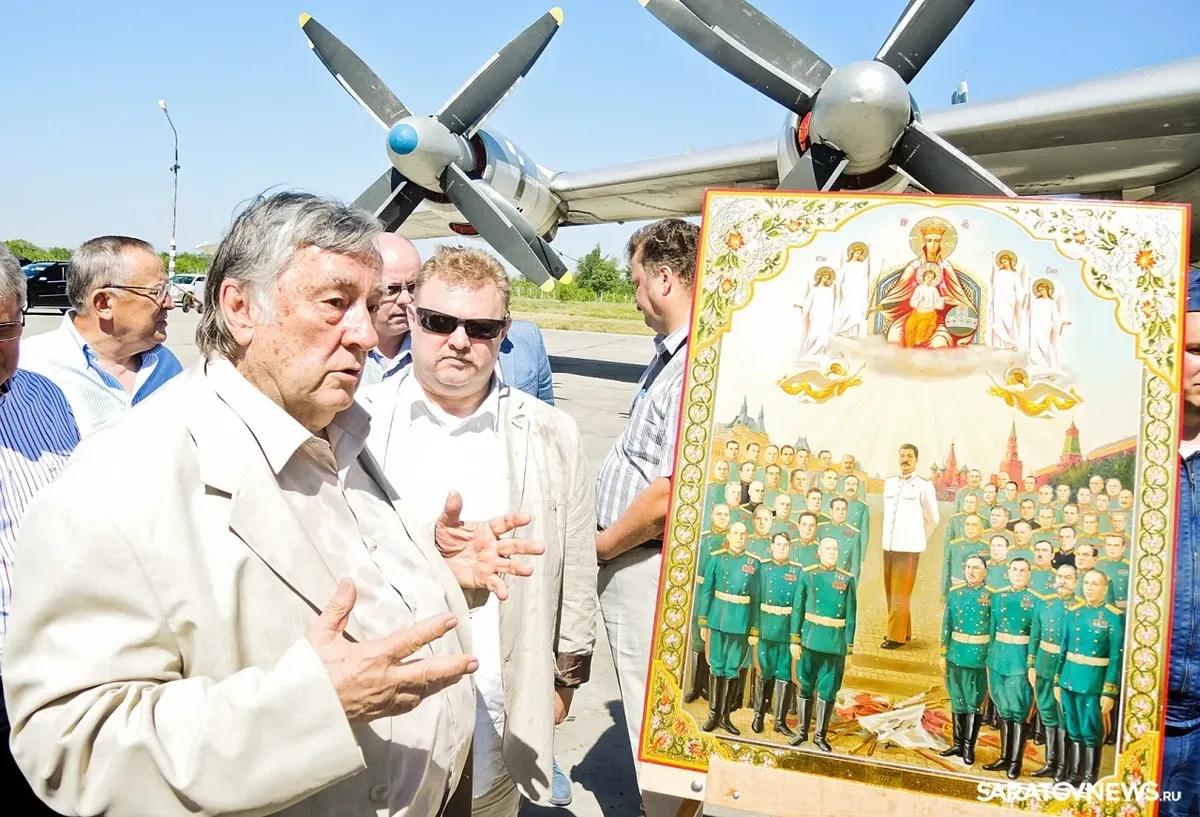
On June 16, 2015, a delegation of the Izborsk Club, led by its leader Alexander Prokhanov, brought a painting to the Engels air base in the Saratov region, which they called the “Our Lady of Sovereign” icon. It depicts Generalissimo Joseph Stalin surrounded by Soviet marshals and Orthodox symbols. She was solemnly greeted by the owners, and the local priest “consecrated” the icon.
Then the most prominent church figures tried to distance themselves from the action as much as possible. The Saratov Metropolis even published a special explanation on its website, in which it explained the consecration of the “icon” with Stalin as a provocation by Prokhanov and the “blatant incompetence” of the priest.
“The canonization of the persecutor of the Church and the organizer of bloody mass repressions is impossible and this very idea is absurd. Attempts to rehabilitate Stalinism undertaken by A.A. Prokhanov and members of the Izborsk Club, are based on a gross distortion of religious and patriotic feelings,” concluded the Saratov Metropolis.
“The proposal to canonize Stalin can be regarded as a manifestation of canonical ignorance and historical cynicism,” Archpriest Georgy Mitrofanov, a member of the Synodal Commission for the Canonization of Saints , a professor at St. Petersburg Theological Schools, characterized these attempts in an interview with the Orthodox website “Living Water.”
“When I was young, I had a party leader I knew who in those early years said that “The Church will someday canonize Lenin.” I thought it was a bad joke, but now it turns out that someone is seriously discussing whether Stalin can be on the icon? They say that someone even paints false icons of Hitler and Lenin that look like Christ, false icons of Stalin with pictures that look like hagiographic stamps.
I find it difficult to find words to describe this wickedness. This is all a very big and completely clear blasphemy! In general, as for Prokhanov, judging by his various statements, he apparently recognizes some invisible force and is interested in mysticism, which he tries to somehow use, but Prokhanov’s mysticism has nothing to do with Christianity.
In the novel by Vladimir Sorokin* “The Sugar Kremlin,” the writer Prokhanov is depicted in the image of “Porkhanovna, the famous Moscow clique.”
“But here you can calm down: the self-sanctified Prokhanov with his small-town sect and invented religion under the slogan “Tyranny for the sake of power” will not last long without the support of the authorities and without exalting it into a state ideology, and will not gather many adherents. I think the head of state will have enough prudence to prevent this. The elder will be honored and allowed to continue on his flight of uncontrollable thought.” Vadim Rogozhin wrote this on his website “The Fourth Estate” in 2015. In the same year, Prokhanov was awarded the title of Hero of Labor by presidential decree. In 2023, the Russian Orthodox Church awarded him the Order of the Holy Blessed Grand Duke Alexander Nevsky, 1st degree.
“We need to remember our roots, exploits and heroes”
Another monument to an outstanding figure of Russia was erected in Kaliningrad. This time - to the executioner and punisher, to whom in history the title “Ant the Hangman” was assigned.
“A wonderful and practical example of how to act in difficult circumstances and achieve results. We need to remember our roots, the exploits and heroes that make up the glory of our people,” the then governor Alikhanov said about Muravyov, opening the monument.
“Perpetuating his [Muravyov’s] memory is the restoration of historical and human justice, an excellent example of caring for the national historical and cultural heritage. I would like to thank the government of the Kaliningrad region and the Russian Military Historical Society for the great work done, thanks to which the implementation of this initiative became possible,” the chairman of the Russian Military Historical Society Medinsky praised himself in a letter announced at the opening of the monument.
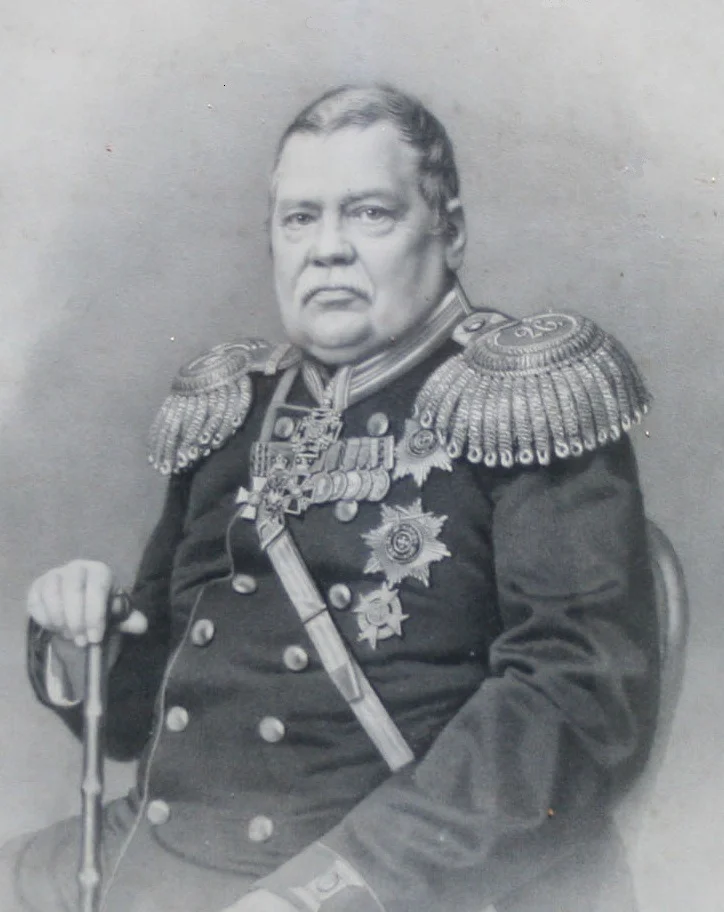
Apparently Mr. Medinsky does not know that on Muravyov’s initiative, bans were issued on periodicals and theatrical performances in Polish, in general on the use of the Polish language in public places, as well as bans on public service for persons of the Catholic faith. By July 1864, 177 Catholic priests were expelled from the region, and all expenses for the maintenance of arrested and exiled priests were borne by the Catholic Church. Seven priests were shot...
In total, 128 people were executed in the region (under Muravyov): “for betrayal of duty and oath by escaping from the troops and joining rebel gangs” - 24; “for participation in the rebellion and committing in it: robberies - 3; homicides - 47; especially active participation in the rebellion and long-term presence in rebel gangs - 6; for leading rebel gangs - 24; публичное чтение и распространение возмутительных манифестов и подговор жителей к восстанию — 7…»
Польское восстание, для усмирения которого Муравьев был назначен 1 мая 1863 года полновластным диктатором Польши, вызвало в русском обществе большой прилив националистических чувств. Неприязнь к европейским державам, утвердившаяся в тогдашних обывательских, чиновничьих и военных кругах, усилила так называемую ультрарусскую партию московско-славянофильского толка, куда входили такие люди, как митрополит Филарет, Погодин, Тютчев, Леонтьев, Катков.
Эта партия сплотилась вокруг Муравьева.
Скоро он почувствовал себя любимцем России, популярнейшим человеком в империи. «Внимание и сочувствие России — лучшая для меня награда», — неизменно отвечал он на приветствия.
В придворных и чиновных кругах Муравьева ненавидели издавна, и раньше всех Александр II, который, как ни старался, не мог подавить в себе чисто физическое отвращение к нему. Ближайшие друзья Александра II поддерживали в нем это чувство… Самым ярым врагом Муравьева был давнишний приятель царя, князь Суворов, внук фельдмаршала, петербургский генерал-губернатор, который сделал своей специальностью ругать этого изверга на всех перекрестках:
— Если меня и его пошлют на тот свет в рай, я попрошусь в ад, лишь бы не быть с Муравьевым.
…И тут прозвучал каракозовский выстрел в царя.
На Муравьева сваливается небывалое счастье, такое, о котором он не смел и мечтать, ему снова дают огромную власть над его давнишним врагом, над ненавистным ему Петербургом. Его снова призвали к любимой кровавой работе — усмирять уже не польский, а всероссийский мятеж. Теперь сам царь будет выполнять его волю!
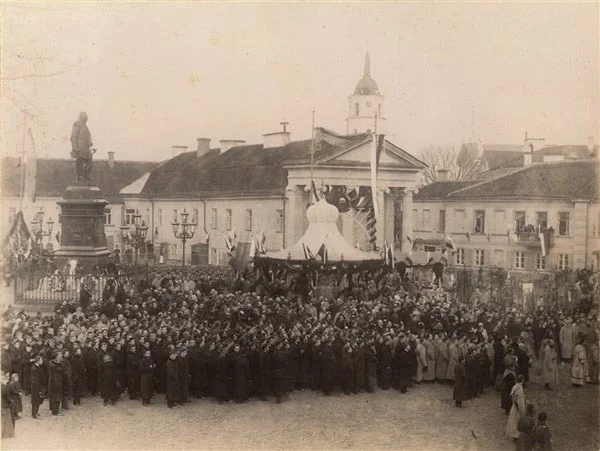
Чуковский пишет: «Города, народности, сословия стали состязаться между собою в выражении патриотических чувств. Армяне, писаря, ямщики, интенданты, евреи, староверы, московские греки, торговцы Мариинского рынка, артисты балета, Финляндский Сенат, Калашниковская биржа, Академия наук, татары, фармацевты, арестанты, студенты Моисеева закона, жители Киева, Одессы, Варшавы, Выборга, Вытегры, Охты, Нарехты, Лахты, жители Ялты, Балты, Омска, Томска и каких-то Шарлатун, и какой-то Вечуги засыпали весь Зимний дворец телеграммами, словно по чьему-то приказу. Даже рабочие, даже студенты спешили заявить свою радость. Тысяча сестрорецких рабочих устроила манифестацию в честь царя. Пятьсот рабочих с фабрики Шиловых прислали царю телеграмму, выражая благодарность вседержителю за спасение жизни венценосца».
Всякий не кричавший «ура!» считался чуть не государственным преступником, поляком, сообщником той «шайки подпольных злодеев, которые в безумном ослеплении посягнули на священную особу царя».
Вообще, по мере того как патриотизм одних принимал все более мстительный и наглый характер, патриотизм других становился робким и заискивающим.
Всеобщий испуг дошел до невероятных размеров, когда стало известно, что во главе следственной комиссии поставлен самый страшный в России человек — Муравьев. Ждали каких-то фантастических, неслыханных, еще небывалых кар. Каждому либералу казалось, что на него уже накинута муравьевская петля».
***
Православие. Autocracy. Народность.
Все три составляющие «уваровской триады» многократно дискредитированы — сначала «общим ходом вещей» до революции 1917-го, и уже целенаправленно (хоть часто и лицемерно) после нее. Какое «православие» в многоконфессиональной стране? Какое «самодержавие» — при последовательно проваливавшихся (всех!) руководителях державы? Какая «народность» — даже произносить такое слово смешно, если вспомнить, что с народами делали все эти десятилетия?
Надо признать, что при всем своем ославленном малодушии автор «триады» все-таки сделал то, чего не сделали люди более смелые и говорившие куда более решительно (те же декабристы): он завещал дать вольную всем своим дворовым крепостным. А граф к концу жизни был одним из самых богатых землевладельцев России, и в шести его имениях трудилось более четырнадцати тысяч крестьян.
Уваров, полиглот, владелец одной из крупнейших частных библиотек Европы (70 тысяч томов), искренне считал, что само по себе образование, просвещение — решат все возникающие вопросы. А они — не решили и решить не могли. Задача образования — готовить из молодых людей «полезных и усердных орудий правительства», думал Уваров. Но подготовка эта ведется плохо, и потому плохо, что «в нашем веке» необходимо основательное образование, а оно не дается как следует.
История России многократно доказала, насколько велик вред, когда эта подготовка ведется «хорошо».
Уваров был убежденным противником принципа, сформулированного британским либералом Уильямом Эвартом Гладстоном, — «Свободе может научить только свобода». В своей речи в Педагогическом институте 22 марта 1818 года Уваров утверждал: «Освобождение души через просвещение должно предшествовать освобождению тела через законодательство». Это убеждение он сохранил до конца своей жизни.
Но ошибся и здесь. И в памяти России так и остался одним из главных реакционеров.