
Translated material
"A long saga with many heroes." How is the trial of the “organizers” of protests in Baymak going?
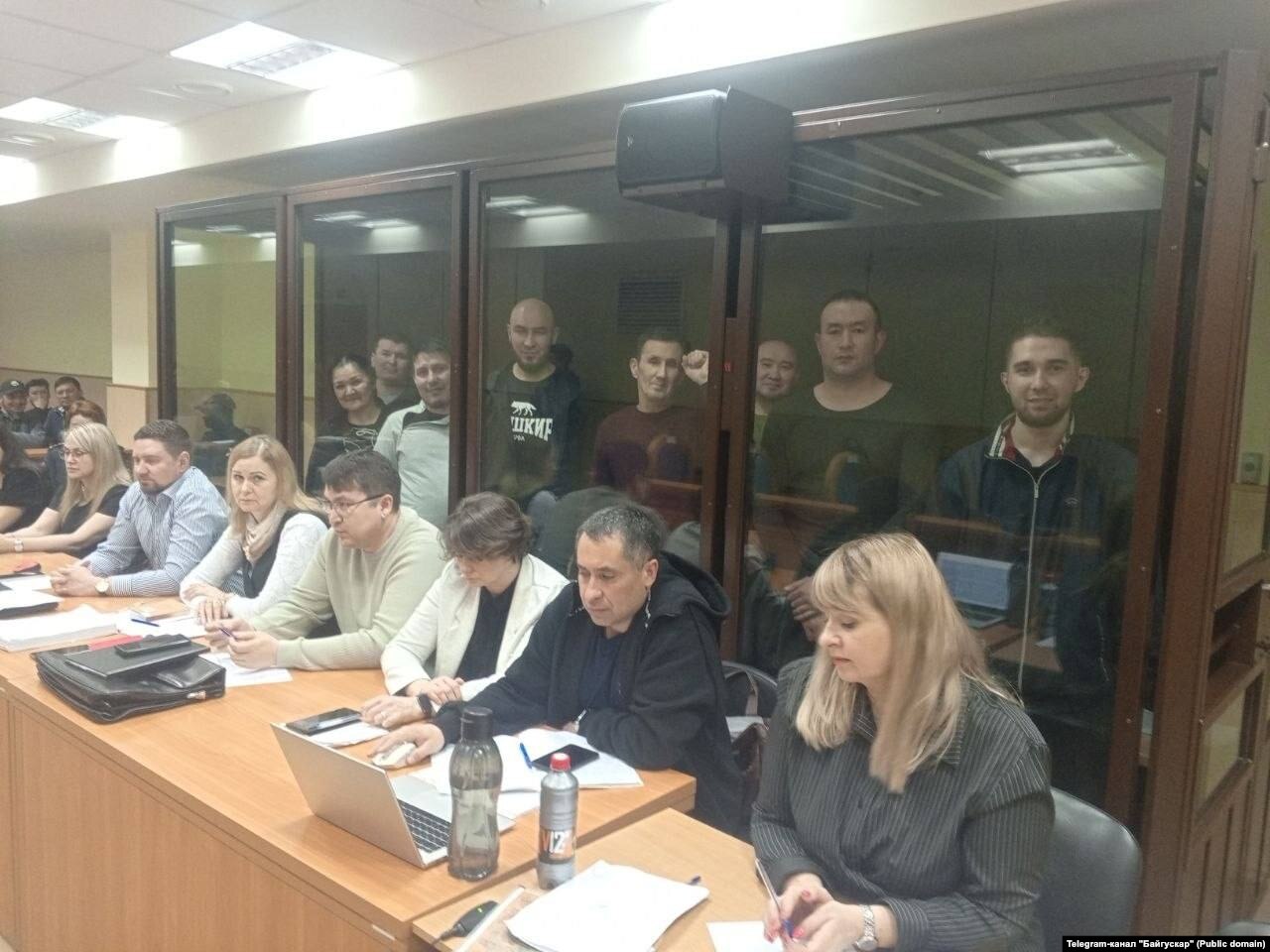
Since August 2025, the Orenburg Regional Court has been holding a trial of ten Bashkortostan residents accused of “organizing mass riots” in Baymak in January 2024. Six of them were also charged with “using violence against a government official.” According to Idel.Realii, interrogations of the accused have finished in court, and arguments between the parties should begin soon. Editorial sources familiar with the course of the trial report that all the defendants categorically deny guilt in “organizing” the Baymak events. A verdict is not expected until September.
"The riots were provoked by the security forces themselves."
The trial of the so-called “organizers of mass riots” in Baymak - Yulay Ayupov , Ilyas Bayguskarov , Artur Mukhametov , Akhmet Yakupov , Zakir Akhmedin , Samat Davletov , Salavat Elkibaev , Danis Gaisin , Ainur Khusainov and Alfinur Rakhmatullina - started in the Orenburg Regional Court in August last year. Since then, more than 40 hearings have been held in the case.
All ten defendants are charged with Part 1 of Art. 212 of the Criminal Code of the Russian Federation ( “Organization of mass riots” ). In addition, Mukhametov, Elkibaev, Ayupov, Davletov, Yakupov and Rakhmatullina were also charged under Part 1 of Art. 318 of the Criminal Code of the Russian Federation ( “Use of violence not dangerous to life and health against a representative of the authorities” ), since, according to the investigation, they “personally used violence against representatives of the authorities during mass riots.”
On January 17, 2024, Judge Elina Tagirova of the Baimaksky District Court of Bashkortostan found Bashkir activist Fail Alsynov guilty under Part 1 of Art. 282 of the Criminal Code of the Russian Federation ( “Inciting hatred or enmity” ) and sentenced him to four years in prison in a general regime colony. The state prosecution requested the same four years for the activist, but in a colony settlement.
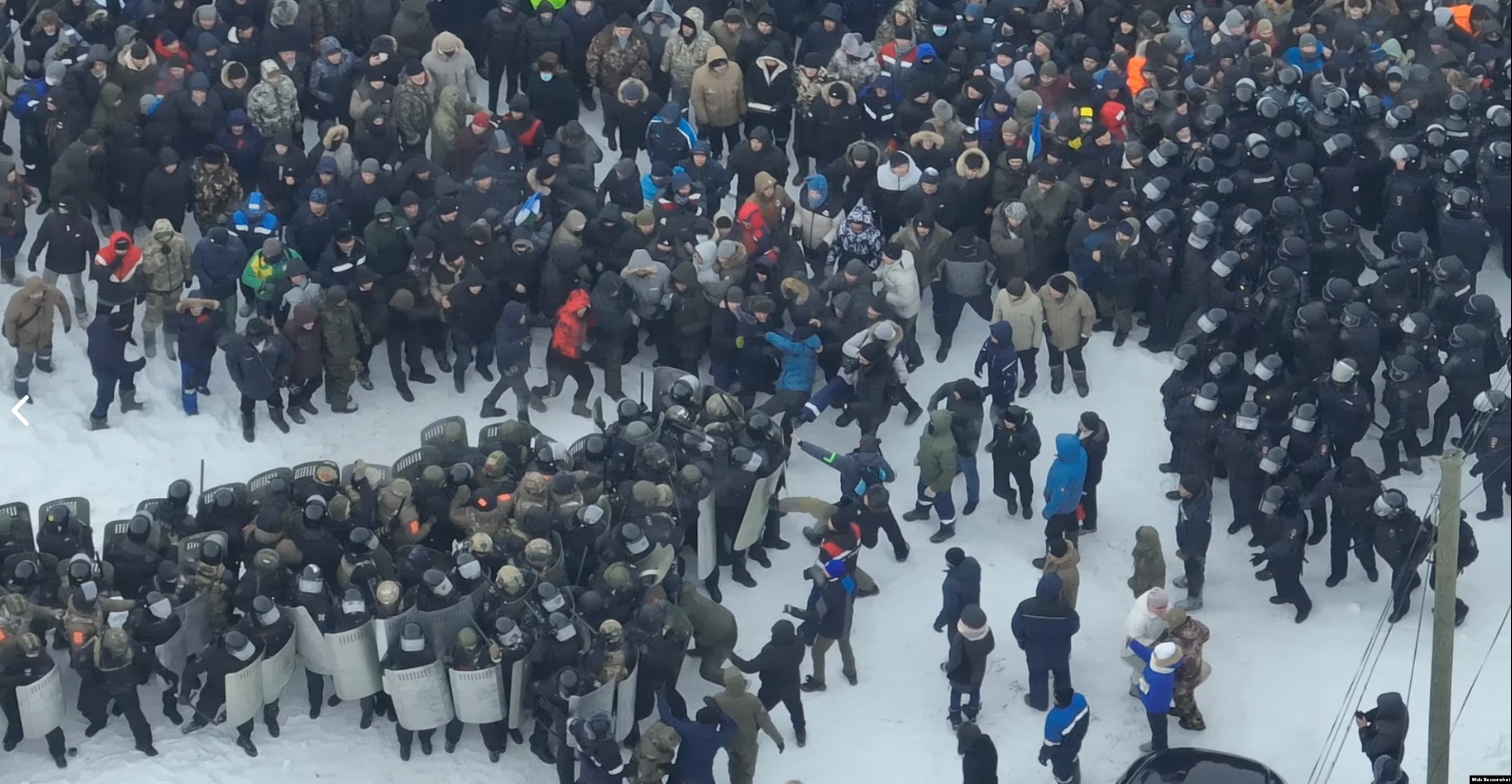
Several thousand Alsynov's supporters came to the announcement of the verdict and greeted the court's decision with indignation. In the square in front of the courthouse, clashes occurred with security forces, who pelted protesters with tear gas grenades and beat them with batons. Protesters responded by throwing snow at the police. As a result, the security forces managed to take Alsynov out of the courthouse only after significant reinforcements arrived.
After the protests in Baymak, the Investigative Committee opened criminal cases under two articles: organizing and participating in mass riots (Parts 1 and 2 of Article 212 of the Criminal Code of the Russian Federation), as well as the use of violence against a government official (Part 1 of Article 318 of the Criminal Code of the Russian Federation). About 80 people were involved in these cases.
In March of this year, “Idel.Realii” talked about what happened during the trial during the fall of 2025 and winter of 2026. Then the editorial sources familiar with the course of the trial reported that the prosecutor's office, during the interrogation of prosecution and defense witnesses, was unable to convincingly prove the guilt of the defendants in "organizing mass riots."
“All the evidence for the prosecution is based solely on the testimony of law enforcement officers who were present in the square,” said one of the interlocutors of Idel.Realii. — There is no evidence that the accused or anyone else “organized mass riots” - no correspondence, no transcripts of negotiations that would at least somehow indicate this.
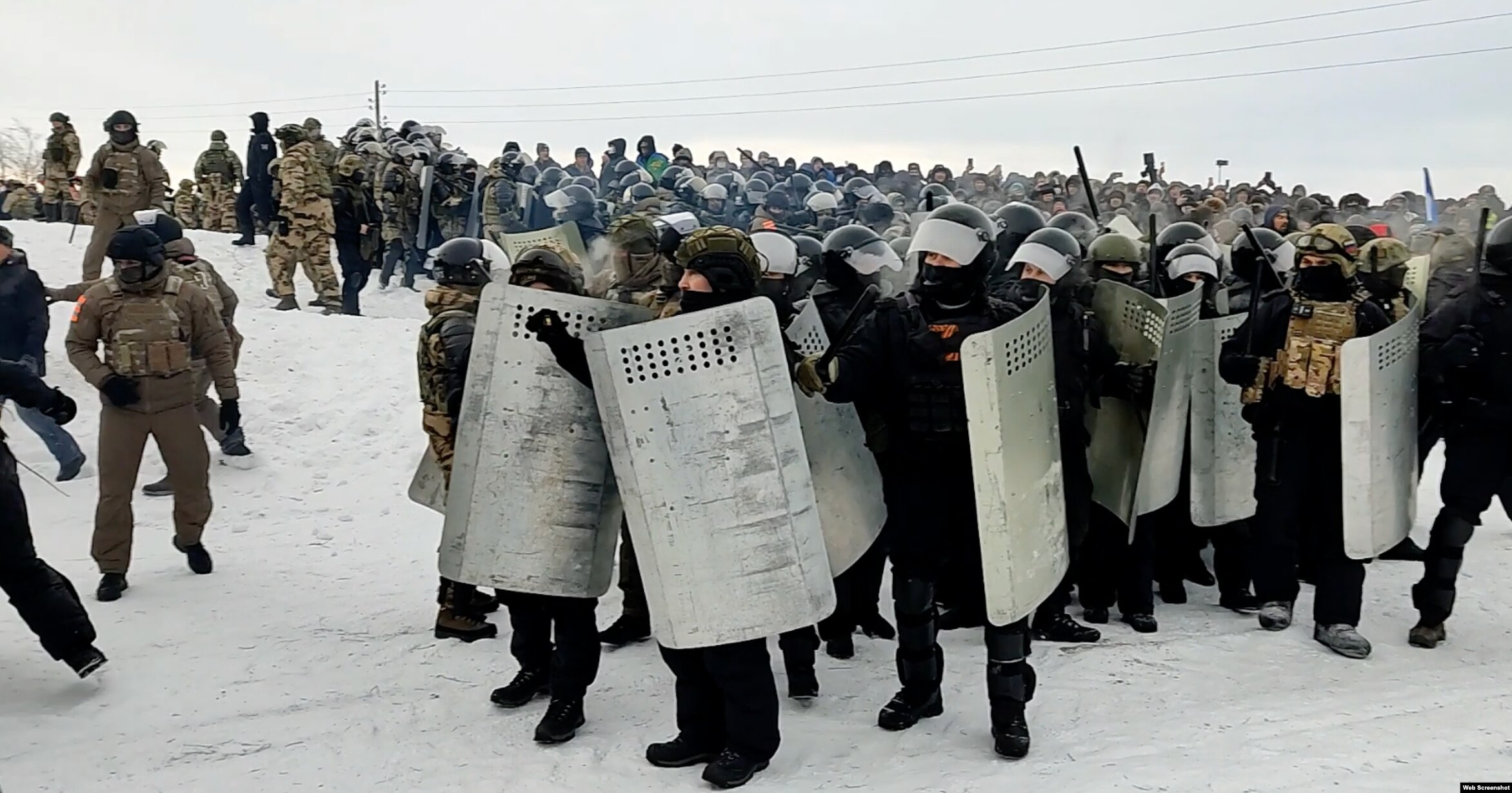
Another interlocutor of Idel.Realii noted that in the videos watched in court, “no calls to beat the security forces or use violence were recorded anywhere.”
“However, the state prosecution regards literally any gesture, any wave of the hand, any cry of the accused as a call for unrest,” the editorial source added.
We also note that during the judicial investigation, many of those already convicted in the “Baymak case” gave evidence in favor of the accused.
“They said that no one organized them, did not coordinate them, that they did not even know the defendants,” a source told Idel.Realii. — The convicts also stated that no one on the Internet persuaded them or forced them to come to the Baymak court on January 17, and that at the gathering itself no one gave them orders where to go or what to do, no one organized “riots” or coordinated them. The “riots,” in their opinion, were provoked by the security forces themselves, when they used force and special means - batons, stun grenades - and after that the people began to throw snowballs at them in response.
"None of the accused admitted guilt in 'organizing mass riots'
One of the sources of Idel.Realii ( the conversation took place at the end of May ) said that the interrogation of the accused ended at the trial.
“None of the accused pleaded guilty to “organizing mass riots,” that is, under Part 1 of Article 212 of the Criminal Code of the Russian Federation,” said the editor’s interlocutor. — Under Article 318 of the Criminal Code, some admitted guilt in full, others partially. But all the accused resolutely rejected the “organization”. Their arguments were confirmed by more than 40 interrogated “ordinary” participants in the Baymak events. So at this stage of the process, as at the previous ones, I believe that the prosecutor’s office failed to prove guilt under the most important article of the charge.
The source added that, in his opinion, “the court sees all this.”
— The judges are already asking purely rhetorical questions - they say, the riot police are pointing everything at you. Apart from the testimony of security forces, there is no other evidence of the “organization” - no interceptions of telephone conversations or correspondence, no video evidence. In particular, the studied videos do not confirm that this or that “organizer” shouted something like: “Push”, “Push”, “Don’t let the cops pass”, “Hit them, throw stones”, “Hit the cops” and so on. This is what only security officials interrogated by investigators say, but this is not true.
The interlocutor also said that, according to his information, the prosecutor’s office “intends to present additional evidence”:
— The state prosecution wants to summon various security officials for questioning — from the “E” center, the FSB, the Investigative Committee. In a word, the prosecutor's office will still try to at least somehow prove the “organization.” But prosecutors will no longer be able to present anything new. Therefore, I think there is a certain prospect that part 1 of Article 212 of the Criminal Code will no longer be applicable to all accused.
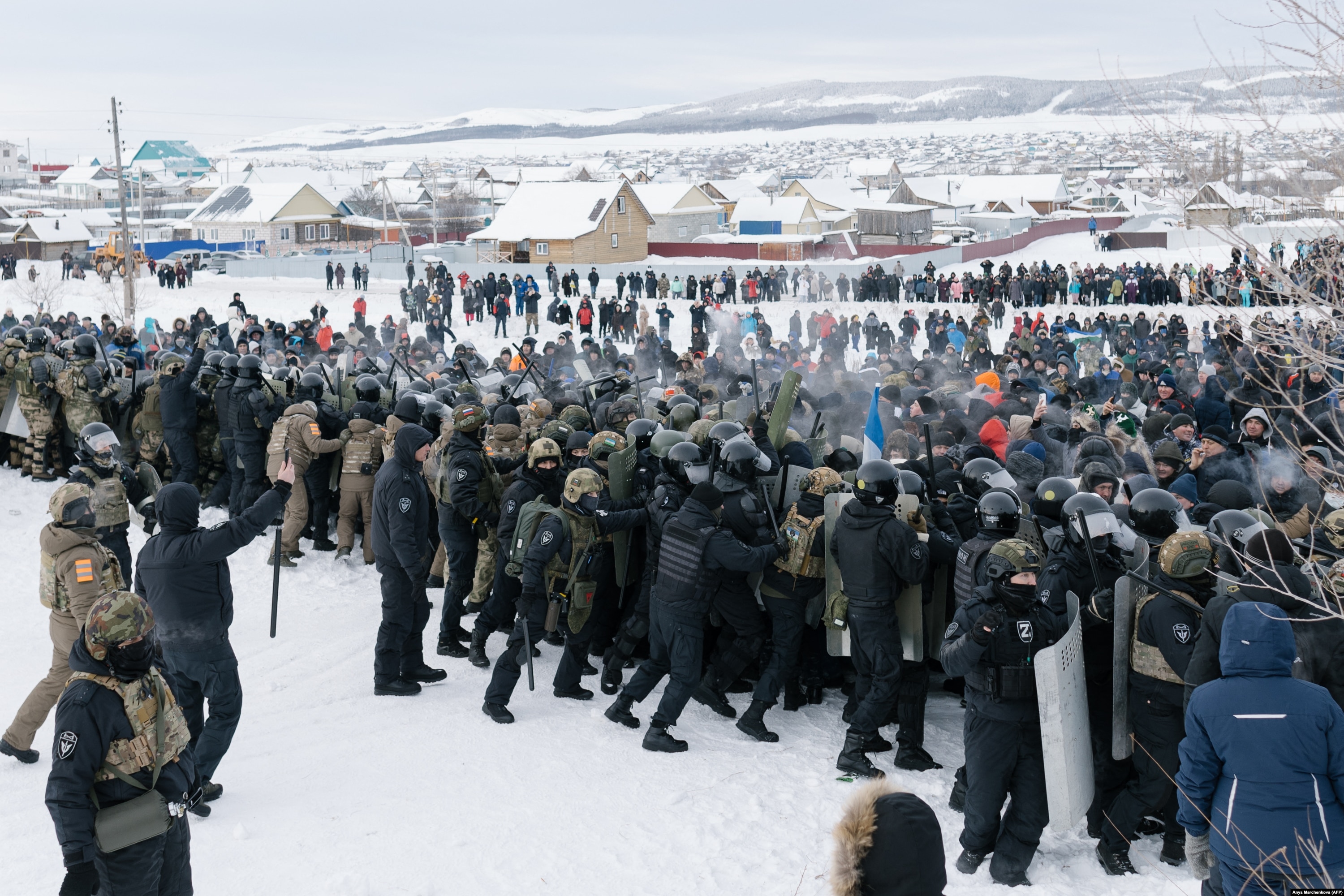
“I come to the conclusion that the Orenburg court will most likely reclassify the article of the “organizers” and will try them as participants,” wrote the brother of the accused Ilyas Bayguskarov, Ilgiz Bayguskarov , who is attending court hearings, on May 10. “If this happens, I myself will insist publicly that this court is humane and fair. Of course, I’m not so dreamy as to think about an acquittal now, but someone may be released from prison.” courtroom at the verdict in Orenburg this summer."
Another source of Idel.Realii also said that the accused “categorically deny any organization” on their part:
“They say that they consider protecting their nature a very important matter, and therefore they came to court to support Fail Alsynov, who fought for the ecology of his native land. They and the defense witnesses also talk a lot about how much they did for their native villages and hamlets - some built mosques and playgrounds, some took children from orphanages to foster, some were clergymen, and so on. There were a lot of such speeches in their defense.
As the editor’s interlocutor noted, there is “a fairly active state prosecutor” at the trial.
“He has 80 security officials who testified that the guys allegedly organized something there.” The defense has approximately the same number of witnesses, including already convicted defendants in the case, who testified that they do not know any “organizers,” that no one organized anyone. What will the court do about this? Perhaps he will note that “there is no reason not to trust the testimony of law enforcement officers.”
“Many prove that they [the defendants] tried to stop people,” Ilgiz Bayguskarov wrote on May 22. “For example, Arthur Mukhametov, when Ilyas [Baiguskarov] got into the paddy wagon, he was constantly trying to persuade the secret service officers to bring Father Fail [Alsynov] to the people so that he could help. Elkibaev says that he took the walkie-talkie because there were provocateurs in Kushtau, and he did not want something similar happened again."
According to the editor’s source, the accused “are generally holding up well” in court:
“As I know, it’s harder for them now than at the beginning.” They still get tired of weekly meetings, for which they need to constantly prepare. And they are all different ages, different health conditions. But still they are all great.
The interlocutor added that in Orenburg pre-trial detention center No. 1, “children periodically continue to be subject to disciplinary sanctions for minor offenses.”
“We speak only Russian, we can’t speak Bashkir, they immediately make a remark,” Salavat Elkibaev’s relatives wrote in Telegram chats. “There are no changes in the case yet, we really hope that they will remove the article about the organization.”
As Idel.Realii managed to find out, the court can probably move on to debates between the parties in August. A verdict is not expected until September.
One of the editorial sources expressed the hope that the trend that has emerged since the winter of this year of mitigating the punishment of already convicted participants in the Baymak events ( as of early June 2026, the courts replaced the colony with more lenient punishments for at least 16 convicted persons ) will have a positive impact on the outcome of the trial in Orenburg.
In turn, earlier the head of the human rights project “Support for Political Prisoners. Memorial” Sergei Davidis told Idel.Realii that, in his opinion, the above-mentioned trend is “unlikely to have a positive, mitigating effect” on the outcome of the Orenburg process.
“Ordinary participants will be sent a signal of humanity, and those whom the authorities consider as their convinced enemies, as a real threat, will personally receive the maximum, unfortunately,” Davidis said.
“Of course, the political component of this process has not gone away, but it has still moved a little to the side, which allows us to hope for a more or less reasonable verdict,” noted one of the sources of Idel.Realii.
“This process resembles some kind of long saga with numerous heroes on both sides,” said another interlocutor of the editors. - This, however, is one huge matter, divided into many small processes. Some are already being released, while others have not even been sentenced yet. Let's see how this all ends.
The next court hearing in Orenburg is scheduled for June 10. The arrest of the accused, as their relatives reported in a closed chat, was extended until June 16.
- According to Idel.Realii, during 2024-2025, the courts of first instance convicted 68 protesters in Baymak. 66 of them were sentenced to terms ranging from 3 years and 3 months to 7.5 years in prison (taking into account the consideration of their complaints in the appellate courts).
- For one convicted person, Minziye Adigamova, the court deferred the execution of her sentence (four years in prison) until her children reach the age of 14. The court sentenced another participant in the Baymak events (her name is not given) to compulsory outpatient treatment with a psychiatrist, finding her guilty of “calls for mass riots” (Part 3 of Article 212 of the Criminal Code of the Russian Federation).
- As of January 2026, the human rights project “Support for Political Prisoners. Memorial” recognized 64 convicts in the “Baymak case” as political prisoners.
Subscribe to our channel on Telegram .
-

Idel.Realities
We are not disclosing the name of the author of this publication due to the threat of criminal prosecution under the law on undesirable organizations in Russia.