
Translated material
The US and Iran exchange blows for the second day
On February 8, 2024, DOXA was added to the register of “undesirable organizations.”
If you are in Russia or planning to return to it, you cannot repost our materials on social networks, link to them or publish quotes.
Read more about what is and is not possible in the cards .
The United States launched a new series of attacks on Iranian territory. The US Central Command reported that the attack targeted military intelligence and surveillance facilities, communications systems, radar stations, air defense systems and drone control centers. Washington said the operation was carried out “for the purpose of self-defense,” and the affected objects allegedly posed a threat to the US military and international commercial shipping.
The Iranian Mehr agency and PressTV reported explosions in at least six regions of the country. According to Axios, citing a source in the US administration, all targets were in southern Iran. The Wall Street Journal's interlocutor clarified that dozens of military installations came under attack, including in the Strait of Hormuz area. However, according to him, no civilian infrastructure was attacked.
The new operation was the second exchange of blows between Washington and Tehran over the past two days and indicates a further escalation of the conflict between the two countries.
What's happening?
In response to the American strikes, the Islamic Revolutionary Guard Corps (IRGC) announced an attack on 18 US military installations in the Middle East. According to the Iranian side, American air bases in Kuwait and Bahrain, the US Fifth Fleet base in Bahrain, and Al-Azraq air base in Jordan were hit.
Bahraini authorities said air defense forces repelled the attack. Kuwait's air defense systems were also activated. The US has not yet confirmed information about the extent of possible damage.
After an exchange of blows, Iran again announced the closure of the Strait of Hormuz, one of the most important routes for global oil and gas trade. The central headquarters of the armed forces of the Islamic Republic, Hazrat Khatam al-Anbiya, stated that the passage through the strait is closed to all types of ships, including commercial ships and oil tankers. Military commanders warned that any ship that tries to pass through the strait could be attacked.
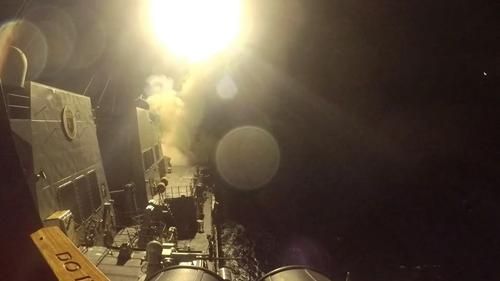
The destroyer USS Michael Murphy (DDG 112) fires Tomahawk cruise missiles on June 10, 2026.
Reuters
Soon after, Iranian state television reported that the military opened fire on two American ships. The US Central Command denied these statements. According to Washington, shipping through the Strait of Hormuz continues as usual, and commercial vessels continue to pass through the waters.
The new escalation has already affected global markets. August Brent crude futures rose $1.48 to $94.58 a barrel.
At the same time, the US administration continued to tighten its rhetoric. Shortly before the start of the operation, Defense Minister Pete Hegseth said that new strikes should strengthen Washington's position in negotiations with Tehran.
“Iran has the opportunity to make a very profitable deal. But they didn't want to do this. If we have to negotiate with bombs, we will negotiate with bombs,” Hegseth said.
According to Fox News correspondent Trey Ingst, Donald Trump also warned Iran of the possibility of new strikes if it abandons the agreement with the United States. The American president himself claims that during the attack 49 Tomahawk cruise missiles were used, as well as aircraft to destroy Iranian air defense systems.
At the same time, according to CNN, the Donald Trump administration is also discussing larger-scale scenarios of further escalation. One of them is associated with a possible operation to seize the Iranian island of Kharg, a key hub for the country’s oil exports.
However, the channel’s sources claim that the Pentagon and the White House treat this option with caution. CNN's interlocutors call such an operation a "last resort" that could theoretically change the balance of power in the war, but would also lead to significant losses among the US military.
What do the experts say?
In a conversation with DOXA, orientalist and NEST Center expert Ruslan Suleymanov connects the new US strikes on Iran with the failure of the negotiation process between Washington and Tehran.
According to him, the current escalation is a continuation of the protracted crisis in US-Iranian relations, which has persisted since the spring of this year.
“The latest strikes are a continuation of the stagnation that has arisen in the US-Iranian negotiations. The state of “no war, no peace” has not changed qualitatively since April. After the obviously failed negotiations in Islamabad, the positions of the parties remain the same. So far, the only tool that both the United States and Iran have resorted to is forceful pressure, an attempt to change the enemy’s position through a show of force. But this is unlikely to bring results, because such actions have not yet had an effect on either Iran or the United States,” Suleymanov believes.
Separately, the expert draws attention to the situation around the Strait of Hormuz, which remains one of the main sources of tension in the region.
“The situation in the Strait of Hormuz remains uncertain. The parties failed to reach a common denominator, and this remains the main obstacle to overcoming the crisis. Until the United States and Iran agree on the rules of the game and abandon the practice of mutual strikes and forceful pressure, uncertainty around the strait will continue. We will continue to see mutual restrictions and attempts at pressure from both Iran and the United States,” he notes.
According to Suleymanov, the current conflict simultaneously contributes to the consolidation of Iranian elites and increases internal discontent in the country.
“On the one hand, what is happening has led to a noticeable unity of the Iranian elites, despite the differences that exist between them. For the regime, this is largely a matter of political survival, when there is nowhere to retreat and internal contradictions fade into the background. But on the other hand, the longer the current uncertainty persists, the more discontent grows among the population, which expects changes and some kind of way out of the crisis. If the situation drags on, the likelihood of protests and internal protests will only increase. We already observed something similar a few months after last year’s twelve-day war,” says the expert.
Context
The war between the United States and Iran has been going on for about four months. Despite Donald Trump's regular statements about an agreement being reached soon—according to CNN's count , he said this at least 37 times—the negotiation process has effectively reached a dead end.
Even after the ceasefire agreement reached in early April, Washington and Tehran continued to exchange blows. The current round of escalation began after the crash of an American military helicopter AH-64 Apache in the Strait of Hormuz. The US said the helicopter was shot down by Iran, but Tehran did not claim responsibility for the incident.
On the eve of the new strikes, Donald Trump held a meeting with Vice President JD Vance, Secretary of State Marco Rubio, CIA Director John Ratcliffe, Chairman of the Joint Chiefs of Staff Dan Cain and Special Envoy Steve Witkoff. According to Axios, the meeting discussed a large-scale but time-limited operation against Iran, which was supposed to increase pressure on Tehran and force it to reconsider its position in the negotiations.
This is not the first such episode in recent weeks. At the end of May, the United States and Iran also exchanged blows in the Strait of Hormuz. Then the US military announced an attack on a facility in Bandar Abbas and the interception of four Iranian drones, and the IRGC announced a retaliatory strike on an American airbase.
The Strait of Hormuz is of particular importance in the current confrontation - a significant part of the world's oil and gas exports passes through it. Therefore, each new threat to disrupt shipping affects not only the situation in the Middle East, but also global energy markets, affecting commodity prices and international trade.