
Translated material
Tito, me and acid communism. Why unfulfilled utopias won’t let us go
Vanya Zhigal
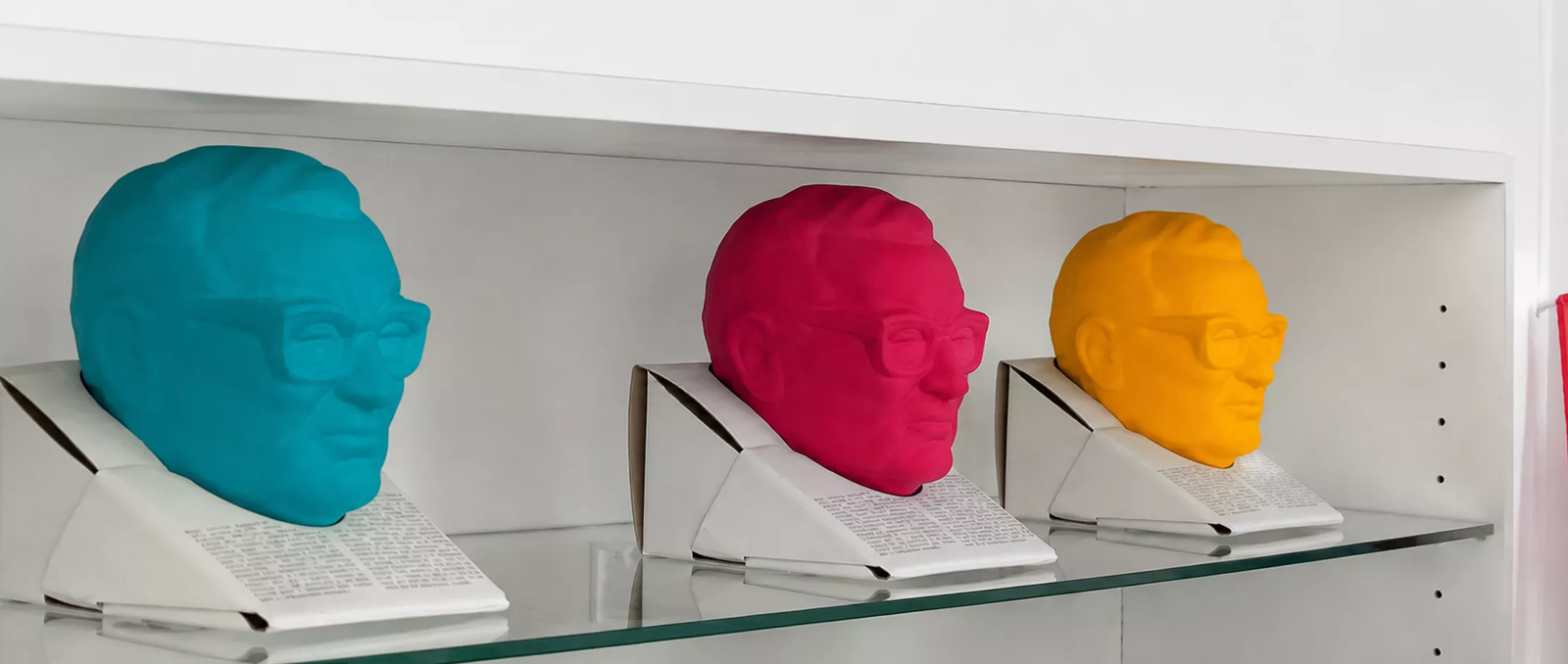
The future sells for 30 euros. An acid pink ceramic head of Tito, purchased from a Belgrade museum, takes Vanya Žigala back to the history of socialist Yugoslavia, the most famous experiment in the “third way” between East and West. From a chance encounter with a museum memento emerges a personal tale of childhood, love, and political imagination—and how vanished worlds continue to promise a future that never came.
Tired marshal with glasses
The acid pink ceramic head of Tito cost me 30 euros - I bought it in the gift shop of the Museum of Yugoslavia in Belgrade. The head is a painted replica of the one kept behind glass in the building next door, the House of Flowers, part of a museum complex dedicated to the history of socialist Yugoslavia. The former winter garden, where Tito spent a lot of time after his split from his wife Jovanka, became his resting place in 1980, and then Jovanka’s resting place after her death in 2013.
Visitors come here to look at the remains of Yugoslavia in their material form - and at the remains of its creator. The history of the country ends here almost literally. Tito's tombstone is located right in the center of the hall; to the right and left are his things, photographs, gifts, memorabilia. Among them is this head.
In 1981, the respectable Danish ceramic workshop Søholm Keramik, commissioned by the equally respectable Danish savings bank Bikuben, produced a piggy bank in the form of the head of Josip Broz Tito as part of the “Great Statesmen” series. Tito was third in this series - after Churchill and Kennedy, but before de Gaulle and Anwar Sadat. A total of four thousand Tito heads were produced. Three of them ended up in Yugoslavia: the bank presented one to the SFRY Embassy in Denmark on the occasion of Republic Day, and two more were handed over with a request to give to members of the Broz family - Tito himself had been dead for a year. The embassy sent one of the piggy banks along with a cover letter to the Yugoslav Foreign Ministry - and from there it went to the museum, where it became an exhibit.
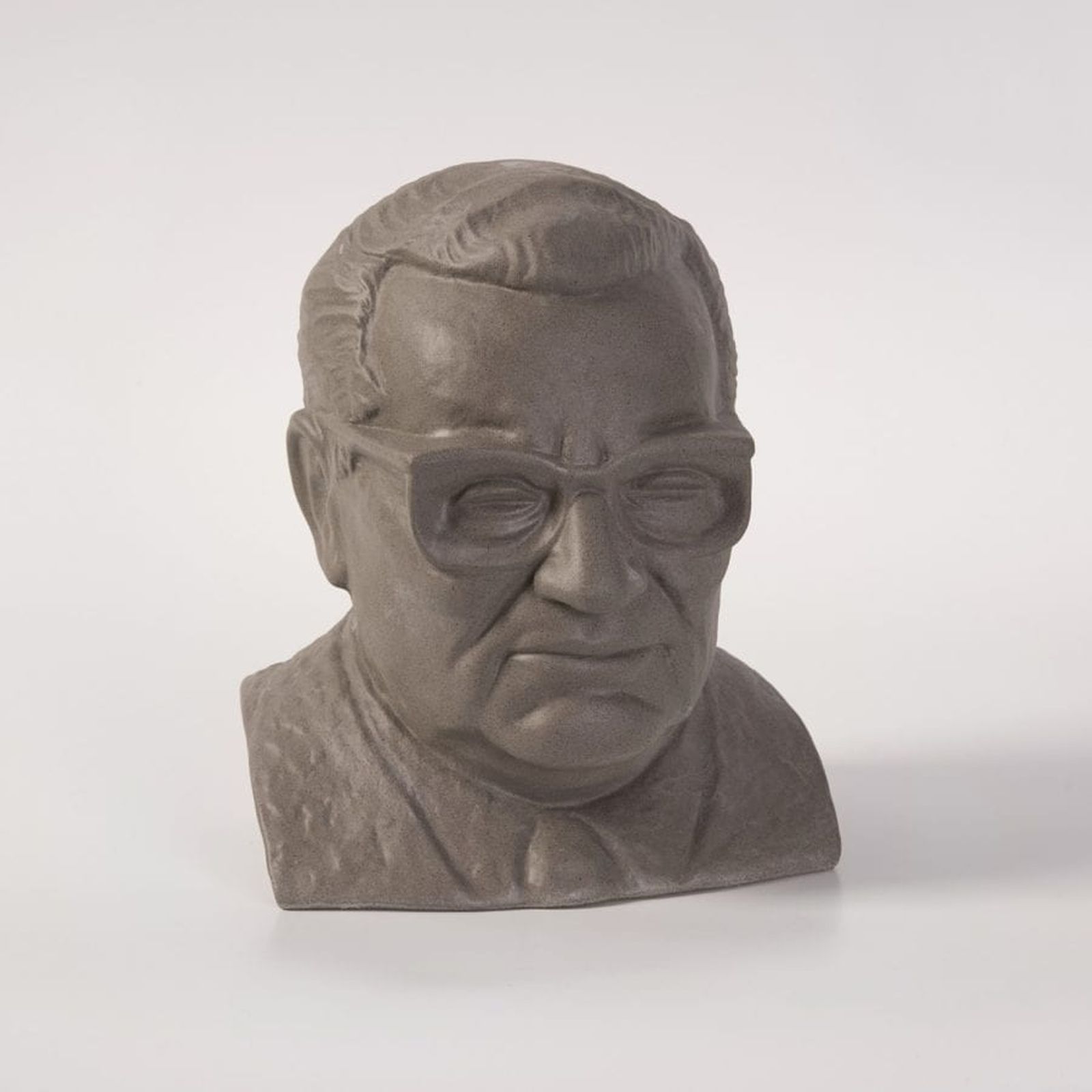
Without accompanying text it is difficult to even understand that it is Tito in front of you. The ceramic head is completely unlike any of the popularized images of the Yugoslav leader.
This is not an energetic marshal in a white uniform or a smiling newsreel hero, but a world-weary old man in glasses.
Deep folds under the nose give him an irritated and tired appearance. It seems as if the sculptor accidentally captured not a political myth, but the human condition at the end of a long era. It was probably this gap between Tito as a symbol of the energetic project of a new world - modernist, international, anti-colonial - and Tito the piggy bank, which captured the weariness of old age, that attracted my attention.
After the collapse of the socialist states, the very idea of a political project capable of improving the structure of the world began to look doomed in advance. Failure in retrospect began to seem inevitable and infected the view of the past with doubt about the very possibility of success. Tired and dissatisfied, Tito seems to already know the outcome of his own experiment.
But in the early 1980s, when a Danish bank ordered a piggy bank from the ceramic workshop Søholm Keramik, this outcome was not yet obvious. Yugoslavia remained one of the most successful versions of the "third way" between capitalism and Soviet socialism in its various variations. Perhaps this is why the ceramic head makes such a strange impression today: in its fatigue one can involuntarily read a premonition of a future defeat, which no one had yet seen.
I was first brought to the Museum of Yugoslavia by M., a passionate fan of socialist Yugoslavia, Yugoslav brutalism and the Yugoslav “black wave”. For the Brazilian Marxist, Tito's Yugoslavia looked like a ghost of a world in which socialism did not yet seem lost in advance. Her interest was not Yunostalgia. Rather, it is a search for a historical moment when the idea of a different structure of the world was still perceived as a practical possibility, and not as an object of museum archeology.
Fredric Jameson wrote that after the defeat of “actually existing socialism,” the future is increasingly perceived as an endless continuation of the present.
Perhaps this is why Yugoslavia still attracts such interest far beyond the Balkans. It reminds us of a time when the story did not yet seem finished.
It was this nerve of time that M was looking for in Yugoslavia. And although the acid-pink ceramic Tito also attracted her attention, she dissuaded me from buying it, promising that we would find me a “normal” Tito - bronze, like her own - at the Belgrade flea market. Nothing came of it, and a few months later I returned to the Museum of Yugoslavia - like a child for a long-desired toy.
Tito in Kazakhstan
The history of my relationship with Tito goes back a long way, although it is difficult to imagine people belonging to more different worlds. I was born in 1993 in Northern Kazakhstan and first heard about Tito when I was five or six years old. By that time, Tito had been dead for almost twenty years, and Yugoslavia was in the throes of its collapse. Kazakhstan only recently gained its own post-Soviet independence and was still learning to live within it. It was then that the name Tito first appeared in my life - completely by accident.
At home, among the books, I found an old Soviet calendar with short notes about memorable dates. Opposite my birthday - May 25 - there were two events at once: African Liberation Day and Tito's birthday. Now that calendar is no longer possible to find - just as it is impossible to return to Kazakhstan and the world of my childhood, which have become infinitely distant. Therefore, we can only guess what year it was for. It would be interesting to find out - relations between the USSR and Yugoslavia were rarely conducive to Soviet calendars celebrating Tito’s birthday.
Tito's date of birth itself was also problematic. In fact, he was born on May 7th, not the 25th. This date arose after the war, when Tito, having become president of Yugoslavia, began to celebrate his birthday in memory of the unsuccessful assassination attempt on him in May 1944. The Germans, who believed forged documents where May 25 was listed as Tito's birthday, tried to kill him on that very day.
In socialist Yugoslavia, May 25 was not only Tito's official birthday, but also Youth Day - one of the most important holidays in the country.
A few weeks before the holiday, usually in Tito’s home village of Kumrovce, a youth relay race began, passing through the largest cities of the country and ending in Belgrade at the stadium of the Yugoslav People’s Army - the current home arena of Partizan. There, Tito was solemnly presented with batons from various youth organizations, congratulations and a symbolic oath of allegiance were read out - to him personally, to socialist ideals and the obligation to preserve the “brotherhood and unity” of the peoples of Yugoslavia. Today these artifacts can be seen in the Museum of Yugoslavia. The tradition continued after Tito’s death—in his place, it was received by the chairman of the Socialist Youth League of Yugoslavia. The last time the race took place was in 1987. Soon the relay was canceled: the country was increasingly experiencing an impending crisis, and the rituals of Yugoslav unity began to look less and less convincing.
However, at that time neither I nor my mother, who grew up in Soviet Belarus, knew all these nuances. It was to her that I went to ask who Tito was - by that time the existence of Africa no longer raised any questions in my mind. From her I learned that there was still such a country somewhere - Yugoslavia, and Tito was its leader. Mom was born in 1965 into a simple working-class family. What could Yugoslavia be for her - a distant socialist country from a geography textbook? When I asked her about this many years later, it turned out that, above all, Yugoslavia was for her a world of high-class sports - football and basketball - and a world of things. In the late Soviet Union, Yugoslav boots or shoes were less a luxury item and more a promise of everyday comfort that the Soviet world sorely lacked.
One way or another, perhaps it was that strange personal connection with Tito, which arose somewhere in the late 1990s in northern Kazakhstan, that explains why, two decades later, I could not leave the Museum of Yugoslavia without his ridiculous head. Even if for the sake of this I would have to leave out my study of Balkan history at several universities, my studies in Serbian, my love for Belgrade - and, of course, M.
Screen for fantasies
As Slavoj Žižek rightly noted , the Balkans have long remained one of the privileged places for political fantasies. For some, Yugoslavia was a territory of ancient violence and complicated history, for others - an exotic space of folklore, chaos and untamed life, as in the films of Kusturica; for Western Realpolitik, especially the late 1980s, a warning about what Europe itself could become. Along with this, there was another fantasy - about Yugoslavia as a possible alternative to Soviet socialism and Western capitalism.
I think this fantasy is ultimately mine.
Socialist Yugoslavia still retains a sense of unrealized possibility.
Unlike Soviet socialism with its cult of mobilization and violence, or Maoist China with its idea of permanent revolution, the Yugoslav project tried to build itself not around a state of exception, but around self-government, relative openness to the world and the gradual improvement of everyday life. How successful is a separate question that does not negate the numerous contradictions and problems of the Yugoslav project itself.
At the same time, the fantasy of Yugoslavia should not obscure the people who lived in it. For some it was a space of opportunity, for others it was a historical misunderstanding. Behind the facade of Yugoslav "brotherhood and unity" there remained national, regional and economic tensions that the Yugoslav project was never able to overcome. As my Serbian colleague B. said, her grandfather liked to repeat:
jedina dobra stvar u komunističkoj Jugoslaviji bila je to što su ljudi bili dobro obučeni: nosili su dobra odela i cipele
The only good thing about communist Yugoslavia was that people dressed well: they wore good suits and shoes.
Grandfather remained loyal to royal Yugoslavia. The drunken Serb I met in a small mountain village near the Bulgarian border did not like socialist Yugoslavia either. My T-shirt with the logo of the Polish Solidarity almost became a reason for a fight. Screaming about his hatred of the West and democracy, he suddenly switched to a story about how he served in the Yugoslav army and wanted to kill Tito. There are still plenty of similar stories about Yugoslavia in the Balkans.
And yet all these stories - about hatred of Yugoslavia, about unresolved conflicts and about the collapse of the country - do not cancel the very need for utopias.
The value of utopia, according to Jameson , lies not so much in the ability to offer a ready-made blueprint for the future, but in the very attempt to imagine historical otherness - a world that cannot be reduced to a simple continuation of the present. Perhaps this is why even the disintegrated Yugoslavia continues to retain its strange intellectual and emotional attraction.
The Yugoslavia project is over and will never happen again. But the very memory of him continues to fuel the political imagination - the ability to imagine a world that is not reduced to a simple continuation of the present, which became infinite after capitalism began to be perceived as the natural state of the world, which has always existed and does not imply any alternative.
Ghosts of "acid communism"
That's why when I look at pink Tito, I think of Mark Fisher. Developing Jameson's ideas, the British leftist theorist and cultural critic wrote about a world dominated by a persistent sense of exhaustion, cultural and political sterility, in which the future is slowly dying out. Struggling all his life with clinical depression, which he understood not only as a personal disorder, but also as a collective symptom of modern capitalist reality, Fischer committed suicide at the age of forty-eight, leaving behind an unfinished foreword to a book that he never had time to begin.
In these sketches, reflecting on the fact that the future does not completely disappear - rather, it continues to return in the form of the specter of unrealized possibilities, the outlines of which appear through the very fabric of capitalist realism - Fischer outlines the concept of “acid communism”. He describes it as a strange combination of left-wing politics, the psychedelic counterculture of the 1960s and 1970s, and the aestheticization of everyday life. This idea is the philosopher’s attempt to go beyond the limits of left-wing political thinking, frozen between the conviction of the catastrophic nature of capitalism and the feeling of the absence of any alternative to it. Without denying the general feeling of exhaustion and hopelessness, Fischer suggests instead of apathy - or traditional leftist politics of asceticism, discipline and endless struggle - turning to joy, energy and aesthetic experience as a way to return the utopian imagination.
For Fischer, acid communism is both a challenge and a promise. The same can be said about the acid pink Tito. It almost looks like a caricature or parody of Yugoslav socialism, and at the same time - a reminder of a time when a just and pleasant future still seemed possible.
Perhaps the desire to take Tito with me was based not only on a ghostly connection established with him in my distant Kazakh childhood, but also on the feeling that, together with this stupid acid-pink head, I was trying to preserve at least a faint material trace of a disappeared historical opportunity.
On my visit to Belgrade, I flew without luggage - with only one backpack. The backpack is wine color, Tito is pink. I wrapped him in a black T-shirt - there were stains of pink paint on it that I could not wash off - to be sure of the safety of the ceramics, and took this head of Tito, turned into a piggy bank, to the airport. I carried it at the bottom of my backpack through almost the entire city, corroded by Vucic’s neoliberal and authoritarian policies, from a country in which it is becoming increasingly difficult to live.
After passport control and hand luggage inspection, I found myself on the plane. I put my backpack under the seat in front of me, and soon Tito and I took off, crossing air borders and moving west.
I carried Tito as a restless reminder that another world is possible - and about M., who once taught me to look at Yugoslavia in exactly this way.