
Translated material
Hypertheater and sensitivity
Two premieres - “Don Juan. Superstar" in MTYUZ and "The Story of One Childhood" in RAMT

Scene from the play “Don Juan. Superstar" by Pyotr Shereshevsky at MTYUZ. Photo: Elena Lapina
Give an Oscar to this goddess
Premiere of the play “Don Juan. Superstar" by Pyotr Shereshevsky at MTYUZ. The play by Semyon Sakseev (Shereshevsky) was written not “based on” Molière or Pushkin’s “The Stone Guest”, but as if through the Looking Glass of all the textbook wandering Don Juan texts: individual scenes and quotes are fused into the original narrative of the psychodrama, but “shine” in a completely different way.
Forty-year-old Ivan (Ilya Smirnov), a prosperous businessman, is not a soulless womanizer or a libertine. But he is also not a daring, creatively gifted person, capable of fatal passion, inseparable from tragedy. Rather, the dearest Buzykin or Balayanov’s Makarov in the networks of modern times. His tragedy lies in the awareness of the worthlessness of existence, emotional devastation. This is not just a midlife crisis, but mortal fatigue from a life in which all external signs have been preserved, but the meaning, frame, and internal content have disappeared. He is trying to somehow fill this void.
Regularly visits parents stuck in the past. Among the shelves with collected works, Dmitry Suponin's Father remembers who he did not become, his Mother (the finest work by Elena Levchenko) gradually gets bogged down in dementia. Ivan supports his sister (Sofia Slivina) morally and financially, who is trying with all her might to arrange her destiny in Serbia. For the third time he leaves his wife (Maria Lugovaya), a sweet psychologist who, like all psychologists, tries to understand the darkness of someone else’s soul with the help of the right techniques, but also champagne and pancakes with black caviar.
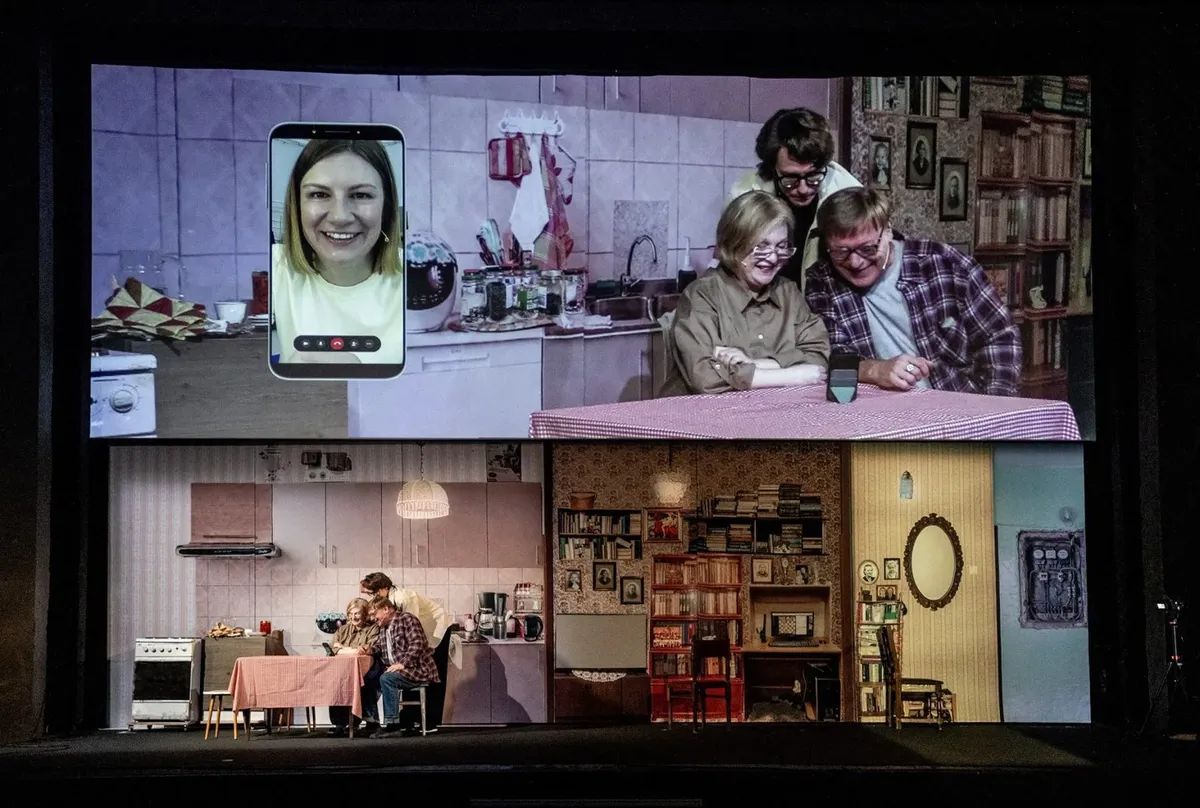
To stir up and animate the “frozen fate”, he comes up with an anniversary for himself at forty years old. Bad omen? How much worse? He will blow up all the signs, shake hands with the Commander, connect 360 watts to his meaningless existence in the “dark forest” with a bad, out of control holiday. This masquerade opera, set to music referencing Bob Wilson's plays, is staged by two directors who chose Molière to make Ivan finally feel like the seducing Don Juan. Or simply “felt myself”, for example, lying next to a drunken philosopher on the road in the center of Moscow. In fact, hypertheater as an attempt at resuscitation... The author of the strange and absurd rock opera Vanechka (“Private Dance Orchestra”).
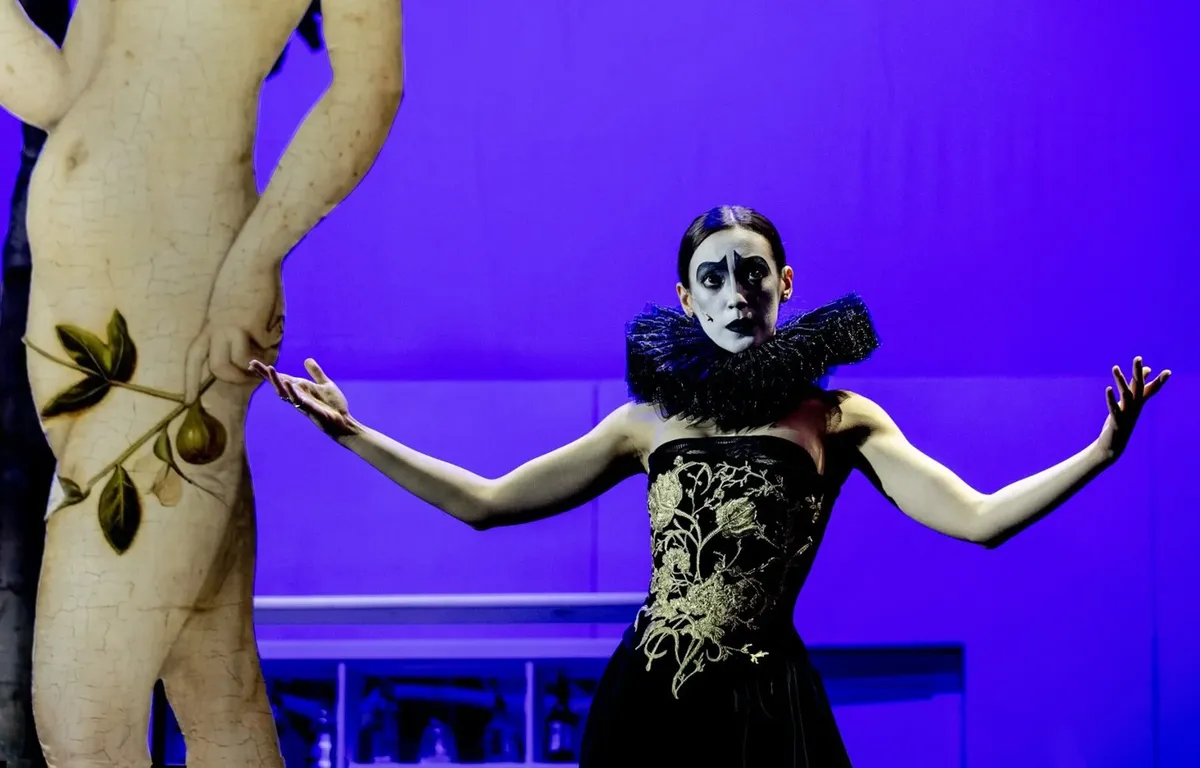
But the directors of the “play within the play” mix Moliere with a pop corporate party with all the most vulgar symbols: rose petals, girls in scarlet dresses, a dancing polar bear and Fellini’s cheeky Galibri & Mavik. “Give this goddess an Oscar!”
Burnt out in the collapse of all the illusions and ambitions of youth, the nerd in a Don Juan frill tries to fight off the women leaning against his weak shoulder, spreads artificial clouds with his hands and prepares to shake hands with the Commander - the eternal image of retribution.
But the Commander's retribution will be a giant baby doll, whose legs have been dangling under the grate from the very beginning of the performance. Perhaps this is the same unborn child whose heart is beating in the ultrasound of his recent wife Eli...
The actors are wonderful. First of all, Ilya Smirnov in the role of the restless Ivan-Adam-Juan, who has irretrievably lost paradise: the character of a well-mannered, well-educated, well-earning contemporary who has departed from the “reality” platform into the darkness of continuous hopeless loneliness in a hotel room is recognizable in every detail. Passenger without address. And perhaps only the “final stop” still arouses some curiosity in him.
The performance is interesting in its flashes of bright scenes and Shereshevsky’s directorial discoveries. But here theater critics write in unison that the four hours of the performance fly by for them unnoticed. This generous timing seemed to me “a gross exaggeration.” The rhythm sags in a number of episodes, and the audience, quietly disappearing during intermissions, would not agree with the critics.
Saga of the Tsevlovskys
Kokoshniks, sundresses and sunglasses, folk rock and trance music. Melodrama and tragedy, romance of education and phantasmagoria with mysticism, living and dead, real and fictional... Soyzhin Zhambalova's theater is a sensory experience to the touch.
At RAMT she composed a multi-layered and polyphonic fantasy based on “The Story of a Childhood” - an auto-fiction by Elizaveta Vodovozova (née Tsevlovskaya), a student of the Smolny Institute.
The play is a two-part saga. Essentially, two performances in one.
The first episode is Childhood. The house is like the lost paradise of a large family hit by cholera.
The second is Adolescence. Smolny Institute. A harsh school of growing up.
But Soyzhin is less interested in the chronology of events, her performance is a kaleidoscope of moments, a mosaic of elusive - forever lost time.
The decay of time, the lace of which turns into holes in the subtle world.
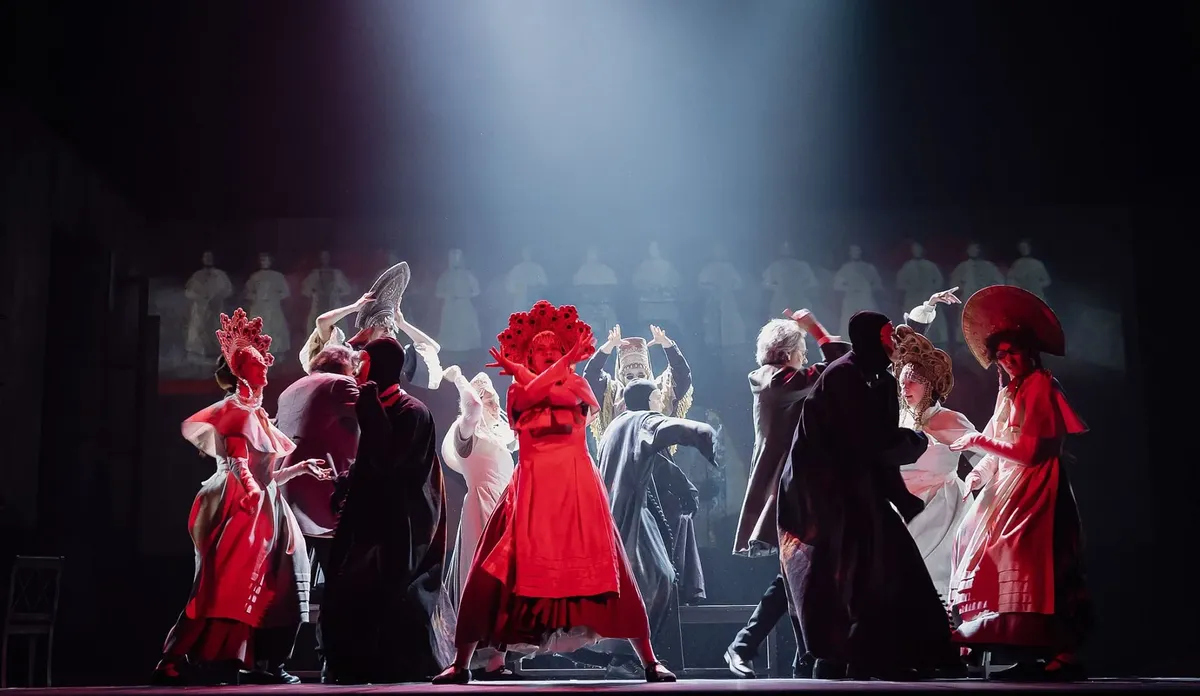
The space of the home is like a sensory area.
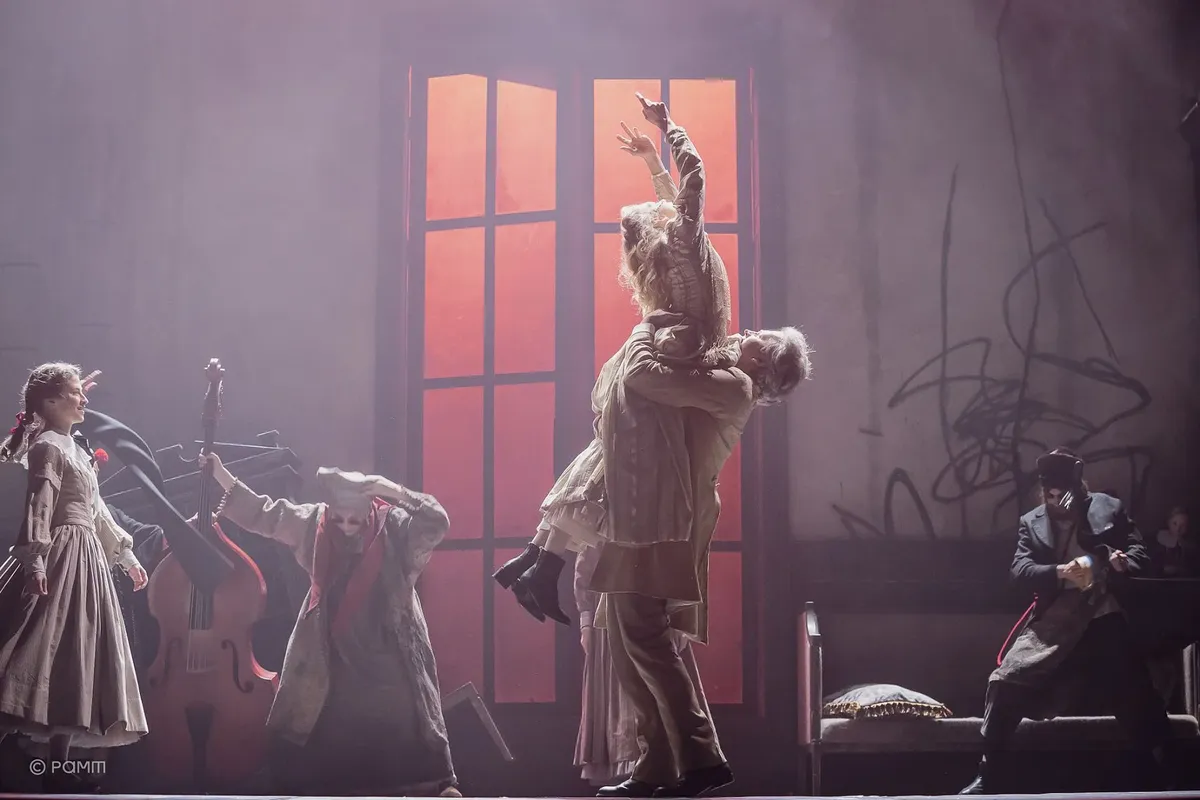
Therefore, the material signs/objects of the lost time symbolize the fragility of the world itself - they stick out as fragments, fragments of memory: a sideboard falling out of the wall, a bed without support, a table without two legs on which you can slide down as if from a slide, a half-baked piano, a double bass bow like a saw, a stove with flourishes. And a giant bird, whose shadow hung unhappily over the heads of the heroes. Objects in Zhambalova’s world are always milestones of memory, signs of love. Like a guitar that turns the dance of lovers into a ritual tender confession. And when they part, the air guitar pantomime will be a reminder of a lost but not forgotten feeling. How the dance of bare feet is a symbol of close relationships.
In the first part, death-cholera enters a large family house with the usual rituals and amusements as an unimpressive girl (they didn’t come up with a role-image for her), and “takes away” one after another the father and children of the family to the ringing of a bell. Their names, written on the backdrop with crumbling chalk, are erased one by one.
At the center of the catastrophe of the world breaking apart before our eyes is Anna Tsevlovskaya (Anna Taratorkina), the mother of a family crumbling like chalk from a blackboard. She needs to educate the surviving twelve to three children at all costs. She literally harnesses herself to the plow, is merciless to herself, to the peasants, to the children. He drives himself like a horse, which seems to grow more and more into the ground. The heart, drying up from grief and hopelessness, seems to have no strength, no desire, no time for love and joy. If it weren’t for the kindest soul of the beautiful Nanny (Tatyana Veselkina), the house would turn into a desert.
But through whose eyes do we see what is happening?
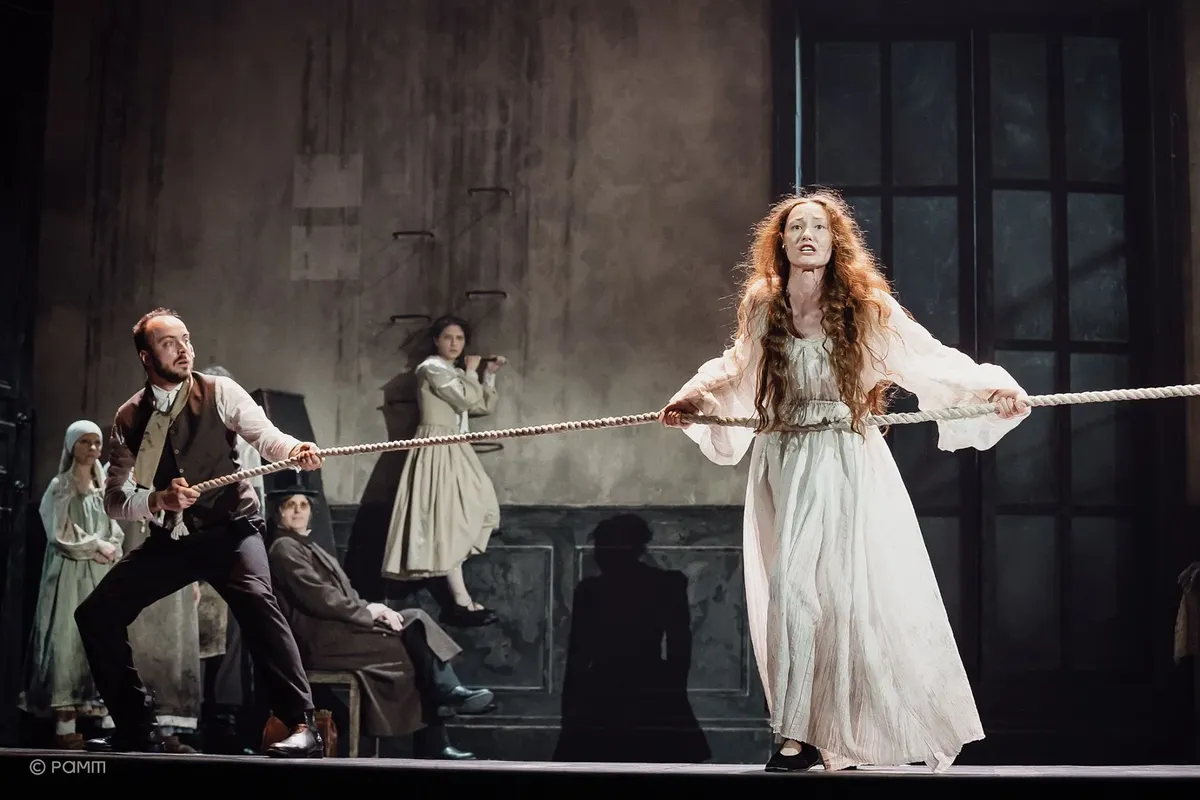
This is the optics of young Liza Tsevlovskaya (Varvara Pakhomova) - the youngest in a once large family, but gnawed by cholera and poverty.
This is her subjective view of her mother, her older sister, who is forced to marry an unpredictable, crazy French teacher. To death is the ritual departure of those closest to the kingdom of shadows. The dead here play tug of war with the living. The dead are stronger. An infernal group of musicians and meditative compositions with a broken electronic pulse by Dakhale Zhambolov are commentators on the action and guides, escorting the departed to the world. One after another, including the “dear nanny”, who, one of the adults, will have such a reserve of tenderness that it will be enough for all three grown-up children. The culmination of the first act is the rollicking mortal dance of the Nanny, who has regained the desperate dash of youth, the very energy of life on the verge of death.
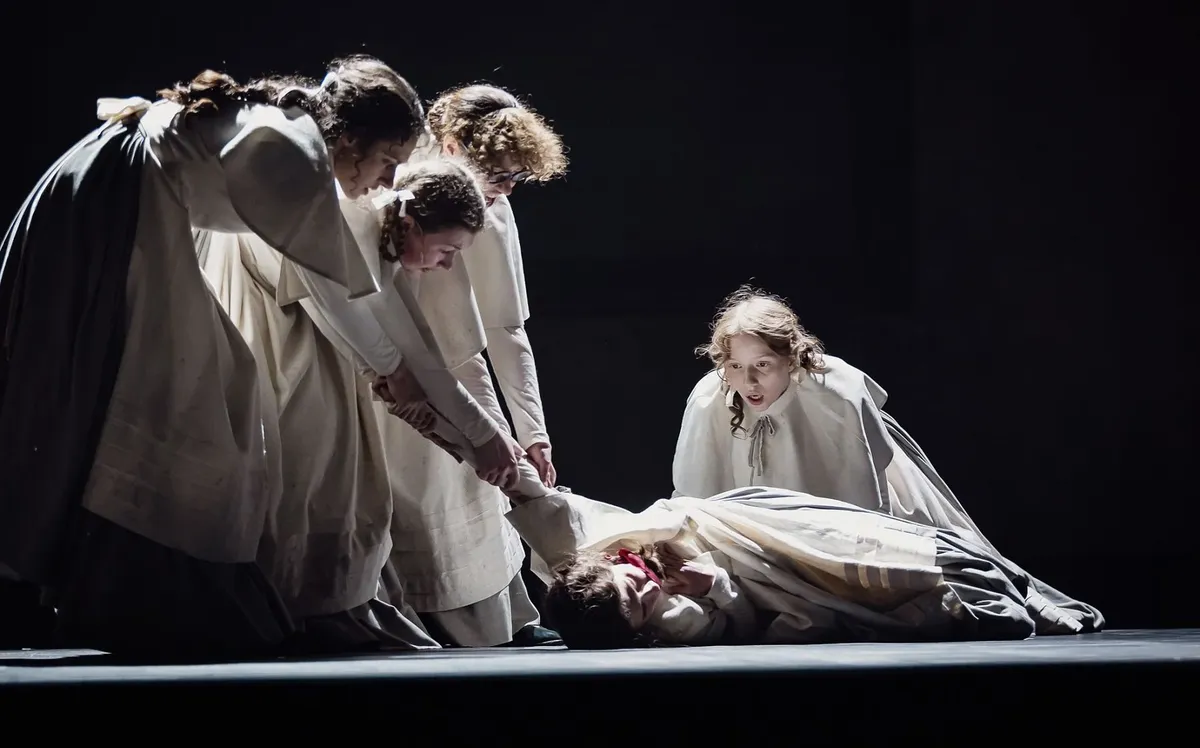
The second part is Smolny. Noble girls are mostly from impoverished families. Epic girls. Tsevlovskaya’s painful personal experience in all its details. Pointers under the back for posture. And books are on their heads: not for reading. Embroidery hoop in hands.
They are cane puppets in the hands of puppeteers - stern classy ladies. And when one of the girls dies, she herself will turn into a doll and will be taken away from the stage. The informer Mademoiselle Tyubyaeva. Stick discipline and tasteless food. The petrified headmistress "Her Ladyship." And suddenly a ray of light in the icy kingdom of tyranny and scolding - teachers of the new formation Ushinsky and Vodovozov. Living people and living texts: Gogol, Fonvizin, Pushkin. Living thoughts are like a breath of freedom.
And behind the memoir outline of a family novel and a coming-of-age novel is the story of the search for freedom and one’s own identity, the history of the country and social transformations from the abolition of serfdom to education reform. But the director sews and embroiders all the relevant thoughts and parallels with colorful metaphors and therapeutic intonation, plays the magic of the theater, erasing the boundaries between the earthly and the sacred, days gone by and the present, from performance to performance he talks about the fragility of human life.
MORE ABOUT CINEMA
Larisa Malyukova runs a telegram channel about cinema and more. Subscribe here .