
Translated material
Repairs to the temple, knight's cross and Order of Friendship
Who is Patriarch Theophilus III of Jerusalem, whom Trump allegedly chose as a mediator in the Russian-Ukrainian settlement

Theophilus III. Photo: ZUMAPRESS.com
In exchange for a knight's cross
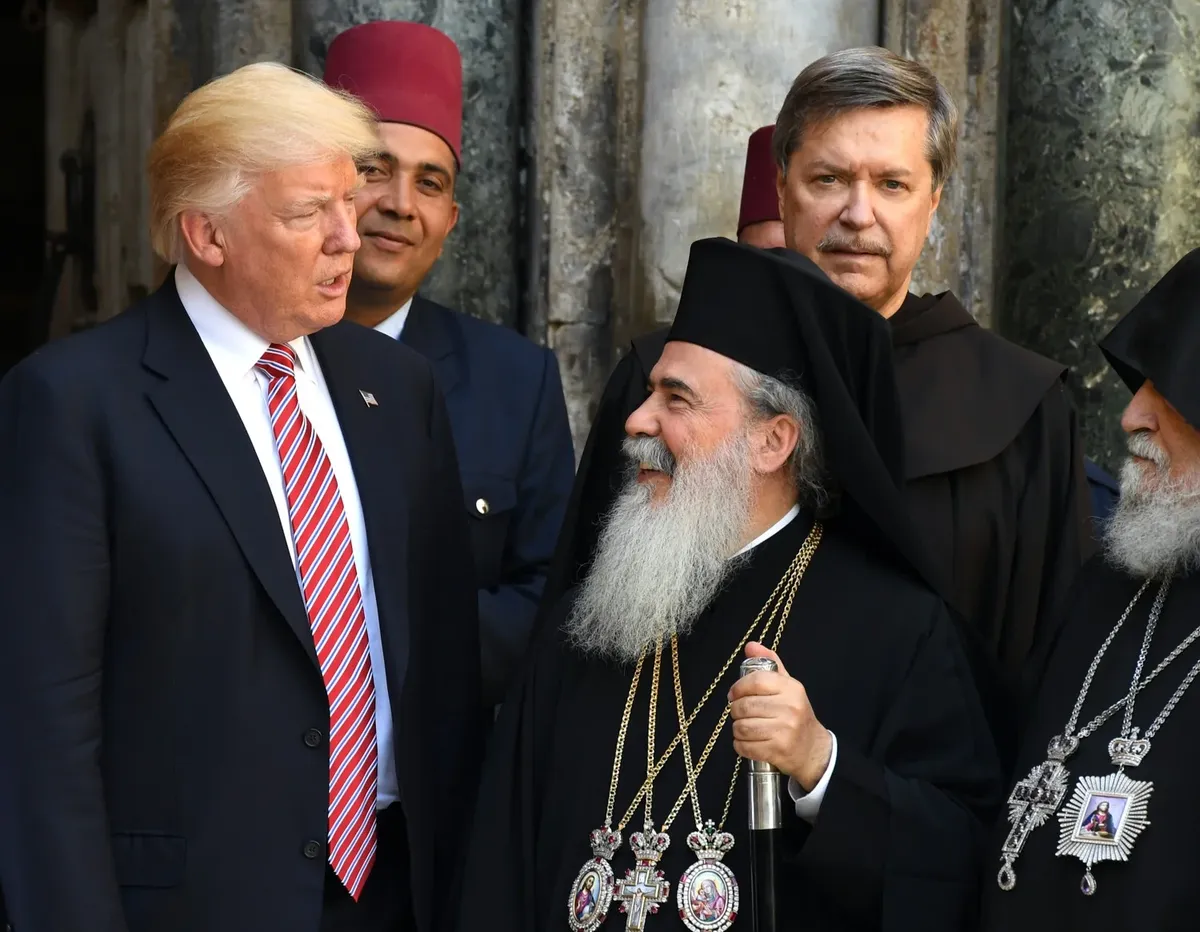
The last time the Patriarch of Jerusalem visited the White House was more than 60 years ago. It was Benedict I, and John Kennedy received him. It is not surprising that the visit of the current Patriarch of the Holy City, Theophilos III, to the office of Donald Trump, which took place on June 5, is recognized as historical in the Orthodox world. The main outcome of the meeting was especially loud: the US President asked the 4th most honored patriarch of world Orthodoxy to talk with Vladimir Putin about ending hostilities in Ukraine. The visit of Theophilus III to Moscow, where at the beginning of the century he already served as the official representative of his patriarchate, is scheduled for the end of the month.
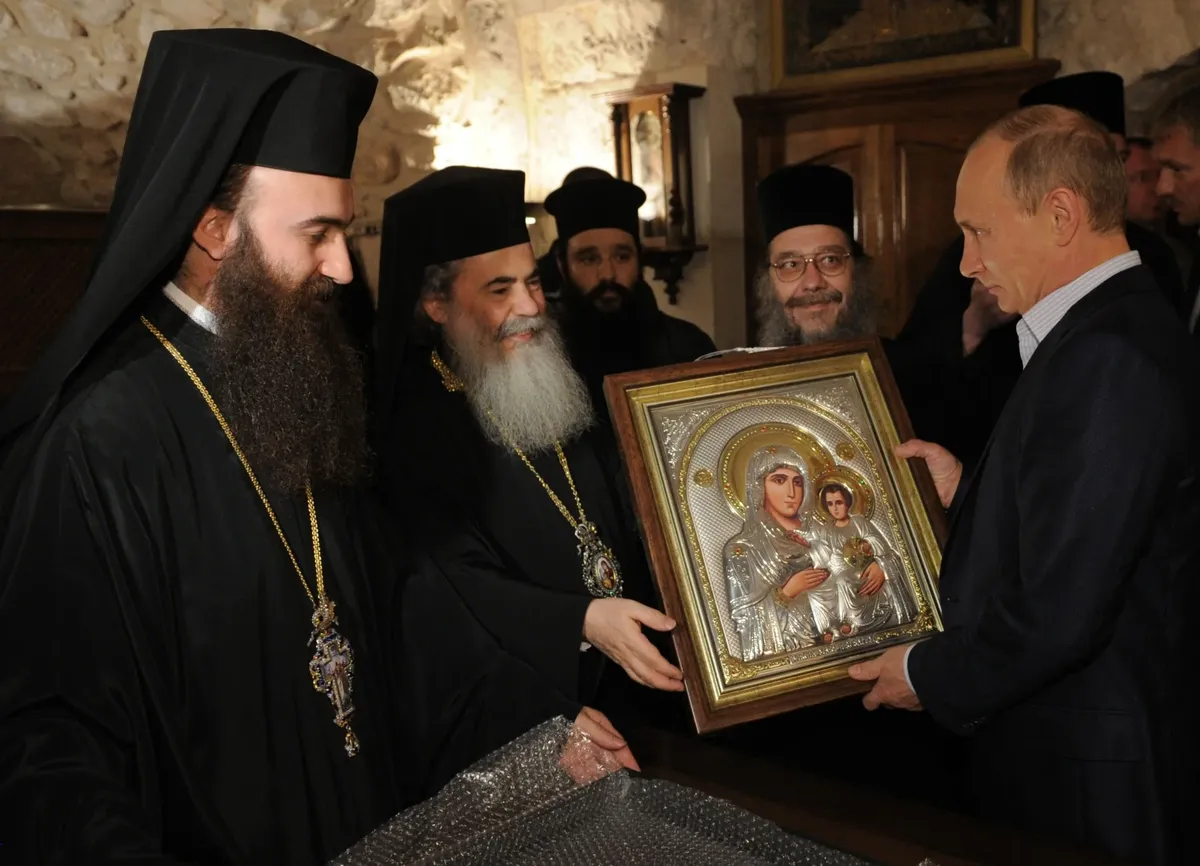
Putin quite favorably perceives the current primate of the Jerusalem Church and considers him friendly to Moscow. Twice the head of the Russian Federation visited Theophilus in Jerusalem, and in 2013 and 2019 the Patriarch of the Holy City visited Moscow. More recently, in 2025, Putin awarded Theophilus the Order of Friendship “for information support of events on the occasion of the 80th anniversary of the Victory.” For my part,
Theophilus successfully participated in negotiations for the release of Israeli Naama Issachar from a Russian prison in 2020 and never directly condemned the SVO - unlike most primates of local Orthodox churches.
Donald Trump, who adores all kinds of awards and believes in his special connection with the Holy Land, was moved when the Patriarch presented him with the Knight's Grand Cross of the Order of the Holy Sepulchre, the highest award of the Jerusalem Patriarchate. The US President promised the Patriarch support in defending the status quo of holy places in Jerusalem, which almost shook at Easter this year, when the Israeli authorities, due to the bombing of the capital by Iranian missiles, for some time denied pilgrims access to the most important shrines of Christianity.
However, to consider Patriarch Theophilos as a new “mediator” or even “Trump’s envoy” would be too reckless due to the fact that this figure is not taken seriously in Kyiv. Firstly, it is too well known about the close contacts (including financial) of the Patriarch with Moscow. Secondly, he categorically does not recognize the autocephaly of the Orthodox Church of Ukraine (OCU), granted by the Constantinople (Ecumenical) Patriarchate in 2019, sharing the Moscow narrative that it is a “schismatic” church (for Ukraine, the OCU remains a kind of national project opposing Moscow’s ecclesiastical jurisdiction over the Kyiv Metropolis). Nevertheless, it is worth taking a closer look at the figure of the Jerusalem primate, heading along the rather unusual route “White House - Kremlin”.
The source of the Kremlin's legitimacy
The ninety-seventh Patriarch of the Holy City of Jerusalem and All Palestine Theophilos III is 74 years old. He was born in the Greek Peloponnese, but since the age of 22 he has lived in Jerusalem, under the Greek Patriarchate. In 1970, he graduated from the patriarchal school of the Jerusalem Patriarchate and became a monk, then studied at the Faculty of Theology of the University of Athens and at the prestigious Durham University in England, where he received a master's degree in historical theology. The young archimandrite with international experience and knowledge of languages turned out to be in great demand in the Jerusalem Patriarchate - he headed its department of external relations and represented his church abroad, in particular in Moscow (2001–2003). Thanks to the experience of serving in Cana of Galilee, where Theophilus had a mainly Arab flock, he received a reputation as “pro-Arab,” which only strengthened after his appointment to a parish in Qatar.
Theophilos became bishop only in 2005, six months before his election as patriarch, which immediately followed the high-profile expulsion of Irenaeus I (Skopelitis) from the See of Jerusalem. He served as patriarch for only four years, after which the synod of the Jerusalem Patriarchate accused him of abuses of church property in the Old City and deposed him, and then defrocked him.
Irenaeus did not recognize these decisions and lived until his death in 2023 in one of the rooms of the Patriarchate, virtually under surveillance, receiving a reputation in ultra-conservative church circles as a “confessor of the faith.” The Arab flock was especially outraged by the activities of Irenaeus, since the patriarch transferred the church facilities to the nationalist Jewish organization Ateret Kohanim, accused of displacing Christians and Muslims from the Old City of Jerusalem.
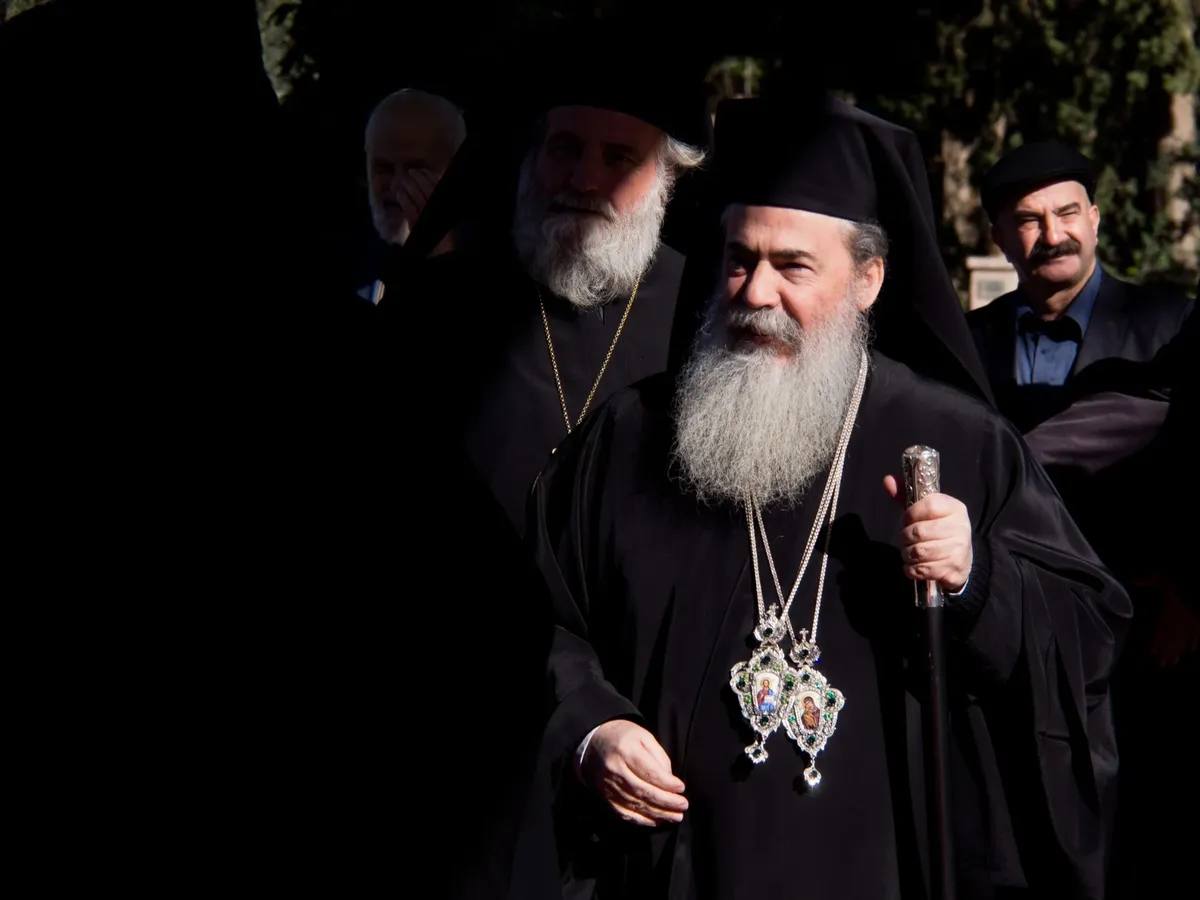
Against this background, Theophilus became patriarch, relying on Arab support, was immediately recognized by the Jordanian king (having the status of “guardian” of the Muslim and Christian shrines of the Old City of Jerusalem), but for a long time did not receive recognition from the Israeli government.
Theophilos’ already quite long patriarchate is a constant balancing act between Moscow, the main sponsor of Orthodoxy in the Holy Land, and Washington, where the interests of the Jerusalem Church are lobbied by the influential Greek community
(The Order of Orthodox Archons operates in the USA, which, in particular, includes billionaires John Kalamos and George Agyros).
The most symbolically significant project for the Russian Orthodox Church and the current Russian regime in Jerusalem was the “Descent of the Holy Fire” on the evening of Holy Saturday. The Easter celebration begins with the live broadcast of this ritual, for which the NTV channel has exclusive rights in Russia. The St. Andrew the First-Called Foundation, headed by the former head of Russian Railways Vladimir Yakunin, also retains the exclusive right to deliver the Holy Fire to the Russian Federation on a specially chartered plane. The main Easter service of the Russian Orthodox Church traditionally begins with Yakunin handing over a piece of this fire to the patriarch on the pulpit of the Cathedral of Christ the Savior.
According to the official version, the Holy Fire is sent by God from heaven only on Orthodox Easter and only to the Orthodox Patriarch, and in the year when it does not “descend”, the end of the world will begin. Belief in the Holy Fire is intended to strengthen in Russians another belief that is more important for the authorities - that “we are doing everything right, victory will be ours.” Thus, the annual miracle turned into a mystical source of legitimacy for the Kremlin power.
Therefore, the recognition of Patriarch Theophilus, made in 2008 at a meeting with Russian journalists, that the Holy Fire ceremony was “the same representation as all other services of Holy Week” was very painful for the Russian Orthodox Church. “He probably couldn’t have spoken more openly about the lighter in his pocket,” Deacon Andrei Kuraev* commented on this confession at the time. Regarding the role of Russia in the Holy Land, the Patriarch spoke as follows: “Since the time of Empress Catherine, the main thing for Russia is not the Balkans, but Jerusalem. Since then, nothing has changed... Russia is committing cultural and political aggression here.”
However, later Theophilus III “made amends” and repented - he went to Moscow twice, met with Putin and never returned to the topic of the Holy Fire. By his order, the Jerusalem Patriarchate changed the very time of this service to make it more convenient for Russian television viewers and the St. Andrew the First-Called Foundation. This Foundation regularly allocates grants for various kinds of social projects of the Jerusalem Patriarchate, and the Imperial Orthodox Palestinian Society, headed by the former Prime Minister of Russia (and former director of the FSB and head of the Ministry of Internal Affairs!) Sergei Stepashin, invests even more in the Holy Land. Directly across the wall from the Church of the Holy Sepulcher is the Alexander Metochion, which is patronized by the society. Is it any wonder that even after several years of the SVO, which, in general, does not find much support in the Orthodox world, Patriarch Theophilus calls Vladimir Putin “the trump card of Orthodoxy”?
Mission Impossible
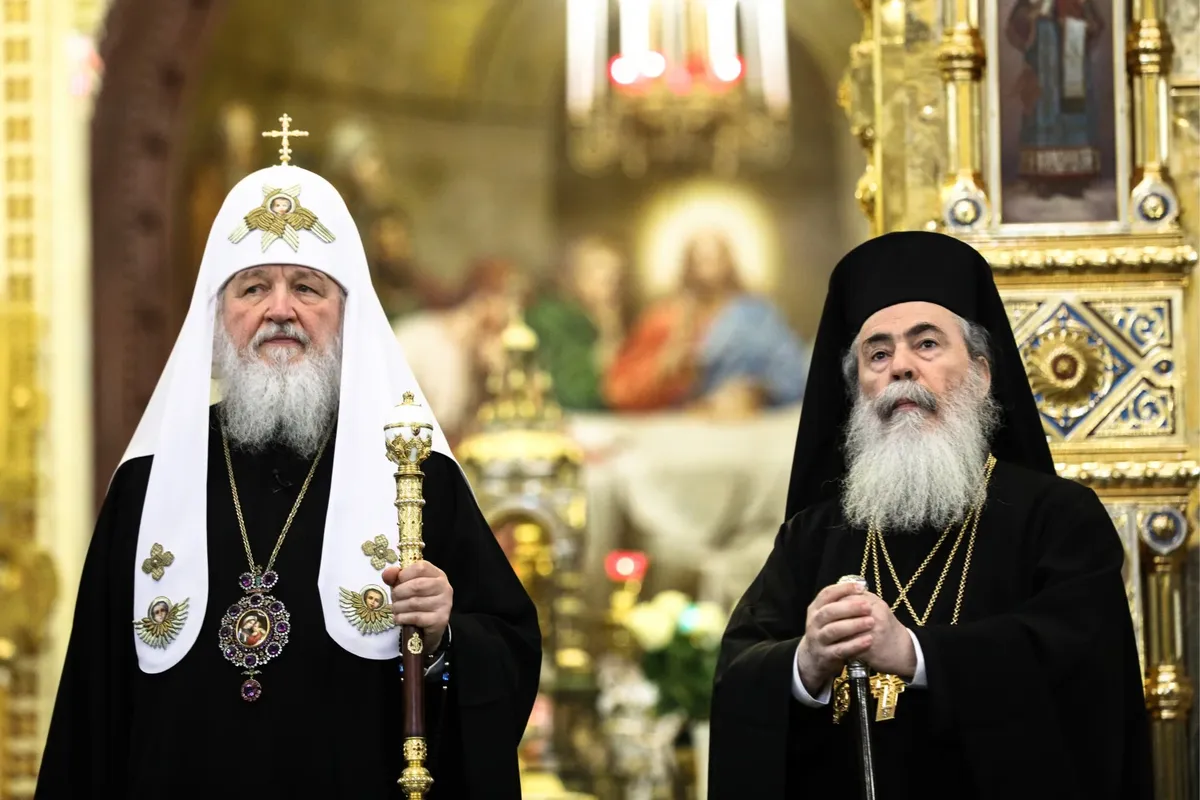
A major joint project of Patriarchs Theophilos and Kirill was an attempt made in 2020 to launch the “Amman format” as an alternative to the “globalist ambitions” of the Patriarch of Constantinople.
The idea of convening the primates of local Orthodox churches in Amman, the capital of Jordan, bypassing Patriarch Bartholomew of Constantinople, was born during Theophilos’ visit to Moscow in November 2019, when the head of the Jerusalem Church received an award from the International Foundation for the Unity of Orthodox Peoples, a recognized instrument of Moscow’s “soft power” in Orthodox countries. On the official website of the foundation, support for Kremlin-friendly patriarchates and certain “programs in the Holy Land” are repeatedly mentioned (albeit vaguely). Among the foundation’s “spot” projects in Israel are the construction of pilgrimage centers in Tiberias and Jaffa and the organization of the “Pilgrim” service with special flights to Tel Aviv. It is obvious that, given the relative small number of Christians in the canonical territory of the Jerusalem Patriarchate, it is the pilgrimage business that forms the basis of its financial well-being.
However, the project of creating on the basis of the Jerusalem Patriarchate an alternative center of world Orthodoxy to Constantinople, controlled by Moscow, was a fiasco. At the first meeting in Amman, in addition to its organizers, only Moscow’s faithful satellite Patriarch of Serbia and the Metropolitan of the Czech Lands and Slovakia, as well as observers from the Romanian and Polish churches, arrived. Patriarch Bartholomew of Constantinople sent a rather harsh letter to Patriarch Theophilus, recalling the ancient Orthodox canons, which give only the throne of Constantinople the right to convene meetings of primates and Pan-Orthodox councils. Although Moscow continues to dispute this right, most local churches recognize it.
…So far, Donald Trump’s initiative to involve Theophilus in the peacemaking process has found a response only in Russia. Orthodox-patriotic media habitually contrast the “close-minded” patriarch with Cardinal Mateo Zuppi, Pope Francis’ special representative on Ukrainian-Russian settlement issues. Unlike Theophilus III, he could make shuttle trips between Moscow and Kiev, but this did not bring much success.
But the response was varied. For example, the Union of Orthodox Experts, which represents the most radical wing of supporters of the SVO and Patriarch Kirill, has already called Trump’s agreement with Theophilus a “disgusting cheap provocation” that will in no way bring the end of hostilities closer. At the end of 2023, the Patriarch of Jerusalem already announced (at a meeting with Pope Francis) his decision to reconcile “the Orthodox peoples of Russia and Ukraine.” Sources in the Moscow Patriarchate confidentially report that then the matter ended with another request for financial support from the Russian Orthodox Church - something similar is expected now, because large-scale renovations are ongoing in the Church of the Holy Sepulchre.
One can understand Trump’s religious euphoria associated with faith in the mystical power of Jerusalem and the Holy Land, but it is obvious that this time Patriarch Theophilus will limit himself to contacts with Moscow in the interests of his patriarchate. If we assume some kind of pragmatic calculation in Trump’s proposal to Theophilus, we will have to admit that it is aimed at prolonging military action. In Kyiv, Theophilus is perceived as an absolute obedient to Moscow, who does not even make contact with the Ukrainian embassy in Israel. “The man has taken a clear position,” a representative of the diplomatic mission told Ukrainian journalists, “he hugs the Russian ambassador, participates in Russian events.”