
Translated material
Limits on gasoline in the Volga Federal District, a blow to Cheboksary, attacks on oil refineries. Podcast
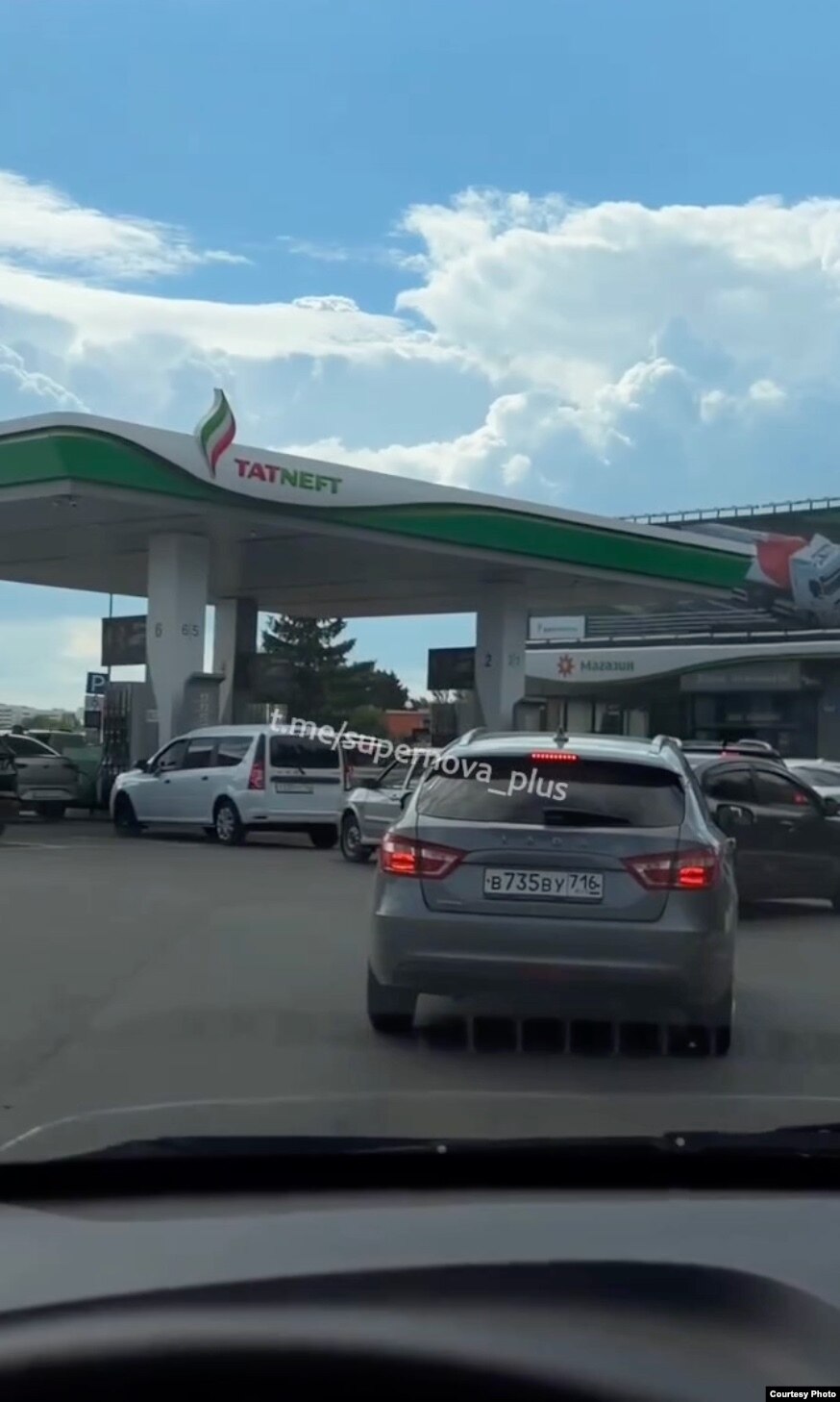
Gas stations in Tatarstan introduced restrictions on the sale of gasoline after attacks on oil refineries. A drone hit a residential building in Nizhnekamsk. A Ukrainian Flamingo missile attacked a defense plant in Cheboksary, and drones attacked the Kuibyshev Oil Refinery and Togliattikauchuk. The Ministry of Finance of Tatarstan reported a drop in tax revenues from large enterprises. These and other news are in the weekly column “Volga region: the price of war.”
Petrol limits
Last weekend, motorists in Tatarstan were faced with the fact that fuel restrictions were introduced at some gas stations in the republic. Judging by the videos published on the Internet, at least Tatneft and Taneko gas stations only allow 20 liters of fuel, and diesel fuel is not available everywhere.
On June 13, authorities in Tatarstan officially introduced restrictions on the sale of fuel “at certain gas stations.” This was announced by the head of Tatarstan Rustam Minnikhanov at a meeting of the headquarters for ensuring the sustainable operation of the fuel and energy complex.
The corresponding release was published on the website of the head of the republic. It says that queues for the purchase of fuel have been recorded at some gas stations in Tatarstan. “In order to avoid artificial excitement and ensure a stable situation, technical work is being carried out, as a result of which time limits have been introduced at certain gas stations,” the message said.
The restrictions were introduced after the Ukrainian military attacked the TANECO oil refinery in Nizhnekamsk, which is part of the Tatneft group, on June 12. Astra wrote that Taneco is one of the most efficient refineries in Russia."
A UAV hit a residential building in Nizhnekamsk
On Friday morning, June 12, another drone that attacked Nizhnekamsk hit a residential building in the city. The head of the republic, Rustam Minnikhanov, announced this. According to officials, four people were injured.
Baza reported that local residents heard the sounds of drones flying around five in the morning.
“One of the drones crashed into the upper floors of a 12-story building. After the impact, debris fell into the yard and damaged parked cars. A fire started at the site of the impact,” wrote Baza.
At the same time, journalists from the publication Astra later came to the conclusion that the explosion in the house could have occurred not at the moment the UAV hit, but a short period of time after. According to the media, either the warhead of a drone that had previously hit the house could have detonated, or gas equipment in one of the apartments, damaged as a result of being hit by a drone.
Attacks on Samara and Tolyatti
The Samara region, neighboring Tatarstan, was also attacked by UAVs on June 12. The General Staff of the Armed Forces of Ukraine stated that JSC Togliattikauchuk, one of the largest petrochemical enterprises in Russia, located in Togliatti, was hit.
The regional governor, Vyacheslav Fedorishchev, said that, according to preliminary data, no one was injured.
An OSINT analyst for the Astra publication also came to the conclusion that the UAVs attacked Togliattikauchuk. Journalists recalled that the enterprise is in the closed register of defense enterprises of the Russian Ministry of Industry and Trade and is part of the Tatneft PJSC group.
“The enterprise occupies an important place in the production chains associated with the military-industrial complex: the rubbers produced here are used in the manufacture of tires and rubber products for military vehicles and special equipment, as well as components used in aviation and other industries,” - Astra clarified.
This is not the only attack on the Samara region over the past week. On June 10, Governor Fedorishchev reported that three people were injured as a result of a “massive drone attack.”
"Several dozen UAVs were shot down by air defense forces and mobile combat groups. Unfortunately, as a result of the attack, damage was recorded at several industrial enterprises. Emergency services are working on the ground. Three residents of the region were injured. They are receiving the necessary medical care," — Fedorishchev wrote.
The official did not say which specific enterprises were attacked. At the same time, the Astra publication established that the Kuibyshev Oil Refinery in Samara was attacked and caught fire. President of Ukraine Vladimir Zelensky and the General Staff of the Armed Forces of Ukraine also announced a blow to this enterprise.
On the same day, June 10, Reuters, citing two industry sources, reported that the Kuibyshev Oil Refinery stopped refining oil after a drone attack.
A Flamingo missile attacked a defense plant in Cheboksary
On the morning of June 10, Cheboksary came under a missile attack - the VNIIR-Progress defense plant was attacked. Sirens and missile alerts sounded throughout the city.
In the Telegram channel “Angry Chuvashia,” according to local residents, they said that city residents heard the first explosion at about 05:44, the second at about 06:22. “After the strikes, a shock wave was felt in different parts of the city, and smoke was observed,” the authors of the channel wrote.
Later, the head of Cheboksary , Stanislav Trofimov, appealed to residents with a request to “refrain from bringing children to school camps and kindergartens until further notice.” And then videos of the arrivals themselves and the consequences of the attacks appeared. It is noteworthy that for the first time in the video of the Ukrainian monitoring channel Supernova+ it was possible to see the Flamingo rocket flying in the sky over Cheboksary.
Three people were injured as a result of the attack. According to the head of Chuvashia Oleg Nikolaev , two victims are in moderate condition, the third is in mild condition. “Nothing threatens people’s lives. One has already been released home,” Nikolaev wrote.
Astra clarified that the administrative building of VNIIR-Progress is “presumably significantly destroyed.” Later, Ukrainian President Vladimir Zelensky confirmed that the attack on Cheboksary was carried out by Flamingo missiles:
“The plan for our Ukrainian long-range sanctions is being carried out absolutely clearly. <...> A military plant in Cheboksary was damaged. 900 km from Ukraine, where Ukrainian Flamingo missiles were used.
Two days later - June 12 - the head of Cheboksary Stanislav Trofimov reported that 42 houses were damaged as a result of the attack.
Let us remind you that VNIIR-Progress produces Comet antennas for the Russian army, which protect the drones of the Russian Armed Forces from Ukrainian electronic warfare systems. The previous missile attack on the plant occurred on May 5 this year.
Missile danger in the Volga Federal District
On June 10, when Cheboksary was attacked by Flamingo missiles and Samara by UAVs, a missile threat was declared in several other regions of the Volga region. We are talking about the Nizhny Novgorod and Ulyanovsk regions, Mari El, Mordovia and Tatarstan.
Why did the alarm cover such a large area? The answer lies in Ukraine's tactics to bypass air defense systems.
According to OSINT analysts of the CyberBoroshno project, who simulated the flight of Flamingo missiles, these air targets were detected by radars and local residents mainly at two points: at the very beginning of the route and already on approach to the facility in Cheboksary. The entire middle of the path, the missiles traveled in the so-called “blind zone” - along a complex, winding trajectory, deliberately skirting large cities.
“According to available data from open sources, it can be confirmed that approximately 5 missiles were shot down: 2 were shot down on approach to Chuvashia, and one was shot down just before the facility in Cheboksary. Thus, probably, two missiles reached the target,” wrote the authors of the CyberBoroshno channel.
In Tatarstan it was proposed to teach children how to protect the population
Last week, Tatarstan was visited by the Minister of Civil Defense, Emergency Situations and Disaster Relief Alexander Kurenkov .
The purpose of his visit was a meeting of the organizing committee for the preparation and holding in Kazan of the so-called “International Salon of Safety Equipment “Integrated Security - 2026” and a kind of acquaintance with the construction of a new training center for rescuers in Kazan.
At this meeting, the head of Tatarstan Rustam Minnikhanov hinted that ordinary people, including children, should be involved in the work of the future training complex.
— When I saw today, of course, in the summer, we should set up a summer camp there. And invite young friends of firefighters or the Ministry of Emergency Situations, rescuers and give them life skills. We exchanged while we were in Minsk, and visited the center of the Ministry of Emergency Situations... We specially went to Belgorod and learned from experience on how to protect our population. And the best thing is the children... Show the children, teach them, and they show their parents,” Minnikhanov said.
Let us note that the Kazan delegation traveled to Belgorod last spring to learn from experience in protecting the city from UAV attacks.
In his speech, Minnikhanov also mentioned “Zarnitsa”, which is held for children at the tank school in Kazan.
Since the Russian invasion of Ukraine began in 2022, the educational sector in Russia has been militarized. Propaganda lessons “Conversations about Important Things” began to be taught to schoolchildren; war veterans, including former convicts, regularly come to educational institutions, and students are involved in militaristic events.
YouTube blocked videos advertising Alabuga Polytech College
The network continues to block videos advertising the Alabuga Polytech College in Tatarstan, where drones are assembled. This time, YouTube removed more than 60 videos.
In May, TikTok also blocked the accounts of bloggers advertising Alabuga Polytech. Among them were accounts with an audience of millions. Before this, a wave of blocking occurred on Twitch.
“Apparently, the videos were removed due to a legal complaint, which may mean that YouTube removed the video after a legal review from some government agency or other authorized entity,” said blogger Alexey Gubanov (Jesus).
In addition, he suggested that the platform also deleted the Alabuga channel itself, since now it does not exist, but in 2025 it was still active.
Ukrainian Foreign Minister Andriy Sibiga welcomed this decision. He expressed hope that “the process will continue.”
"Alabuga Polytech" is a college in the special economic zone "Alabuga" in Tatarstan. After the start of the full-scale Russian invasion of Ukraine, the production of Iranian Shahed drones was organized there. Even minors are involved in assembling drones. The college is under EU sanctions.
Deaths and numbers
Over the past week, Idel.Realii identified the names of 300 military personnel from 15 Volga regions who died in the war in Ukraine. 111 of them are natives of the Perm region.
Bashkortostan is the leader in the number of identified deaths: the war claimed the lives of at least 10,236 military personnel from the republic. Next on the list are Tatarstan and the Perm Territory.
In total, in the Volga region, plus the Astrakhan region, the names of 56,306 dead military personnel are known. In Russia as a whole, according to calculations by Mediazona and the BBC Russian Service as of June 12, at least 226,055 people died.
Tatarstan reported a drop in tax revenues from large enterprises
An unusual trend has been recorded in the economy of Tatarstan: business is getting poorer, and people are paying for two. Over the past three years, the republic's treasury has lost billions of rubles from income taxes.
Last year alone, business tax deductions fell by almost 20 billion rubles, and the first quarter of 2026 showed a drawdown of another 15% compared to the same period in 2025. The Minister of Finance of the Republic , Marat Faizrakhmanov, announced this at a meeting of the State Council of the Republic.
The bulk of income tax revenue - almost 60% of the total - was provided by oil production, gas industry and service companies, transport, communications and information companies.
It would seem that if tax payments have fallen so much, then a hole should form in the budget. But taxes from citizens - personal income tax - came to the rescue of the financial sector of Tatarstan. In 2025, the consolidated budget of the republic received more than 223 billion rubles of such taxes - this is more than 30 billion more than a year earlier.
These same taxes helped bring the consolidated budget balance to zero.
“The positive dynamics of tax receipts was influenced by the increase in average wages in the economy,” Minister Faizrakhmanov emphasized.
According to the latest data, in 2025 the average salary in Tatarstan was about 90 thousand rubles. Its growth over the year was 20%. And personal income tax collections increased by 15%. In April 2026 (these are the latest current data ), the average salary is slightly above 94 thousand rubles.
However, as Izvestia wrote with reference to the Central Bank at the end of 2025, last year net income growth (minus increased prices) turned out to be two times lower than the authorities’ forecasts - 2.5%. In 2026, Russians are promised a nominal increase of another 8%, but due to the high prices in stores, the actual wallet will become minimally heavier. Simply put: more money comes to the card, but you can buy the same amount with it.
Subscribe to our channel on Telegram .