
Translated material
Burning roofs of shrines
The Assumption Cathedral of the Kiev Pechersk Lavra survived many wars over 10 centuries. It was blown up and burned by both our own and others

A fire on the roof of the Assumption Cathedral of the Kiev Pechersk Lavra, which occurred as a result of a hit (either a missile or a drone - the parties to the military conflict are giving conflicting information). June 15, 2026. Photo: social networks
It was destroyed in 1941, but not completely. Restored. It burned on the night of June 15, 2026, but will undoubtedly be revived again. The main temple of the main monastery of Kievan Rus is today included in the “alarming” part of the UNESCO World Heritage List and is under special protection of the 1954 Hague Convention. It introduces international criminal liability for damage to World Heritage sites.
It is not surprising that after what happened on the night of June 15, the main cultural agency of the UN strongly condemned the hit (either by a missile or a drone - the parties to the military conflict give out conflicting information) on the Dormition Cathedral of the Lavra - “one of the most significant spiritual and cultural monuments of Ukraine.” Judging by the photographs, the main explosion hit the altar part of the Stefanovsky chapel of the cathedral, and fragments were scattered across the roof of the temple in a wide radius. Part of the fresco painting was destroyed, and nearby museum storage facilities and a library were damaged.
...According to legend, the construction of the Assumption Cathedral of the Kiev Pechersk Lavra was initiated in the middle of the 11th century by the Monk Theodosius of Pechersk, the second abbot of the monastery, at the behest of the Mother of God.
The stone temple, gigantic by the scale of that time, was built in just three years at the expense of princes Izyaslav and Svyatoslav - the sons of Yaroslav the Wise - and became a princely tomb.
Later, during the Hetmanate, Cossack elders - hetmans, atamans, colonels - were buried in the basement of the cathedral and near it. And the monastery itself gradually turned into a kind of old age home for lonely heroes of the Zaporozhye Sich.
Old Russian chronicles called the Assumption Cathedral the Great Church, which served as the architectural prototype of many cathedrals in different parts of Rus' (some even adopted its name - for example, the Assumption Cathedrals in Vladimir-on-Klyazma or Rostov the Great).
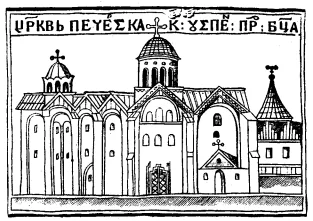
For the first time, the cathedral and the entire monastery were destroyed by “their own” - the Suzdal prince Andrei Bogolyubsky and his Polovtsy allies - in 1169. Then - the hordes of Khan Batu in 1240: then most of the monks died during the storming of the monastery, and the survivors fled. The restoration of the usual way of monastic life began only in the 14th century. The next aggressors came to the monastery in 1482: Moscow Prince Ivan III initiated an attack on Kyiv (which was part of the Grand Duchy of Lithuania) by his ally, the Crimean Khan Mengli-Girey. The monastery was then completely plundered, and the brethren were taken into captivity.
Under Peter I, in 1718, a mysterious arson of the Lavra occurred from several sides at once. In the greatest fire in the entire history of the monastery, the Lavra library and archives burned down, the documents of which proved the independence of the monastery and the entire Kyiv Metropolis from Moscow.
In Ukrainian historiography, the opinion has become established that the arson was sanctioned by the emperor - as part of the then struggle against the “Mazepa” and the remnants of the Cossack freemen.
Be that as it may, as a result of the fire, only the foundation and part of the wall remained of the ancient Assumption Cathedral; it was rebuilt in the Ukrainian Baroque style.
The cathedral was almost completely destroyed by an explosion on November 3, 1941, two months after the capture of Kyiv by the Germans. Historians are still arguing: whether the explosives planted during the retreat of the Red Army under many city objects detonated, or whether the explosion was caused by the Germans. Only the chapel of St. John the Evangelist with the golden dome above it survived the 1941 explosion.
The cathedral was restored in its modern form by the government of Ukraine for the 2000th anniversary of Christianity. Both in Soviet times and during the years of independence, it legally belonged and still belongs to the national reserve “Kievo-Pechersk Lavra”, but until 2023, services in the cathedral were performed by the “pro-Moscow” Ukrainian Orthodox Church (UOC). As Novaya wrote , the abbot of the Lavra, according to the UOC, Metropolitan Pavel (Lebid), supported the SVO in his own way and found himself under house arrest. And after a song glorifying “Mother Russia” was sung in one of the monastery’s churches, the Ukrainian authorities terminated the agreement on the free use of the monastery with the UOC monastery.
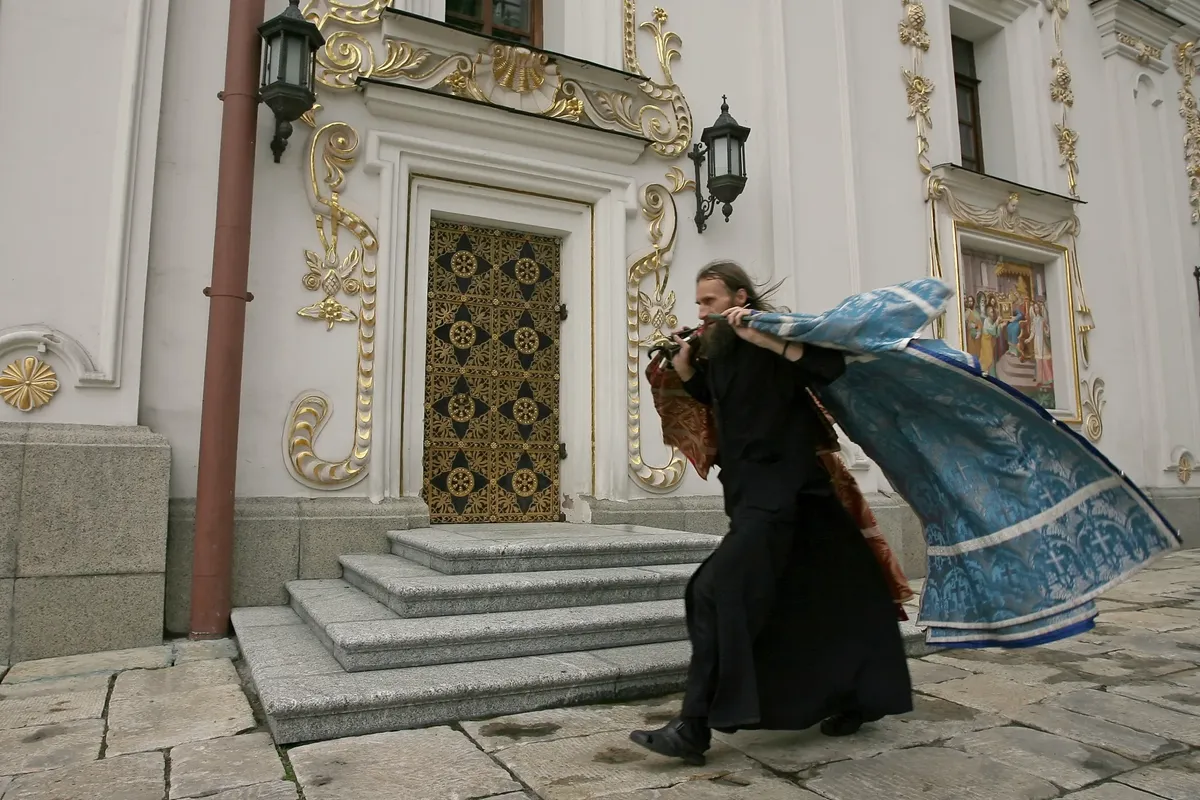
Now this church, which is trying to distance itself as much as possible from the Russian Orthodox Church, but does not break the church-canonical connection with it, serves in one of the Lavra’s churches, the rest are gradually transferred to the use of the autocephalous Orthodox Church of Ukraine (OCU), which in Moscow is called schismatic. For the last couple of years, it was she who performed divine services in the Assumption Cathedral; it was her clergy and seminarians who carried icons and utensils out of the burning church on the night of June 15.
After restoration, the cathedral largely served as a museum, and there were no relics significant for Orthodox Christians in it.
The main object of attraction for pilgrims in the Lavra has always been and remains the Far and Near Caves, where the relics of 122 Kiev-Pechersk saints rest. Recently, the “Moscow” Church Slavonic inscriptions above their crayfish were replaced with Ukrainian ones.
The upper part of the monastery, with its 76-meter bell tower, which remains the architectural dominant of the Pechersky district of Kyiv, has always remained more or less a museum space - in post-Soviet times, the monks came there as guests, strictly on schedule. The Kiev Pechersk Lavra was inactive from 1920 to 1941 and from 1961 to 1988. During the Soviet years, only a small number of monks were allowed into the Far Caves complex.
Directly opposite the Lavra there is an object with a mysterious name for the Moscow ear “Mystetsky Arsenal” . The second part of this name obviously evokes military associations. The facility was also damaged that night - a significant part of its roof burned down. In fact, the object has nothing to do with storing weapons: this is the largest and most modern exhibition complex in Ukraine - so to speak, the personal brainchild of ex-President Viktor Yushchenko (“mystetsky” translates as “artistic”).
The complex is located in a completely rebuilt building of a military repair plant, which, in turn, grew out of the Old Pechersk Citadel, built under Peter I and Hetman Ivan Skoropadsky on the site of a destroyed convent. They say that the monastery was ruined because its last abbess was Maria (Mazepina), a close relative of the “independent” hetman Ivan Mazepa, whom Peter considered a traitor. Under Paul I, the citadel was converted into an Arsenal, where guns and gunpowder were actually stored until 2003.
The burning roof of the revived Assumption Cathedral of the Kiev Pechersk Lavra may become one of the most sensitive symbols of the ongoing military confrontation - at least for Christians. Like the burning roof of the “Defense of Sevastopol” panorama a few days earlier, it is a symbol of the fact that military conflicts deprive one of the ability to respect or at least see shrines and cultural monuments. They only allow you to see enemies.