
Translated material
Forbidden code
Attempts by adults to prevent children from using the Internet have no prospects. But this is the beginning of a big intergenerational conflict

British Prime Minister Keir Starmer wants to tighten regulation of social networks as his political legacy. Almost everything will be prohibited for teenagers, including chatbots for romantic communication. Tech companies are traditionally against it, while parents are in favor, and, judging by surveys, everyone, not just those whose children have suffered from bullying. This is the beginning of a great intergenerational conflict.
It seems that this is not all about the Internet at all, but about the conflict between “fathers and sons.” The former, at some point, forget that they themselves were small, and, having received power, try to take revenge for their childhood. The latter simply want to live their own lives.
Everyone has forgotten that our relationships with adults have fundamental features. The desire to escape from home to a hut built in the garden, one’s own language, often incomprehensible to elders, one’s own culture. This is natural and has nothing to do with family relationships at all. You can love your child as much as you like, take care of him as much as you like, but his desire to separate and stuff his own personal bumps will not go away.
Each generation has its own mythology of childhood, often truly unsafe. For boomers, this is, for example, saltpeter and carbide. Here every generation can throw in its own. Some were cheerful quadrobers, others were sad emo. Probably, modern shopping centers, where teenagers hang out in food courts, are safer in this sense than industrial zones and abandoned places, but I’m sure: there’s a lot we don’t know, and it’s probably for the best - it’s calmer.
Virtual space is no exception in this sense. Remember the language of “bastards”? KG/AM? “Preved”, “I am a crevedko”. Later, it’s a complete mess. Today there is a different vibe, sometimes turning into cringe...
In addition to the natural evolution of language, all this has a completely prosaic functionality - to show that “we are different.” And that's absolutely normal. The same applies to the platforms themselves. Different generations have different logic. They look at each other and sincerely don’t understand what’s funny. This, by the way, is an element of protection.
A conventional child will not read a long philosophical text, supported by graphs and statistics, just as a conventional adult will not even guess that there is a deep and extensive mythology behind stickers and emoticons.
Roblox is a great example in this regard. Most professional commentators not only have no experience working with the platform, but also cannot clearly explain what determines its popularity. For those who missed it, this is the next version of Minecraft. Only here, instead of a world made of cubes, you can create your own games and, of course, communicate with each other. It's more fun together. Just as Minecraft acquired its own culture, including a full-length film, Roblox, judging by the amount of specialized literature and courses for children, has become a platform for modern childhood.

Are there threats in the virtual space? Certainly. It would be stupid to deny this; people complained about Roblox not only in Russia. Mass communications naturally attract not only respectable participants, but also all sorts of dubious characters. But this is also beyond technology. The task of the platforms is to make convenient tools like the “complain” button, high-quality moderation of content that may be harmful, and, in general, that’s all. Neither platforms nor any government can solve global social problems. There are already a ton of laws on child protection, they are becoming stricter every year, but the problems have not gone away.
Let us state the main theses: intergenerational conflict is a common thing, any space, be it real or virtual, will always pose threats. Neither one nor the other can be fixed. This is part of our universe.
Then it's a little more complicated. To begin with: children are a very convenient argument. It’s very difficult to argue against “Do you want children to…”. Of course we don't want to. Tragedies that are inevitable, once in the spotlight, become the main driver of prohibitions. Looking into the eyes of parents who have lost a child and saying something about freedom is unrealistic. And this gives rise to a distortion expressed, let’s say, in excessive and often meaningless rigidity.
But besides practice, there is also theory. Imagine that you are a child, you are loved, everything is fine. But here adults are collectively trying to deprive you of your childhood and your own experience. Apart from aggression, such actions do not cause anything. This strengthens the already natural teenage protest. As a result, instead of trying to build trusting relationships, the gap between generations is only growing.
The consequences seem obvious, but apparently not for everyone. And this is where the myth that children are stupid comes into play. You can talk as much as you like about the stages of development of the frontal lobes, the age of making objective decisions and responsibility for one’s actions, but to completely deprive a young person of freedom, to put it mildly, is unfair.
The result will not be long in coming. The younger generation, born with a smartphone in their hands, will begin to independently solve the problems that adults have given them, fortunately there is artificial intelligence, which greatly facilitates the development of new products. Some models will be restricted for access, but there are others. After all, without any AI, this is a good reason to learn programming languages on your own. Made by children for children is already a reality.
Separately, I would like to remind adults: who taught you to use all the delights of the Global Wide Web? Who taught you video calls? Who do you run to when the Internet doesn't work? That's the same!
We found videocassettes with erotic films at home and knew how to climb onto the highest shelf, where the forbidden stuff lay. Do you think today's children can't handle blocking?
How exactly the war against prohibitions will take place is not so important. Someone will figure out how to bypass parental controls, someone will acquire alternative devices, someone may figure out the most banal solution - change the device region. Applications and services will mimic “legal” ones behind an icon depicting a textbook, and when parents approach, the interface will instantly transform from a gaming one into an educational one. Next is a question of imagination, and in children it is better developed. Adults, as we see, can only prohibit.
A logical question arises: what to do? And the answer is scary: nothing. Until the Internet became widespread, everything worked fine. Everything was decided by two institutions - the market and the community. The first forced us to regulate technology, the second - content. There were no politicians then, and the Internet was wonderful despite all its problems: sensitive content got onto the Network on the second day of its creation, like all sorts of bad characters. It’s hard to believe that the slogan Internet is for porn is an episode of the musical Avenue Q with the characters from Sesame Street. And nothing, everything was fine.
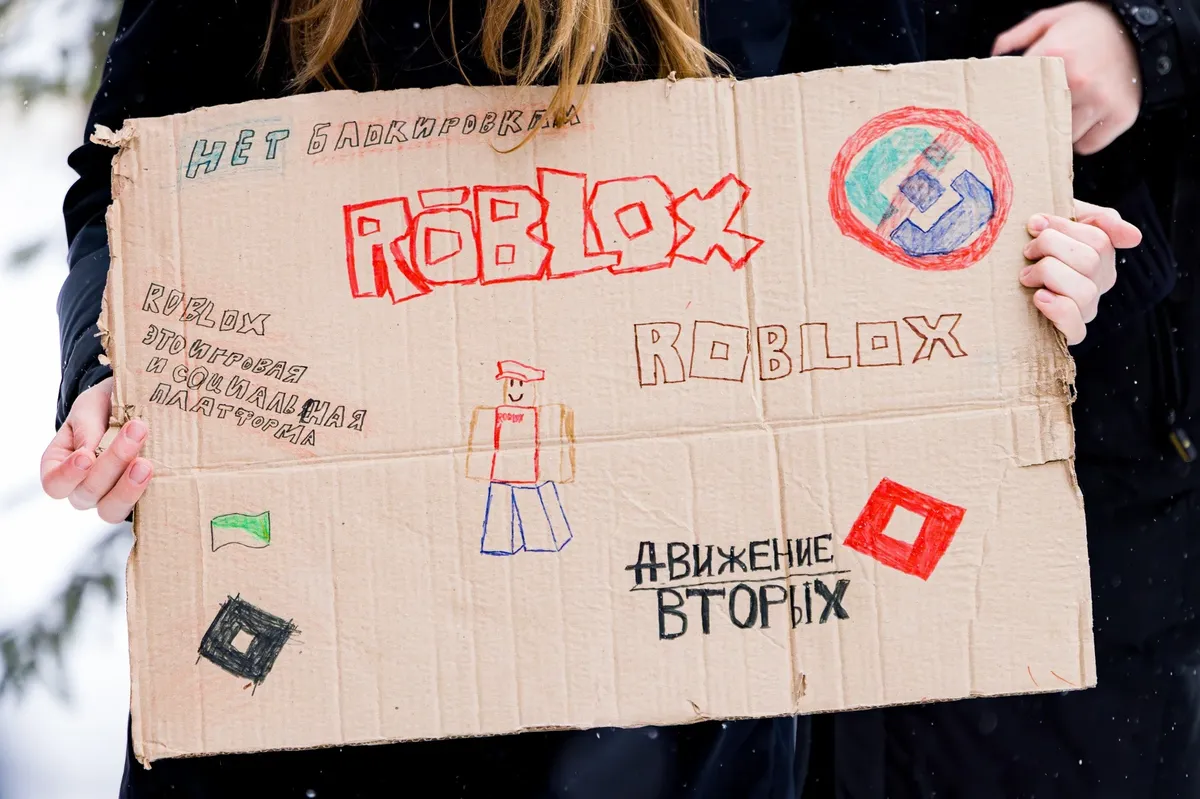
After six months of bans, Roblox is working again in Russia. Officials report that they have reached an agreement with the company. What traditionally turned out to be a lie - the platform long ago announced tougher communications.
In theory, everything works; In fact, as reported from the scene, chats are simply turned off. The main feature of the service is now unavailable. It would seem that you can rejoice. But time was not wasted.
Over these months, teenagers have not only mastered the means to bypass blocking, but also learned a lesson: the main threat to a happy childhood is adults who can deprive them of their favorite toy at any time. The reaction to the next ban may be more aggressive. And the next law will cause a completely different reaction. It is impossible to ban children. It's a shame that they have to prove it once again.