
Translated material
Agricultural judges of the Russian south are the tip of the iceberg
Why anti-corruption claims of the prosecutor's office against the lands of Kuban restore only half of justice

Photo: Sergey Karpukhin / TASS
In the spring of 2018, as part of the former Human Rights Council, I took part in a visiting meeting of the HRC in the Krasnodar Territory. Every second complaint that we received concerned the illegal - under the influence of violence or, more often, deception - seizure of a land share received as a result of the privatization of collective and state farms in the region in the early 90s.
The trip culminated with a meeting, in which the governor sat on the presidium, and the people in the hall, including participants in the famous “tractor march” of 2016. The governor’s smooth speech was soon interrupted by questions from the audience: “Who are the judges?” Mikhail Fedotov joked in his usual manner: “Maybe we should dissolve the courts altogether?” The audience exploded in response: “Yes! Disperse! We decided to hire!..”
In 2018, we were unable to help anyone in the Krasnodar Territory: mutual responsibility and corruption concreted the problem of land shares, as it seemed, forever. But in 2025, cracks suddenly appeared in this concrete - thanks to the efforts of the former Prosecutor General, and now the Chairman of the Supreme Court, Igor Krasnov. We cannot say anything about his motives, but the so-called anti-corruption lawsuits have already changed the picture of privatization in the 90s, in particular in the agricultural sector and in the Krasnodar region.
Why judges are “golden”
On June 5, two events occurred that illustrate the close connection between justice and agriculture in the Krasnodar region. The Oktyabrsky District Court of Krasnodar converted into state ownership the property of former judge Elena Khakhaleva, her ex-husband Robert Khakhalev (before the wedding - Zilpimiani), sister Natalia and a number of other “affiliated persons”. On the same day in Moscow, at the auction of the Federal Property Management Agency, 8 thousand hectares of arable land of the former collective farm “Zavety Ilyich” were sold, which, on the basis of the same anti-corruption claim, were seized from persons affiliated with the former chairman of the Krasnodar Regional Court, Alexander Chernov. According to the village residents, the land went to the structures of Oleg Deripaska.
The name of the “golden” judge Khakhaleva made headlines in 2017, when someone, apparently one of the guests, leaked a video from the wedding of her daughter Sofia to the Internet. According to those who understand, this wedding, including the celebrities invited, cost about $2 million, and the newlyweds were given a Bentley. According to my information, Khakhaleva was then offered to quietly resign from the post of chairman of the board of administrative cases of the regional court, but she refused, feeling quite confident.
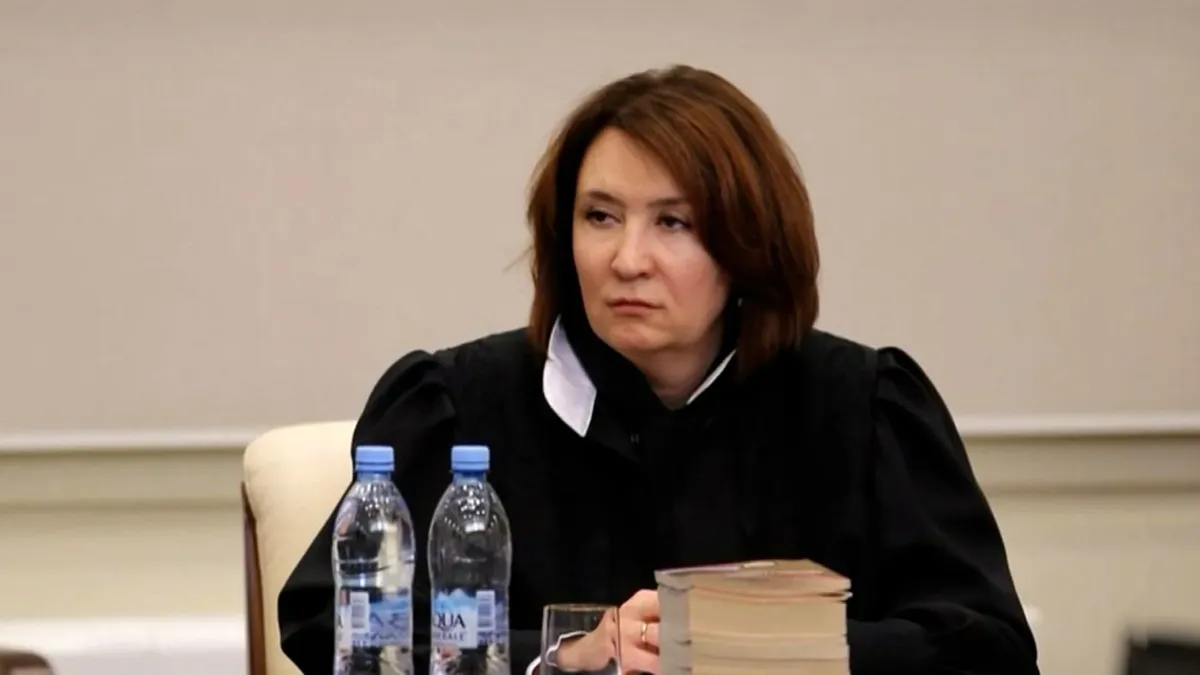
The scandal was gaining momentum: the topic of a law school diploma, which Khakhaleva allegedly completed in Georgia, without knowing the Georgian language, arose in the public. According to information announced in the current trial by the prosecutor's office, before becoming a judge in 2000, Khakhaleva traded in sporting goods together with a Georgian authority nicknamed Peso. On the Black Sea coast, the scorched Adidas was running out of steam, so she had something to exchange her refereeing position for.
With a Georgian diploma and without any special experience, Khakhaleva was hired as a judge of one of the village courts, but already in 2002 she was transferred to the regional court, where she eventually headed the judicial panel for administrative cases, but often also participated in the consideration of civil disputes about land.
The judicial system managed to get rid of the “golden judge” only in 2020, but she was fired not for illegal decisions, but “for absenteeism”: she was absent from the workplace half of the working days of the year.
On the same basis, a criminal case was opened for fraud on an especially large scale, but it was suspended: Khakhaleva was able to fly out of Russia.
The secret of Elena Khakhaleva’s unsinkability may have been that in 2017, her Sonya married not just anyone, but the grandson of the chairman of the regional court, Alexander Chernov. The splendor of the wedding somehow overshadowed the fact that Chernov, apparently, was not only a guest at this event, and the entire skillfully heated campaign of black PR may have been waged not against Khakhaleva, but against him.

In 2019, in connection with reaching 70 years of age, Chernov left the post of chairman of the regional court. In August 2025, the Krasnogorsk District Court of the Moscow Region, where the case was transferred for an objective consideration, seized in favor of the state the property of Chernov and his affiliates worth 13 billion rubles, including those lands that had just gone to, presumably, Deripaska. In April, the same Central Court of Krasnodar, which last Friday satisfied the anti-corruption claim against Khakhaleva, seized Chernov’s property for an additional 900 million rubles, including, as the joint press service of the courts reported, “36 kg of gold.”
Dashing Shares
Before moving further, it is necessary to explain on what such capital is built in the Krasnodar Territory and around what there is a constant struggle: at the cellular level, these are land shares or shares of former collective farmers.
In the early 90s, peasants who received land shares during the privatization of collective farm property rarely demanded the allocation of their share in the common property; most often they rented out shares to larger landowners, and they paid in grain, rice or sugar.
Around 2000, shareholders began to realize that they had been cheap and demanded that their shares be allocated in kind in order to process them themselves, sell them, or rent them out to another tenant on more favorable terms. Agricultural holdings emerged and began to take control of small plots of land, often through threats and fraud. Raider techniques were used, such as fictitious loans, forging minutes of general meetings of shareholders held in the early 90s, and others.
Buyers appeared in the villages, acting in the interests of third parties, about whom there were only rumors. Shareholders began to rush about, conflicts began, sometimes with shootings, and, of course, litigation. Confusion in the boundaries of disputed areas, as well as in changing legislation and judicial practice, has reached such a degree that it has allowed judges on the same disputes to make directly opposite decisions with a difference of several years, months, or even days.
The number of sheets of court decisions is probably such that they can cover all thousands of disputed hectares: this is, as it were, a second layer of soil. But if the land layer is “real estate,” then the paper layer is constantly fluctuating. It is no less “fertile”: in addition to land rent - 1, corruption rent is extracted from it - 2. Its beneficiaries are: former heads of farms, officials of registration offices, “law enforcement officers” of all stripes and, of course, judges. Even when redistribution is based on intimidation and murder, as was the case in the village of Kushchevskaya, the transfer of ownership is most often formalized by a court decision.
Here is a typical scheme for an unscrupulous owner, which was also used by judges: using the security of a land plot, you can get a loan from a bank, invest the money in the construction of real estate on the Black Sea coast, sell off the apartments, and then declare the construction illegal.
A fierce legal dispute at the second stage will be waged around the issue of the legality of construction, and no one will even remember where the already repaid loan, and especially the land pledged for it, came from.
UK-light
On April 16, 2026, the joint press service of the courts of the Krasnodar Territory reported on an anti-corruption lawsuit brought against Elena Khakhaleva, her ex-husband Robert Khakhalev, their son Kirill and sister Natalya Khakhaleva, who worked as a judge of the Arbitration Court of the region. At the same time, the Oktyabrsky District Court, at the request of the prosecutor's office, arrested the property of another thirty-six individuals and legal entities. Of these, twenty-two individuals and legal entities, whom the prosecutor’s office considered affiliated, mainly with Robert Khakhalev, were brought in as Khakhaleva’s co-defendants in two stages.
It is known that in January 2025, at the request of the Russian Federation, Khakhaleva was detained in Baku while trying to fly to Dubai, but the Azerbaijani court refused to extradite her to Russia. Now Khakhaleva, as her lawyer said at the trial, is in Georgia. Her ex-husband, like almost all of her co-defendants, also participated in the trial through representatives and did not appear in the courtroom.
Such a crowd of co-defendants created certain difficulties during the consideration of the case - representatives of many of them quite convincingly proved the absence of any connection with the Khakhalevs. Judge Maxim Balin did not heed these arguments, but his decision, the announcement of the operative part of which took about an hour due to the list of property, will be appealed.
It should be clarified that in the event of an anti-corruption claim, joint liability does not arise, and each of the co-defendants acts as a nominal owner of the objects that the plaintiff (prosecutor's office) considers de facto to belong to the main defendant - in this case, Khakhaleva. Perhaps the prosecutor's office brought so many co-defendants into the case in order to increase the property mass subject to seizure for the state's income, and to report beautifully about it.
But of all twenty-two co-defendants, only Elena and Natalya Khakhalev were state officials. Meanwhile, such a claim is a kind of criminal trial “light”. We are actually talking about a serious property punishment, but the standard of evidence is lowered compared to a criminal trial. The prosecutor's office only proves that the official was engaged in business activities contrary to the law and that his expenses exceed official income. Meanwhile, the 20 co-defendants in the Khakhaleva case were never even government employees.
In order to prove the affiliation of the co-defendants with Khakhaleva, the prosecutor’s office in this civil trial relied on data from the criminal case, including operational information declassified for this purpose. But within the framework of a criminal case, this evidence should have been (and probably will still be) examined, and the parties should have the opportunity, among other things, to question witnesses. As part of the “anti-corruption lawsuit,” they did not have such an opportunity. Meanwhile, the co-defendants don’t even know what kind of criminal case Khakhaleva is having - either an old one concerning fraud and absenteeism, or some new one about abuse of official position and bribes.
Far from defending the Khakhalevs, we at the same time state that in the total volume of property seized from them, there may also be objects that legally belong to other persons.
Finally, in a criminal case there are always victims. And here they are too, but they remained behind the scenes and did not receive any representation.
Who forgot to call to court
According to information from the prosecutor’s office, announced in court on May 26, “from 2010 to 2016, about 100 artificial trials were initiated in the Novopokrovsky District Court alone.” Khakhaleva, who by this time held a position in the regional court, “assisted in the adoption of unjust decisions” by the lower court. In this “illegal way, the Khakhalevs took possession of a land fund of over 12.5 thousand hectares.”
Artificial, or elsewhere “fictitious” claims could relate, for example, to fake agreements on transactions with land plots, which were those same shares or shares.
Such transactions must be declared invalid with the return of shares to those from whom they were, frankly speaking, stolen through court decisions.
And this is not at all the state, in whose favor the court seized the land property of the Khakhalevs, and before that of Chernov and other officials of the region. These are former collective farmers and their heirs who have been seeking the return of their property for years, who were first deceived by some, then by others, and now by the state, which took possession of their former lands through the courts. How many of these shares are there in the total volume of 12.5 thousand hectares? Who are their original and legal owners?
I believe that former owners of shares and interests can now bring so-called vendication claims - to recover from someone else’s illegal possession objects of property that were taken out of their possession as a result of deception or intimidation.
Of course, this would be a risky precedent, opening the way for a new, but fair redistribution of ownership of fertile southern lands. But it was not former collective farmers who planted this mine under them.
Krasnodar — Moscow