
Translated material
There are no exceptions!
How the Ministry of Justice turns a foreign agency into a vicious circle

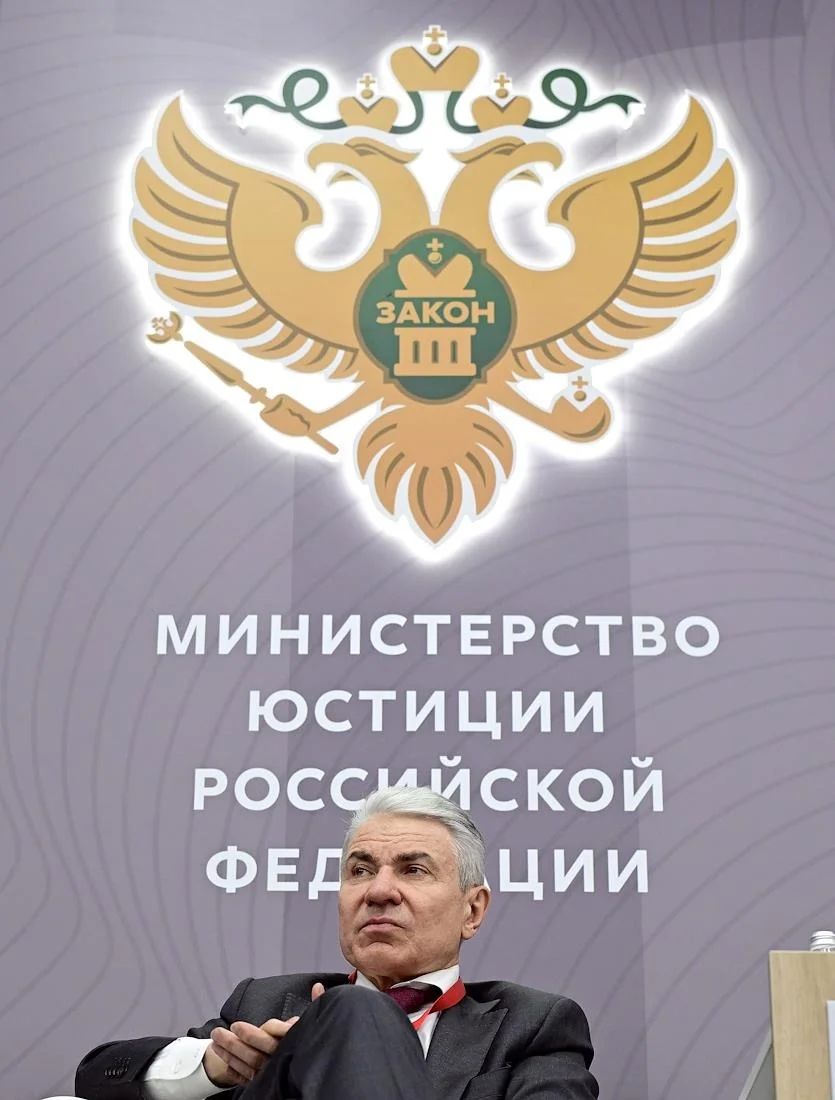
Photo: Dmitry Dukhanin / Kommersant
In the statements made in the Federation Council by Deputy Minister of Justice Oleg Sviridenko, it is worth paying attention not only to the widely circulated message that only 4% of those declared “foreign agents” have some kind of “foreign funding”.
It is noteworthy that the official describes as a simple and possible procedure what no one succeeds in practice: to achieve exclusion from the register of “foreign agents.” The reason for this state of affairs lies precisely in the position of the Ministry of Justice.
If we talk about the deputy minister’s statement that “foreign funding” is not required for a citizen to be declared a “foreign agent,” it is notable for its clear contradiction with repeated statements by Russian President Vladimir Putin. Namely, that recognition as “foreign agents” only means the obligation to show “foreign funding” (for example, at a meeting of the Presidential Human Rights Council in December 2025, Putin said: “We have one most important thing - show the sources of funding. Well, what’s so terrible about that?”).
There's really nothing scary. But 96% of “foreign agents” have nothing to show in this case. And this, so to speak, strongly diverges from the thesis about “the most important thing.”
Those who are disliked by ministers, governors, mayors, and so on have long been included in the register of “foreign agents” - without being constrained by the norms of even the law on “foreign influence” that exists.
The Ministry of Justice even sees the mythical “foreign influence”, as is known from court cases (otherwise it is impossible to find out why they were included in the register), even in interviews with foreign media (although the same interviews are given freely and without consequences by the president, ministers and State Duma deputies).
Afterwards, the alleged “agent” (though the Ministry of Justice has not yet been able to answer any of them in court whose “agent” he is) is deprived of two dozen constitutional rights and finds himself in a position from which he cannot get out.
Sviridenko (he is the one who signs orders to add “foreign agents” to the register), speaking in the Federation Council, said that the legislation “provides for more than clear and completely transparent mechanisms for excluding foreign agents from the register,” that “an application for exclusion from the register can be submitted if one or all signs of a foreign agent are lost.”
And that “the very decision to be included in the register can be appealed in administrative proceedings in court.”
Let's start with the second: no one has yet been able to challenge in court the inclusion of “foreign agents” in the register, because the Ministry of Justice calls “foreign influence” whatever it wants. And the courts invariably agree with this, rejecting any arguments of “foreign agents”, no matter how much they explain, for example, that giving an interview to a foreign media or appearing on air with a “foreign agent” does not at all mean receiving any help from them, much less “being influenced.” Moreover, this “influence” - this is clarified in the framework of other procedures and other courts - is interpreted by the Ministry of Justice as unlimited.
Now about the “more than simple and completely transparent mechanisms” (according to the deputy minister) for excluding “foreign agents” from the register. For some reason, no one has yet managed to successfully use them either. And the reason is not that “foreign agents” do not know how to read the law or competently draw up applications to the Ministry of Justice.
To all applications for exclusion from the register (except for cases of liquidation of an organization or death of an individual) with a message that the reasons for which the citizen was included in the register (regardless of their validity) no longer apply, the Ministry of Justice refuses.
Exceptions to this rule, if there are any, are not publicly known. On the contrary, there are cases when even the liquidation of the organization did not help: for example, “Golos”* stubbornly refused to be excluded from the register of “foreign agents”. When its former co-chair Stanislav Andreychuk (now on the list of “foreign agents”) filed a complaint against this decision, and then asked the Ministry of Justice whether it was necessary to submit reports for the movement, a criminal case was opened against him for... failure to submit these reports. And then he himself was included in the “foreign agents”. What do they say, it would be funny...
So, when informing the applicant about the refusal to remove the discriminatory status, the Ministry of Justice does not bother itself with any details, does not send any inspection reports, but only refers to the articles of the law. There is only one way to understand what’s going on: go to court, where the Ministry of Justice sends objections to the administrative claim.
An analysis of these objections shows that they are as “justified” as the reasons for which people were added to the register.
The applicants write that the very “signs” that Mr. Sviridenko is talking about have been lost (which, as he says, is enough for exclusion from the register). For example, that after being included in the register they did not give interviews to foreign media.
To which they receive the answer: you know, we found on your resources links to other interviews, although published before being included in the register (these interviews, we note, were not previously indicated by the Ministry of Justice among those that served as the reason for inclusion). This means that “foreign influence” continues to influence you.
Cursing to themselves (or even out loud) at this logic, the applicants are organizing to purge their networks of these (and at the same time other) links.
Naively hoping that now the Ministry of Justice will have no other choice but to recognize the need for exclusion from the register. Not so.

The Ministry of Justice again refuses the new application for exclusion from the register without explanation. And when applicants go to court to challenge the refusal, they put forward new arguments: it turns out that interviews with foreign media or other “foreign agents” are available on their resources. And the “foreign influence” did not stop...
This logic may seem contrary not only to the law, but also to common sense, and it may seem that it will inevitably fall apart in court. Nothing of the kind: the court agrees with her. Without reacting to attempts by “foreign agents” to explain that they have no influence on the placement of any materials on other people’s resources.
Let us note that not just anywhere, but on the website of the Ministry of Foreign Affairs of the Russian Federation, Minister Sergei Lavrov’s interview with the Shanghai Media Group* dated May 20, 2026 is quietly hanging. Without any consequences for the minister. And this is far from the only example of what the Ministry of Justice calls “foreign influence”...
Meanwhile, the described system was designed exactly this way, so that anyone could be included as a “foreign agent,” but it was impossible to get rid of this status.
To, at the discretion of officials, register as “internal enemies” (with the deprivation of many rights) those who are objectionable. Inconvenient. Who speaks critically about the activities of the authorities. With whom it is impossible to argue publicly, including during elections. Whose questions don't you want to answer? And so on.
It’s easier to sign up as a “foreign agent” and this will solve all (or almost all) problems. De facto block the opportunity to engage not only in political but also in social activities.
Of course, an indispensable condition for the operation of this system is the court. Which, it seems, receives an unspoken, but implemented (judging by practice) instruction: “enemies” should not find the truth, should not be able to challenge the decisions of the Ministry of Justice. Otherwise everything will collapse and become meaningless.
However, even in such a system, the Ministry of Justice is trying to make life easier for itself: a law has just been passed that prohibits “foreign agents” not only from posting social advertising on their resources, but also from applying for exclusion from the register more than once a year. It’s tiring: reading statements, writing refusals, inventing arguments for the court. It is easier to limit applicants to one more right, in addition to those they are already deprived of, and without any trial.
Andrey Serov
* Included by the Ministry of Justice in the register of “foreign agents”.
PS
According to Minister of Justice Konstantin Chuychenko, 243 organizations and individuals were excluded from the register of foreign agents, of which 75 were able to cancel this status at their own request.However, the minister did not provide any details of this exception, did not name any names, and most likely, we are talking about liquidated organizations and their leaders.
None of the publicly known “foreign agents” reported that he managed to achieve exclusion from the register (in his personal capacity) simply by submitting an application to the Ministry of Justice.