
Translated material
“I came up with some kind of rattle!”
The developer of anti-UAV protection was jailed for 13 years. The investigation considered that the device was not needed by anyone

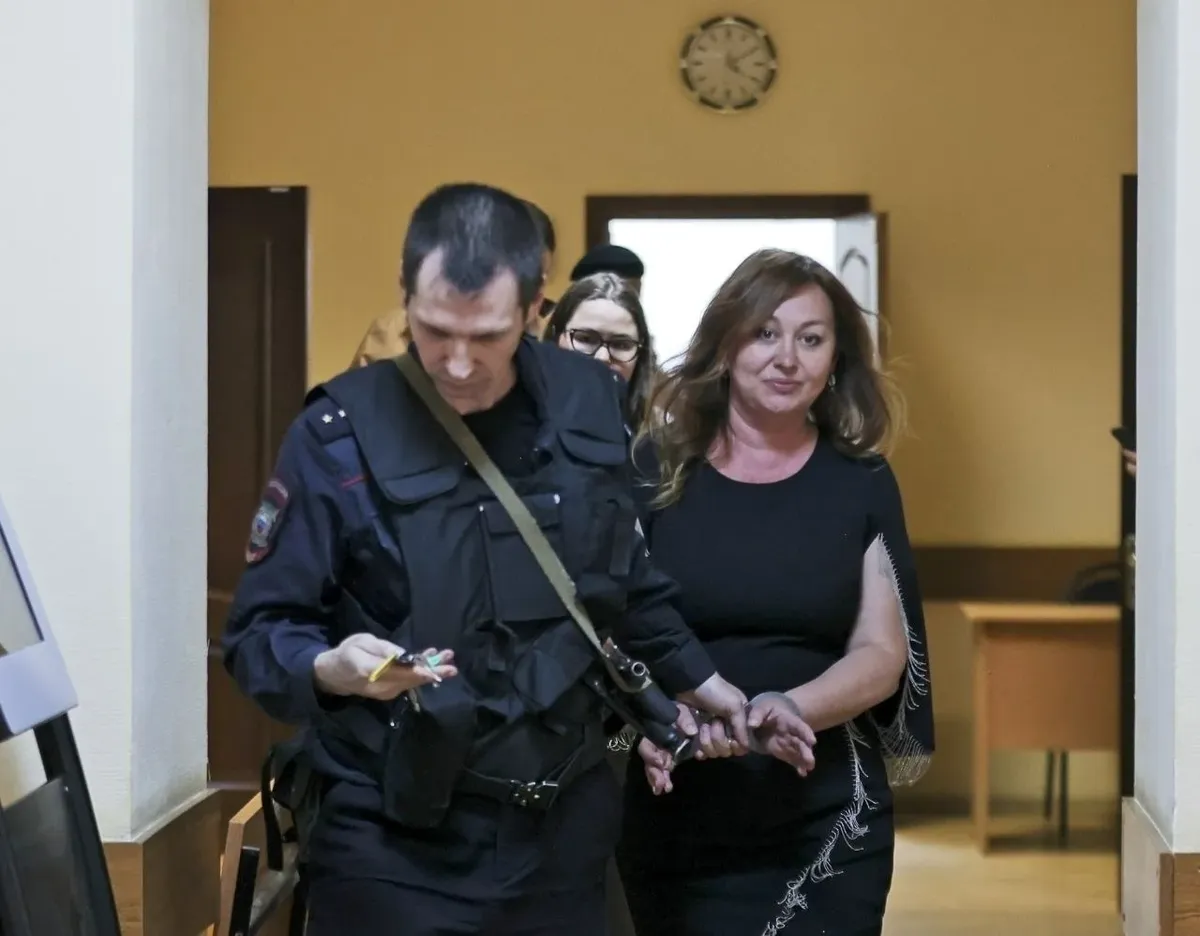
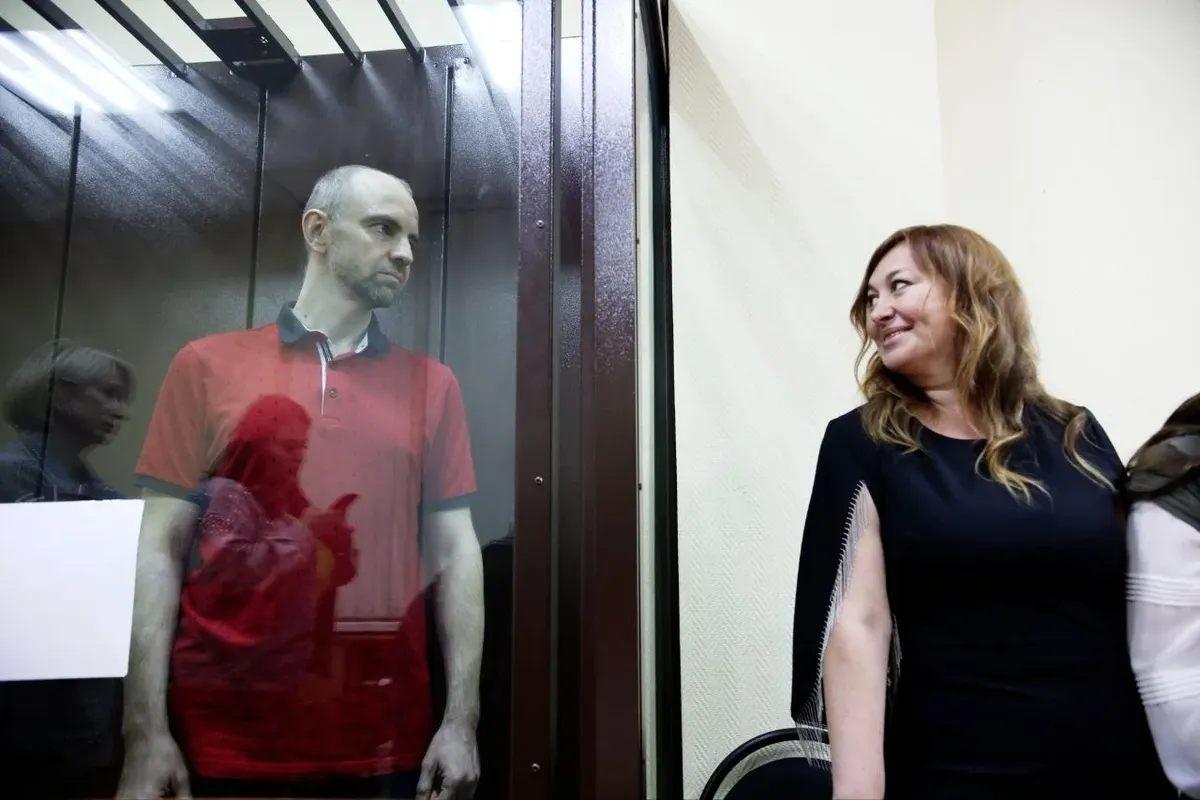
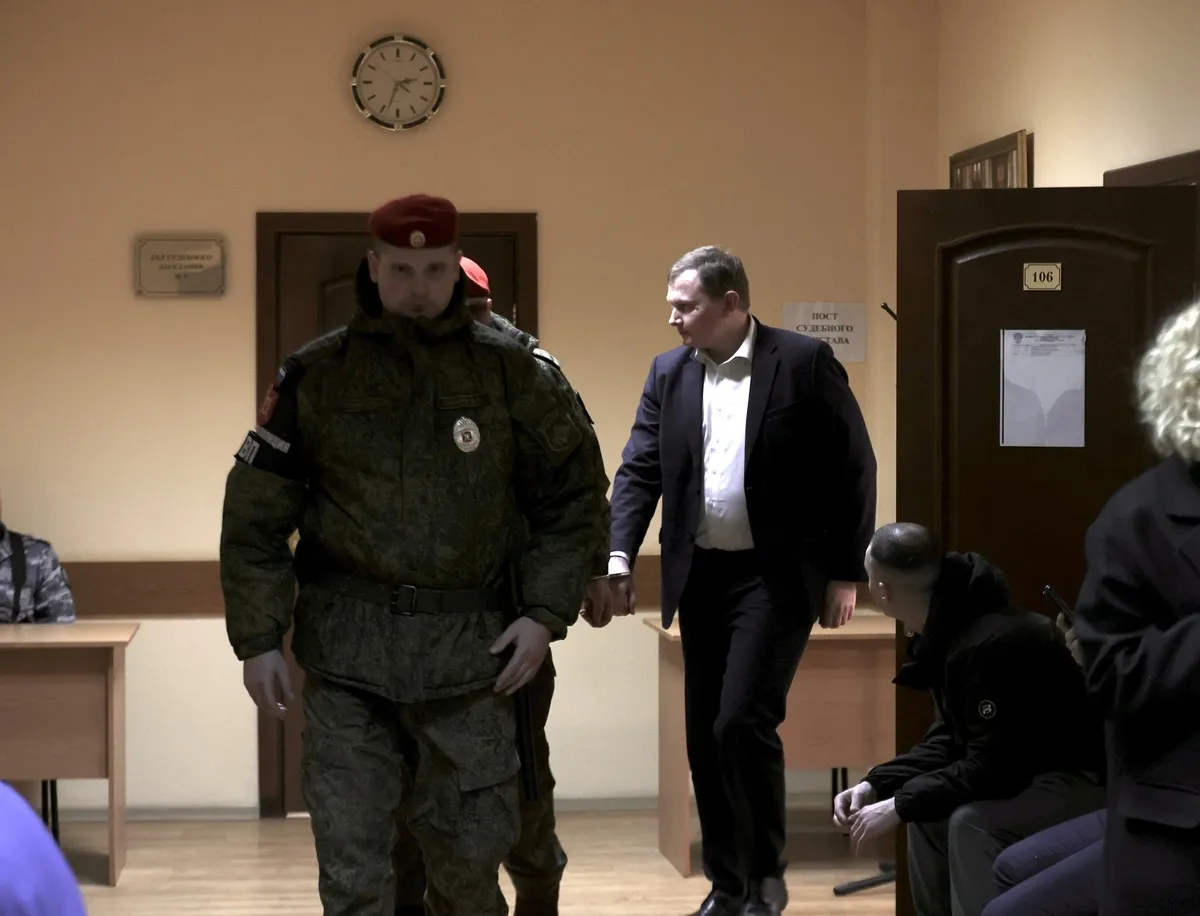
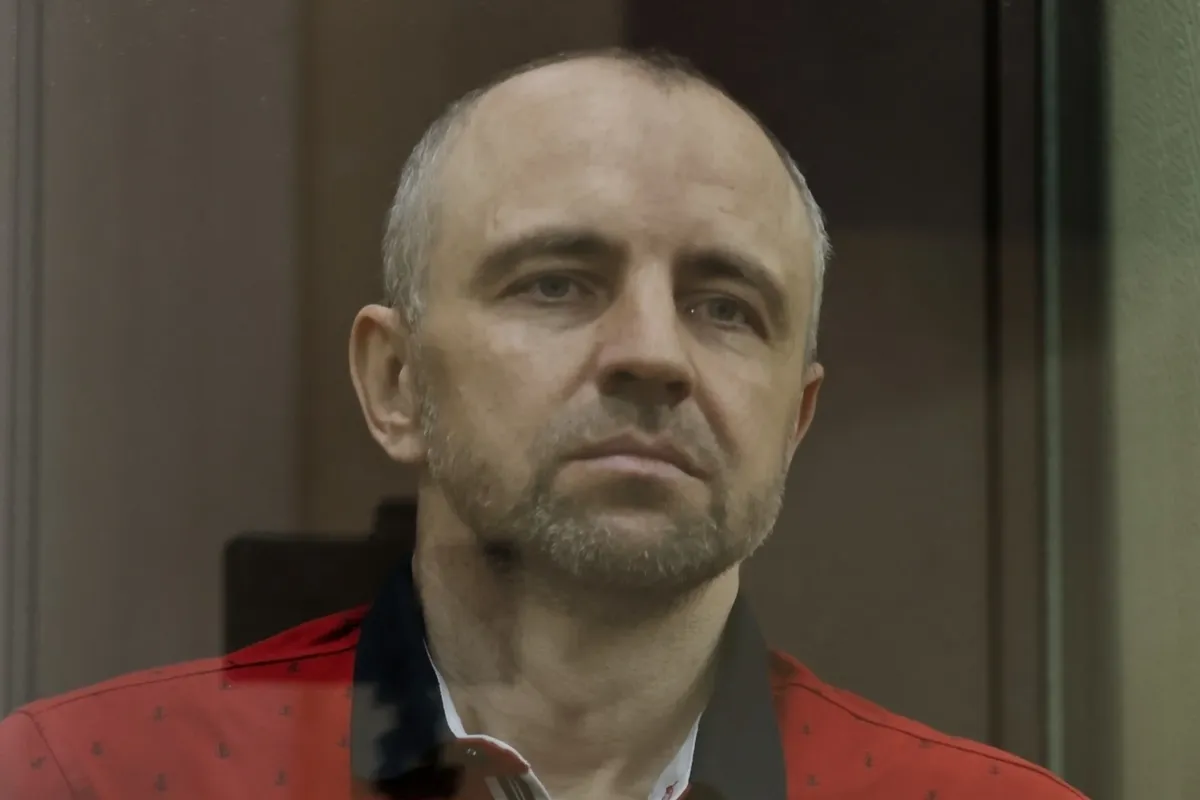
Lieutenant Colonel Efimov is escorted to the military courtroom. Photo: Evgeny Kurakin
“Seven times smaller and cheaper”
On June 18, a court in Moscow satisfied the request of the Prosecutor’s Office, found the scientist and developer of anti-drone defense systems Sergei Efimov guilty and sentenced him to 13 years in prison. And his friend, businessman Marina Halandach, was sentenced to 10 years of general imprisonment. Efimov was charged with fraud on an especially large scale, money laundering and abuse of official power in the execution of a state defense order.
The prosecutor's office insisted that Efimov inflated the cost of components when developing anti-drone systems, while acting in collusion with the owners of controlled companies - directors of the Intelferum company Alexei Sokolov (he was previously sentenced to a suspended sentence) and Consultant Marina Khalandach. The damage was suffered by one of the military units, which tried to collect 12 million rubles from the defendants jointly and severally. The court also satisfied this claim in full.
Lieutenant Colonel Sergei Efimov worked in the closed research institute of the FSB of Russia as the head of a unit. He was engaged in research activities and development work. He developed a complex for countering unmanned aerial vehicles called “Obereg”, which was tested in combat conditions and was highly praised by the leadership of various departments (five generals signed the acceptance certificate for this product).
Marina Khalandach is an acquaintance of Efimov, the director of Consultant LLC, who helped with the support of transactions bypassing sanctions. She entered into an agreement for accounting services with the company Intelferum, which was headed by Alexey Sokolov, who became the key witness for the prosecution.
The defendants categorically deny guilt. According to the defense,
Efimov created a unique product that was superior in tactical and technical indicators to existing analogues: the detection range of FPV drones was 4 km, aircraft-type drones - 20 km, in addition, it covered a wider range of frequencies that they are controlled by.
The device turned out to be compact and semi-automatic - it itself recognized the type and frequencies of drones. Suppression was guaranteed to occur at a distance of at least 1 km by directed interference.
According to the studied case materials, Efimov personally went to test prototypes of products in the combat zone and front-line regions - Belgorod, Kursk, Bryansk.
The interrogated witnesses who worked on the commission for the acceptance of the Obereg confirmed the high efficiency of the complex, and also reported that its characteristics were better, more powerful, more mobile, and in addition it turned out to be seven times cheaper and almost the same number of times smaller than the complex in service. And the defendant said that he had become a victim of a “career race of rear rats.” In general, the defense version is as follows: there could be no theft, since money under government contracts was paid after the product was accepted by the commission of the military unit.
The accusation is based on the thesis that the supplied equipment does not meet the stated requirements. However, these requirements themselves are partially classified, have not been fully examined in court, and the defense is deprived of the opportunity to study them in detail. This fundamentally violates the accused's right to defense and the adversarial principle.
Hidden assessment standards (TSR): the logic of the investigation is based on internal FSB order No. 203/DSP and tactical and technical specifications (TST) for the complexes. At the same time, the key sections of the technical specifications (goals, objectives, technical requirements) are hidden as “secret”. The defense cannot prove the identity of the supplied equipment, since it does not see what exactly it needs to be compared with.
Unverifiable forensic examination: commodity experts made conclusions about non-fulfillment of work and damage, comparing the results with these hidden requirements of technical specifications. Lawyers are deprived of the procedural opportunity to challenge the examination, since the original evaluation criteria (“black box”) are hidden from them.
To prove his innocence, Efimov S.V. it is necessary to disclose the technical parameters, algorithms for detecting drones and methods for their combat use in border areas. This data constitutes a state secret.
The Reutov Garrison Military Court refused to close the process or transfer it to the specialized court (2nd Western District Military Court), citing the lack of visible stamps on the investigative copies. Thus, the defendant was faced with an unacceptable choice: either commit a new crime by divulging state secrets in an open meeting, or defend himself not in full force, allowing the prosecution to use this against him.
"I did something bad"
During the development of Amulet, its authors faced significant obstacles: manufacturers of electronic components refused to cooperate with FSB units directly, fearing sanctions. And the management insisted: to find a way out of the situation as soon as possible. A witness questioned in court, the deputy general director of one of the potential contractors, quoted their organization’s direct response to the negotiations: “Look for other companies, we will not work with you directly.” And he explained: they do not want to hire a separate lawyer to participate in closed state auctions, nor “leave the simplified procedure” for the same purposes.
This is how Alexey Sokolov appeared in this story. He specifically registered Intelferum LLC for the needs of the project in order to supply the institute with the necessary components from Russia and abroad. He also entered into an agreement to develop software for automation of complexes. After which Efimov’s division, in collaboration with component manufacturers and programmers, managed to create a unique product within a year.
According to the defendants, the product worked perfectly, and the leadership of the FSB almost clapped their hands and demanded that the series be launched urgently.
The story of interference in development and subsequent prosecution arose on June 6, 2024, after a “voluntary visit” to the military prosecutor’s office of the Balashikha garrison of component supplier Alexei Sokolov without a lawyer. Sokolov did not receive a summons, but, according to what was disclosed in court, Deputy Garrison Prosecutor Daniil Govera called him, demanding his appearance, allegedly threatening him with forced arrest if he did not arrive, although a criminal case had not yet been initiated. It is still unclear within what formal framework this survey was conducted, and what served as the reason and basis for initiating the case.
As Sokolov subsequently wrote in his complaint to the Prosecutor General (available to the editors), the military prosecutor’s office immediately took away his phone, deprived him of contact with the outside world, did not allow him to seek legal assistance, tortured him with thirst, did not allow him to go to the toilet, and put him under psychological and emotional pressure for five hours. All this time, a sheet of paper with ready-made testimony allegedly lay in front of him.
He was insulted, threatened with exorbitant sentences, and forced to self-incriminate and incriminate other participants. In the end, he signed everything.
After leaving the military prosecutor's office of the Balashikha garrison, Sokolov called Marina Khalandach and said: “I did something bad against Seryoga.”
On September 30, 2024, the Investigative Committee in Balashikha opened a criminal case under the article of fraud. On October 3, Efimov was detained.
Subsequently, Sokolov entered into a pre-trial agreement and admitted guilt. Materials regarding it have been separated into separate proceedings. He received four years probation.
The defense asked the court to request the results of the inspection following his appeal to the Prosecutor General's Office, but the request was rejected.
During interrogation in court, he said that he served as a simple courier.
Sokolov’s testimony is reflected in the decision of the Zheleznodorozhny City Court of the Moscow Region: “He created a company with which the military unit, based on the results of formal competitive procedures conducted by Efimov, will conclude government contracts for the supply of components for the complexes being developed, the cost of which will be inflated relative to the real one, and the resulting difference in the cost of the products will be stolen.”
According to Sokolov, Marina Khalandach performed organizational, administrative and economic functions in his organization, was actually the manager, and both she and Efimov managed the money.
At the same time, Sokolov confirms that he met with the management of all enterprises, agreed on deliveries, signed contracts and primary documents, took parts from production, negotiated with Chinese manufacturers, including the return of failed equipment. For example, the courier entered into contracts with Radioservice 10 times.
Despite the pre-trial agreement, he confirmed in court that there were no negotiations about the theft of budget funds between the defendants, and there was no talk of kickbacks to anyone.
“Like Bonnie and Clyde, they lived beautifully.”
As damages to the defendants, the state prosecution, and now the court, imputed taxes paid by the Federal Tax Service, the annual salary of IT company programmers, developers of AI and software algorithms for the complex, the profit of Intelferum LLC and the profit of other component suppliers, accounting services of Consultant LLC, as well as arithmetically not accounted for tranches to these suppliers, from which components for the complexes were actually purchased.
According to the examined bank statement, Sokolov withdrew 600 thousand rubles from the account of the Intelferum company from 2021 to 2023 as dividends and other expenses. It turns out to be approximately 200 thousand per year, or 16,000 rubles per month.
Sokolov agreed with the investigation that this influenced the inflated prices of components. He returned all 600 thousand to the military unit, despite the fact that this amount included the company’s associated expenses.

The same amount, 16,000 rubles per month, was paid by Intelferum to Consultant for accounting services. Despite the successful performance of services related to government contracts by this organization, the court considered these funds to be stolen. At the same time, the investigation considered this to be legalization.
Defendant Halandac spoke in court about significant procedural violations: economic and accounting examinations were not even carried out in such a complex case, only merchandising was carried out. As it turned out, right in the office of an investigator of the Investigative Committee, a person who in court could not confirm his credentials as an expert, and during interrogation admitted that he was not essentially an expert. The court refused to conduct an economic forensic examination in such a complex case related to government procurement.
The investigation considered the only evidence of conspiracy to commit a crime to be “the romantic relationship of the defendants.”
Investigator Kantemir Shkhagobsoev said: “Like Bonnie and Clyde, they lived very beautifully.” He believed that Efimov had invented something insignificant: “I came up with some kind of rattle!” According to the position of the investigation, there was no need for the development of “Amulet” at all.
...The proceedings in the Reutov Garrison Military Court began to be held behind closed doors as soon as the time came for evidence for the defense. Each stage of the process was consistently closed at the request of the representative of the injured party - that same research institute - Alexey Dunaev.
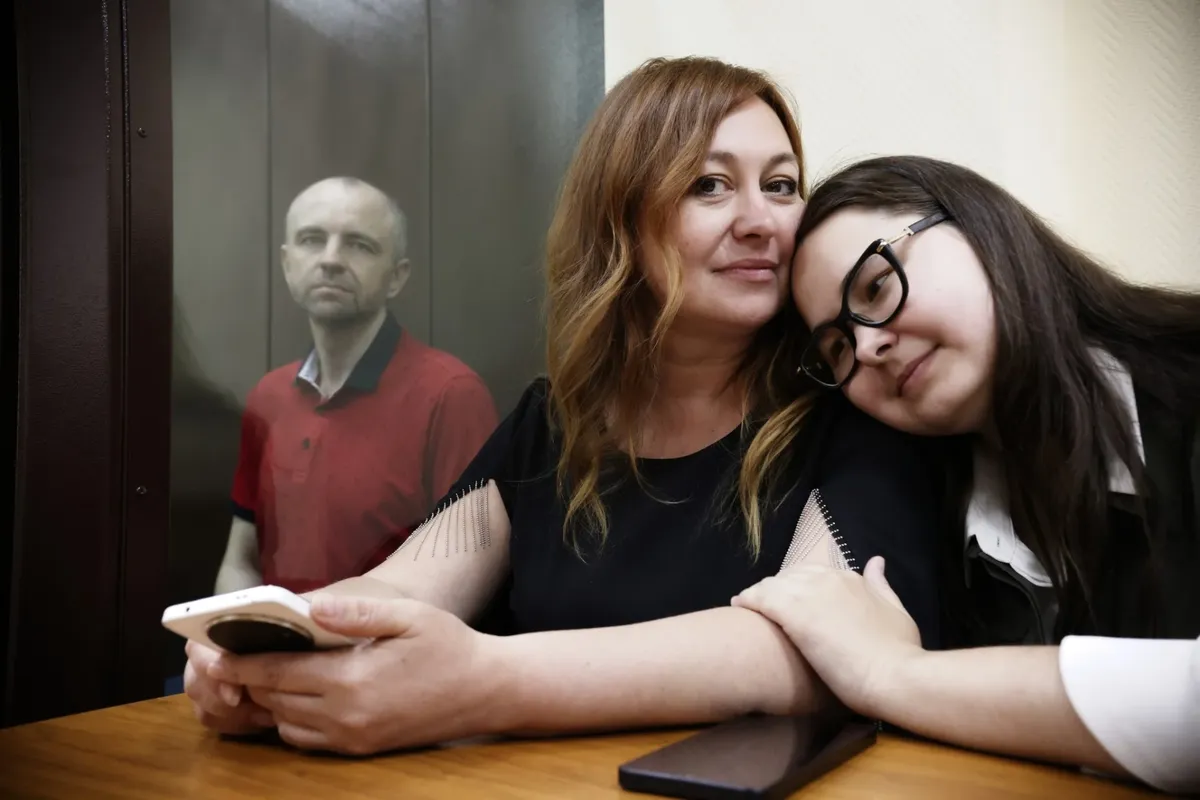
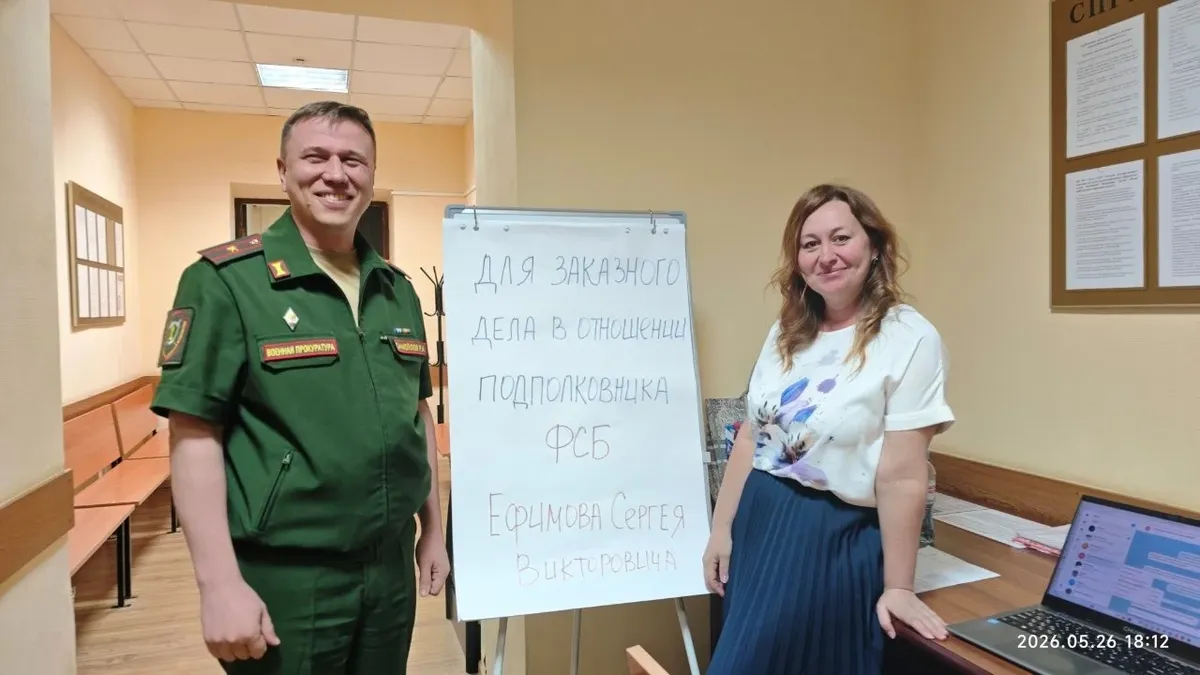
Efimov and Khalandach actively defend their innocence. They were removed at every stage of the process for “delaying it”: either for asking to call an ambulance, or for raising their hand, or for trying to develop a paper “crime scheme” in A1 format. Marina Halandach brought to court painted album sheets for each episode and an easel in order to more clearly demonstrate to both the presiding judge and the prosecution the absurdity of the charges brought against her.
Efimov was allowed to speak fully on the case only at the stage of the last word, so his speech lasted more than 8 hours.
Khalandach, being under subscription, at the end of May went on a picket to the monument to Marshal Zhukov on Manezhnaya Square with a poster “Drones are flying - the developers are sitting.” The poster was snatched from her, and she was taken to the police, where, according to her, the officer on duty did not hide the fact that he had received instructions to file a “5th part” against the detainee, that is, to bring the maximum charge under the administrative article for violating the picketing order. And employees of the 2nd special regiment Ivan Fokin and Ilya Galeguzov teleported Khalandach half a kilometer in their reports, indicating that the action was held on Red Square, and not on Manezhnaya, where single picketing is allowed.
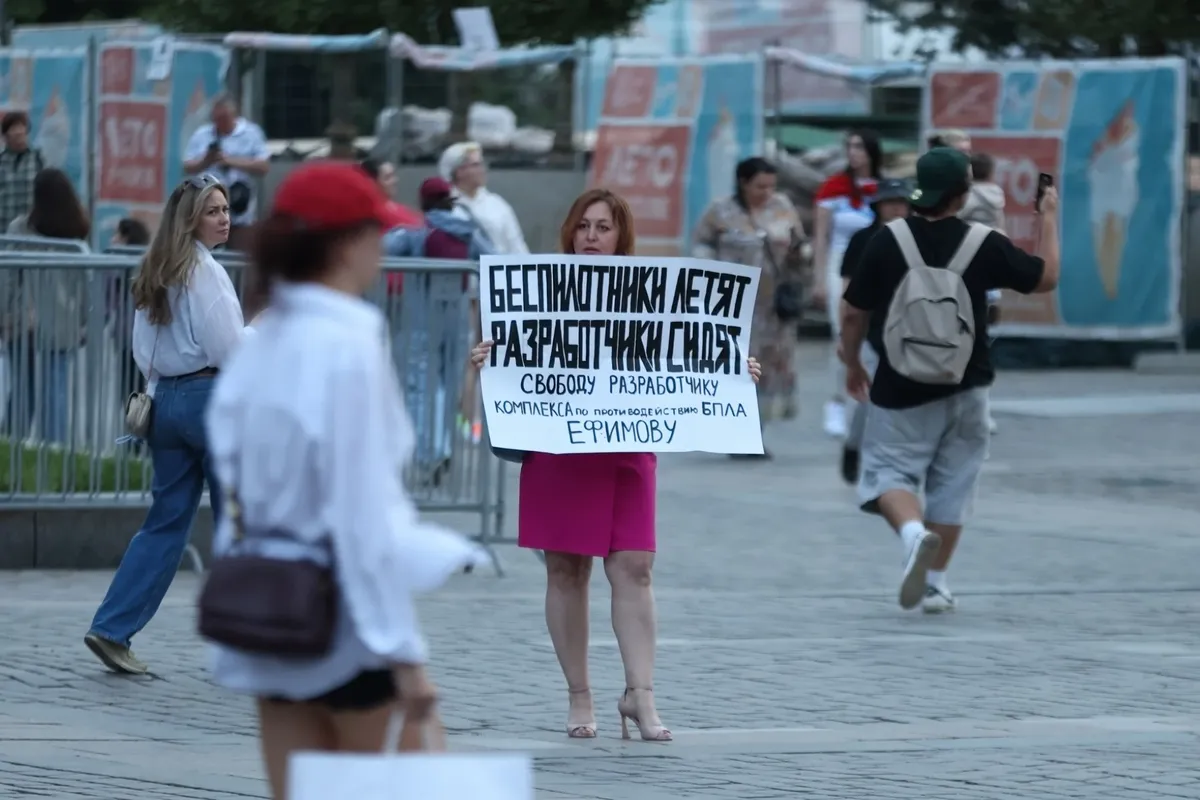
During the debate, state prosecutor Roman Samoilov especially noted the defendant’s going to the picket as inappropriate behavior and demanded that she be taken into custody in the courtroom. Earlier, a story also appeared online about how the same prosecutor came to see Halandach in the city hospital, where she was admitted with a hypertensive crisis after one of the court hearings. She then claimed that there was pressure on the doctors to quickly discharge her.
During the trial, Efimov was left without his lawyer by agreement of Zima Bachalova (Sautieva). During the trial, a criminal case was opened against her for insulting a judge. In May, investigators tried to take her into custody, but the Reutovo city court refused.
The defendants were left with only appointed lawyers, whom they repeatedly challenged and sent complaints to the chamber for inaction, failure to provide legal assistance and violation of the law on the legal profession.
At the investigation stage, the property of Halandach, plots of land purchased in 2021, were arrested. The investigation believes that they were bought with criminal money, although she was charged with a crime committed in 2023. Efimov’s car, purchased in 2022, was also seized.
According to border guards, research institute employees, and the general director of an IT company interrogated in court, the arrest of the scientist interrupted the active stage of introducing artificial intelligence capabilities into the Amulet product, accelerating the process of responding to objects in the sky and completely excluding the human operator from the anti-drone fight.
All money for software development is considered stolen, although this very software was developed and was at the testing stage.
The institute’s attempt to release the Obereg complex in 2024, without Efimov, turned into failure and a new series of criminal cases. The price of equipment has doubled (8 million rubles per piece). Two employees of the research institute have already been convicted in this case. Including Efimov’s former immediate supervisor, Colonel Vladimir Semenov, who received 5 years and 2 months in a general regime colony.
Semenov, after the arrest of Efimov in 2024, continued work on preparing to equip border areas with anti-UAV systems. At the same time, he was unable to reproduce the products with the given characteristics, and the resulting complex is inferior in characteristics to the previously developed one and is not applicable in combat conditions.
He was convicted under Part 2 of Article 285.4 of the Criminal Code of the Russian Federation for abuse of official powers in the execution of a state defense order. The defense in the case of Efimov and Khalandach believes that there is no corpus delicti in his case. The investigation mixed the concepts of work on state defense orders and intradepartmental work. Incorrect qualification applied. Work within the framework of the “Amulet” product was intradepartmental work. As part of the state defense order, there was a supply of components for this work, but Semenov was convicted specifically for intradepartmental work, which in this way allegedly damaged the authority of the FSB.
The defense was carried out by lawyer Valentina Inkova, who chose the tactics of passive defense, did not irritate the court with petitions and requests, did not present evidence of the defendant’s innocence, and agreed with the state prosecution not to call key witnesses, but simply to announce them without subsequent interrogation. At the end of the judicial investigation, Semenov admitted his guilt in full, and spoke for a very long time about the fact that, as a soldier, he was forced to carry out the order to supply 15 complexes for testing. He shifted all the blame onto the military unit commander, Major General Ugolnikov, the head of the institute.
Khalandach, being under recognizance not to leave the place, attended the hearings of this trial and tried to ask Inkova’s lawyer in front of her client a question why they were “leaking the case” like that. The result was a scandal. Inkova notified the Investigative Committee investigator and the court that pressure was being put on her and her client to change their testimony, and asked to take action. She also asked to ensure safety measures for the participants in the process - Halandach allegedly threatens her life and health and a long prison sentence for Semenov, that from fear Semenov’s capillaries burst in his eyes, and she has not slept for several nights, she wanted the preventive measure to be changed for criticizing Halandach.
В итоге, именно её подзащитный был взят под стражу в зале суда.
Со слов Ефимова, новое изделие — уже не тот «Оберег»: дальность обнаружения беспилотников его была не более 1 км, подавление — 600–700 метров. Комплекс не был мобильным устройством: весил 80 кг и требовал постоянного подключения к электрической сети. Свои наработки и алгоритмы Ефимов не успел никому передать. Сотрудники НИИ начали массово увольняться после серии уголовных дел. Во время допроса в суде часть из них уже работали в коммерческих организациях.
Василий Дизель, специально для «Новой»