
Translated material
Disagreement as a crime
The prosecutor's office demanded 8 years in prison for the deputy chairman of the Yabloko party, Maxim Kruglov, for “fakes.” But the case itself looks like a fake

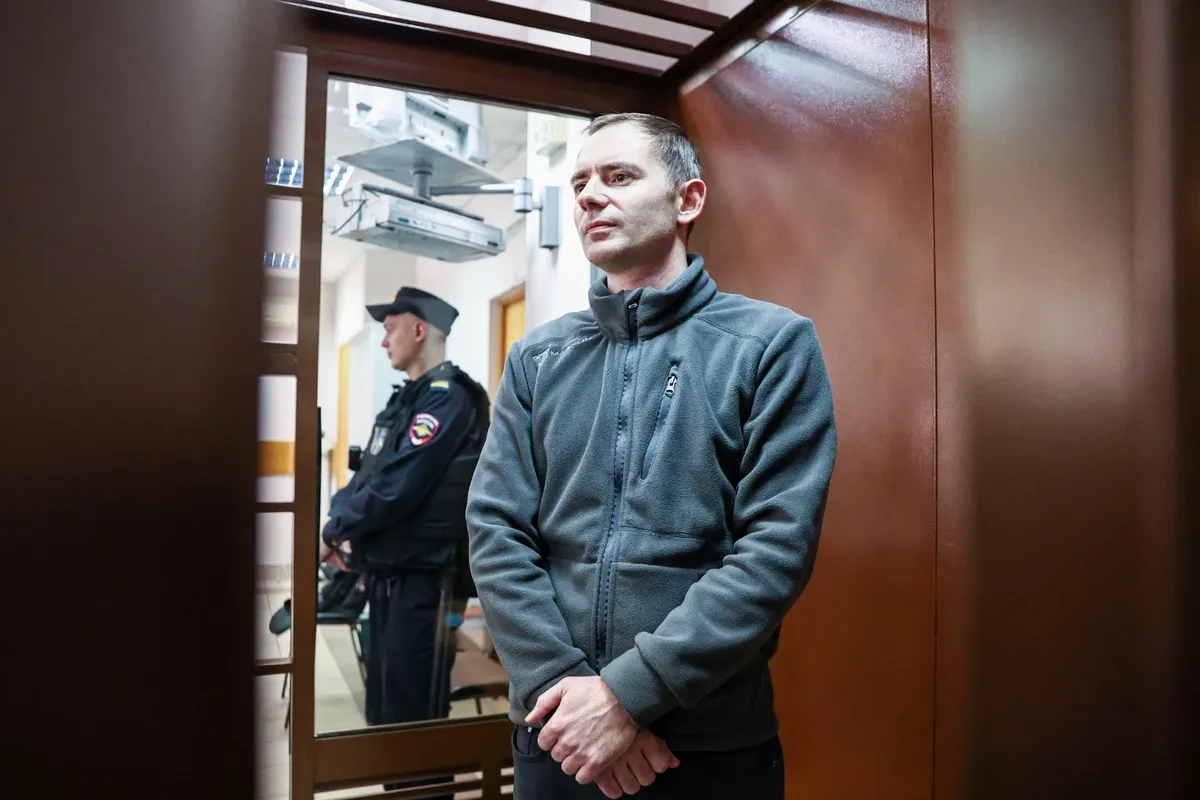
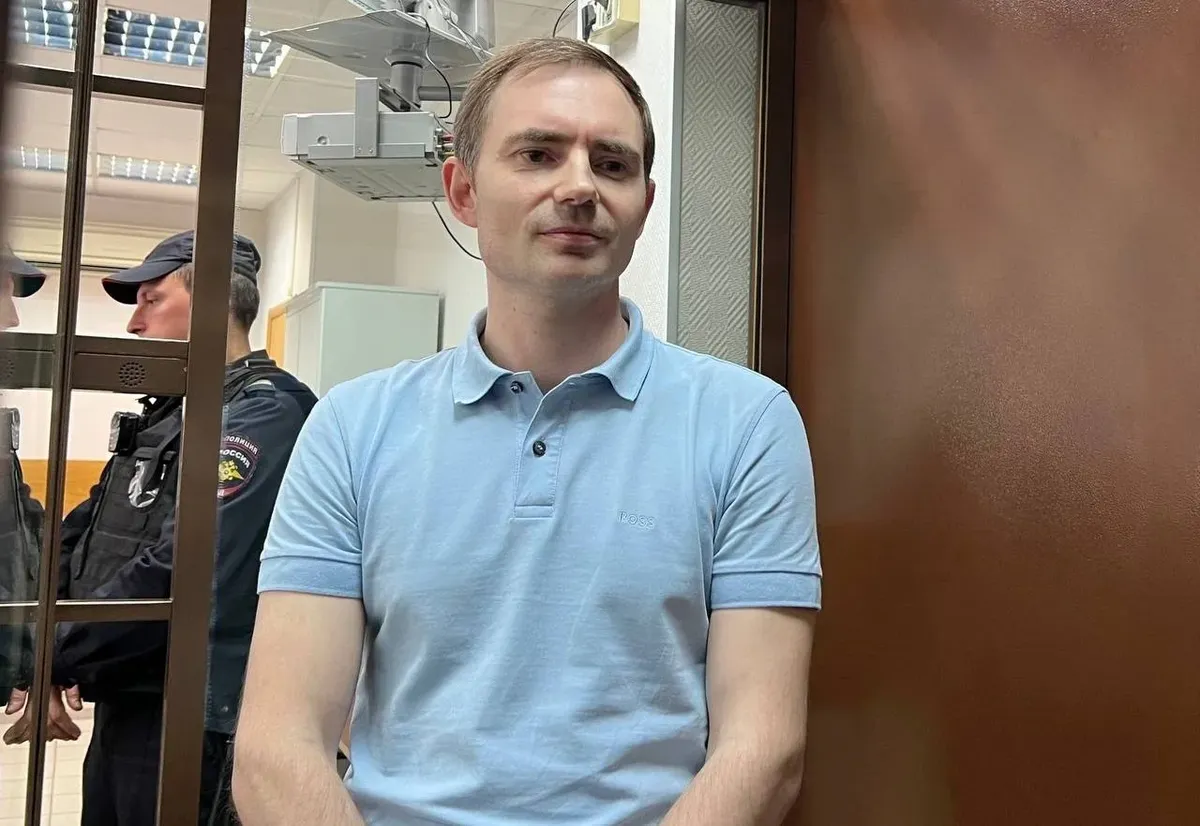
The trial of the deputy chairman of the Yabloko party Maxim Kruglov in Moscow. Photo: Sofya Sandurskaya / TASS
In the Zamoskvoretsky Court of Moscow, in the case of the deputy chairman of Yabloko, Maxim Kruglov, they again discussed the oddities of the charges, which had accumulated so much by the end of the trial that they had already begun to argue with each other. The investigation claims that the politician’s criminal intent arose back in 2020, at the time he created a telegram channel - two years before the appearance of the criminal article on military “fakes” (Article 207.3 of the Criminal Code). The prosecutor proves the existence of political hatred, but the examination she read does not say a word about such hatred. The indictment names mysterious “UN civilians.”
The prosecution witnesses, whom the prosecutor referred to during the debate, were no less remarkable. Political scientist Valery Somov, who works at the State Budgetary Institution “Zhilishchnik”, discovered Kruglov’s publications three years after they were posted and then told about them to an FSB officer, whom he said he met by chance. Young Guard volunteer Alina Matveeva said that she decided to file a complaint against the politician several months after reading the publications and after the initiation of a criminal case. Against this background, in the debate, the defense again raised the main question of the trial: if disagreement with the official position of the state is now considered political hatred, then where does the criminal case end and the political discussion begin?
“I did not allow feelings of hatred”
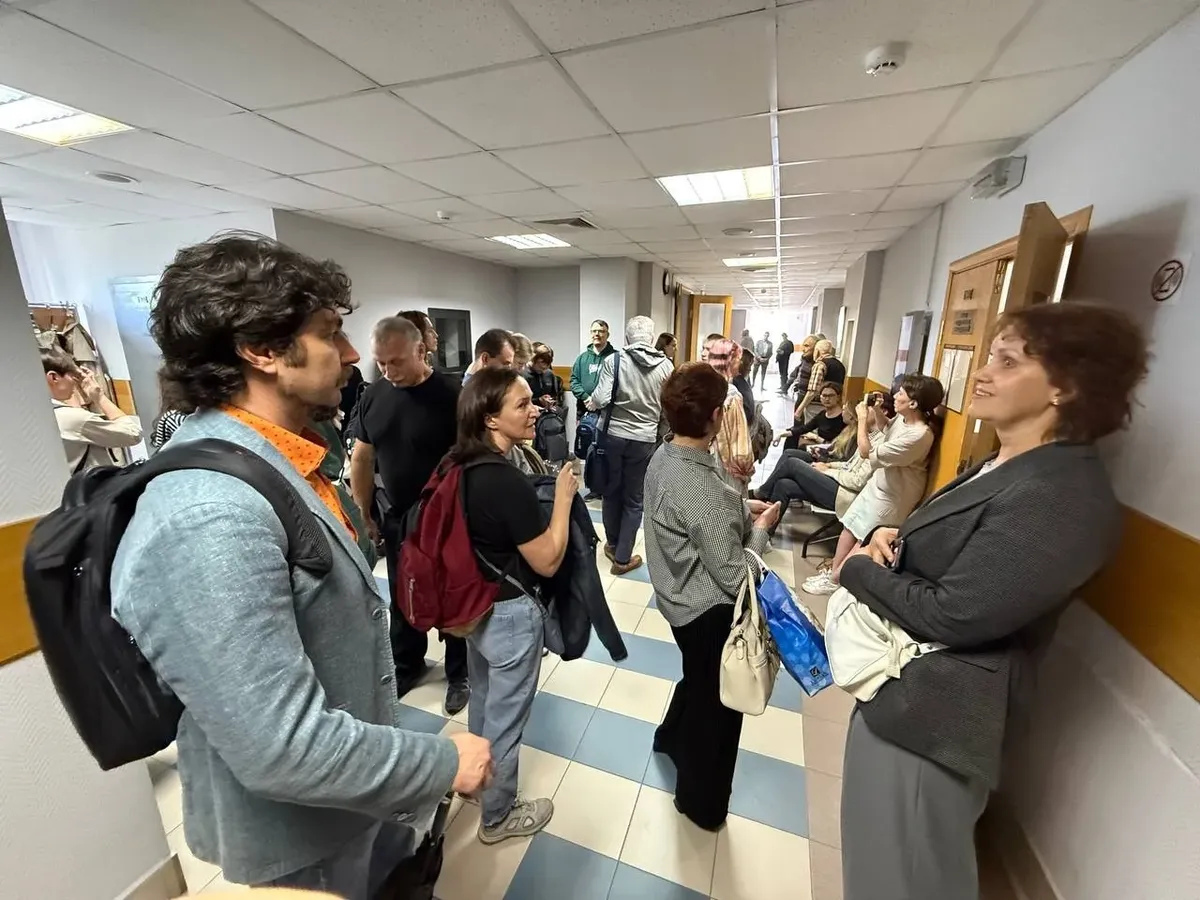
On June 17, fewer people came to Kruglov’s interrogation than usual. But the hall was still almost full. The benches were filled with relatives, fellow party members and regular listeners of the trial.
Lawyer Natalia Tikhonova suggested not wasting time on formalities and immediately moving on to interrogating the defendant. “Could you tell me a little about yourself?” - she asked.
Kruglov began with a biography. He said that he was born in Moscow, studied as a political scientist at the Russian State Social University and already in his first year joined the youth branch of the Yabloko party.
After university, he defended his PhD thesis in political science at the Russian State University for the Humanities, continued working in the party’s central apparatus, participated in elections to the Moscow City Duma and State Duma, and joined the federal bureau of Yabloko. In 2019, he was elected to the Moscow City Duma, where he headed the party faction. In 2024, the term of parliamentary powers ended, and Kruglov became deputy chairman of the party.
When it came to political views, the politician again returned to the Yabloko program. “Human rights, separation of powers, independent judiciary, independent media, respect for the individual’s position, political competition. A standard set of liberal democratic principles,” Kruglov said.
Tikhonova asked to talk about the party’s political opponents. Kruglov answered calmly and almost academically.
According to him, in the modern Russian political system, Yabloko is in opposition to United Russia. At the same time, he called the term “party in power” not entirely accurate, preferring to talk about the “political elite.”
He also named the Communist Party of the Russian Federation and the Liberal Democratic Party among his political opponents.
— How do you feel about SVO? — Tikhonov’s lawyer asked the defendant.
— My attitude towards the SVO is like that of our political party. The fighting is a tragedy and the loss of life must stop. It is necessary to conclude a ceasefire agreement as soon as possible and return to the diplomatic track.
One of the central themes of the hearings was political hatred - this is precisely the motive that appears in the indictment.
— Have you ever experienced hatred towards political opponents? — Tikhonova clarified.
“I didn’t allow such a feeling inside myself,” Kruglov answered.
As an example, he recalled the former leader of the “A Just Russia” faction in the Moscow City Duma, Magomed Yandiev. According to the defendant, Yandiev was surprised by his arrest: “He knows me not as an aggressive political opponent, but as a person who has always tried to smooth out rough edges.”
Kruglov also spoke about the characterization that Elena Shuvalova, a deputy from the Communist Party of the Russian Federation, gave him. According to the politician, even people who hold different views never perceived him as a person basing his activities on hatred.
“For me it is important to bring people together, to oppose in an intelligent way without becoming personal or resorting to hate speech. So that in the future we have space for conversation,” Kruglov said.
He recalled that while working as a deputy, military personnel and their families repeatedly approached him. In the case materials, according to Kruglov, there is also a testimonial from a Russian military man who spent eight months in Ukrainian captivity.
“When reading the indictment, I have a lot of bewilderment,” the politician continued.
He stated that he still did not understand where the motives of hatred towards certain social groups came from in the case. He is particularly bewildered by the investigation's version of the time when the criminal intent arose.
According to the indictment, the intent allegedly appeared at the time of creating accounts on social networks. “That is, long before the very article of the Criminal Code appeared, under which I am now being tried,” Kruglov noted.
After questioning by the defense, prosecutor Yulia Guznyaeva took the floor. Her questions concerned primarily technical details. Was the telegram channel public? Who had access to it? What phone number was used when registering? Who could post?
Kruglov answered reluctantly. When asked about the publicity of the Telegram channel, he said that he did not know. He also doesn’t remember his VKontakte ID. When the prosecutor began asking questions about the phone number, Kruglov recalled that he had already answered them during the preliminary investigation. Judge Elina Babayants and the prosecutor explained that these testimonies have not yet been examined in court, which means they cannot be referred to.
After a short consultation with lawyers, Kruglov suddenly announced:
— I refuse to answer questions from the state prosecution. It seems to me that I have already explained everything at the stage of defense issues.
The judge explained that the prosecutor still has the right to ask questions, and the defendant can answer them at his own discretion.
Kruglov clarified:
— If the judge herself asks questions, I am ready to answer in full.
Lawyer Sergei Badamshin explained that his client considers the prosecutor’s questions pointless, but does not refuse to participate in the process. Soon Kruglov began to answer. When asked if anyone other than him could have published materials on his accounts, he said:
- As far as I know, no.
Then the prosecutor suddenly asked:
- Is your father alive?
- I'm alive! - his voice came from the last rows.
Intention - before the article
After the interrogation was completed, the court immediately moved on to the debate. State prosecutor Guznyaeva stated that Kruglov’s guilt has been fully proven. In support, she referred to the testimony of prosecution witnesses: Valery Somov, who introduced himself as a political scientist, and Alina Matveeva, a volunteer of the Young Guard of United Russia. “The fact that witnesses may belong to other political parties or movements does not at all indicate the existence of grounds for slander,” the prosecutor said.
She then moved on to the expert opinion and the Department of Defense letter. Guznyaeva quoted the department’s response:
— The military personnel were not assigned any tasks aimed at combating the civilian population of Ukraine.
According to the prosecution’s position, the absence of such information at the disposal of the Ministry of Defense indicates the falsity of Kruglov’s publications. The prosecutor also added that the politician was aware of the possible wide public response of his publications. The defense, which argued that the controversial posts were published before the current version of Article 207.3 of the Criminal Code appeared, was not convinced by the prosecution. The prosecutor stated that the publications continued to be accessible even after the initiation of the criminal case.
At the end of her speech, Guznyaeva asked to assign Kruglov eight years in a general regime colony and to prohibit him from administering Internet resources for four years after his release.
After a short break, the defense began. Tikhonova's lawyer noted that the prosecution was unable to explain what kind of hatred they were talking about. Political? To the military? To a different social group? According to her, there is no evidence in the case of the existence of such a motive.
The lawyer recalled that the publication about Bucha was made before the official position of the Ministry of Defense appeared. Consequently, Kruglov physically could not know the future version of events that would later be presented by the authorities.
Tikhonova also drew attention to the main time paradox of the case. The investigation claims that the criminal intent arose back in 2020, at the time of the creation of the Telegram channel. However, Article 207.3 of the Criminal Code itself appeared only on March 4, 2022.
According to the defender, the investigation did not even establish what the name of the channel was at the time of publication of the controversial messages. The indictment includes the name “Maxim Kruglov. Apple,” although in 2022 the channel was called “Maxim Kruglov. Deputy."
“Kruglova’s guilt has not been confirmed. Maxim Sergeevich must be acquitted,” Tikhonova concluded.
“Commenting only spoils”
Lawyer Badamshin continued this line of defense. He urged the court not to replace political competition with political hatred: “If you follow this logic, we can say that witnesses Somov and Matveeva also experienced political hatred towards the defendant.”
Badamshin listed several contradictions in the prosecution. Among them are intent that appeared before the appearance of the criminal article, a requirement for Kruglov to know the authorities’ position that has not yet been published, and attempts to evaluate publications retroactively. The lawyer noted that the Ministry of Defense briefing is used as a marker of the correctness of any reports about the SVO, which is fundamentally wrong.
Kruglov himself recalled that when publishing the post he relied on data from the UN High Commissioner for Human Rights. He noted that UN structures are not banned in Russia and are not considered undesirable, and Russia itself remains a permanent member of the organization’s Security Council.
To support his words, the politician cites an unexpected example from life in a pre-trial detention center. On TV, he saw a speech by the new Commissioner for Human Rights, Yana Lantratova, who referred to the same data from the UN Commissariat.
The defendant also discovered in the materials another “absurdity” from the indictment, where in the quote from his post it is written about the dead “UN civilians” - which is an obvious mistake.
Kruglov called the main issue of the trial an attempt to connect disagreement with the official position of the state with political hatred. “Are we really going so far now that disagreement is equated with political hatred? This is contrary to the Constitution,” the politician was perplexed.
In her remarks, the prosecutor tried to answer the defense's arguments. When Kruglov asked to speak louder, since in the “aquarium” he could hardly hear the participants in the process, Guznyaeva said irritably:
- Well, that means you need to listen more carefully!
She commented on the story of the “UN peaceful citizens” who appeared in the indictment with a smile.
“Everyone perfectly understands the context and what was meant,” explained the state prosecutor.
Regarding the publication about Butch, the prosecutor said that the clause “apparently” in itself does not change the content of the post. In her opinion, Kruglov did not simply express an evaluative opinion, but accompanied the publication with photographs of destruction that were not in the UN report. Separately, Guznyaeva responded to arguments about political hatred:
— Why does the defendant connect disagreement with the political regime with political hatred and argue that the prosecution equates them? Let me remind you that this was established by psychological and linguistic examination.
After that, she read out a fragment of the expert report. However, the passage she quoted was about violent actions against civilians. There was not a word said about political hatred. It seems that this circumstance was noticed not only by the defenders.
- This is not because the prosecution in court puts such an equal sign. “We come to this conclusion based on the totality of evidence,” Guznyaeva concluded.
Lawyer Badamshin did not respond in detail to the prosecutor’s remark. “To continue to comment is only to spoil it,” he chuckled. There was laughter in the hall.
Tikhonov’s lawyer also promised to be brief, but still pointed out several points that, in her opinion, sounded particularly revealing. First of all, the defender drew attention to the story of the “peaceful citizens of the UN.” According to her,
the prosecutor actually admitted that the indictment uses an abbreviated paraphrase of Kruglov’s publication, and such a paraphrase changes the original meaning of the text.
Tikhonova recalled that, referring to the UN report, Kruglov was not obliged to reproduce its contents verbatim. “A reference to a source does not imply quoting the document line by line,” the lawyer is sure.
She then returned to the main dispute of the trial - the motive of political hatred. According to the defense lawyer, the prosecutor’s just-uttered remark deserves special attention from the court. Guznyaeva argued that the presence of such a motive was confirmed by a psychological and linguistic examination, however, in the fragment of the expert report she read, it was exclusively about violent actions against civilians.
“In fact, the prosecutor herself confirmed that the issue of political hatred was not examined by experts,” Tikhonova concluded.
After this, the judge declared the hearing closed. On June 24, Maxim Kruglov will give his last word, after which the court will retire to make a decision.