
Translated material
The rate saves the ruble
What is behind the cautious step of the Bank of Russia, which reduced the key rate by a quarter of a percent

Photo: Maya Zhinkina / Kommersant
At a meeting on June 19, the Board of Directors of the Central Bank of the Russian Federation did something that the market almost did not expect: it reduced the key rate not by 50 basis points, but only by 25 basis points. - up to 14.25% per annum. This is the ninth decline in a row, but the move was half the consensus. And it's not about inflation, which is (almost) slowing, or the economy, which is (partially) cooling. The main reason is the budget situation.
Formally, the Central Bank had reasons for a more bold rate cut: according to Rosstat, GDP in the first quarter of 2026 decreased by 0.2% year-on-year, in April-May the current seasonally adjusted price growth slowed to 2.1% (after 8.7% in the first quarter), and core inflation decreased from 6.2% to 4.2%. But at the same time, the Central Bank itself warned that the data for the first quarter were distorted by calendar and weather factors, and a more accurate assessment was possible only based on the results of the first half of the year. Therefore, the regulator, without engaging in self-deception, focused primarily on alarming signals - and all of them turned out to be related to the budget.
The ends don't meet
In January-May 2026, the federal budget deficit reached 6 trillion rubles, or 2.6% of GDP. This is twice as much as for the same period in 2025, and has already exceeded the annual plan of 3.79 trillion rubles approved by the budget law.
Revenues are practically not growing: over five months they increased by only 0.3% year-on-year, amounting to 14.78 trillion rubles. Expenses at the same time increased by 17% - to 20.79 trillion rubles. That is, the country has already spent almost half of all funds planned for the year.
HELP "NEW"
Oil and gas revenues fell by 29.8% (to 2.98 trillion) due to cheap oil at the beginning of the year and the strengthening of the ruble. Non-oil and gas revenues increased by 12.4% (to 11.8 trillion), mainly due to VAT (+21% y/y) - the effect of increasing the VAT rate to 22%.
The Ministry of Finance has already confirmed that the deficit at the end of the year will be higher than planned, and the achievement of the primary balance will be postponed for three years - until 2029. This means that the Ministry of Finance does not even plan to reach this same balance sheet in the medium term. And it will finance its priorities - at least with debt.
Therefore, two phrases appear in the Central Bank’s press release that explain its caution in lowering the rate.
The first is direct: “Fiscal policy over the three-year horizon will be more stimulating than previously expected. This may require a higher key rate trajectory than was assumed in the April baseline scenario.”
The second is even tougher: “Maintaining the primary structural budget deficit until 2029 may require a tighter monetary policy than in the baseline scenario . ”
In other words, the Central Bank admitted that fiscal policy was preventing it from fighting inflation. And he warned: if the Ministry of Finance does not bring the deficit under control, the rate will be higher than planned.
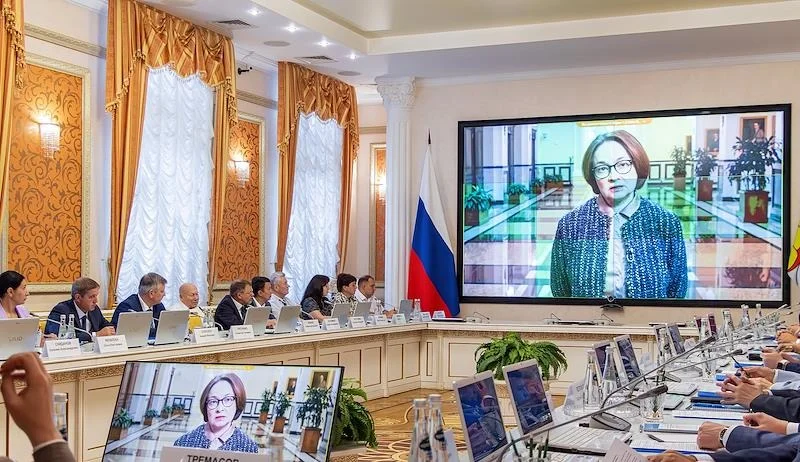
At the press conference, Elvira Nabiullina, who after a long break appeared in public, thanking all those who were worried about her health, was even more frank. She bluntly said that the risk of revising the parameters of fiscal policy is “ essentially already being realized” and uncertainty remains regarding its scale. And then she added that the contribution of fiscal policy to the money supply remains elevated, and taking into account the revision of budget parameters, “it will be greater than we previously assumed .”
This is no longer a hint, but a warning. The Central Bank says: “You are accelerating the money supply through a deficit, and then I’ll figure it out.”
Four pillars of the Central Bank’s caution
Why didn’t the regulator risk cutting the rate by 50 bp? The reasons lie in four signals he saw in the data.
Firstly , in April-May the growth of lending accelerated - both corporate and retail. Nabiullina paid special attention to this at the press conference: “If the acceleration of lending turns out to be a stable trend, and not a short-term surge after low values at the beginning of the year, then this may indicate that the current monetary conditions are no longer perceived by borrowers as restrictive.” She also warned that if strong lending continues, " it may require us to take a tighter stance than expected in the base case ."
Secondly , the Ministry of Finance borrows, spends, and accelerates demand. The Central Bank sees this and does not want to add its own monetary impulse to the budget impulse. Otherwise, inflation will accelerate again.
Thirdly , unemployment formally remains at historical lows. Nabiullina admitted that tension in the labor market is decreasing slowly, and wage growth, although it has slowed, is still outpacing labor productivity growth. In the logic of the regulator, this means that costs remain high, which means that inflationary pressure not only does not disappear, but remains stable. And therefore: “ for a sustainable reduction in pressure on costs and prices, further convergence of wage growth and productivity is necessary .” Work more, get less, in other words.
* Fourthly , external factors work rather in favor of rising prices, and the excess feed of increased foreign exchange earnings did not go to the economic horse. The head of the Central Bank noted that the balance of risks “has shifted more towards pro-inflationary ones.” The situation in the Middle East is ambiguous - so far, disinflationary effects have prevailed for Russia (a strong ruble due to high oil prices). But, on the other hand, there remains uncertainty regarding the scale of the consequences for the global economy, which may affect the Russian Federation through import prices and logistics costs. And at the same time, Nabiullina mentioned the “one-time” fuel crisis, which has already caused a surge in prices for gasoline and diesel. It is clear that it is futile to treat fuel shortages with monetary policy drugs, but the Central Bank will take into account the contribution of this factor to inflation.
Yes, current inflation is slowing. Yes, core inflation has fallen. But the Central Bank looks further into the future - and sees three leading indicators:
Credit impulse - the acceleration of lending in April-May - is future inflationary pressure. If credit continues to grow, it will create demand that is not met by supply.
Inflation expectations - they have decreased both among businesses and among the population, “however, they still remain elevated.” People expect prices to rise by 12–13% in the coming year. Until expectations are anchored, inflation will not return to 4%.
Fiscal impulse - The Ministry of Finance continues to accelerate demand through deficits. This creates structural pro-inflationary pressures that are not relieved by monetary policy.
High interest
At the same time, the OFZ market (federal loan bonds) has been giving a signal for several weeks that cannot be ignored. The yield on long-term government bonds reached 15%, exceeding the key rate. In normal logic, when the Central Bank reduces the rate, long-term securities rise in price and their yield falls. But now the opposite is true: at the far end of the yield curve there is growth.
Why? The answer is simple and complex at the same time. The Ministry of Finance is forced to borrow because it needs to close the budget deficit. But he doesn’t do it just “for the money.” His strategy is to lengthen the debt structure. Yes, he is now paying a premium for long issues (yield 14.85–15%). But he fixes this rate for 10-15 years.
In the world of debt management, the rule is to borrow when the demand is there, not when it disappears.
Today investors are ready to buy long OFZs, even at 15%. Tomorrow, if the budget deficit continues to grow or the foreign policy situation worsens, they may demand 17-18%. Or stop buying long-term securities altogether. Therefore, the Ministry of Finance, when placing expensive “long” securities, acts rationally: it converts current market demand into predictable budget obligations for the years ahead. It's like taking out a mortgage at a high but fixed interest rate, instead of renting a house for years, wondering if the rent will double tomorrow. In the long term, this is not a “loss”, but “insurance” against the worst scenario.
Moreover, the market does not believe in a rapid drop in rates. And he has historical reasons for this. In the modern economic history of the Russian Federation, there have been three cases when OFZ yields stopped following the lower Central Bank rate - and each time the market was right - rates rose again: in 2013-2014, in 2018, in 2020-2022. This is now the fourth episode of this series.
Investors see the budget deficit, see credit growth, hear the Central Bank talking about the need for “pauses” in the rate cutting cycle and that future decisions are “not predetermined.” And they conclude: “We don’t want to hold long securities without a serious risk premium.” Elvira Nabiullina actually confirmed this skepticism at a press conference: “ Neither the further reduction of the key rate nor the size of the step at each specific meeting are predetermined. We may need to pause to evaluate all the information coming in and the effect of our previous decisions .” When the chairman of the Central Bank talks about “pauses,” the market hears: “The rate will not fall quickly.”
Temporary difficulties in redistributing price increases
The situation with prices for gasoline and diesel, which have risen sharply due to the need for unscheduled repairs at refineries, also speaks in favor of a cautious decision on the rate. And, as the head of the Central Bank emphasized, “June inflation will be affected by the surge in fuel prices.” Nabiullina also noted that in June prices for fruits and vegetables reversed after an atypically strong decline in the spring, and this could also contribute to the acceleration of current inflation. That is why the press release included the phrase that the current rate of price growth may accelerate in June.
In addition, the head of the regulator warned about the situation with housing and communal services: “ In July, we will not have an increase in housing and communal services tariffs, as last year. Their indexing has been postponed to October. This means that annual inflation may temporarily decrease slightly due to this factor. But this will only be a redistribution of price increases within the year "
This means that
in July-September, inflation may look better than it actually is due to the absence of the usual July hike in tariffs. But in October this jump will occur, and annual inflation will return to “true” values.
The Central Bank will not be fooled by the temporary improvement - it is looking at sustainable inflation, which is still in the 4-5% range.
What about tomorrow?
To meet the annual budget deficit target, government spending in the second half of the year must fall by 13.4% compared to the same period last year. Well, this is unlikely, given government priorities. A more likely forecast for the deficit for the year is 6–8 trillion rubles.
Therefore, the Central Bank made it clear: further easing of monetary policy will depend not only on inflation, but also on how the Ministry of Finance behaves. Although it already follows from the statements of Minister Siluanov that the budget will remain a pro-inflationary factor at least until the end of the decade.
The next meeting of the Central Bank is July 24. If fiscal risks do not materialize, another reduction is possible. But the move is likely to be cautious again. Nabiullina directly said that the Central Bank can afford a pause to evaluate the incoming data. And that future decisions are “not predetermined.” The market has heard this and is not expecting a quick rate cut.

Where does the contradiction between fiscal and monetary policies come from? The Ministry of Finance and the Central Bank solve different problems: the Central Bank slows down inflation, the Ministry of Finance finances the priority sector in the face of a lack of income. The Ministry of Finance accelerates demand through the deficit, the Central Bank is trying to cool it through the rate. The Ministry of Finance borrows at a high price in order to lengthen the debt; the Central Bank sees this as a pro-inflationary signal and lowers the rate more cautiously. And none of them can stop. The Ministry of Finance cannot help but borrow - the deficit needs to be closed. The Central Bank cannot sharply reduce the rate - inflation has not yet been defeated, and the budget is accelerating it.
All this is not a mistake, but a clash of two rational strategies in conditions of colossal uncertainty. And while the government sticks to its priorities, the Central Bank will keep the rate higher than both people and businesses would like.