
Translated material
Four Years Until Dawn
Chapter from the novel by Alexei Polikovsky

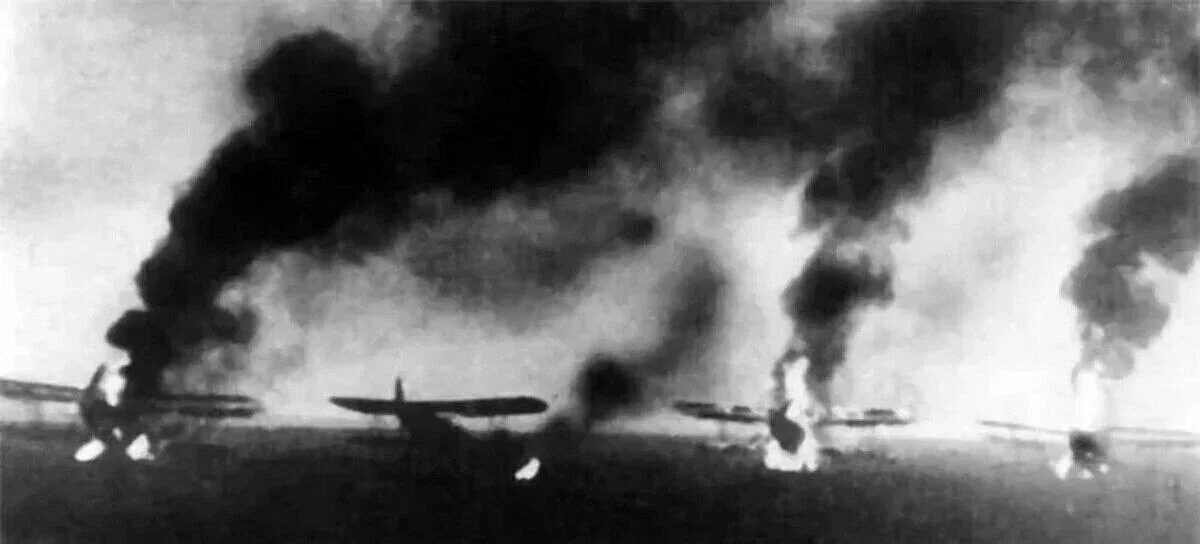
Crashed Soviet planes at a captured airfield. One German is sitting on the wing of an I-16, another is filming it. Photo: archive
An hour and a half after Kurnosov’s U-2 with the dead colonel landed on the volleyball court, another plane passed over the Imeninsky airfield. It was an I-16 fighter, a small, nimble plane with an open cockpit, from which a pilot with a strong-willed face, accustomed to always winning an athlete, and with a heavy lower jaw, looked down at the crashed SB and destroyed tanks. He also saw a Messerschmitt in the shadows of the forest and guessed that it had landed at an airfield that had just been captured by the Germans due to a technical malfunction. The hood flaps were raised, and technicians stood on stepladders on both sides. This pilot was the commander of the Air Force of the Western Special Military District, Major General Ivan Kopec.
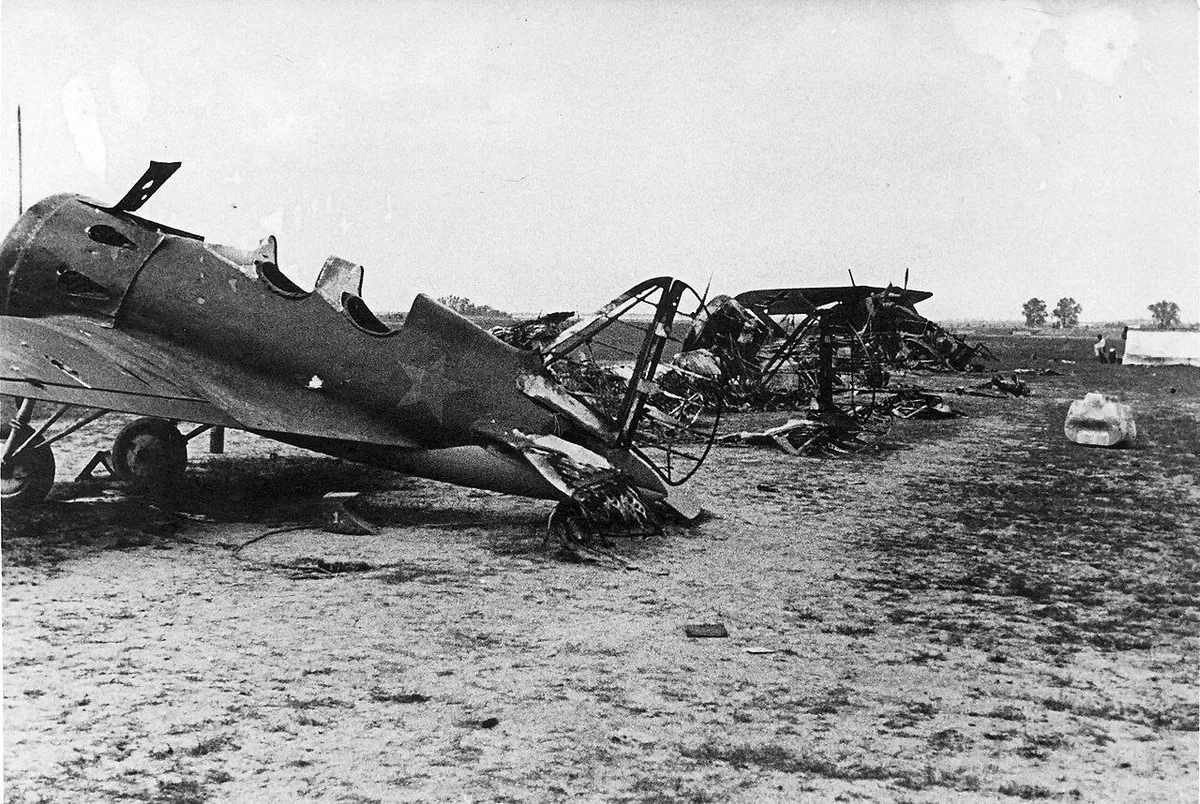
General Kopec flew over border airfields one after another. After Imeninsky, I flew to Pruzhansky, from a height of two hundred meters I saw a row of burnt-out fighters and realized that they were caught on the ground and did not have time to take off. He flew further, to another airfield, and fearlessly passed over it at an altitude of fifty meters, despite the fact that he saw German tanks and trucks on the ground; then he saw eight new, secret, tarpaulin-covered Il-2s captured by the Germans in the parking lot.
Then I went to the Kobrin airfield. I approached from the direction of the sun, cautiously, I didn’t know who was at the airfield, but I saw from above how two I-153s were landing, and sat down after them.
From the air I saw a Yak-1 standing in the middle of the airfield with holes in the wings, all riddled with holes, with a broken cockpit canopy, and a shot through the tail. "Someone got it."
And there are also mutilated planes scattered here and there, all the same “Seagulls” - I-153 sesquiplanes - with engine cowlings torn off, with holes from shrapnel in the fuselage, with pieces of skin torn out of the wings.
The technicians ran to the landing planes, and they also ran to his small I-16. A minute later he stood at the wing, surrounded by pilots and technicians. The two who sat down in front of him were also here.
- Comrade commander...
They recognized him and looked at him with silent questions. He understood.
— I’m flying around airfields to find out the situation...
I looked at the faces again.
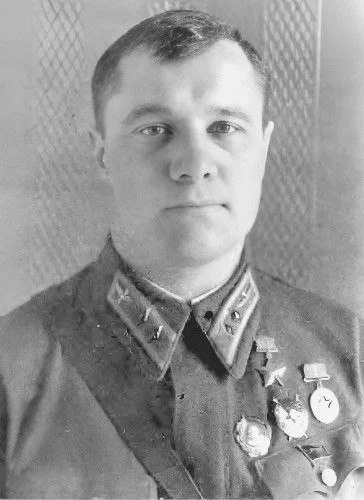
- Where is Major Surin?
They were silent. Some lowered their eyes, some looked at him, as if they were waiting for him to tell them something very weighty and important. He knew Surin and valued him very much. He was the first in the area to master the Yak-1 and flew it perfectly.
- Where is the regiment commander?
— Comrade commander of the district air force, Major Surin, died.
Now he was silent.
- How did this happen?
“The flight leader took off towards the border, this was his fourth flight today,” said the short captain in a blue tunic and blue cap. He spoke slowly, as if through force. “Before reaching the Bug, we found a Dornier-215 group above us and attacked them. They themselves were attacked by the escorting Messerschmitts, the regiment commander's plane was shot down, and he himself was seriously wounded. Major Surin returned to the airfield, landed the plane... They took him off the plane in their arms. Twenty minutes later he died. I took command.
— Report the situation.
— At two twenty in the morning, Major Surin arrived at the airfield and announced readiness number two. At three o'clock the connection was cut off, at three thirty the lights went out in all of Kobrin. Major Surin ordered the aircraft to be dispersed along the edges of the airfield; was done. At four fifteen the first bomb attack was carried out on the airfield, followed immediately by the second. Major Surin ordered: “Everyone in the air!” - I took off first...
- Report your losses.
— Eight planes did not return, seven were destroyed during the bombing of the airfield.
He stood silently among them, tall, taller than them all.
“We were at a dance on Saturday,” a young pilot in a helmet suddenly said. — The light went out. Straight from the dance here.
“Come on, we’ll show you, comrade commander,” said the captain. All together, the pilots, technicians and Kopets among them, crossed the field, passed three serviceable I-153s standing near the forest, and here, at the edge of the forest, he saw a mound of fresh earth in the grass and a piece of plywood stuck into it, on which was written in block letters in ink pencil:
Major Surin Boris Nikolaevich
1907–1941
Below, under the inscription, a five-pointed star was drawn with the same ink pencil.
So he flew around the airfields one after another and everywhere he saw the same thing: burnt out, overturned, I-153, I-15, I-16 fighters lying with their chassis wheels up and the new MiG-1. Where he could sit, he sat and listened to what the pilots told him; standing next to his plane, they said that the first time they were bombed at half past four in the morning, and then the second, and third, and fifth time, German bombers kept coming to the airfield, so they had to take off under the bombs. The pilots, who had already been over the Bug and Brest, said that the air there was full of planes with crosses, the air was humming with their engines, and more and more were coming from the west.
He laid out a map on the wing of his plane and showed the airfield in Pinsk to the pilots standing around him. He sent them there, there he hoped to collect what could still fly and fight, what was still left from the dead squadrons and regiments that ceased to exist.
The small, light, fast I-16 of the Air Force commander was rapidly rushing across the blue sky. He flew through smoke and fumes. Sometimes they shot at him from the ground, but Kopec did not pay attention to this. He saw the same thing that the pilot Kurnosov had seen an hour earlier: roads along which German tanks and trucks walked in long columns, German infantry stretched along the sides of the highway, German motorcycles, German cars. During these hours, in a fighter plane, flying over the border airfields where he was transferring aviation in the spring, confident that in the inevitable and imminent war, the district’s troops would go forward and aviation would have to fight in the skies of Germany and Poland - he experienced a feeling of a terrible, irreparable mistake. Again there were planes abandoned on the ground and burned at airfields, and gradually the hopeless horror of defeat reached him.
In the evening, while it was still daylight - the evenings at the end of June are long, it gets dark late - the Air Force commander's fighter landed at an airfield near Minsk. Driver Mintser was waiting for him with the car. An hour later he was in his office. Adjutant Captain Pozhidaev entered and closed the door behind him.
- What, Sasha? — Kopets looked at the adjutant who stood in front of his desk. There was not in the commander’s face that endless confidence of an undeniable champion, which was always in his smile, mockery and gestures, and his eyes looked worried and even with melancholy; So it seemed to the adjutant. It was as if not just a few hours had passed since General Kopec flew to the west, but many days; and now it was a different person, and there was a strange absent-mindedness in his look and actions; while talking with the adjutant, he twice took a pencil from a black ebonite cup and twice put it in its place.
“Ivan Ivanovich,” said Captain Pozhidaev, “Major Pomba from the third department came here twice while you were away.”
General Kopets silently looked up at Pozhidaev. Even when he sat at the table, he was not much shorter than the adjutant.
“A special officer I know, Chekulev, came to say there is an order for your arrest.”
A sharp fold suddenly cut through Kopets’s left cheek, stretching upward from the corner of his mouth. Never before had an Air Force commander had a nervous tic. He rubbed his cheek vigorously with his palm, as if in forgetfulness and in that sudden and strange absent-mindedness that he had also never had before. He removed his hand from his cheek and looked at the adjutant.
He nodded to him and then nodded towards the door - go.
He picked up the phone himself.
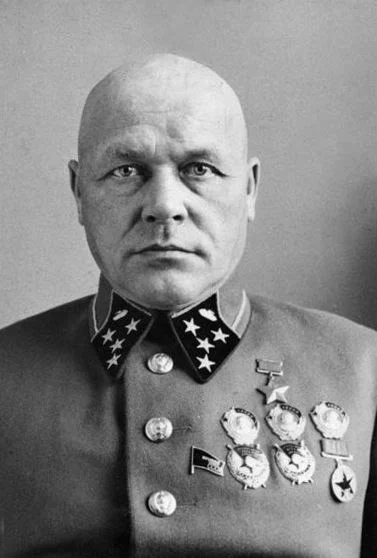
— General Pavlov is listening.
— General Kopec is on the line.
- Report, Ivan.
— The airfields have been bombed. The losses are huge. I can’t count it exactly, but I estimate up to 300 aircraft of all systems, including training ones.
“There can’t be such losses.” This is alarmism, Ivan.
- It's true, Dmitry Grigoryich. I saw everything with my own eyes. The Imeninsky airfield is in the hands of the Germans, Pruzhansky is bombed... We are being bombed continuously. They come in as if on a parade and bomb. Heinkels, Dorniers, Junkers... Most of the losses were on the ground.
- Why didn’t you prevent it?
“Suddenly, they couldn’t stop the first strike at night because they hadn’t mastered night flights on the new technology.
- What now?
— The district’s aviation does not exist as an organized force.
“You shouldn’t say that, Ivan.” They won't forgive you for alarmism, you know. In the morning directive, the General Staff gave you the task of bombing Koenigsberg and Memel. Report your readiness.
- What to bomb with? There's nothing to bomb with!
- Do you understand what you are saying? Go stick your head under some cold water!
Pavlov added a swear word and hung up.
For some time General Kopec sat at the table with his eyes closed. The pictures of the day—what he saw—passed before his closed eyes. He saw the holey fuselages of small, energetic I-16s with red stars, he saw the horribly and absurdly protruding landing gear of overturned fighters, he saw the broken wings of DB-3 bombers and the black, burnt grass of the runways. I saw a low-speed TB-3 lying in a field, a huge body spread out on the green grass, flying to bomb bridges and torn to pieces by high-speed Messerschmitts. He was again in the cockpit of his light, maneuverable, fast-turning fighter - Chato was the name of his fighter in Spain, Chato - and he was suddenly transported to where the young lieutenant was taking off into the hot, thick blue sky. He opened his eyes, reached out and took the gun from the table.
At the district headquarters, an officer entered the office of General Pavlov, who was standing in front of the map, and hesitantly said:
-Dmitry Grigorievich...
- Yes. What? Speak.
— Major General Kopec shot himself.
Pavlov’s bright, transparent eyes stared at the officer’s confused face. They looked at each other in silence. And it suddenly seemed to the officer, looking into the bottomless, unblinking eyes on Pavlov’s bare face, that in the very depths of these eyes lurked madness.
“Coward,” Pavlov suddenly said loudly.