
Translated material
Destroy again
In Vorkuta, a memorial sign to those killed in the Gulag uprising was also demolished. But for the first time - at the request of those who returned from the Northern Military District

Cemetery "Yur-Shor". Photo: webarchive
The official reason for the destruction is that among the 33 names of the dead prisoners there are prisoners convicted of participation in the activities of the UPA * - the Ukrainian Insurgent Army, banned and recognized as “extremist” in Russia.
This is not the first time such memorials have been destroyed. But, it seems, the first where the “veterans of the Northern Military District”, to whom the Vorkuta authorities refer, acted as censors of history.
A memorial sign at the old cemetery was erected on October 14, 2010 on the territory of the former 10th Yur-Shor camp department with the participation of the local administration.
Yur-Shor is one of the main places of memory of the Vorkuta camp complex.
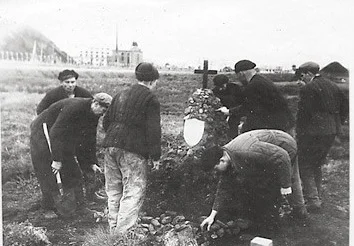
From 1944 to the mid-1950s, prisoners of Vorkutlag and Rechlag, as well as civilian employees of mine No. 29, were buried here. The graves were marked not with names, but with number plates.
For many years there were no problems with this sign - until, as the Vorkuta administration reports, “a meeting of the city leadership with the participants of the SVO took place.”
Reportedly, the initiator of the demolition of the memorial was “a deputy of the city council, a military veteran, a member of the Northern Military District, awarded the Order of Courage, as well as two medals “For Courage,” Grigory Dyshlyk. He himself is now outside the city on a work trip.”
Judging by the photographs of the meeting, which were posted by the Komiinform news agency, Dyshlyk himself was not at the meeting with the administration of Vorkuta, but allegedly “the position of the initiative group at the meeting was voiced by the participants of the SVO”: “The bitter truth about the crimes of the Nazis and their accomplices should not be lost. We all need to remember what happened to prevent this from happening in the future. It is enough to mark the burial place itself on the map. And remove the memorial sign from this place - there is no need for it to be in our city.”
The administration reported that it “promptly sent a request to the museum,” and “during the inspection, archival data confirmed: in this cemetery, prisoners convicted of participation in the activities of the Ukrainian Insurgent Army *, the Organization of Ukrainian Nationalists * (recognized as extremist and banned in the Russian Federation) and other nationalist formations that fought on the side of Nazi Germany are actually buried.”
That “these documents were declassified and published in 2004 as part of the multi-volume scientific collection “The History of Stalin’s Gulag” and are in the public domain.”
That “there are dozens of names in total on the list. Articles: 54-1a (treason), 54-8 (terrorist act), 54-11 (participation in a counter-revolutionary organization). Sentences range from 10 to 25 years in camps, many are sentenced to capital punishment.” And several names from the “archive list” are given.
And in the administration’s message there is a remarkable entry: “some of them died much later than the events of 1953.”
This is official information from the Vorkuta authorities.
Now let's try to figure it out in more detail.
By “events of 1953” we mean the “Vorkuta Uprising” - a riot of Rechlag prisoners in the vicinity of Vorkuta in July - August 1953.
After the death of Stalin and the arrest of Beria, unrest and strikes of prisoners began in Rechlag (and not only there), who demanded the abolition of the hard labor regime, the lifting of restrictions on correspondence with relatives, the possibility of early release, and the abolition of numbers on clothes.
In all camp sections, except for the 10th (which, as already mentioned, was located in “Yur-Shor”, where mine No. 29 was located), the Rechlag guards managed to cope with this, but the 10th continued to hold out. As the Ministry of Internal Affairs later reported, “the organizers of sabotage in camp department No. 10 behaved more boldly and defiantly.” And they demanded to immediately resolve the issue of a massive review of cases and the release of all prisoners from the camp.
On August 1, 1953, the uprising was brutally suppressed: officers of the Ministry of Internal Affairs shot prisoners with machine guns, more than 50 people were killed.
There is information on the Internet about the opening of the memorial sign. It says that this happened on the initiative of the Department of Social, Cultural, Preschool and Educational Institutions and the Vorkuta public organization “Ukrainian Hut”. That it perpetuates “the memory of representatives of the Slavic peoples - victims of Stalin’s terror. That “the idea of installing the monument belongs to the head of the Department of Social, Cultural and Preschool Educational Institutions, Nikolai Beyzak.”
In other words, everything was done on the initiative of the city authorities.
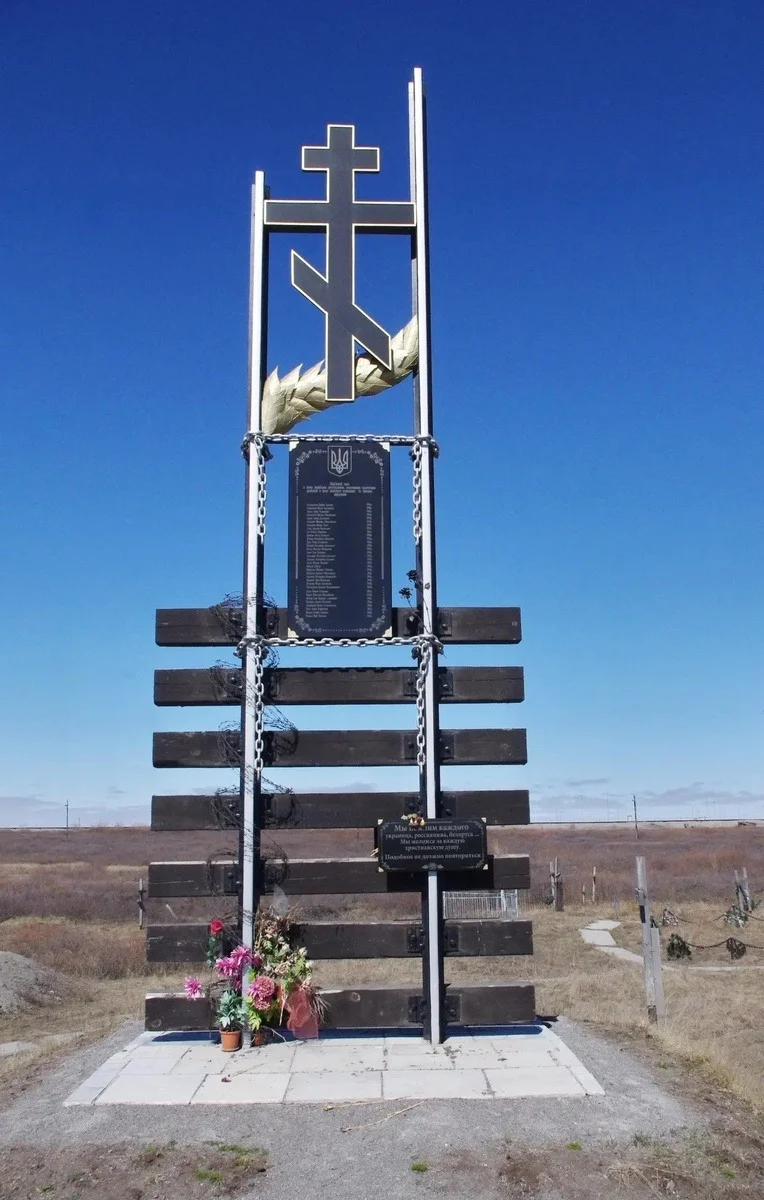
It goes on to say that “all the symbols of the terrible time of repression were embodied in the memorial sign. This is a symbolic railway stretching into eternity. The city began with rails and sleepers; prisoners worked on the construction of the highway.
As such, there was no collection of money for the monument; many organizations, city enterprises and individuals contributed to perpetuating the memory of those killed during the construction of the northern railway. Some helped with materials, others with transport and labor.
The monument was consecrated with the participation of Archpriest Michael, a representative of the Kyiv Metropolis of the Ukrainian Orthodox Church. During the event, 33 lamps were lit according to the number of names engraved on the memorial plaque.”
A list of 54 prisoners from camp department No. 10 of mine No. 29 who died on August 1, 1953 and were buried in the Yur-Shor cemetery is provided. Among them are Ukrainians, Lithuanians, Estonians, Latvians, Germans, and there are also Russian names.
So, there are doubts about the reliability of the administration’s message about the presence on the memorial sign of the names of those who died after the events of 1953. In any case, in 2010 the administration had no doubt that all these people died during the uprising...
Were there “Nazi collaborators” among those 33 people whose names were written on the memorial sign (as North Military District veterans and the Vorkuta administration claim)?
The Vorkuta authorities cite six names to justify their actions:
“Gavchak Anton Lukyanovich (born 1930) - member of the UPA, organizer of the youth nationalist organization “Eaglets”, committed armed attacks on military personnel. 8 people were killed.
Vasily Semenovich Guk (born 1915) - served in the Ukrainian-German police, participated in arrests, interrogations and beatings of Soviet citizens.
Chernetsky Bogdan Stanislavovich (born 1930) - intelligence officer and informant of the OUN, assisted in committing acts of sabotage.
Duma Fedor Stepanovich (born 1932) - had connections with the OUN, met with members of the underground and passed on intelligence information to them.
Dovbysh Vladimir Grigorievich (born 1930) - went illegal, joined the OUN, was engaged in robbing the population.
Chunis Semyon Gavrilovich (born 1907) - secretary of the village government under the Germans, in 1944 he avoided service in the Soviet army, joined the OUN, and provided financial assistance to the bandits.”
All these names are included in the “list of 54”. And there is the “Lviv Book of Memory,” which, with reference to convictions, provides more detailed information about three of those listed: Anton Gavchak (only his year of birth is 1920, not 1930), Fyodor Duma and Semyon Chunis.
Gavchak, a member of the OUN since 1943, was arrested in 1949 and in 1950 sentenced to 25 years in prison with disqualification for 5 years.
Duma (for collaboration with the UPA, convicted in 1950) and Chunis (member of the UPA underground, also convicted in 1950) received the same sentences.
Everyone has the same date of death - August 5, 1953, in the camp (apparently, only on the 5th were death certificates compiled).
So, about the Nazi collaborators: the OUN-UPA indeed collaborated with the Nazis during the Great Patriotic War. And she participated in their crimes. And those who participated in these crimes were deservedly convicted: there is nothing to argue about. “Volyn massacre” is an indisputable fact.
However, the territory of Western Ukraine (and in general the entire territory of the Ukrainian USSR) was completely liberated from fascist occupation by August 29, 1944 during the Lvov-Sandomierz operation. By this time, two of the prisoners (out of six) listed by the Vorkuta administration were 14 years old, and one was 12 years old. After the war, they could, being in the OUN-UPA, fight against Soviet power, but during the war they could hardly have been accomplices of the Nazis.
As for the other three, only one of them is accused of serving in the German-Ukrainian police, the other two are accused only of membership in the OUN-UPA. And not in aiding the Nazis.
By decree of the Presidium of the Supreme Soviet of the USSR of September 17, 1955, two years after the Vorkuta uprising, an amnesty was declared for “those Soviet citizens who during the Great Patriotic War of 1941–1945. out of cowardice or ignorance, they found themselves involved in collaboration with the occupiers.”
Including, regardless of the term of punishment, all those convicted of serving in the German army, police and special German units were released. An exception was made only for “punishers convicted of killing and torturing Soviet citizens.”
In other words, those who collaborated with the occupiers, served in their army, but had no blood on their hands, were forgiven by the state. With the removal of a criminal record and loss of rights. As an act of mercy.
As indicated in the “Lviv Book of Memory”, the mentioned Gavchak, Duma and Chunis were rehabilitated by the Lviv Regional Prosecutor’s Office.
Gavchak - in 1995, Duma - in 1992, and Chunis - in November 1991 (still during the existence of the USSR and Ukrainian SSR).
One can, of course, say that these are decisions of the Ukrainian authorities, but the RSFSR Law “On the Rehabilitation of Victims of Political Repression” directly states (Article 11): “Documents on the rehabilitation or recognition of persons as victims of political repression, issued in states - former union republics of the USSR, are valid on the territory of the Russian Federation.”
No one has canceled this norm. And the administration of Vorkuta in 2010, before installing the memorial sign, most likely requested certificates of rehabilitation.
In 2013 (when the 60th anniversary of the Vorkuta uprising was celebrated), a solemn ceremony was held at the memorial sign. And a video was made about her, where it was said that “for many years in the last days of July in our city they remember the tragic events of recent history 60 years ago,” when after the death of Stalin there was a wave of strikes in all the camps of the USSR. That in the camps of Vorkuta people hoped for liberation or at least for a softening of the camp regime. That the strikers were dispersed from the barracks with the help of jets of water from fire trucks, but such an impact only embittered the rebels, people broke through close to the building where the camp leadership was located, and the guards opened fire to kill.
The story also says that every year townspeople gather to lay flowers at this sad place, a memorial prayer is heard over the graves of Gulag prisoners, and city leaders and representatives of the city-forming industry come to pay tribute to the memory of the dead. And that “after the ceremony, the deputy head of the municipality, Yaroslav Melnikov, presented certificates and gifts to active participants in the Memorial society** and to volunteers in the improvement of territories near memorial sites.”
This was 13 years ago. By that time, it had been almost ten years since the documents had been declassified and the collection on the history of the Gulag mentioned by the Vorkuta administration had been published. Neither the authorities nor the public had any doubts about the necessity and importance of the memorial sign at that time.
But different times have come. In the current realities, a memorial sign with a “Ukrainian accent” was doomed to cause discontent with the authorities.
There are two options for the development of events.
The first is that the administration of Vorkuta, which itself installed the memorial sign, has now decided to present the situation in such a way that, by demolishing it, it is only meeting the needs of the Northern Military District veterans. And she made them understand that it would be useful to take such an initiative.
The second option is that the initiative was taken by the veterans themselves, who are not necessarily deeply aware of the history of the issue, but responded in accordance with current government guidelines. Believing that their status gives them the right to make offers that cannot be refused.
In either of the two cases, we have a very typical—and hardly the first and only—situation when veterans of the Northern Military District not only apply for deputy and bureaucratic positions, but also turn into “memory regulators.” A kind of censor. Those who have the right to determine which historical memory is correct and which is not.
To act, as Alexander Radishchev once wrote (albeit for a different reason), as “deanery officers.”
Since the provision of “protection of historical truth” was written into the Constitution in 2020, under the guise of this protection we have from time to time observed the very rewriting of history, the inadmissibility of which the authorities constantly assure us.
Because what is considered “historical truth” is decided by the authorities or organizations specially trained for this purpose, such as the “military historical society”. Based on your current needs, or more precisely, from the need to portray the past in such a way that it justifies the present and serves as a model for the future. This “highly approved”
the truth is protected by destroying the inconvenient memory of the Soviet past. And first of all - about Stalin’s repressions.
To convince citizens that the state, while persecuting “enemies of the people,” was always right. Otherwise, what good, they will begin to doubt that the state is also right today in persecuting “enemies.”
So they are destroying memorials and memorial signs (which Novaya Gazeta has talked about more than once).
And now in Novosibirsk they want to demolish the foundation stone for the victims of political repression, installed in 2019 and never becoming a monument.
In April of this year, unknown people tore down a sign from it: “A monument to the victims of state terror, whose graves or places of mass graves are unknown,” will be built here, and now they want to demolish the foundation stone under the pretext of “comprehensive improvement.”
And Deputy Lugovoi continues to talk about the enormous merits of the Cheka, the KGB and the FSB in protecting the country from “external influence” and demanding that the Solovetsky Stone be removed from Lubyanka Square, returning the monument to Dzerzhinsky there.
It is not for nothing that Orwell called the corresponding body the “Ministry of Truth” and not the “Ministry of Memory”.
Andrey Serov