Date
Author
Материал Роза Люкс Иллюстрации София Хананашвили
Source
Preserved copy
Translated material
Forward to feudalism vs back to capitalism. Why does the future suddenly seem worse than the past?
Over the past few years (primarily at the instigation of economist Yanis Varoufakis), people are increasingly talking about “techno-feudalism” here and there. And if you think about how we rent a place, say, on Ozone, the association with land rented by a peasant is almost inevitable. This creates an almost Sorokin-esque picture in the head: the tsar, the oprichnina, technological progress turning into a digital concentration camp, hiding behind the discourse of justice and care for the common people.
Sociologist Rosa Lux wrote a long text for us about whether we should be afraid of the advancing feudalism, why we don’t like the unemployed, and why we always count our working hours.
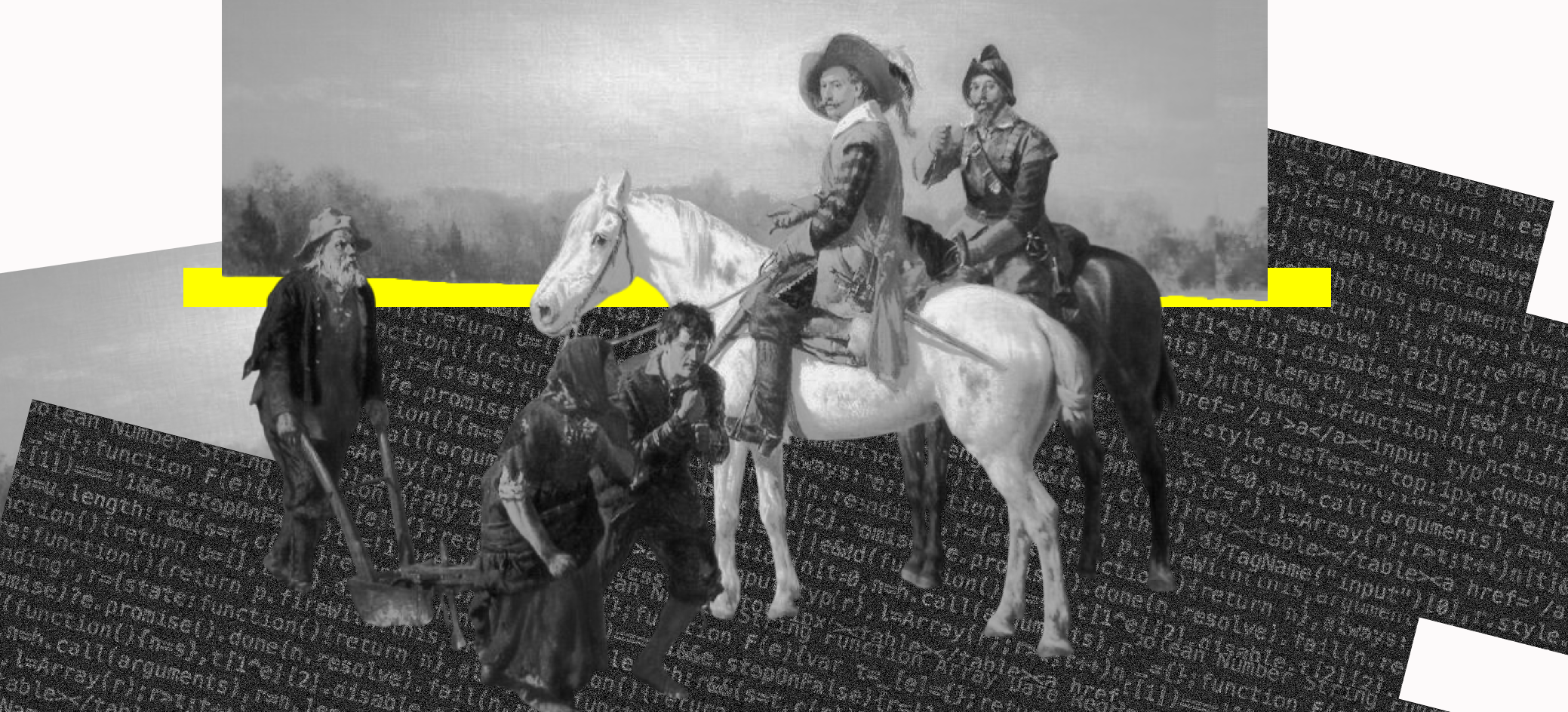
The end of history has not yet arrived, but weather forecasters do not promise a wonderful future for capitalism. Increasingly, one can hear that we live in the era of neo-feudalism, which evokes a terrible picture of sewage pouring into the streets, widespread illiteracy and the approaching apocalypse. However, there is still a difference between capitalism and feudalism. And perhaps therein lies the key to describing our time.
When raising the question of what capitalism and feudalism are, we inevitably encounter the difficulty of defining the boundaries of the concepts. Both systems are abstract, vast entities spanning long time periods and geographic spaces. They changed in the process of their formation, but historically they could well exist in parallel. However, firstly, what becomes much more important is that both systems function as myths on which real structures rest. These myths are enshrined in the public consciousness, creating in our minds a certain picture of the social structure. They fill the system with values and give it moral foundations. And secondly, we can identify some ideal types of capitalism and feudalism and their supporting elements, which are most often found in any society, regardless of external conditions.
Feudal society is built on a class, hierarchical principle. Estates are characterized by closedness, that is, low crossing of borders: it is not possible to simply rise from rags to riches, as a rule, at the legislative level. In society there are not rights, but privileges that can be inherited. Although some statuses function as professions, in connection with which you will have to rise to them, for example, to an artisan or a clergyman.
The most important privilege in feudalism was the ownership of land, which was most often given for military service. A fief, that is, a plot of land, is the main asset of the upper class: representatives of a lower social position (most often peasants, who made up the bulk of the population as a whole) were required to pay rent for the use of the fief. Rent was passive income: nobles usually did not produce anything, but only received tribute for what was rightfully theirs.
However, it is impossible to reduce relations between classes to purely economic ones: status plays too big a role in such societies. This is well illustrated by the limited channels of mobility, which come down primarily to three institutions: the army, the church and marriage. For example, having earned capital in one’s own business, becoming a nobleman was extremely difficult, and in some cases, simply impossible. The nobles treated such nuggets with contempt, even if they themselves had big problems with money.
Let us recall, for example, that the plot of Molière’s comedy “The Bourgeois in the Nobility” is based on this (the original title Le Bourgeois gentilhomme had an additional meaning for pre-revolutionary France: the word gentilhomme meant a hereditary nobleman who had at least four generations of noble ancestors. A rich bourgeois (bourgeois), who personally received the nobility, and did not inherit it, belonged to the category of nobles (nobles) and under no circumstances could it be designated as gentilhomme). According to the plot, a wealthy tradesman, Mr. Jourdain, tries to imitate the noble class in everything, which his means fully allow, but looks funny to those around him: this bourgeois hires teachers of music, dance, fencing and philosophy, who openly make fun of him, luring him out of money.
Closed feudal societies are contrasted with open capitalist ones, based on a new ideological doctrine of freedom. Estates are being replaced by classes distinguished primarily according to economic rather than status criteria. Now it is not as honorable to be born rich as to earn wealth through hard work. And in later periods of the development of capitalism, representatives of inherited capital even try in every possible way to look like “self-made” people.
The boundaries between classes are becoming much more permeable: there are now no restrictions on channels of mobility, and the volume of social movements is becoming colossal. For example, in a fairly short period of time, the peasantry, which made up the bulk of the population, is reduced to just a few percent in the overall structure of modern states. And the growth of material well-being and the general level of education becomes the basis for an increase in the middle class, which personifies the standard and guarantees of stability of the social order.
The main asset becomes not land, but capital. Relations between classes are now characterized by wage labor, which can also be described by the principle of freedom: the worker has the right to choose his employer.
In feudal society, ideas about the primacy of duty, service, and tradition prevail. The main worldview is religious. Moreover, religions tend to reduce the number of gods in the pantheon, often reaching the number one - such a divine structure is quite consonant with the worldly: there is one supreme god (aka king, king, emperor, etc.), to whose law everyone is subject. It is not surprising that powerful figures could endow themselves with divine properties and present themselves as the viceroy of God on earth. The fate of man lay in the realm of fate and was largely predetermined. Social order was based on faith, which became the central symbol of feudal society. Tradition supported this belief.
Fatalism is replaced by the conviction that man himself is the architect of his own happiness. A person acquires agency, why does he now need God? God died, we killed him. Without God, you can strive to build the world you want: a world based on freedom (as the main value), equality and brotherhood - the three pillars of the new era. From them flow the main ideological trends that define modern societies: liberalism, socialism and conservatism.
Agency and scientific knowledge lead to the rapid development of technology. Scientific and technological progress, directed towards the future, is opposed to tradition. This means that here and now everyone can achieve happiness, which is declared as a new goal. To achieve which there are specific, calculated steps, so that the world becomes predictable.
It turns out that things might get worse, not better.
There is a great temptation to call today’s society feudal, because everything seems to be going according to Sorokin: the tsar, the oprichnina, technological progress, turning into a digital concentration camp, hiding behind a discourse of justice and care for the common people. It is not for nothing that one of the most beloved economists in intellectual circles, Yanis Varoufakis, so promotes the term “techno-feudalism”. In practice: we still have classes, not estates, with formally permeable boundaries (often even more permeable than ever before). These are still the same classes of capitalists and wage workers (the latter are now, however, divided into many other classes, but are still united by the need to sell their labor power). Liberalism is invariably the main ideology: moreover, it has managed to triumphantly praise the end of history.
Economists point to the growing role of rent for the opportunity to use cloud services provided by corporations. For example, in order to sell any product online, most likely you will need to create an account on Ozon (or Amazon - depending on the political space around you), paying money to the service for a place on the site. The system is not limited to just an entrance fee; you also need to take into account visibility taxes, the ability to stay in trend, receive positive customer reviews, etc. Such a service acquires the status of a “cloud fief,” and the system itself is compared to a feudal one.
For the user, the appearance of the advantage of non-ownership is also obvious: it is now much easier to pay a small subscription for Spotify or car sharing than to buy a huge library of music or a personal car (which, among other things, needs to be maintained). In addition to user money for subscriptions, “cloud feudal lords” also collect another valuable resource - data received for free in exchange for some special functionality, and later sold to advertising agents. It is this sale of advertising that actually makes up the bulk of the profits of cloud companies. It turns out that user data is simply appropriated by corporations.
The very term “user” seems to hint: and now nothing belongs to you, neither your working time, nor your free time, nor housing, nor transport, nor films, nor music. Instead of the neoliberal “buy,” we hear “rent.” Of course, the manifestation of new forms of domination and the fear of losing any control over one’s life is felt not as progress - the luminary of liberalism - but rather as a rollback. As if instead of a progressive movement forward, towards a bright communist future / a production paradise / a fair society (what needs to be emphasized ideologically), or at least stopping at the end of history, there is a slow rollback - into the dark Middle Ages, dirty due to mountains of garbage, poor due to the growing polarization of income, with epidemics, wars, uncontrollable natural disasters and a disconnected Internet, if necessary.
In many ways, this feeling is due to the growth of right-wing sentiments. They are not only tied to the preservation of some ideally existing world order in the past , to which we must certainly return, but are also accompanied by actual legal or other actions aimed at limiting various freedoms for which we had to fight so long and hard. However, such logic represents a trap of modernity: after all, conservatism as an ideological movement itself arises in response to images of freedom, equality and fraternity. The "beautiful past" - where the grass was greener, the air cleaner, men more masculine and women more feminine - was formed parallel to the rapid development of capitalism, and it is radically different from the traditions in feudal societies.
And besides this, the agency of the individual is regressing, that is, the ability to influence the course of events around, promoted by the ideologies of the New Age. Once again, the little person from school literature lessons finds himself in the face of a huge machine of corporations or the state. The level of fatalism is growing, and the growth of religiosity and other esoteric practices is subjectively felt. All this is supposedly characteristic of the spirit of feudalism. However, the individual does not disappear from the philosophy of existence; he only becomes more and more atomized. And this fits perfectly into the logic of the capitalist spirit. In a feudal system, the unit of life is considered to be rather a community; no individual exists, he is only part of a group. The ideology of modern times begins with the liberation of the individual. That is why atomization and the problem of loneliness are relatively new phenomena. The farther away, the more a person is separated from a person.
The development of technology frees up a lot of free time for workers, which, however, does not lead to greater autonomy. Working hours are increasingly strictly observed by capitalists, and the worker himself is forced to sit his pants, losing the meaning of his activities, which is a clear marker of alienation - about which many books have been written and many films have been made in the era of the heyday of capitalism.
Drowning in capitalist realism, society was afraid of the impossibility of imagining a world outside of capitalism, but when we are nevertheless asked to do this, it turns out that things may not be better, but worse.
We seem to have lost the optimism of the New Age, but we certainly haven’t lost our thirst for new narratives. Now there is no longer any doubt that the end of history is not in sight. We don’t know what will happen next, because the world has ceased to be calculable. Although, probably, the beginning of any new era is difficult to predict from the current moment.
Technology, obviously, will play an important role in further development (let’s leave technology aside, let’s think about feudalism), but will there be a person? Dark theories directly declare that anthropocentrism has come to an end. We can no longer ignore the robots, nature, and other non-humans that surround us. Their agency sometimes exceeds social agency.
Wage labor is not disappearing anywhere yet. At least, if the price of labor is so low that it does not spur the development of technology. Rent, to one degree or another, has existed in economic life for a long time. And we will talk about a systemic shift in changing its volume depending on the further polarization of rich and poor: some own everything (by right, and not by privilege), others - nothing. If a system of co-ownership and co-use does not arise.
A new set of values corresponding to the times must also be born.
Was everything in feudalism so bad?
When thinking about feudalism, the first association that comes to mind is something dirty and dark. Images of medieval cities appear before your eyes, where slops are poured directly into the streets, poverty, illiteracy, hunger and plague reign all around, and cursed monarchs have fun in their huge castles from morning to night (or from night to morning). From the point of view of today's world and the ideological paradigm we are accustomed to, the picture is unpleasant, if not wild. Of course, without diminishing the shortcomings of modern society, it should be noted that many of the properties of this picture drawn by the head were real. It was not for nothing that hunger and disease formed the basis for the image of the apocalypse, which was so fearfully awaited with enviable frequency.
Nevertheless, many aspects of this idea of the Middle Ages rest, firstly, on the modern cultural interpretation (through cinema and literature primarily) of that era, and secondly, on the value-ideological principles of the Enlightenment and liberal ideology. In general, if we imagine life in capitalist cities at the beginning of the last century, dirt, dust and poverty will also describe the existing order in them quite well. And today's Europeans will probably be shocked by modern India, or any other country to which mass production has been carried out.
The capitalist system is primarily based on wage labor relations. Some buy labor, others sell it in exchange for obligations to perform certain tasks during working hours. The worker does not sell the result of his labor, but precisely time, which in the capitalist system acquires sacred significance. The topic of time constantly flashes in various headlines: “Since the twentieth century, have we begun to work less?”, “Keynes also predicted that the working week would be reduced to 20 hours a week!”, “Why am I the only one working even on my day off, while everyone around me is idle?”, “How much screen time have you spent this week?”, “How many days have you spent at sea in the last year?”, “How many total years have you spent on your education?”, “In How many years do you plan to retire?” etc.
Time is becoming one of the key themes in culture: from straightforward statements (the saying “time is money” or the film “Time”, the heroes of which are paid literally minutes of their lives, the rich have millions of years left, and the poor can barely live to see the end of the day) to more metaphorical, but no less famous works (remember, for example, Damian Hirst, who imprinted the dead eternity of today in a solution of formaldehyde being, or Sisyphus, whose image is not in vain constantly flashing in memes). In capitalism, your time does not belong to you, which makes it more similar to a slave system.
In feudalism, a completely different logic for managing time operates: they expected a result from work, not a process. Of course, relations with the feudal lord could be based on the mandatory number of days that the peasant had to work for the landowner as a type of rent (corvée), but, firstly, most often it was several days a week, and secondly, it was far from being limited to such practice. For example, peasants could give away part of their harvest or pay in money. Привычные нам сегодня системы контроля, с учётом каждой отработанной минуты, были во многом технологически невозможны. А наказания предполагались за плохую работу, то есть проверялся результат труда.
То же касалось и других сословий. Например, ремесленники выставляли на продажу готовый товар или брали заказы. Сколько и в каком темпе им приходилось выполнять работу, зависело только от них самих. Конечно, на это влияли и конкурентные отношения, возникающие между различными мастерами, однако самой роли надсмотрщика, которая так характерна для капиталистического производства, здесь не предусматривалась.
Другой отличительной чертой капитализма как системы является не столько его рыночный характер, сколько постоянная нацеленность на преумножение, повышение эффективности, просчитываемость и предсказуемость. Как раз потому, что время — деньги, ты просто не можешь сидеть на месте и смотреть в стену. Задавались ли вы когда-то вопросом, что же делают люди, которые не работают? Наверное, без конца смотрят телевизор или тупят в телефоне. Такая картинка вызывает недоумение или даже раздражение (что вообще-то входит в противоречие с либеральной доктриной современности, обещающей свободу выбора и на труд).
Философия средневекового существования, конечно, во многом обусловленная бедностью, была построена вокруг того, что имелось. Сегодня же возможность остановиться становится привилегией. А достижение какой-то цели становится абсурдом: как тот самый Сизиф нужно просто без конца начинать сначала. Так принцип бесконечного преумножения капитала, определяющий рост дела, переносится и на повседневную жизнь, зачастую, впрочем, ограничиваясь лишь плоскостью потребления. А для большего потребления нужно больше производить.
Однако уже сегодня образ эффективного конвейера, приносящего гигантские прибыли при минимальных затратах, начинает развеиваться. В штате компаний на огромных зарплатах обнаруживаются люди, занимающиеся непонятно чем. А основной функционал многих корпораций оказывается неприбыльным (например, как упоминалось выше, основную прибыль «облачные феодалы» получают за продажу рекламы). С одной стороны, это даёт возможность заниматься множеством неприбыльных, но вроде полезных проектов, что раньше лежало в прерогативе государства и часто имело под собой мотивы обеспечения военных нужд. С другой, точно так же эти ресурсы могут быть потрачены на сомнительные прихоти обладателей капитала (например, на обанкротившийся проект Metaverse).
Сегодня образ праздного существования дворянина в модном костюме, не предназначенном для жизни, выглядит странно. Конечно, не нужно поддаваться обаянию сибаритских дней, но как не нужно и пытаться угнаться за бесконечной занятостью, характерной для идеала буржуазного. Не всё должно приносить абстрактную пользу. Иногда вам просто может нравится что-то делать или, что важнее, не делать. Бесконечная производительность привела нас к обществу усталости. Выгорев, дальше не сможешь уже ничего. А остановка равносильна смерти. Возможно, надо просто притормозить по дороге.
Конечно, эти плюсы феодализма вряд ли заставят нас отчаянно захотеть вернуться в ушедшую в прошлое систему отношений. Однако, возможно они заставят задуматься о создании нового мифа, открывающего новые ценности и горизонты.