
Translated material
Why sellers raise prices and leave marketplaces
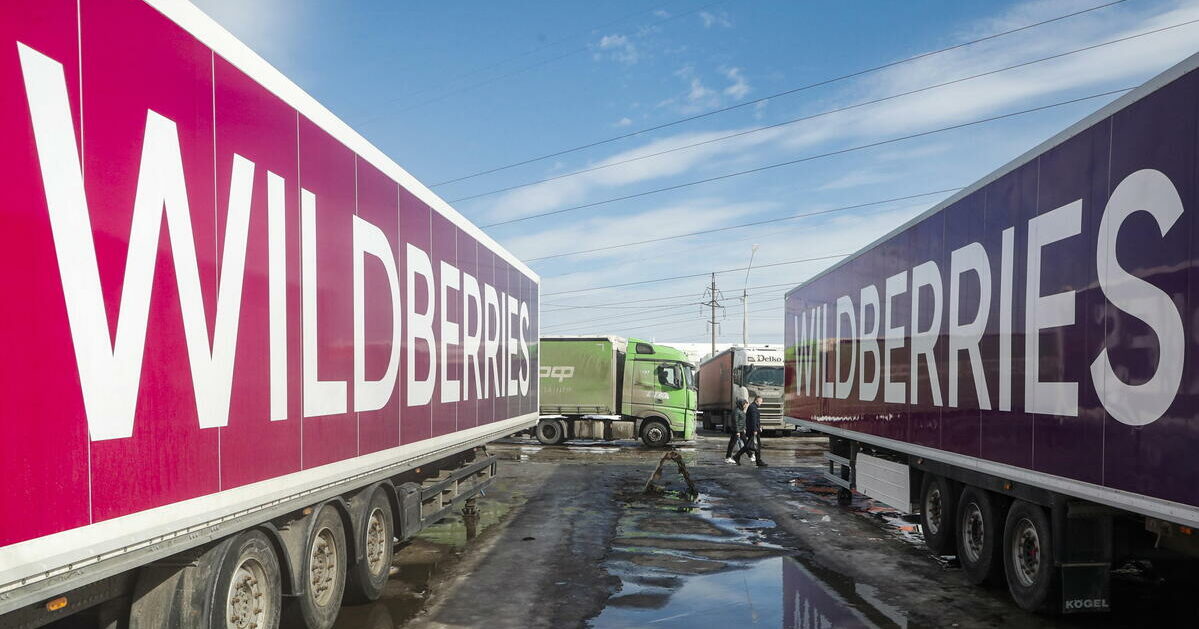
why sellers raise prices and leave marketplaces
A revolt of sellers is brewing on marketplaces - they are threatening to leave the sites. Everything is so serious that the authorities even want to prohibit marketplaces from giving discounts and reducing prices. “Character” tells the stories of brands that, despite successful trading, went bankrupt, and looks at what will happen to marketplaces and prices if outraged sellers really leave.Rules of the game
Natalya, like a million other Russians, is a seller on the marketplace. She sells outerwear in winter and suits in summer at Wildberries. But lately things have been going very badly.
“In 2022, I earned about two thousand rubles from each down jacket sold, and now, God willing, two hundred. Everything is consumed by logistics, storage, Wildberries commission and promotion - their internal advertising. Without it, the buyer won’t see my product at all,” she tells Cherta.
In addition to rising costs, the working conditions on the marketplace are also changing, in particular the rules for withdrawing money from the site: “Before, money came in a week, but now in a month. Now, if I want to get money for my sold goods in a week, I need to pay,” complains Natalya.
Over the past year, her business has gone into serious negative territory for the first time. Now she has a debt to the bank of 624 thousand rubles. Natalya decided to pause her business and leave the marketplace. “Many people leave and sell, just to get something out of it. “I decided to leave Wildberries because it was simply not profitable,” she explains. “Only those who are given individual conditions for trading by management earn money.”
In June 2025, Wildberries increased commissions for sellers by five percent. Then the site explained this by the increased load on the infrastructure.
Since October 31, 2025, commissions have increased by a few more percentage points, mainly for the clothing and footwear categories. And in March 2026, the platform changed the conditions for withdrawing money and increased a number of commissions for sellers.
“The hardest thing is that Wildberries changes conditions without assessing our losses. We invest in a product six months before sales, and the marketplace can change everything in two weeks,” says another seller, Christina. — We understand that the economy sometimes dictates, but Wildberries sells not its own goods, but ours. And, probably, we need to somehow solve this together.”
It turns out that a person who runs a business invests in his business, strives to develop it, but cannot argue with the changing rules of the marketplace. “It’s problematic to refuse the terms of the site when you have 20 million worth of goods frozen in warehouses in one second,” adds Christina.
She and her husband have been selling women’s outerwear and pajamas on Wildberries for four years now. In 2022, Christina went on maternity leave from her position as an analyst at Coca-Cola, her husband worked as a marketing and sales manager, then the family decided to try to start their own business. We took out a loan for training and purchasing goods, and started sales. A total of 27 million rubles were invested in the business.
According to Christina, the profitability of the business has been declining over the past four years, but if previously it was falling gradually, then since March 2026 they have been operating at almost zero. Moreover, over four years, the price of their goods has increased by an average of 40%, but this still does not allow them to make money.
Sew a dress for 84 rubles
In the spring of 2026, many videos appeared on social networks in which sellers on marketplaces complain about the conditions of the sites, say that they are working almost at a loss and announce their departure from Wildberries.
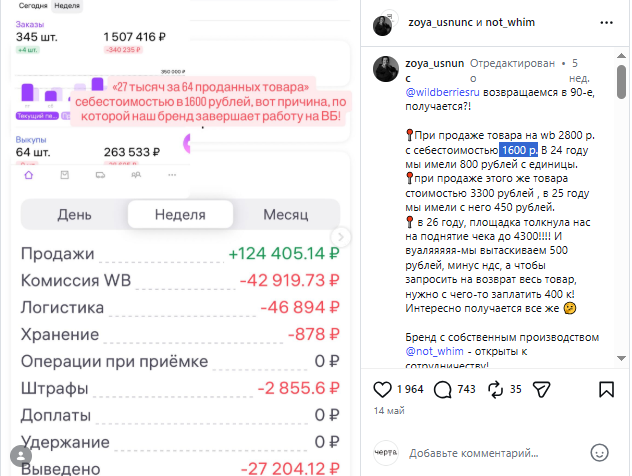
The owner of the clothing brand Not Whim, Zoya,says that with a cost of 1,600 rubles, in 2024 she sold her goods on Wildberries for 2,800 rubles, and after all the deductions to the marketplace, her income was 800 rubles from each item.
But since then, commissions and other expenses for Wildberries have grown so much that in 2026 it was forced to raise the price to 4,300 rubles in order to receive half the income. Zoya decided to leave WB, but she will have to pay 400 thousand rubles just to return the goods that are already on the marketplace.
Seller Nastya sells clothes and also leaves Wildberries: “Now we sell hoodies below cost in order to get out of this circle. We have been on the site for more than three years. Every year this niche (clothing) becomes more and more difficult: more competition, more investments, more regulations and less space for small brands.”
The brand of home clothes and underwear, your mini secret, has similar mathematics - from revenue of nine million rubles, the profit is almost zero. The store describes its economy in detail: the dress sells for 5,265 rubles. Of this money, the marketplace commission is 1652 rubles, logistics - 3082, tax - 182, storage - 146, acquiring - 119. Thus, the seller remains only 84 rubles. With this money you need to buy fabric, sew clothes and pay employees. As a result, the store decided to leave the marketplaces.
“The financial results of the year on WB - it would be better if they gave the goods to people for free,” complains the owner of the Stilnyashka brand and co-founder of the international clothing production holding Hasmik. She says that she came to marketplaces long before the term “seller” appeared: “It was 2016. I still remember the times when we came to the Wildberries office and said that we would not sign any clauses of the contract.”

Now, in her opinion, Wildberries has become a monopolist and can dictate any conditions to sellers. Sellers have to either agree to them or leave. “Marketplaces are vacuuming up buyers from the market, and if the state does not intervene, the entire offline market will collapse. It’s not like small stores—big chains won’t be able to handle it. What we are seeing now: networks are closing, and this is just the beginning. The state did not intervene, they allowed the monopolization of the market, the monopolists began to behave in a very non-market manner.”
Raise prices to survive
Buyers' opinions in the comments under sellers' complaints were divided. Many people support brands and promise to buy their products on websites or social networks. But some are perplexed: this is a business, if the profit is not enough, raise prices.
It seems like this is really the only way to make money or at least break even for many sellers.
“We plan to raise prices, look for goods with high margins,” says Christina. “We are now planning to change the assortment with less logistics and a high redemption rate.”
Government intervention can also lead to higher prices for goods. Thus, recently a government commission approved amendments to the Code of Administrative Offenses, which introduce fines for marketplaces for forcing them to reduce prices. For indirect price pressure, for example, deterioration in the rating or position of a product in search results, sites face a fine of up to 400 thousand rubles.
In addition to rising prices, buyers will also face a poorer choice, Christina believes. With such low margins, the seller has no room for error. This means that sellers will rely on proven products and experiment less. Shoppers will notice that the assortment will decrease. There will be a lot of basic things, less something interesting, says the seller.
She also admits that a significant part of sellers will leave marketplaces. Especially small brands that sell their own unique product, rather than large players with a wide range. “You need more money to hold on, and loans are bad. High commissions, difficulties with importing. We need a lot of capital, a large matrix of goods. For example, one product did not go well - it may be covered by another. And if you have [only] one product, you invested your last [money], and it didn’t work, you’re bankrupt.”
Get out of the trap
Leaving a marketplace is often more expensive than staying. Chertya’s interlocutors believe that it is for this reason that many sellers, working practically at zero, remain on the platform for now. The fact is that the seller must pay a significant amount for the removal of goods from Wildberries warehouses.
“Leaving WB is not that easy. To withdraw goods, you need to pay about 200 rubles per item. Wildberries support hardly responds; they don’t send closing documents. I always need to make sure that some of my lost goods don’t pop up in my office and start rolling back and forth. So as not to lose money on logistics and storage,” says Natalya.
These fears are not unfounded. Thus, the hair cosmetics brand shop.wella says that it received a fine of 269 thousand rubles for lost goods after leaving the site. “Despite the fact that I closed my personal account several years ago, I have now received a fine for my lost goods! You see, it’s lying somewhere, no one knows where, but I have to pay for it,” write representatives of the brand.
According to Christina’s calculations, in order to remove her own goods from warehouses, she needs to pay two million rubles. If the seller is not ready to give that kind of money to the site, he has to wait until the remainder is sold out. In Christina’s case, this could take six months, or even a year.
The your mini secret brand needs to pay more than five million rubles to pick up its goods from Wildberries warehouses. “A large number of sellers [are] in this situation. You either continue to work for zero, or pay millions to exit the system,” they say at the store.
Hasmik considers this a trap that many sellers have fallen into. She recalls that back in 2020, Wildberries changed its algorithms, and all products sold above the price determined by WB itself were no longer ranked and shown to the buyer. If the product is not sold, the seller has to pay for storage. “You can’t take your goods back, because reverse logistics costs more than the goods themselves,” says Hasmik. “You find yourself in a trap from which most now cannot escape.”
Life without marketplaces
Even more sellers have spoken out about the unfairness of marketplace fees and rules. While many of them still remain on the platform to sell off their leftovers and not pay for removal, the buyer does not see significant changes. But in six months, when the sellers have settled with the platform and are able to leave, the picture for the buyer may change dramatically.
Natalya believes that in the end, about 20 percent of the sellers that exist now will remain on marketplaces. Mainly those who have their own production. “The rest create their own websites or go to Lamoda. Of course, now, compared to that summer season, prices have increased, and due to the situation in Russia, purchasing power has decreased. Many simply sell at a loss and go bankrupt.”
In the comments under outraged posts, sellers are discussing the creation of alternative platforms like WB and Ozon.
Some try to sell through their websites. In 2025, sellers have already launched almost 10 thousand websites selling goods, which is 12% more than in 2024.
Seller Julia is trying to sell her goods on Avito. She managed to pick it up from the Wildberries warehouse. True, she had to place numerous boxes in the one-room apartment where she lives. “At night I loaded boxes of 30 kilograms into the car and drove them to WB warehouses myself - hello to my hernias and persistent hematomas on my legs. While someone was leaving the entrance with a purse, I was coming out with 10 boxes and tape in my hair,” Yulia tells the story of building her business on Wildberries, which ended this year.
After leaving WB, Zoya started sewing clothes for other brands in her production. Zoya believes that it is time for brands to unite and help each other. “We came to WB almost 3 years ago. Then everything looked like a new kingdom of possibilities. But over the past year, WB has treated us like Lord Frey treated the Starks at the Red Wedding,” the girl writes . “Perhaps now is the time for brands to unite, and not fight each other for the remaining traffic.”
Maximize your income here and now
The boom in trading on marketplaces occurred in 2023 and 2024. Residents of Russia began to buy there everything that they previously bought in regular stores, and a lot of things that they had not bought at all before. Then it seemed that marketplaces were an ideal place to make money and run your own business.
But already in 2025, a wave of bankruptcies began among people who entered this business in the hope of quickly making big money by reselling things from China. But even then it seemed that those who already had experience in such trade, who were not engaged in resale, but had their own production, would survive and develop their business.
But marketplaces do not live in a reality separate from the rest of Russia. The situation in the Russian economy is rapidly deteriorating, and all government decisions are aimed at creating restrictions for small and medium-sized businesses and confiscating money from businesses to patch military holes in the budget
Maybe it would be beneficial for Wildberries to support its sellers by providing them with acceptable trading conditions, but not in today’s Russia. A war with no end in sight, complete uncertainty of the future, almost zero investment activity - all this pushes businesses towards the idea of maximizing their income here and now, without thinking about development and without thinking about the years ahead.