
Translated material
In the United States, eight anti-fascists were sentenced to 450 years in the case of protesting against ICE
On February 8, 2024, DOXA was added to the register of “undesirable organizations.”
If you are in Russia or planning to return to it, you cannot repost our materials on social networks, link to them or publish quotes.
Read more about what is and is not possible in the cards .
In Texas, a court sentenced eight anti-fascists to a total of 450 years in prison for protesting at the ICE Prairieland Detention Center near Dallas. The Intercept reports . The prosecutor's office classified the incident as a "terrorist attack" on a federal institution, and the defendants themselves - as participants in an "antifa cell" in North Texas.
Benjamin Hanil Song received the longest sentence - 100 years in prison. He was found guilty of attempted murder of a law enforcement officer: according to the prosecution, he shot a police officer in the neck, who survived. The remaining defendants received sentences ranging from 30 to 70 years. The charges include participation in riots, use of weapons and explosives, “material support for terrorists” and obstruction of justice.
What are we talking about?
A protest at the Prairieland ICE detention center in Texas took place on July 4, 2025. According to the US Department of Justice, the protesters set off fireworks, damaged cars and a security booth, and also took part in an attack that resulted in a police officer being wounded.
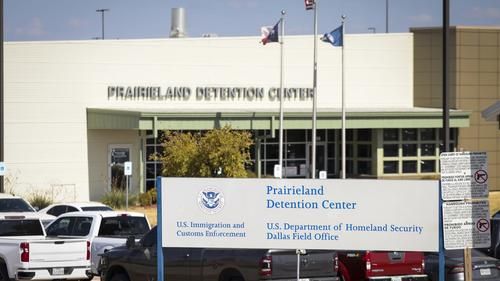
Prairieland ICE Detention Center in Alvarado, Texas
KERAnews
The defense insisted that most of the accused came to the rally as a “noisy demonstration” against deportations and detention of migrants, and not to commit violent acts. Benjamin Song's lawyer, Philip Hayes, argued that his client did not intend to harm anyone. Song himself stated that he opened fire because he thought the police were going to shoot one of the protesters. His mother also denied that he intentionally shot the law enforcement officer.
As The Intercept notes , the defense viewed the trial as an attempt to turn the case of a specific shooting incident into a large-scale political persecution of an entire group of left-wing activists. Lawyer MarQuetta Clayton, who represented Marisela Rueda, called the trial an “experiment” in criminalizing the anti-fascist movement.
A significant part of the indictment was built not only around the events at the ICE center, but also around the political materials seized from the defendants in the case. The prosecutor showed the jury radical zines, memes, drawings of burning police cars and videos of clashes between left-wing and far-right activists. At the same time, the prosecution acknowledged that these materials themselves are protected by the First Amendment to the US Constitution The First Amendment to the US Constitution guarantees freedom of speech, press, assembly and political activity , but insisted that they indicate the defendants' commitment to "antifa tactics."
Special attention during the trial was given to Elizabeth and Ines Soto, a married couple associated with the local Emma Goldman Book Club, named after the anarchist Emma Goldman Emma Goldman is an anarchist, feminist and revolutionary activist, one of the most famous figures of the world anarchist movement of the early 20th century. She advocated for workers' rights, freedom of speech, women's equality and against war . During the searches, a printing press was seized from them, on which pamphlets and zines were produced. The defense argued that the state was actually trying to criminalize political literature and the very membership of left-wing political circles.
The prosecution also brought in Kyle Shideler of the right-wing think tank Center for Security Policy as an expert. The Center for Security Policy is an American ultra-conservative think tank known for its anti-immigrant, Islamophobic and far-right positions. The organization supports strict security measures, opposes migration, and often collaborates with right-wing politicians and media in the United States. Many researchers and human rights organizations consider the center to be one of the key institutions of the American far-right movement . He described antifa as a network of activist:k using the Signal messenger, black clothing and black bloc tactics Black bloc is a street protest tactic in which participants dress in black clothing, masks and cover their faces to make it difficult for police and cameras to identify them. Most often used by anarchist:kami, anti-fascist:kami and other radical left movements during demonstrations and direct action . According to the prosecutor's office, even participation in the protest in black clothing could be considered a form of “material support for terrorism,” since it allegedly helped to hide the identities of other protest participants.
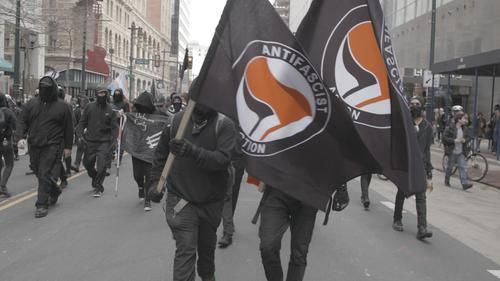
Anti-fascists use black bloc tactics, 2017
VICE Magazine
"They're asking you to throw protesters in jail as terrorists," defense attorney Blake Burns told jurors during closing arguments.
What do the experts say?
In a conversation with DOXA, political analyst and author of the podcast“Forgotten in America” Dan Storev notes that the prosecution used as evidence not only the actions of the defendants themselves, but also signs of political affiliation - in particular, participation in a protest in black bloc clothing.
The analyst draws attention to the fact that the connection of the accused with any centralized antifa organization has never been convincingly proven, despite the fact that this very thesis was at the center of the indictment.
“We see a situation where belonging to a certain political environment begins to be used as a basis for criminal prosecution. This is reminiscent of a broader trend in authoritarian regimes: authorities choose a group that can be presented to society as the source of all problems, and then use it as a convenient internal enemy,” says Storev.
In his opinion, against the backdrop of rising prices and social discontent, it is beneficial for the American authorities to shift public attention to anti-fascists, migrants and other groups that can be considered a threat to public safety.
“It is much easier to explain to people the deterioration of their lives by the actions of some “enemies of the people” than to discuss economic problems, foreign policy or the decisions of the administration itself,” the analyst believes.
Storev also notes that such logic is increasingly evident in different countries of the world. He said authorities use vague categories like “terrorists” or “extremists” to expand their ability to target political opponents.
“This is not unique to the United States. We see different governments creating the broadest and vaguest possible categories that can then be applied to a wide range of dissenting groups,” he says.
At the same time, the analyst emphasizes that this is not so much about the destruction of state institutions, but about their political subordination.
“It is often said that Trump is breaking American institutions. But in many cases, something else happens: institutions are preserved, but begin to work in the interests of a specific political force and its agenda,” Storev notes.
According to the analyst, what makes the current process particularly important is that the legal mechanisms created under Trump may continue after the change of administration.
“Even if the next president is a Democrat, there is no guarantee that these tools will be dismantled. History shows that mechanisms of political persecution, once created, often continue to be used by other governments,” concludes Storev.
Context
This case was one of the first major trials after Donald Trump signed an executive order in 2025 declaring the “antifa movement” a terrorist organization. Human rights activists and administration critics noted at the time that antifa is not a single organization with leadership, membership or headquarters, but rather represents a decentralized anti-fascist movement and political identity.
Acting US Attorney General Todd Blanche, who previously served as Trump's lawyer, said the sentences demonstrate that "antifa terrorists" who attack law enforcement officers and federal targets will face a "swift and harsh" government response. Several other defendants in the case are scheduled to be sentenced on July 1.
On June 16, federal prosecutors in Minnesota indicted 15 people believed to be associated with anti-fascist groups in Minneapolis. They are charged with conspiracy, assault on federal officers, incitement of violence, interstate harassment and destruction of government property.
At the same time, protests against the actions of US Immigration and Customs Enforcement (ICE) continue in Minneapolis. In January 2026, federal immigration officers shot and killed two civilians there.
On January 7, an ICE agent shot and killed 37-year-old Renee Nicole Goode after her vehicle blocked the path of an unmarked ICE pickup truck. The murder caused a wave of public outrage. Weeks later, on January 24, ICE and Border Patrol officers shot and killed 37-year-old veterans hospital nurse Alex Pretty during anti-immigrant raids in the city.
On January 23, the largest protest against ICE in recent years took place in Minnesota. According to the organizers, more than 50 thousand people took part in it. On the day of the strike, businesses closed and protesters took to the streets demanding the removal of federal agents “from communities, schools and neighborhoods.”