
Translated material
Pilyulkin and the GRU Textbook
The doctor explains why reading cannot replace pills
A book is a best friend and an insidious villain, an enemy for the eyes and a surprise for the psyche, an antidepressant and a depressant rolled into one. Before idealizing reading, consult with doctors - they already know what is best for you. On the occasion of the recent Medical Worker's Day, Gorky's in-house entertainer Gleb Kolondo talked with a simple Russian doctor, Nikita Kazantsev, and found out why you shouldn't be treated by detectives and in what cases you can apply Harry Potter to your tired head.
All of us, since February 24, 2022, have found ourselves in the face of advancing barbarism, violence and lies. In this situation, it is extremely important to preserve at least the remnants of culture and support the values of humanism - including for the sake of the future of Russia. Therefore, the editors of Gorky will continue to talk about books, reminding our readers that there is still a place for thought and fiction in the world.
They say that reading is the best treatment. But who exactly is speaking?
Internet collections of aphorisms attribute this idea to a certain Alexander Glukhov. An organization called “Municipal Cultural Institution “TIGILSKY CENTRAL INTER-Settlement LIBRARY”,” which there is no reason not to believe, quotes :
“A book is a medicine for the soul, a storehouse of science, and a source of wisdom.”
Russian Wikipedia knows four Alexander Glukhovs. Did any of them talk about the book as a potion, and if so, who exactly? We don’t know this and, most likely, we will never know. It would seem worth consulting with the AI, but he generally claims that “this beautiful and profound phrase belongs to the outstanding thinker, writer and scientist of the East Abul-Faraj al-Malati (also known as Gregory John Bar-Ebrey), who lived in the 13th century.”
Meanwhile, colleague Yulia Shcherbinina refers to the ancient Egyptians, and specifically to Ramses II, who had a sign “Medicine for the Soul” hanging above the entrance to the book depository.
It is interesting that literature as an equivalent to medicine is spoken mainly by people who are not directly involved in healing. Or staunch supporters of bibliotherapy - the word seems to be good, but for some reason it is associated with something like homeopathy.
Well, what if you ask not a scribe or a bibliotherapist, but an ordinary (in a good sense) modern doctor? Let's do so. Let's make an appointment with 26-year-old doctor Kazantsev, but we won't force him to listen to us - on the contrary, for once we'll listen to him.
— Nikita, what do doctors even read?
- I won’t speak for everyone, but I’m now reading something that is very important to me as a doctor - “The GRU Special Forces Survival Manual. Experience of elite units." There is tactical medicine here. Life support. Now I’ll open a page.
“Capers are a creeping shrub. The green buds are eaten and used as a seasoning.” Or, let’s say: “Oxalis is a herbaceous plant with a creeping rhizome. Leaves are basal, trifoliate. The leaves are rich in vitamin C. Edible raw.” And then everything is like that. The meat of animals is also discussed. Okay, to be honest, such a weak thing for me as a doctor, of course.
- What then is the strength?
—Are you interested in fiction or professional literature?
— The main thing is that it’s interesting.
— Don’t expect any revelations here: medical thinking is limited and primitive. Young doctors pray to Henry Marsh's book, Do No Harm. Or “The Surgeon’s Heart” by Fedor Uglov. I respect Uglov, he was an incredibly cool doctor, he experienced so much in his life and operated until his last days, and also taught at First Medical Center, where I studied for six years.
And here, by the way, is my shelf with medical literature.
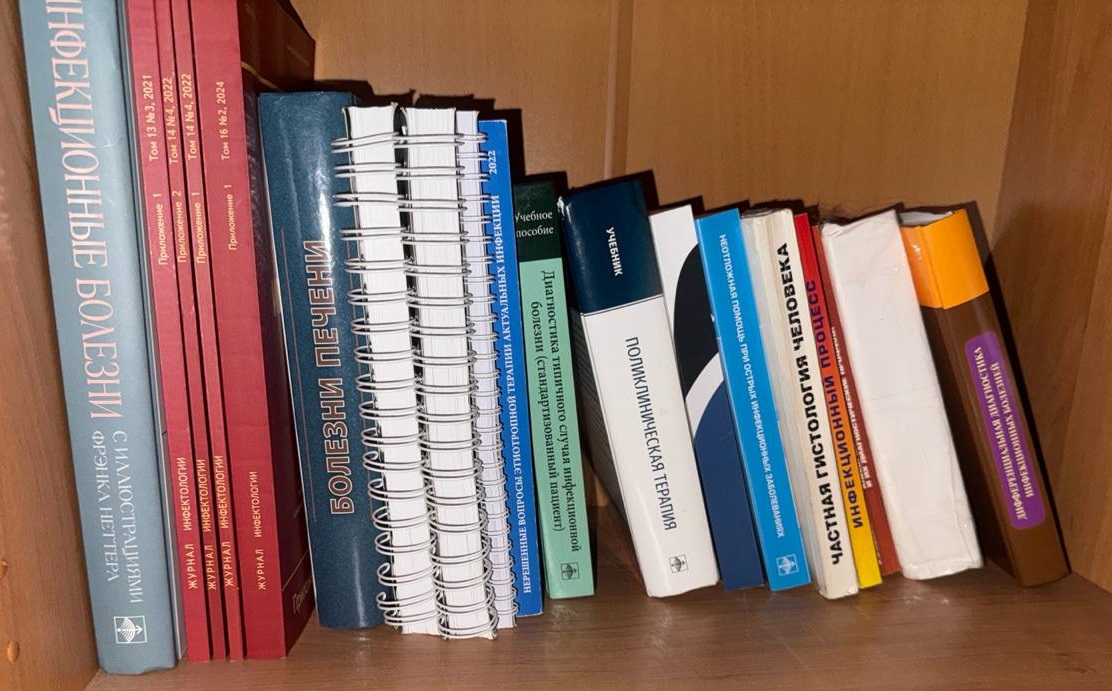
But everything here is professional.
- Yes, this is, of course, good, but you cannot create a sensation in the field of bibliotherapy from this.
“Let’s think about it together then.” Ask another question.
—Which literary doctor do you think is the best?
- Pilyulkin. Because he is comical, but he believes in his work. He has treatment for all occasions - castor oil, iodine and laxative. Modern state medicine looks something like this.
— Is reading books good for your health?
- Of course, this keeps cognitive activity in good shape, and tone means health.
- What can you say about this material? I don’t know what newspaper it was in - I found the picture on the website of the KOMI-PERMYAK NATIONAL LIBRARY named after. M. P. Likhacheva.

“Classical literature is a universal remedy for stress, neuroses, and obsessive states. Detectives and adventures - for obsessive states, psychoses. Science fiction and fantasy - for phobias and fears. Poetry for depression. Fairy tales and folklore literature - for hyperactivity in children and chronic disobedience in difficult teenagers. Philosophical and spiritual literature - for acute stress, chronic depression. Humorous literature is for teenagers in adolescence, improves mood in the postoperative period.”
- Is what is said here true?
— I think no, this is the most natural populism. From the position of a doctor, it is generally strange to associate the genre of literature with a labile psyche. This can affect each individual person very differently.
— What is a labile psyche?
— Mood swings under the influence of internal and external factors, roughly speaking.
— Are there books that can help with mood swings under the influence of internal and external factors?
- I think not.
- What about, for example, “Harry Potter”?
— “Harry Potter” is fun to read to relax. But it’s also tiring, because it’s very difficult to tear yourself away from the adventure; you want to know what will happen next to this fellow wizard.
— What if you reread it for the tenth time, knowing everything in advance?
“Then it’s probably just cool.” I didn't have that experience.
— Do you have the feeling that, from a medical point of view, reading fiction is, by and large, a meaningless activity?
- I would put it differently. A direct therapeutic effect, as indicated in the newspaper, should not be expected. But there may well be an indirect effect. Literature is great for neural matter, it makes neurons work and analyze information at a faster rate. As already mentioned, by reading, we maintain cognitive activity in good shape, this is the prevention of early dementia. This is probably a dry effect that we can talk about.
— “Dry effect” doesn’t sound very good for some reason. “Wet” would have been nicer, so cool and refreshing.
- Of course, I completely agree with you. But medicine is more about dryness. Accuracy and objectivity are important here, and it is desirable that all statements be supported by something. Therefore, we work according to recommendations that are written by cool guys in white coats based on a ton of processed scientific literature. This saves us from obscurantism in medicine, which is very common in the CIS.
- What can you say about this consideration?
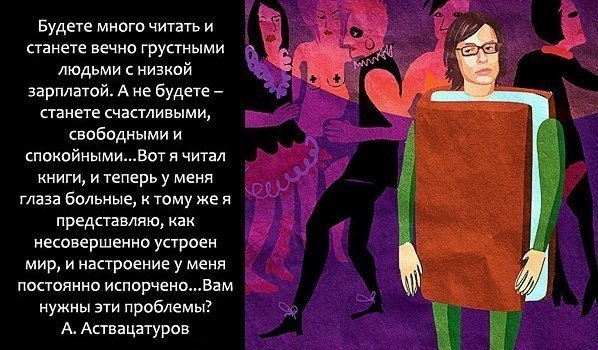
In the source, the text sounds a little different: “Young people have been studying poorly lately, they don’t read anything, they just sit through lectures, and I tell them that they are doing the right thing! So I read books, and now my eyes hurt, besides, I imagine how imperfectly the world works, and my mood is constantly spoiled. You will read, I instruct them, and you will become the same eternally sad people with low salaries. If you don’t, you will become happy, free and calm. Why do you have problems like mine?”
— I rather agree than disagree with this consideration. But I think that the imperfection of the world should not frighten and spoil the mood. It is impossible to know everything: the more I know, the less I know. There is no absolute knowledge, as for me, that’s why it’s more interesting to live because reality is subjective. Literature reinforces and confirms this subjectivity.
— Doesn’t it follow from this that, from the point of view of “dry medicine,” reading fiction is a harmful activity, because it spoils vision and causes depression?
— To understand medicine, you need to constantly study literature, and for some reason no one thinks about damage to vision. And if we talk about fiction, then it depends on what you read. Personally, I perceive reading as an excellent leisure activity that helps me relax.
— And rest is health. Or not?
— Of course, rest is the basis of health.
“Then let’s wish everyone to rest as often as possible?”
- Of course, we will. Relieving your brain should be beneficial: it’s better to read a little and pass out than to doomscroll.
— Why does the word “doomscrolling” sound like someone scrolling through a Doom game?
— It’s probably when you’re standing in Doom, spinning around in one place, that’s also a useless exercise.
“Are you really reading the GRU Special Forces Survival Manual now?”
- Not anymore. I finished reading.