
Translated material
Canudus forever
About the book “Sertans” by Euclides da Cunha
The famous book of Euclides da Cunha “Sertans. Long recognized as a classic of Brazilian modernist literature, The War of Canudus is perhaps more modern than it seems. Its author, in an attempt to describe the essence of the national identity of Brazilians, revealed one of the key conflicts of our time - between archaic strata of society and a new type of state, brutally persecuting any dissent in the sphere of biopolitics. Read about this in the material by Vladimir Maksakov.
All of us, since February 24, 2022, have found ourselves in the face of advancing barbarism, violence and lies. In this situation, it is extremely important to preserve at least the remnants of culture and support the values of humanism - including for the sake of the future of Russia. Therefore, the editors of Gorky will continue to talk about books, reminding our readers that there is still a place for thought and fiction in the world.
Euclides da Cunha. Sertans. War in Canudus. M.: Ad Marginem Press, 2025. Translation from Portuguese by Vladimir Kultygin, edited by Olga Okuneva. Content . Fragment
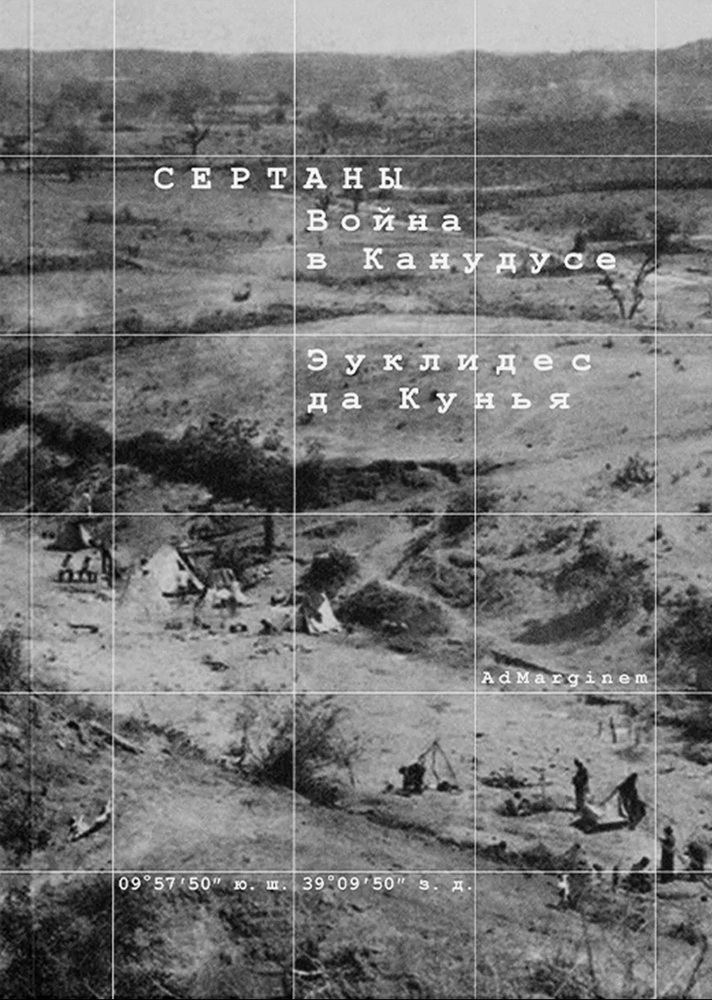
I'll start with the name. The Sertans are steppe (literally “desert”) areas in northeastern Brazil. Before the appearance of the book in question, they practically did not come to the attention of researchers (with the exception of geographers) - there was simply no need for this. Everything changed at the end of the 19th century, when a powerful religious movement arose in Sertan, in a place called Canudus, led by a man named António Maciel, nicknamed Conselheiro (Counselor). The government sent tens of thousands of soldiers to pacify the newly-minted prophet and his followers. The religious revolt turned into a real war, in the fire of which both the sertans themselves and thousands of people burned in the fire in 1896–1897. Career military engineer Euclides da Cunha went to this war as a journalist - not imagining that he would create a national epic.
Soon after the end of hostilities, he realized that he wanted to comprehend what had happened. And not limit yourself to processing your military correspondence, but write a real historical study. It was with approximately this idea that he began work on “The War in Canudus.” And here it is necessary to make the first clarification: Euclides da Cunha managed to collect - as far as possible - numerous testimonies of the inhabitants of Canudus about themselves. In his own words, he even picked up individual pieces of paper on which appeals to Conselheiro were written - or curses against the government:
“In the most meager plunder that History has known, where the most valuable booty was torn images and coconut rosaries, the main interest of the victors was attracted by letters, notes of all kinds and mainly clumsy poems. The torn pieces of paper, on which barbaric spelling and clumsy handwriting made a worthy pair with the most absurd ideas, seemed to be a true snapshot of the thinking tormented by demons, a concentrated expression of the psychology of that war.
Work on the book took five years, it was published in 1902, already in the new century, and critics (albeit in hindsight) agreed that this text was a milestone for Brazil.
Euclides da Cunha took his life’s work very seriously. And he began the book with a verbose and tedious historical and philosophical introduction, in which he gave, as it seemed to him, an exhaustive description of the sertans in the context of Brazilian history - in order to make what follows more understandable. He tried to describe (as he thought) the so-called Brazilian race, meaning by it "the people" in accordance with the natural-scientific and positivist views of his era (and, unfortunately, no small amount of Social Darwinist prejudices). But then Euclides da Cunha was forced to admit that he did not have an answer to the question of the essence of “Brazilianness” - and then he carried the idea of a distinctive civilization into the future, coming to the conclusion that Brazil had yet to become its own:
“We are preparing for the fact that in the distant future a historical race will be formed, if this is facilitated by a long period of independent life of the nation. In this regard, we have turned the natural order of things upside down... We are doomed to civilization. Either progress or extinction awaits us.”
This theme is in many ways common to all of Latin America: its culture is just in the process of creation, it is still young, and although it has its own traditions, they do not hinder its development. (I note that the word “progress”—along with “order”—eventually became enshrined in Brazil’s official motto: Ordem e Progresso .)
It is only at the end of his controversial preface that Euclides da Cunha finally turns to the history of the sertans. The community of locals he describes is much more conservative and archaic than the bulk of the Brazilian population. And it is no coincidence that the author still does not know how to approach him: his characteristics break down the positive methods of modern science (let me remind you that Cunha uses all the achievements of theoretical thought available to him - up to “racial theory”). However, here he not only gets into the nerve of the tragic story of Canudus, but also makes an important discovery.
When Euclides da Cunha began to describe the syncretic religion of the Sertans, it became obvious to him that it was their inhabitants who were most receptive to the appearance of a charismatic religious leader, whom they took almost as a messiah. Suddenly it turned out that these seemingly not the most “developed” people, to whom da Cunha, who talks about them, is not without prejudice, are exclusively religious. Moreover, a surge in their activity occurs just when the culture of the entire country is modernizing (Brazil is turning from an empire into a republic - a reason for pride!) and the first national narratives are being formed. And in the midst of all this modernism, a surprisingly powerful religious movement arises in newly independent Brazil. How will the authorities react to his appearance?
And here the author comes to one of the main and terrible conclusions. A modern state cannot afford for some other, alternative ideology to flourish within its own borders, which also lays claim to certain territories. At the same time, the residents of Canudus, of course, did not think about any independence, independence or autonomy. If we recall the words of da Cunha about the Brazilian civilization that is still just creating itself, then we can say that the Sertanejos (residents of the Sertans) also participate in this process in their own way, without at all thinking about separating from their own people.
It turns out that the main reason for the government’s hatred of Canudus, which ultimately led to bloodshed unprecedented in the history of Brazil, was religious differences. The authorities denied people the right to pray and perform Catholic rites as they saw fit. That is, the young republic went against popular religiosity, which is exceptionally deep in Latin American countries. Everything else no longer played a critical role. It was the inhabitants of Canudus who belonged to the ideal type of inhabitants of the Sertans, they were those people who were able not only to survive in this inhospitable world, but also to make it suitable for others. The government turned out to be blind even to this potential benefit. Because, as Euclides da Cunha understood - before many other contemporaries - the goal of the modern state is primarily to impose its harsh and cruel will. In fact, he discovered the phenomenon of biopolitics, half a century before Michel Foucault and at the other end of the “civilized” world.
Simultaneously with this discovery, another was born. Da Cunha began to describe the war in Canudus as a man of a rather narrow profession: let me remind you that he was a military engineer by profession, and ended up in the sertans as a correspondent. But at the same time, one gets the feeling that for quite a long time he could not find an adequate way to describe what was happening - the contrast between the different parts of his book was too great. In the end, the future classic made the only right decision, which ensured the immortality of his text: he radically changed the genre of his documentary work, which the further, the more it began to resemble a novel. And he describes the war itself, as literary scholars would say, using purely artistic means. That is, artistic logic turned out to be much more convincing than scientific or journalistic narrative. Leo Tolstoy argued with history in much the same way, and the coincidences between War and Peace and Sertans are sometimes striking:
“...One of the columns was to go first through Monti Santo, and the second was to gather at Aracaju, and then cross the state of Sergipe and reach Jeremoab.”
However, let's return to the war in Canudus. Obviously, António Conselheiro turned out to be a unique, charismatic leader who would become typical of Iberoamerica, although his contemporaries still needed to understand this. He restores churches and cemeteries (and also builds new temples), calls on the people to repent, and most importantly, at some point he begins to play the role of almost a prophet (at least in the depiction of Euclides da Cunha). At the same time, he is not a conquistador, not an “internal colonizer” of Brazil (historical bandeirant), and finally, he is not a dictator, despite the fact that by that time there already were the first dictators on the continent. That is, Antonio does not embody any of the historical and cultural types of power familiar to Latin America. Instead, he is a much more complex and contradictory figure - a conservative revolutionary, the author of a great religious utopia.
Euclides da Cunha captures an important historical moment for the emergence of such a leader in Brazil - the transition from empire to republic against the backdrop of relatively recent independence. Here the figure of the great liberator of the Sertans appears.
But what Euclides da Cunha did not realize was that he managed to predict, perhaps, the key mechanism of conflicts of the new century. It would seem that he is writing about the struggle between old and new, between archaic and modern, monarchy and republic, religion and rationality. But in reality, we are talking about a terrible, almost Girardian mimetic rivalry over who will represent the so-called universal values, who has more rights to identify themselves with the Catholic religion, with the conditional “national character” and “national type.” However, is war inevitable?
Alas, yes. Including because there was a change in the behavior of Conselheiro himself - and Euclides da Cunha felt and conveyed this fully, although he did not have the opportunity to speak with those who personally knew the new prophet. If people live in anticipation of the apocalypse, the hope of the imminent end of the world, the second coming and the Last Judgment, then they do not care at all what will happen in their this-worldly (and momentary) life. From here it is only one step to the great Christian heresies, including those calling for provoking persecutors so that as many people as possible would become martyrs. In the realm of the bizarre historical imaginary captured by Euclides da Cunha, Latin America has caught up with Europe.
The conclusion that the author draws from this, unfortunately, has not lost its relevance to this day. The confrontation between the archaic and the modern, between society and the state is becoming increasingly fierce. Moreover, sometimes it is not so much the essence of these forces that is important, but the ideas about them imposed on us. And there is no end in sight to this struggle. Canudus is blazing on a planetary scale.