
Translated material
“Will they let him back into the US?”
A fragment of Denis Zakharov’s book “Capote in the USSR: the true story of one journey”
In mid-July, the St. Petersburg publishing house “Find a Lumberjack” published a book by Russian researcher Denis Zakharov, “Capote in the USSR: the true story of one journey.” Twelve years of work with personal collections in the USA and Russia, interviews with eyewitnesses who met the American writer in our country, unique archival documents and exclusive photographs formed the basis of this documentary work of 650 pages. “Gorky” publishes a fragment of a chapter devoted to the background of the trip: how a socialite exchanged creative solitude while working on “Breakfast at Tiffany’s” for an adventurous trip behind the Iron Curtain.
All of us, since February 24, 2022, have found ourselves in the face of advancing barbarism, violence and lies. In this situation, it is extremely important to preserve at least the remnants of culture and support the values of humanism - including for the sake of the future of Russia. Therefore, the editors of Gorky will continue to talk about books, reminding our readers that there is still a place for thought and fiction in the world.
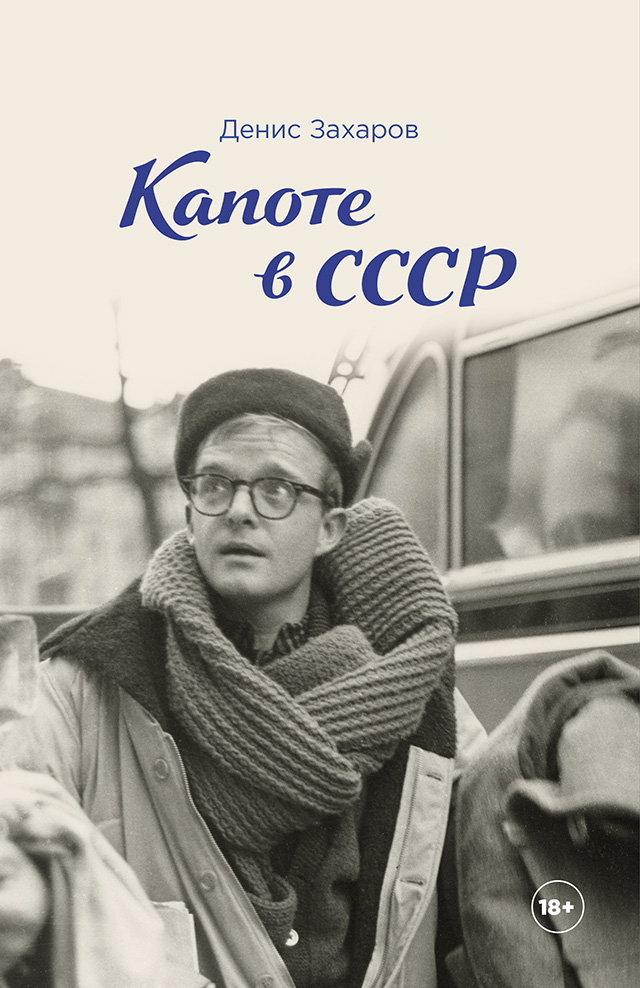
Denis Zakharov. Capote in the USSR. St. Petersburg: Find a lumberjack, 2026. Contents
…On November 8, 1955, a week before Porgy and Bess director Robert Breen wrote in his diary about his upcoming meeting with Capote, journalist Leonard Lyons let slip in his column: “Truman Capote may accompany the Porgy and Bess troupe to Moscow” [1] . This news became one of the first in a chain of mentions of Capote’s plans for a visit to Russia.
In early November, Truman entered the office of William Shawn, who had served as editor-in-chief of The New Yorker since 1952. According to magazine historian Ben Yagoda, it was Capote who came up with the idea for the reportage. And from an editorial point of view it looked promising: a sensitive writer, a black theater troupe, communist Russia. Capote had never written a single line of reporting before, and the magazine had never paid significant advances to non-writers. Nevertheless, the editor agreed [2] .
Capote found himself in a double win: Everyman Opera covered all expenses associated with his trip and stay in the Soviet Union, and The New Yorker additionally paid an advance for the future text and per diem. As follows from the letters of the director’s wife Vilva Brin, life in Moscow for a foreigner turned out to be unexpectedly expensive; with the official exchange rate of four rubles per dollar, even a modest lunch could cost ten dollars. At the same time, currency rules excluded free exchange; rubles could not be converted back. Participation in the trip as part of the troupe freed Capote from the need to constantly count money and made his stay in the USSR not only possible, but also economically reasonable.
He arranged his departure to the USSR with his characteristic theatricality. Truman ordered a hat from the Russian emigrant and famous designer Valentina Schlee especially for the Moscow winter [3] . Socialite Babe Paley provided him with warm clothes from Abercrombie & Fitch ; in addition, he purchased a yellow cashmere scarf - three or four times wider than usual. Wrapped in all this, “he looked exactly like a little bunny,” recalled one of the members of Brin’s troupe [4] .
The last word went to socialite Gloria Vanderbilt, one of his close friends. She had just returned to New York and, having settled back in her city residence in Manhattan, decided to gather friends. Truman's departure fit perfectly into her plans.
On Friday, December 9, 1955, Vanderbilt hosted a farewell celebration for Capote at her Gracie Square penthouse. The house turned out to be overcrowded: there were so many people who wanted to say goodbye that even “uninvited guests, including a dog” [5] managed to get in there. The atmosphere was noisy, in the spirit of a Holly Golightly party: famous musicians took turns at the piano, they improvised, sang, and the guests danced with pleasure. The celebration lasted until dawn. The party was still in full swing when the "indomitable maverick" Truman Capote left the apartment at 6:30 a.m., a detail chronicled by chroniclers. [6] How could they have known that the writer would go straight from the celebration to the airport.
And just the day before, Capote hosted an afternoon reception at the most glamorous restaurant in Manhattan, Le Pavillon. “The diminutive novelist was dressed in a bright tweed suit, a red waistcoat, a canary yellow shirt and a green bow tie,” wrote Dorothy Kilgallen. [7] This parrot outfit did not go unnoticed by another journalist, Harvey Breit from The New York Times : “By the time you read these lines, the writer Truman Capote will already be in the Soviet Union. And if you ask whether he will be allowed back into the United States, we will answer: yes, it is quite possible - something like in the story of O. Henry, where criminals pay parents to take back a kidnapped child.
In the conversation, Truman said that he was very excited about the trip. “I will be in Russia for about six weeks. I'm thinking of visiting Tolstoy's estate. I would really like that." We asked if Tolstoy is his favorite author. He replied that no, Turgenev is one of his three favorite writers (the other two are Flaubert and Proust). “Turgenev is a great stylist,” he explained his choice.
Capote is a short and frail man. We fatherly begged him to take care of himself and be careful. Capote asked not to worry: “I’m not going to tell anything,” he assured. - No one" [8] .
Then this remark was perceived as a joke - another manifestation of secular wit. But in that era, any trip behind the Iron Curtain automatically became a reason for suspicion, and the promise “not to tell anyone anything” sounded presumptuous. Especially when it was pronounced by a famous wit and storyteller, who went to a place where they listened attentively and remembered it for a long time.
In the mid-1950s, the route from New York to Europe began at Idlewild Airport, the main air gateway to America. The flight across the ocean was tedious and uncomfortable: the journey took from twenty to thirty hours and included refueling and technical stops in Great Britain, Scandinavia or West Germany. Passengers, exhausted by the turbulence, were released into the air terminals for dinner, breakfast, strong coffee and a quick nap before they had to take to the air again.
In December 1955, Pan American's transatlantic flights were operated by heavy piston Super Stratocruisers , flying from New York via London and Frankfurt am Main and then along the air corridor to West Berlin, landing at Tempelhof Airport. It was precisely this route that the journalists accompanying the tour traveled to Europe [9] .
Truman Capote arrived in Berlin on the afternoon of December 12, 1955, in the company of Leonora Gershwin, the same restless Lee who spent a whole year wandering with the troupe on tour. “Her conversation is random, randomly rushing forward fragments of phrases, pronounced in a ringing whisper that is not hidden from people and glued together with affectionate names.
“Sunny,” she chirped as we drove through the darkness and drizzle along the Kurfürstendam, “have you heard about the Christmas tree?” The Russians are throwing us a Christmas tree. In Leningrad. What a beauty. Moreover, they don’t believe in Christmas at all , do they, darling? And then, Christmas is much later for them. Because they have a different calendar. My joy, is this really true? [10]
Both were accommodated in the expensive Kempinski Hotel, located on the corner of Kurfürstendamm and Fasanen Strasse. In the same hotel lived Robert Brin and his wife Vilva, society columnist Leonard Lyons and Herman Sartorius, a New York stockbroker, patron of the arts and close friend of Brin. During World War I, Sartorius served in the French Army and the American Ambulance Service, and later worked for many years as treasurer for the pharmaceutical company Reed & Carnick . In 1952, he attended the premiere of Porgy and Bess in the United States and, according to the official version, was so delighted with it that he followed the play to its screenings in Chicago, Boston, Washington, Houston, London and Paris [11] .
Leningrad and Moscow looked like special items on the 1955 list. Previously, Sartorius served as deputy secretary of state at the American embassies in Warsaw and Athens, and such positions in those years often combined diplomatic and intelligence functions.
Since the beginning of December, the Porgy and Bess team has successfully performed in Frankfurt am Main, where they gave several performances to full houses at the Apollo Theater. The New York Times wrote: “The delight was deafening. The universal theme of suffering made Americans understandable to Germans. Porgy and Bess is seen as one of the most effective means for meeting the Russians on their territory - on the cultural front of the struggle between East and West. The impact of the performance on the minds and hearts of people is almost irresistible" [12] .
The troupe then moved to Düsseldorf, where it performed for three days, after which equally successful performances were held in Munich. West Berlin became the final point of the European tour. With the evening performance on December 16, the tour officially closed, and a few days later the large team was waiting to move to the station in the Eastern Sector and a special train going through Moscow to Leningrad.
By this time, the main organizer of the tour, director and producer Robert Brin, had already been pushing for this trip for six months. The path was long: diplomatic correspondence, endless appeals to the head of the Soviet government. Capote, writing about Brin in The Muses, captured in him this mixture of stubbornness and theatricality:
“Brin is about forty-five years old, of average height and well-built, which cannot be missed due to his predilection for tight trousers and fitted jackets a la Eisenhower. He wears custom-made black or purple shirts. He has thinning blond hair, and he always, on the street and at home, wears a black beret. His face, thin, pale, with sunken cheeks, seems to belong to two completely different people, depending on whether he is serious or smiling” [13] .
Brin spent the summer of 1955 in Geneva. On July 18, a meeting of the heads of government of the four great powers began here: the USSR, the USA, Great Britain and France. On the agenda were issues of collective security and the development of contacts between East and West. On the eve of the arrival of the Soviet delegation in Switzerland, Robert Brin dictated a telegram to the Kremlin, in which he informed Vyacheslav Molotov:
“For several months we have been negotiating the possibility of staging the opera Porgy and Bess in the Soviet Union. The troupe’s artists will certainly be happy to show [the performance] to the Soviet audience <…>. Our company sincerely believes that the production of this American black folk opera can do a lot to establish cultural exchange between our countries. The undersigned will be located in Geneva and can be contacted through the American Consulate" [14] .
The persistent American did not receive an answer to the telegram, but he was not going to give up. Brin remembered that two years ago Andrei Vyshinsky, then the USSR representative to the UN, spoke with delight about his success as a director. “I don’t understand why you don’t bring Porgy to Moscow? Soviet audiences will definitely like your opera!” - exclaimed Vyshinsky [15] .
Robert Brin took the words of the Soviet diplomat as a guide to action. He hastily sent a request to the US State Department, but they responded extremely vaguely: “First, receive an official invitation from the Ministry of Culture, then we will allow tours to the USSR.” The director contacted the Soviet embassy, but they told him: “First, get permission from the US State Department, and then we will issue an invitation.”
The circle closed, and Brin gave up hope of fulfilling his old dream - to appear with his production on the Soviet stage. He had neither the time nor the desire to fight windmills. However, after a couple of years, the political climate warmed up. And this served as a signal that we could try again.
Encouraged by the friendliness of the Soviet delegation at the Geneva summit, Brin unleashed the “heavy artillery.” At the end of July 1955, another letter from the director landed on the table of the Chairman of the Council of Ministers of the USSR Nikolai Bulganin. In it, without much hesitation, the American presented his main trump card: “Your Excellency! I think that you would be interested in reading the opinion of the President of the United States about the opera “Porgy and Bess,” which I give you below from his letter.
I was just pleased to learn that Porgy and Bess is embarking on its second tour of Europe. I had, of course, heard about the extreme success of their first tour. I don’t know if I can express convincingly enough how serious and fruitful this activity seems to me. You and your worthy team are participating in the real deepening of relations between peoples, and this only develops the respect of peoples for each other. You are truly ambassadors of art in the full sense of the word. Sincerely yours, D. D. Eisenhower.
The undersigned believes that the opinion expressed by the President will serve as an introductory recommendation for our letter to you about the possibilities of visiting “Porgy and Bess” in the USSR. With deep respect, Robert Breen" [16] .
A few days later, the head of government, Nikolai Bulganin, was surprised to find in his papers another dispatch from Brin, in which he made a new proposal. We have already discussed the exchange of creative teams. The Americans are bringing the opera “Porgy and Bess” to Moscow, and the Russians are bringing the dance ensemble of Igor Moiseev to Washington.
The option of cultural cooperation, built on the principles of reciprocity, interested the Soviet leadership much more than the recommendation of American President Dwight Eisenhower. Already on August 23, 1955, the Secretary of the Central Committee Mikhail Suslov signed a strictly secret protocol “On an invitation to the USSR for a tour of the American opera troupe “Porgy and Bess”” [17] . Bulganin, Kaganovich, Kirichenko, Malenkov, Mikoyan, Pervukhin and Suslov voted “for”. There were no votes “against” or “abstaining” [18] . Four months later, members of the Politburo with almost the same composition will see the fruits of their decision on the stage of the Moscow Stanislavsky and Nemirovich-Danchenko Theater.
Truman Capote ended up on the list of the Everyman Opera ensemble by chance. Instead, he was recommended to Brin by composer Harold Arlen, who was unable to go behind the Iron Curtain due to illness. Capote's trip was paid for from the troupe's funds, counting on an elegant report in The New Yorker . The director’s wife, Vilva Bryn, sensed something was wrong even before leaving, when Capote remarked: “It’s so chic to go to Russia.” And soon he wondered why such a dull performance with such pitiful characters was being presented for such a historical event.
-What would you prefer? - she asked Truman. - “Lady Windermere's fan?”
“Why not,” he replied. — After all, the British recently went there with Hamlet, and the French brought Comedie Française [19] .
While in Berlin, the Everyman Opera participants were eagerly awaiting their departure to Russia. Robert Brin, not without pleasure, told reporters: “Every minute was planned by the Soviet authorities. The artists will need all their health to withstand the hospitality planned by the Russians" [20] .
But as soon as the reporters left, the smile disappeared from the director’s face. Only a narrow circle of those close to him knew about the scale of the organizational and financial problems of this trip...