
Translated material
Data on cases of treason and espionage for the first quarter of 2026
48 verdicts in a month is a new record for Russian courts in cases of treason and espionage. All known data for the first quarter of 2026

Since the beginning of Russia’s full-scale invasion of Ukraine, more than 1,100 people have already been convicted under articles of treason, espionage, confidential cooperation with foreigners and assisting the enemy. The First Department continues to publish data on these cases.
Especially for our project, Parubets Analytics analysts collect them based on court records, official press releases, publications of independent media and human rights activists, specialized Telegram channels and archived copies of deleted web pages, as well as other open sources. The identities of 1,265 persons involved in criminal cases of the “war” period related to state security have been established.
We present a study of criminal practice for the first quarter of 2026.
Main
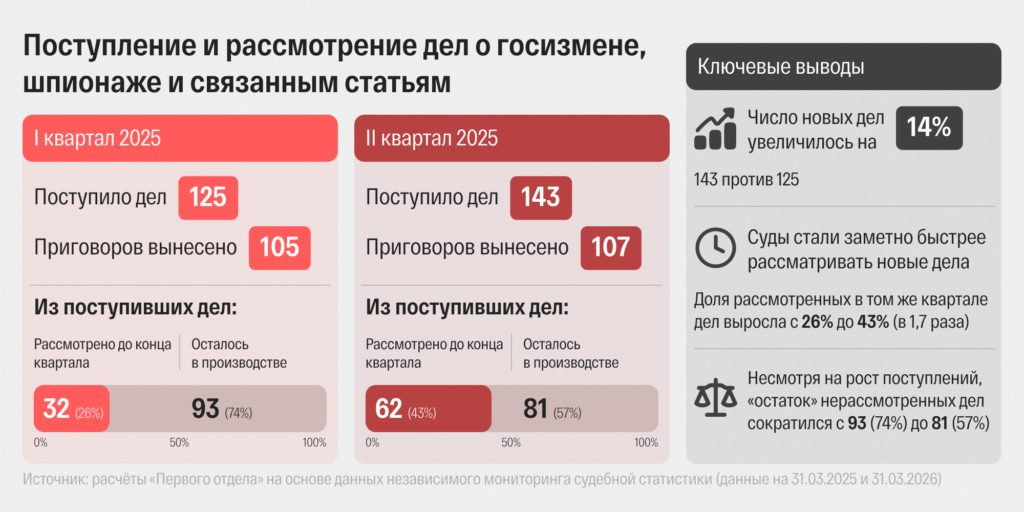
- There are more cases in the courts. In the first quarter of 2026, the courts announced almost the same number of verdicts as a year earlier, but the number of incoming cases increased: 143 new cases versus 125 in the first three months of 2025.
- Review times have been reduced. The courts began to work much faster. If in the first quarter of 2025, only 26% of received cases were considered by the end of the reporting period, then in the first quarter of 2026 - already 43%.
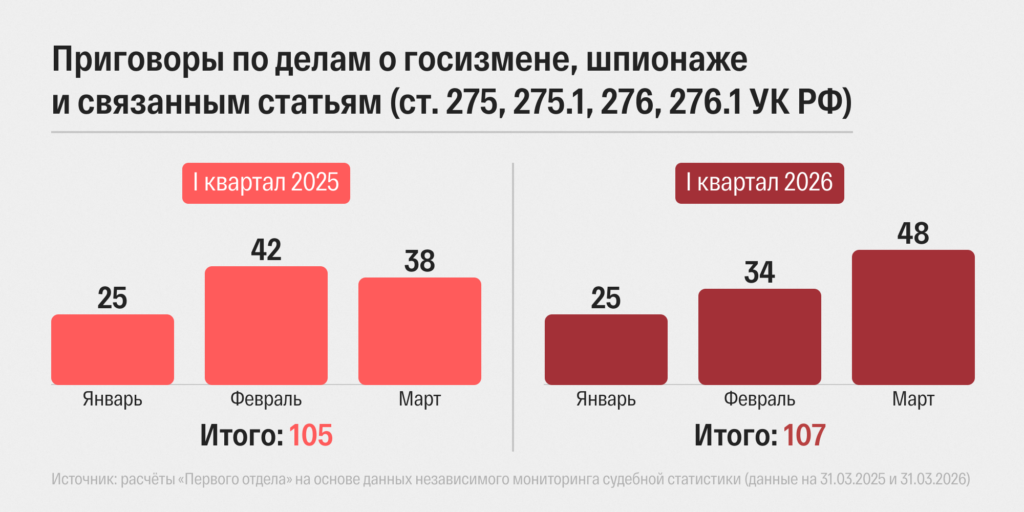
- All-time high in March. March 2026 set a record for the entire period of observation: during the month, courts announced 48 verdicts in cases related to state security. This is the highest figure in history.
- The charges are getting worse. More than half of those convicted, in addition to “treason” and “espionage,” were also charged with “terrorist” and “sabotage” articles.
- Total closure. Almost 70% of convicts have personal data hidden in their court records. Closedness is a key feature of cases related to state security.
Prosecutions for “treason” and “espionage” remain the key and one of the most actively used tools of Russian repression.
Key data
Since 2022, more than 1,100 people have already been convicted in cases of “spy” crimes against state security. Over the previous 29 years - from 1997 to 2021 inclusive - 170.
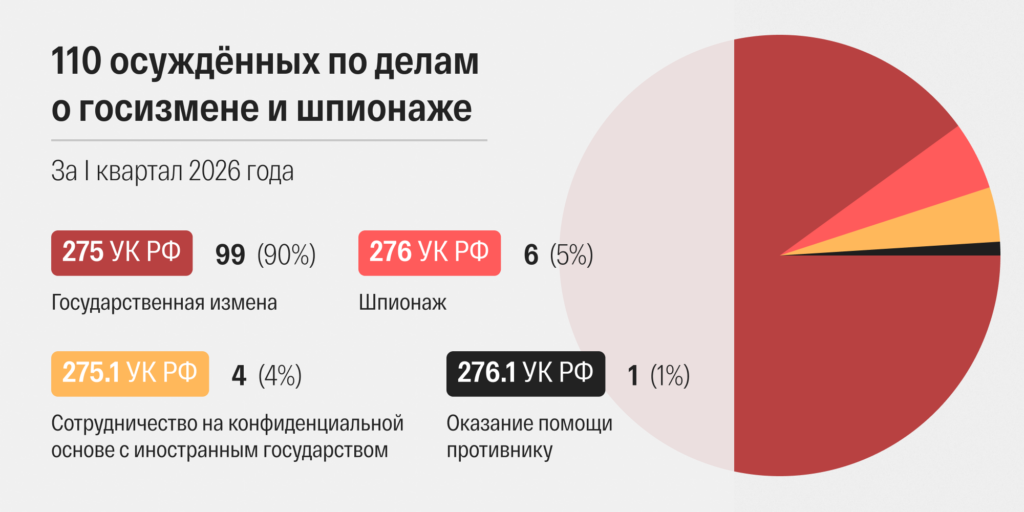
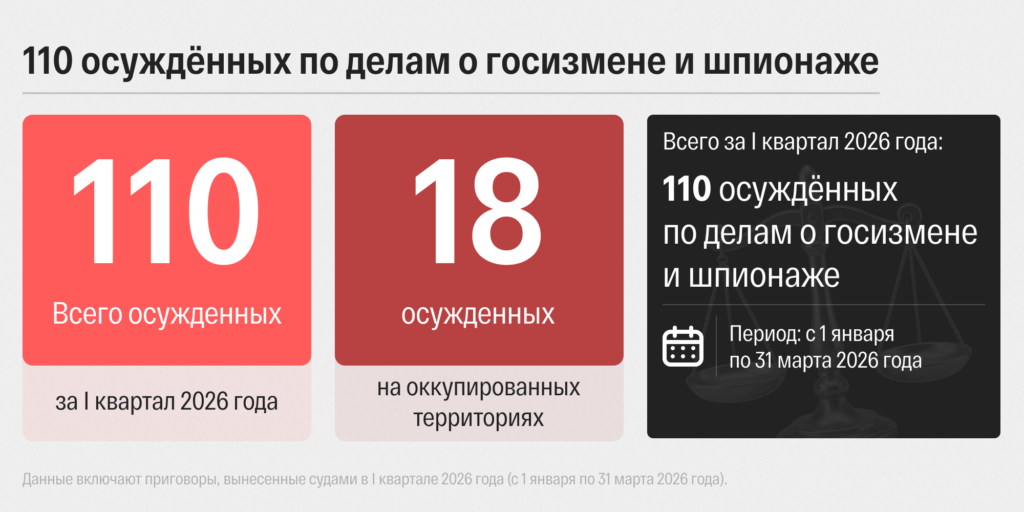
During the first quarter of 2026, Russian courts announced at least 107 verdicts under “spy” articles (Articles 275, 276, 275.1, 276.1 of the Criminal Code of the Russian Federation). 110 people were convicted. In the first three months of 2025, almost the same number of verdicts were announced - 105, and the number of convictions was exactly the same as this year.
There were 55 working days in January, February and March 2026. This means that on average every working day, Russian courts announced guilty verdicts against two people in cases related to state security.
The courts applied compulsory medical measures to two accused: one such decision was issued in the Omsk region, the other in the occupied territory of the Donetsk region.
At least one defendant did not live to see the verdict. In January 2026, in the Orenburg region, his case was closed due to his death.
In four cases, the courts returned the materials to prosecutors. Twice - because the judges decided to make the charge more serious - probably reclassify it from Art. 275.1 (“confidential cooperation with foreigners”) to the more serious art. 275 (“high treason”), and two more times due to violations of the Criminal Procedure Code in the indictment.
Monthly growth
In 2025, the number of announced convictions peaked in February, with the pace decreasing slightly in March, from 42 to 38 convictions. In 2026, the pace is growing continuously: 25 verdicts in January, 34 in February and 48 in March.
The March figure was an absolute record for the entire period of observation. Analysts estimate that the number of convictions in treason and espionage cases will continue to rise in 2026, but the growth rate will likely be lower than in 2025. Based on current dynamics, an increase of 10–15% is expected, which could lead to approximately 525–550 convictions by the end of the year.
The current intensity of the repressive machine is best reflected by the number of new cases that are just coming to the courts.
From January to March 2026, at least 143 cases of treason and espionage were submitted for consideration. During the same period last year, there were 125 of them. The increase was about 14% - this confirms that the scale of prosecutions under these articles continues to expand.
Courts work faster
Of the 125 cases received by the courts in the first quarter of 2025, judges managed to consider only 32 (26%) by the end of March. The remaining 93 cases moved to the following months.
In the first quarter of 2026, the intensity of court work increased noticeably. Of the 143 cases received by the end of the quarter, decisions had already been made on 62 cases (43%), and only 81 cases remained pending.
Thus, the share of cases that the courts manage to consider within the first months after receipt has increased almost 1.7 times - from 26% to 43% .
“Military courts have become the busiest in Russia, and in order to cope with the flow of “terrorist” cases, they are forced to clearly plan their work. In practice, this means that cases are scheduled months in advance and a certain amount of time is allocated for each case, often one meeting. The situation with the military court of appeal is even worse: the waiting time for consideration of an appeal can last up to a year,” says First Department lawyer Evgeny Smirnov.
The role of military courts is growing
In cases of treason and espionage, the role of military courts is becoming increasingly noticeable. If at the end of 2025 military courts accounted for about 39% of all pronounced sentences, then in the first quarter of 2026 this figure reached 41%.
Now, on average, two out of five verdicts in cases related to state security are pronounced by military courts.
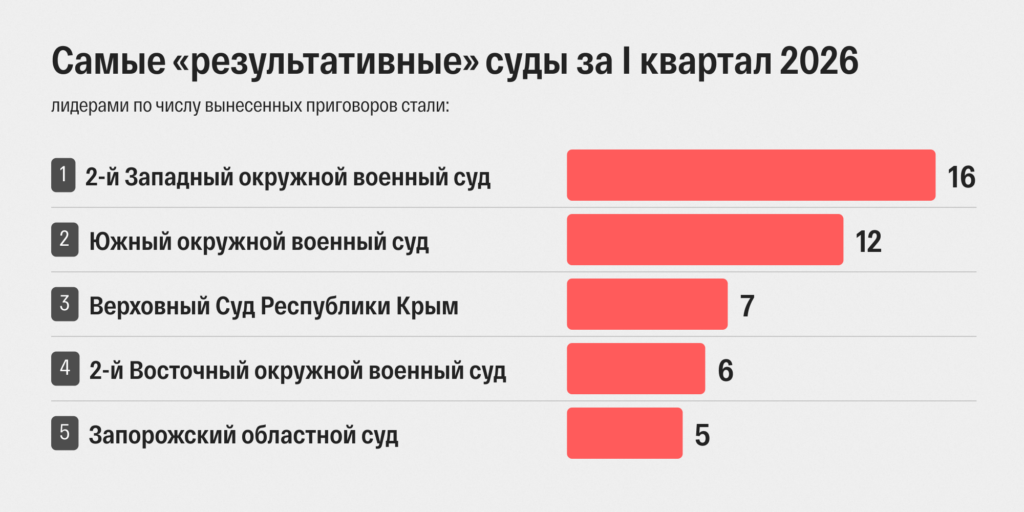
The leaders in the number of sentences from January to March were the 2nd Western District Military Court (16 sentences) and the Southern District Military Court (12 sentences). In total, they announced 26% of all decisions in the country during the quarter (28 out of 107).
The charges are getting heavier
Another important trend is that defendants are increasingly being charged with several articles of the Criminal Code at once. Of the 110 people convicted in the first quarter of 2026, only 42 (38%) received sentences exclusively on “core” articles of treason or espionage (Articles 275, 275.1, 276 or 276.1 of the Criminal Code of the Russian Federation). The remaining 68 people (62%) were simultaneously found guilty of other charges.
Most often, the charge is strengthened by “terrorist” articles. At least 40 convicts (36%) were simultaneously convicted under articles of the “terrorist” spectrum of “family” (Article 205-205.5 of the Criminal Code of the Russian Federation). Another 14 people (13%) were convicted under Art. 281 (“sabotage”), and 11 people (10%) received sentences under other articles. In addition, 3 defendants (3%) went to trial immediately with a bunch of charges: both terrorist and sabotage charges.
This happens because one act is classified under two articles at once. Thus, for contact with the Russian Volunteer Corps, they can be accused of both “terrorism” and “treason.” In the first case, the charge will be related to the court decision recognizing the RDK as a “terrorist organization”, in the second - with “activities directed against the security of the Russian Federation.”
Cases against citizens of Ukraine
In the first quarter of 2026, at least 18 people were convicted in the occupied territories of Ukraine, including Crimea.
In total, in all Russian courts during this period, sentences were pronounced against at least 26 Ukrainian citizens under articles of treason and espionage. To date, we have been able to identify 15 convicts.
Six people from this list are considered missing in Ukraine. Among them is Ruslan Domarev . He disappeared at the very beginning of the full-scale invasion, on March 1, 2022, and his sentence was announced on March 23, 2026 - four years after his disappearance.
According to Russian security officials, from September 2022 to February 2023, Domarev collected and transmitted to the Ukrainian special services information about the locations of units of the Russian Armed Forces in the Svatovsky and Kremensky districts of the LPR. Illegally stored weapons, ammunition and explosive devices were allegedly found and seized from his home.
Thus, Ukrainians make up at least a quarter of the total number of people convicted under these articles in the first quarter (26 out of 110 people).
In total, of the 1,126 people convicted during the full-scale war , at least 353 people (about 31%) have Ukrainian citizenship.
Distribution by articles of the Criminal Code
Article Art. 275 of the Criminal Code (“high treason”) remains the main charge : in the first quarter of 2026, 90% of the accused were convicted under it.
According to Article Art. 276 (“espionage”) only 5% were convicted. Due to the fact that Russian passports are imposed on residents of the occupied territories, they are tried as citizens of the Russian Federation - under Art. 275 (“high treason”).
Share of cases under Art. 275.1 (“confidential cooperation with foreigners”) continues to decline: in the first three months of the year, only four people were convicted under it.
Unlike 2025, in the first quarter of 2026, courts have never yet combined charges of “high treason” and “espionage” in their sentences.
Geography of sentences
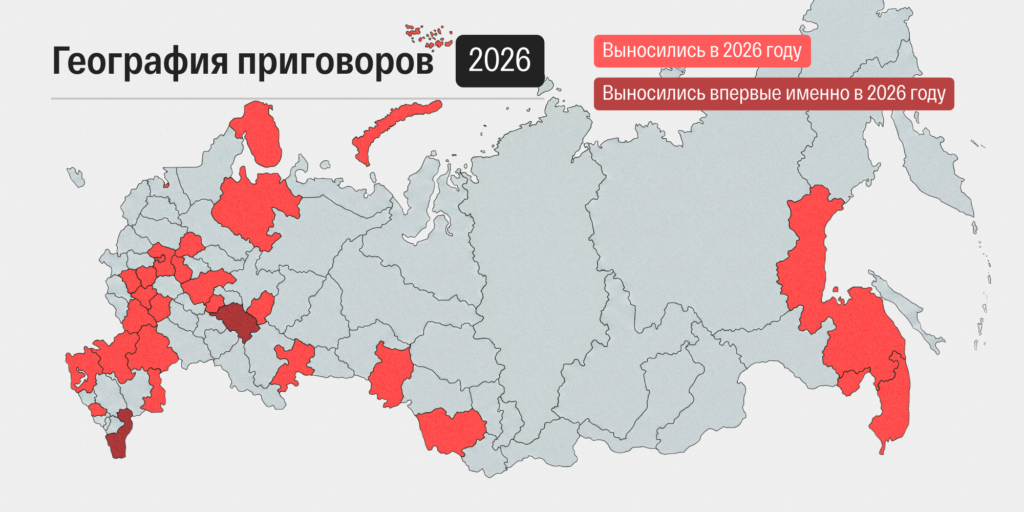
In the first quarter of 2026, verdicts in cases of treason and espionage were handed down by a total of 40 courts in Russia and the occupied territories of Ukraine. Of these , 7 are military courts, and the remaining 33 are courts of the constituent entities of the Federation.
The geography of persecution has expanded noticeably: in 2026, the first verdicts under these articles in the entire period of observation were proclaimed in Tatarstan and Dagestan.
On the map below:
Regions where verdicts in cases of crimes against state security were announced in the first quarter of 2026 are marked in red .
Bordov - regions where such sentences were announced for the first time in 2026.
Hiding data
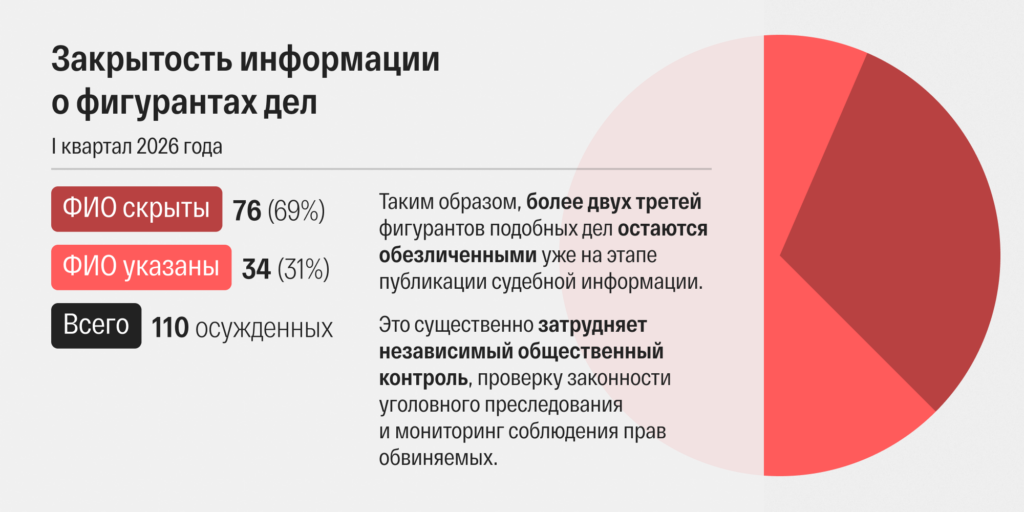
Information about those prosecuted in criminal cases for crimes against state security is systematically hidden. Thus, in the first quarter of 2026, the names and surnames of at least 76 out of 110 convicts (about 69%) were hidden. In only 34 cases (31%) did court records contain information that could identify a person directly from court records.
The 1st Western District Military Court, the 2nd Eastern District Military Court and the Southern District Military Court hid information less than others.
Appeal against sentences
According to the law, an appeal against the verdict of the first instance court can be filed within 15 days. If there is no complaint, the sentence comes into force immediately after this period.
We identified signs of an appeal using an indirect marker: those cases where there was no information about the entry into force of the decision in the court file at all, or the official date of entry into force of the verdict came later than 21 days after the date of proclamation of the verdict of the court of first instance, were considered the alleged “appealed” cases. This number of days is due to the fact that if the end of the period falls on a weekend, then its last day is considered the first working day following it.
An analysis of practice showed that out of 107 sentences for the first quarter of 2026, only in 15 cases the decisions came into force in the first three weeks. In the remaining 92 cases (86% of decisions) there are indications that they were appealed.
This figure is an estimate, since an empty box on the court card does not always mean filing an appeal. However, this metric suggests that the vast majority of sentences in criminal cases of this category are appealed by the parties at least formally
Who is being judged
It is almost impossible to collect complete data on the age, gender or citizenship of convicted persons. Often names can only be found out months after the verdict - analysts compare case files with publications in the press, the Rosfinmonitoring register and data from other open sources.
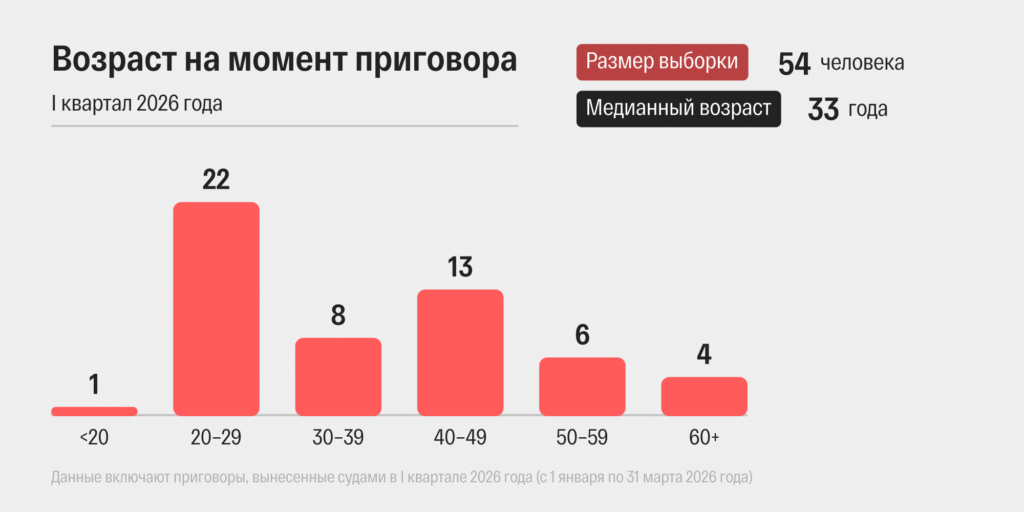
By June 15, 2026, it was possible to identify 60 of the 110 people (55%) convicted in the first quarter. Therefore, the figures below remain preliminary for now. Nevertheless, they already allow us to see general trends.
The median age of convicts at the time of sentencing is 33 years.
The youngest defendant at the time of sentencing was 19 years old (born in 2006), his name is Vladislav Sosedko . The young man was detained in July 2024 (at that time he was a minor) for submitting applications on Telegram to join the “Freedom of Russia Legion” and the “Russian Volunteer Corps”. As a result, he was found guilty of “preparing for treason,” “participation in a terrorist organization,” “justifying terrorism,” and “disseminating “military fakes””; the verdict came into force.
The oldest person involved is 70-year-old Ukrainian citizen Nikolai Tinkov from the Zaporozhye region. He is one of the first known people convicted under Art. 276.1 (“providing assistance to the enemy”). In just one sitting, an occupation court created by the Russian authorities sentenced a pensioner to 10 years in a maximum security colony for transferring 3,015 hryvnia (about 6,300 rubles) to the needs of the Armed Forces of Ukraine.
In the first quarter of 2026, courts convicted at least nine women. Six of them are citizens of Ukraine:
Maria Grin is a 21-year-old resident of occupied Donetsk, sentenced by the Southern District Military Court of the Russian Federation to 20 years in a general regime colony on charges of “high treason” and attempted terrorist attack. Russian authorities accused the girl of collaborating with the Security Service of Ukraine (collecting data on the deployment of Russian troops, photographing “police” and “court” transport), wanting to join the Azov battalion, as well as attempting to set fire to the building of the Kirov Interdistrict Court of Donetsk using Molotov cocktails in July 2024.
Angelina Skiba is a 25-year-old native of Gorlovka, sentenced by the 1st Western District Military Court to 13 years in prison. The girl, detained by the FSB in August 2025, was accused of making six money transfers for the needs of the Armed Forces of Ukraine and the Azov regiment in 2024–2025 for a total amount of about 4 thousand hryvnia (6,855 rubles). Her late husband Mykola Skiba served in the National Guard of Ukraine since 2022. In May 2022, he and his colleagues left Azovstal and surrendered. For a long time, the man was in a pre-trial detention center in the Volgograd region, where on March 13, 2024 he died due to failure to provide medical care.
Elena Nishanova is a 48-year-old resident of the occupied part of the Kherson region. On March 11, 2026, a Russian court sentenced her to 10 years in prison in a case of “espionage.”
Elena Kosenko is a 43-year-old resident of the occupied part of the Kherson region, whom the Kherson Regional Court sentenced no later than February 9, 2026 to 10 years in a general regime colony on charges of “espionage.” Kosenko was kidnapped on September 6, 2024 and held for several months in an unknown location before being transferred to the Chongar pre-trial detention center. The Russian investigation charged her with collecting data on the deployment and movement of military equipment and personnel of the Russian Armed Forces in April 2024, with the subsequent transfer of information to Ukrainian intelligence through a messenger.
Svetlana Loy is a pensioner from Tokmak (the occupied part of the Zaporozhye region), sentenced by the occupation Zaporozhye regional court to 15 years in a general regime colony and a year of restriction of freedom on charges of “high treason.” Russian authorities charged the woman, who acquired Russian citizenship in December 2023, with financing the Armed Forces of Ukraine. According to investigators, from January to November 2024, Loy, through a mobile application of a Ukrainian bank, transferred from her Ukrainian pension to the needs of the Ukrainian army (in particular, to the “Come Back Alive” fund) an amount equivalent to 63,420 rubles.
Galina Bekhter is a 68-year-old pensioner from the village of Plodorodnoye (the occupied part of the Zaporozhye region), sentenced to 11 years in a general regime colony under the article of “high treason” for a monetary donation to the Ukrainian army. While in pre-trial detention center No. 1 in Simferopol, the woman faced a rapid deterioration in her health: according to activists, her dementia is progressing, she refuses to eat, has a critically low weight and is unable to take care of herself. Despite Bekhter's serious physical and mental condition, the prosecution appealed the March 5 verdict, demanding that the prison term be increased to 16 years.
Terms of imprisonment
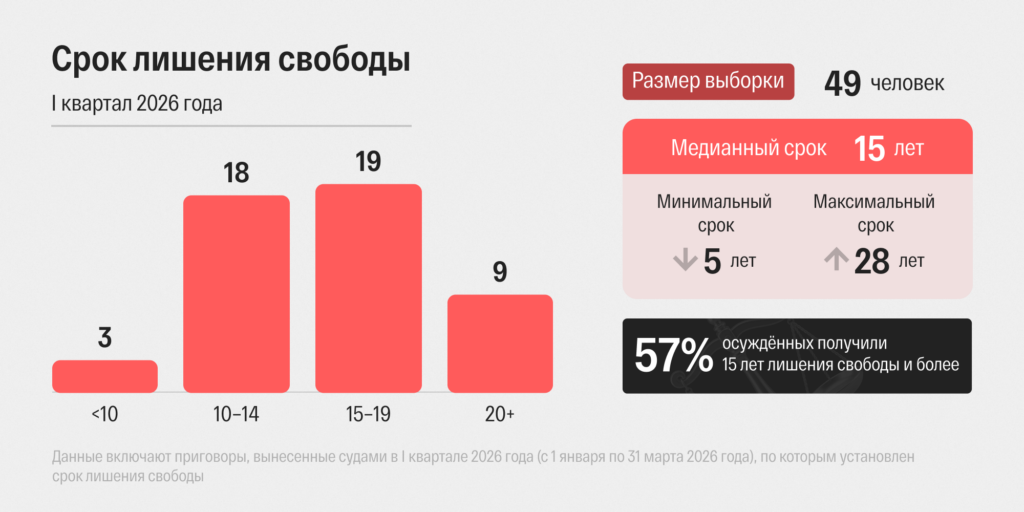
We were able to find information about punishment for 49 convicts. Sentences under these articles remain unprecedentedly harsh: the median sentence was 15 years in prison, and the average was about 15 years and 5 months.
The minimum identified period is 5 years. He was assigned to the already mentioned Vladislav Sosedko.
The maximum sentence - 28 years in prison - was received by Artem Kharin , a 21-year-old Russian soldier from the Kirov region, sentenced on March 6, 2026 by the Southern District Military Court in the case of “high treason,” “sabotage” and “participation in a terrorist organization.” According to information obtained from the materials of his criminal case, in the summer of 2023, Kharin set fire to a railway transformer on the instructions of the Russian Freedom Legion, after which he voluntarily entered into a contract with the Russian Armed Forces to transfer intelligence data from the Avdeevsky direction to the organization. He was detained by military counterintelligence in November 2023 in the occupied territory of the Donetsk region and was subjected to harsh transportation to the Russian Federation. From Belovodsk to Sychevka he was transported in a trunk where exhaust gases were coming in, with his hands tightly tied behind his back and tape over his eyes. At the border with Russia, Kharin was transferred to another car and taken to the airport in Millerovo, Rostov region, from where on March 4, 2024, he was taken under escort to Yekaterinburg.
- От 10 до 14 лет назначили для 18 осужденных (37%);
- От 15 до 19 лет назначили для 19 осужденных (39%);
- 20 лет и более назначили для 9 осужденных (18%).
Таким образом, больше половины людей, о сроках наказания которым нам стало известно, приговорены как минимум к 15 годам заключения .
Дмитрий Заир-Бек, глава «Первого отдела»:
«Увы, рост числа преследуемых по делам о преступлениях против госбезопасности продолжается. Главная тенденция начала 2026 года — пугающая рутинизация преследований. Суды реже „буксуют“ в материалах: почти половина новых дел теперь рассматривается влет, хотя речь идет о сроках в 15-20 лет. Органы госбезопасности фактически сформировали конвеер преследований, стандартную бюрократическую процедуру с заранее известным финалом. А секретность нужна, чтобы напустить ужаса на тех, против кого эти репрессии направлены — честных граждан, которые просто хотят жить в нормальном мире».