
Translated material
The most important four minutes. Why are there still no defibrillators in public spaces in Russia?
Dina Ivina
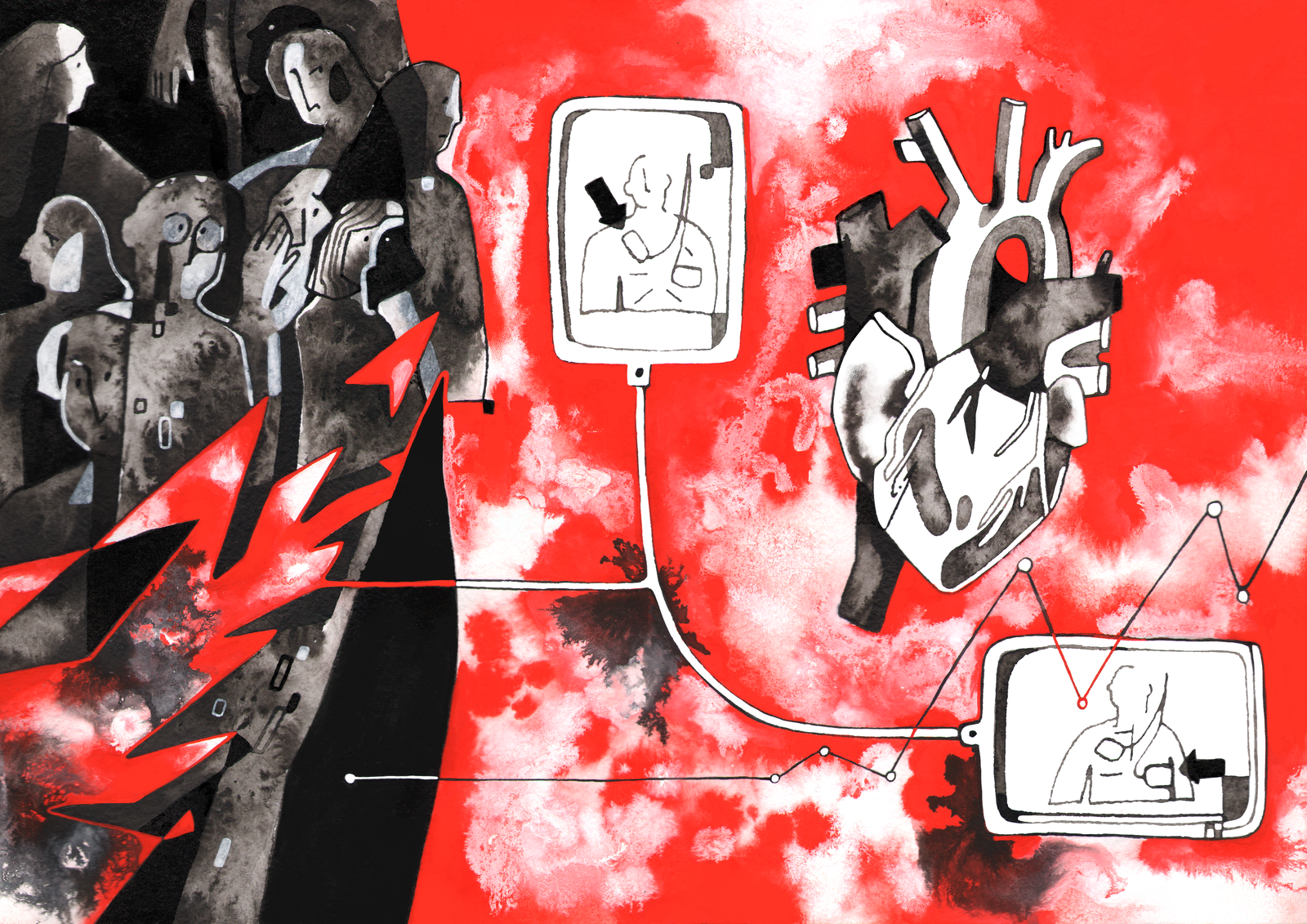
An ambulance can take twenty minutes to travel, which is five times longer than the amount of time the brain has after cardiac arrest. During this period, a person’s life often depends not on the doctor, but on the one who happens to be nearby. An automatic external defibrillator (AED) can use voice prompts to help a passerby perform resuscitation: it analyzes the heart rhythm itself and will not allow you to press a button if the shock is not needed. But in Russian schools, gyms, train stations and shopping centers, such devices are still rare. The law allows the use of AEDs for first aid, but there is still no mandatory standard according to which they should be installed in crowded places.
Discourse journalist Dina Ivina spoke with general practitioner, toxicologist and science popularizer Alexey Vodovozov about why chest compressions are only part of salvation, how laws work in Russia and in which countries defibrillators are becoming as common a part of city infrastructure as fire extinguishers.
Sudden cardiac arrest can occur in any public place, and in this situation, a person's life depends on what actions are taken in the first few minutes. Although modern technologies make it possible to resuscitate a victim by ordinary passers-by, automatic defibrillators in Russian schools, gyms and shopping centers are still a rarity.
Heart massage is half the salvation
In movies, we often see how the hero’s heart is “turned on” with his hands. In reality, this procedure is certainly important, but not nearly as effective as on the screen. Chest compressions maintain minimal blood flow, prolonging the time during which the shock can be effective - but only until an AED is used and doctors arrive. Ideally, both actions are needed: start CPR immediately and bring a defibrillator as quickly as possible.
When the heart suddenly stops, there is a condition called fibrillation: the muscle consumes the remaining energy, but does not pump blood. In the most reversible cases, the electrical system of the organ works chaotically: the device can recognize such rhythms and try to interrupt them with a discharge.
“The AED becomes a game-changer because it addresses the very cause of chaos. The controlled impulse restarts the heart's electrical system. Indirect cardiac massage is extremely important, but it only imitates the pump, buying time before the doctors arrive. Without a discharge, the heart gradually loses energy resources, and the condition turns into asystole - a complete cessation of electrical activity. At this stage, it is much more difficult to save a person,” explains Alexey Vodovozov.
Statistics confirm: every minute of delay reduces the chances of survival by 7-10%. In particular, there is a North American study in which the survival rate when using an AED by bystanders is about 38%, but if the defibrillator is not used at all and only manual cardiac massage is performed, the chances of survival drop to 9%.
Price of four minutes
Medicine operates with the concept of the “ golden window ”. Without blood flow, the risk of brain damage increases rapidly within minutes. Consciousness disappears after 10–20 seconds, and after 4–6 minutes, irreversible processes begin in the neurons.
“This is why waiting for an ambulance, even within the ideal 20 minutes, is often too long. By the time doctors arrive, a person may develop severe post-resuscitation brain damage that is incompatible with normal life,” Vodovozov emphasizes.
This risk is not limited to older people. Cardiac arrest in young athletes, for example, is often associated with hidden pathologies that cannot be noticed without special examination. These may be genetic defects of the heart's electrical system, such as long QT syndrome, Brugada disease, or myocarditis. In such cases, the heart looks healthy outwardly, but fails under load, leading to instantaneous arrest.
How does a defibrillator work?
The main fear of a person holding a defibrillator is to shock a healthy person and cause him even more harm. However, fears are unfounded: the AED is designed so that even a person without medical education and first aid skills can use it.
The device operates in semi-automatic mode. After gluing the electrodes to the victim’s chest, the device itself takes an ECG and analyzes the rhythm.
“A modern AED simply won’t allow you to erroneously deliver a shock to a person who doesn’t need it. The shock button will not activate if the computer does not detect atrial fibrillation. He himself gives voice instructions: “Don’t touch the patient” or “Press the button,” says Alexey.
In addition, the device has virtually no contraindications. It can be used to save children and pregnant women.
It is worth following safety rules: do not touch the person during analysis and discharge, follow the voice prompts of the device, if the person is in the water, you should pull him out and dry the chest so that the electrodes stick well.
Russian paradox: allowed, but not required
Despite the obvious benefits, defibrillators in Russia are still not installed even in public places with high traffic volumes, for example, at railway stations. The legislative framework for their implementation has been formed since 2019; an important step was Order of the Ministry of Health No. 220n, which entered into force on September 1, 2024. He admits that, if necessary, first aid can be provided by an “unlimited circle of persons” - that is, any passerby.
In fact, the installation of AEDs in Russia today is pure altruism and voluntary social responsibility on the part of the owners of establishments. If the device hangs in a private gym or shopping center, this means that the owner voluntarily allocated 150–300 thousand rubles for this (the cost of a high-quality device plus maintenance) and began training staff at his own expense.
For government agencies such as schools, installation can be particularly challenging. Their purchase depends on the decision of the manager, the availability of separate funding and the willingness to justify the costs. Since there is still no approved list of locations , the devices are not included in the mandatory equipment standards. At the same time, according to 2018 data, more than 200 children died annually during physical education lessons in Russian schools. This was often caused by sudden cardiac arrest.
“The legislative framework is just being formed, and the infrastructure is at an early stage of development. A high-quality device costs hundreds of thousands of rubles and requires regular battery replacement and staff training. For many budgetary institutions, such as schools, this is a legally and financially difficult task,” explains Vodovozov.
Now AEDs can be found at major airports , in medical university buildings and even in some metropolitan parks . But there is no single mandatory network in Russia, and data on the placement of defibrillators is fragmentary.
Of course, hanging devices at every step will not solve the problem. The main enemy of salvation is the bystander effect and fear of responsibility.
“From a technical point of view, any person can use an AED, but it will not teach you to overcome the psychological barrier, quickly navigate and correctly perform cardiac massage. The optimal way is a combination: the most accessible defibrillators plus mass education of the population so that the habit of not getting lost in an emergency is formed,” concludes Alexey.
How it works in the world
Meanwhile, in international practice, the presence of AEDs in crowded places is the same norm as a fire extinguishing system. The presence of defibrillators affects mortality statistics. Thus, in countries where devices hang in every quarter, passers-by successfully save people even before doctors arrive.
The numbers speak for themselves: on average, the world's average chance of surviving cardiac arrest outside a hospital is only about 5%. However, in areas with a high density of instruments, the numbers are higher. Japanese recommendations for placement of devices indicate that when using the device in a public place for three minutes, almost 40% of patients achieved full recovery: that is, the person survived, did not suffer severe brain damage and was able to return to normal life.
Many countries are fighting against fear of the device. For example, the WHO-supported Kids Save Lives initiative is introducing CPR lessons into the school curriculum for children from 12 years of age.
What to do if in front of your eyes a person has lost consciousness and is not breathing normally?
Make sure that you and the victim are not in danger. Call others for help and call an ambulance. If there are other people nearby, ask them to check if there is an automatic defibrillator nearby. However, you should immediately place the person on a hard, flat surface and begin cardiopulmonary resuscitation.
If there is an AED nearby, turn it on and follow the voice instructions of the device. If not, continue resuscitation until paramedics arrive, until the victim regains normal spontaneous breathing, or until another person can relieve you.