
Translated material
In five years, the State Duma has adopted five environmentally hazardous laws
On February 8, 2024, DOXA was added to the register of “undesirable organizations.”
If you are in Russia or planning to return to it, you cannot repost our materials on social networks, link to them or publish quotes.
Read more about what is and is not possible in the cards .
During the work of the 8th convocation of the State Duma, deputies adopted at least five laws that threaten the environmental situation in Russia, according to a new report from DumaBingo. DOXA retells the main details of the report; you can read it in full at this link .
What laws were passed?
- Limitation of public environmental assessment (PEE). Adopted in 2023. The law introduces a qualification exam for admission to an independent examination, deprived foreign agents and employees of international organizations of the right to participate in it, prohibited the transfer of project documentation to third parties, and created a register of experts under the control of Rosprirodnadzor. Experts fear that through certification, authorities have the opportunity to influence the composition of experts and thereby deprive the examination of independence.
- Clear cuttings on Lake Baikal. Adopted in 2025. From March 1, 2026, clear cutting of dead forest is allowed in the Central Ecological Zone of Lake Baikal if it has lost its “useful functions.” Formally, the clear-cutting mechanism was removed from the final version of the law, but the possibility of felling remained through another legal mechanism - the transfer of forest fund lands to other categories, which removes areas from the protection of forestry legislation.
- Changing the boundaries of protected areas (SPNA). Adopted only in the first reading. According to this bill, areas that have “lost their environmental value” for “economic use” may be excluded from specially protected natural areas and construction may be allowed on them. Deputies and environmentalists pointed out that the text of the law does not contain criteria for “objects of federal significance” that can be placed in protected areas, and there is no explanation of what is considered “irreversible complete loss of environmental significance.”
- New exams for hunters. Valid from September 1, 2025. Formally, the law introduces testing for knowledge of the “hunting minimum” from regional authorities - previously, to obtain a hunting license, a signature stating knowledge of the rules was enough. The main problem is that for the second reading, deputies involved in hunting added a second step: in order to get tested, you must first “confirm your practical skills,” and this can only be done through hunter-mentors, individual entrepreneurs and legal entities with the right to hunt, or through a large self-regulatory organization. This carries risks of corruption.
- Shooting Red Book animals. Adopted in July 2025. The protection of rare species has been removed from the level of federal law: now the procedure for their extraction is established by the Government. The Earth Touches Everyone project drew attention to the dangerous rule that allows harvesting “for the purpose of conservation of wildlife” without specifying these purposes, and harvesting for “population monitoring.”
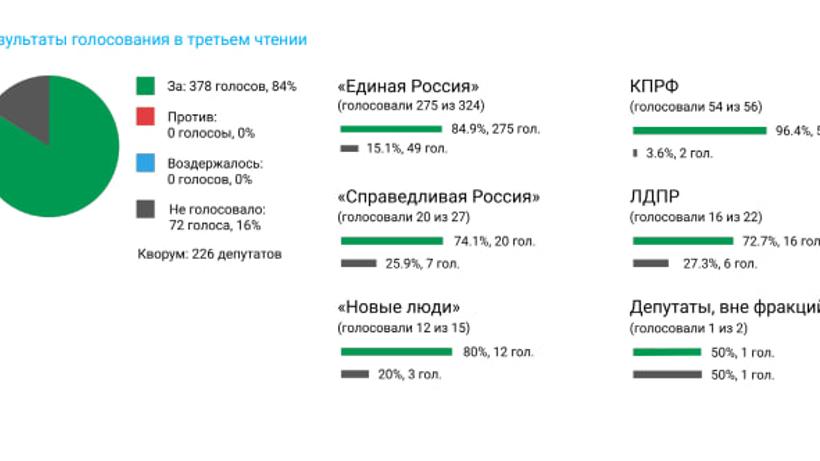
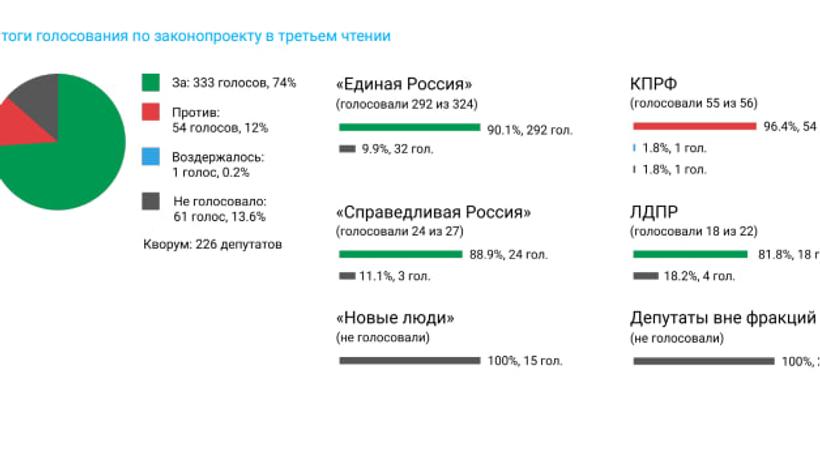
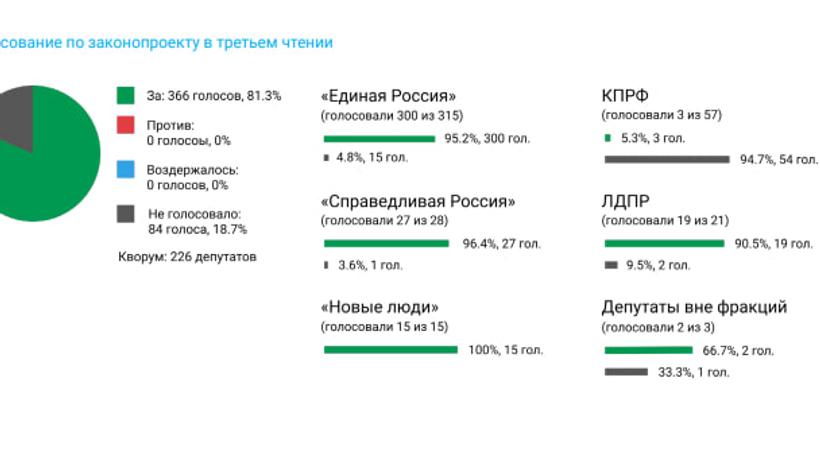
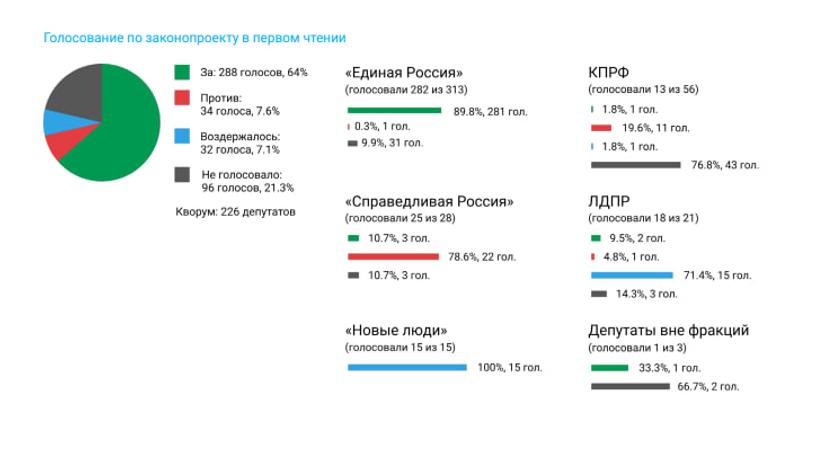
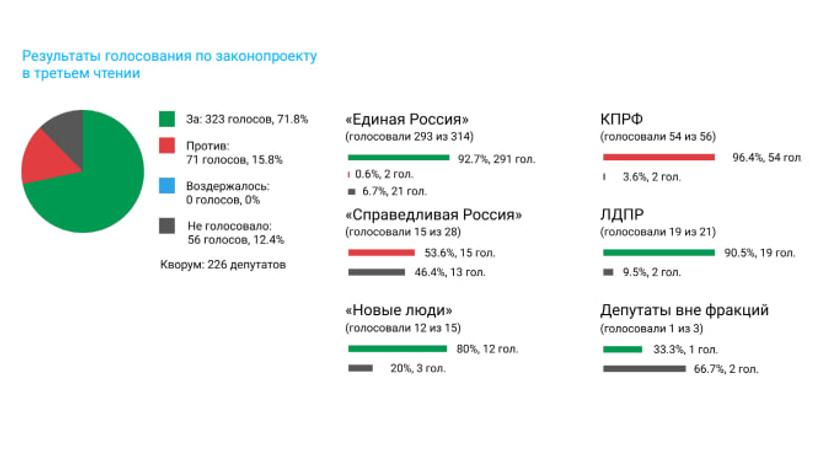
Voting on the law on hunters, environmental protection, animals listed in the Red Book, protected areas and clear-cutting on Lake Baikal
"DumaBingo"
Business interests come first
As DumaBingo writes, industry interests are behind all adopted laws. Thus, the law on energy efficiency was promoted by United Russia member Alexander Kogan, former Minister of Ecology of the Moscow Region and adviser to Governor Vorobyov, whose family is connected with the largest developer of the Samolet Group of Companies; Kogan’s own wife and daughter are also involved in the construction business. Tourist interest is behind the law on clear-cutting on Lake Baikal: special economic zones have been created on the shores of the lake, which have attracted large investments.
Previously, DOXA found out that the ongoing logging on Lake Baikal is taking place in the interests of oligarch Vladimir Yevtushenkov, who plans to build an elite recreation complex there.
In general, according to the adopted laws, it is clear that economic benefits are placed higher than environmental activities.
At the same time, the report notes the role of United Russia as a monopoly party. The law on environmental impact passed in the third reading thanks to 292 votes from United Russia, the Baikal law - 284 votes in favor in the first reading and 91 votes in the second and third, the law on protected areas - 281 votes in the first reading.
The only place for discussing these laws remains the State Duma Committee on Ecology, where there are deputies defending environmental interests. Among them are Oleg Mikhailov (CPRF), Anatoly Greshnevikov (SR), Vyacheslav Fetisov and Nikolai Buduev (both United Russia). At the same time, the position of deputies rarely influences the position of the committee, since it is headed by United Russia member Dmitry Kobylkin, who consistently votes for laws that are harmful to the environment.