
Translated material
As we know, we do not have irreplaceable skulls.
How the soldier Ivan Chonkin was born
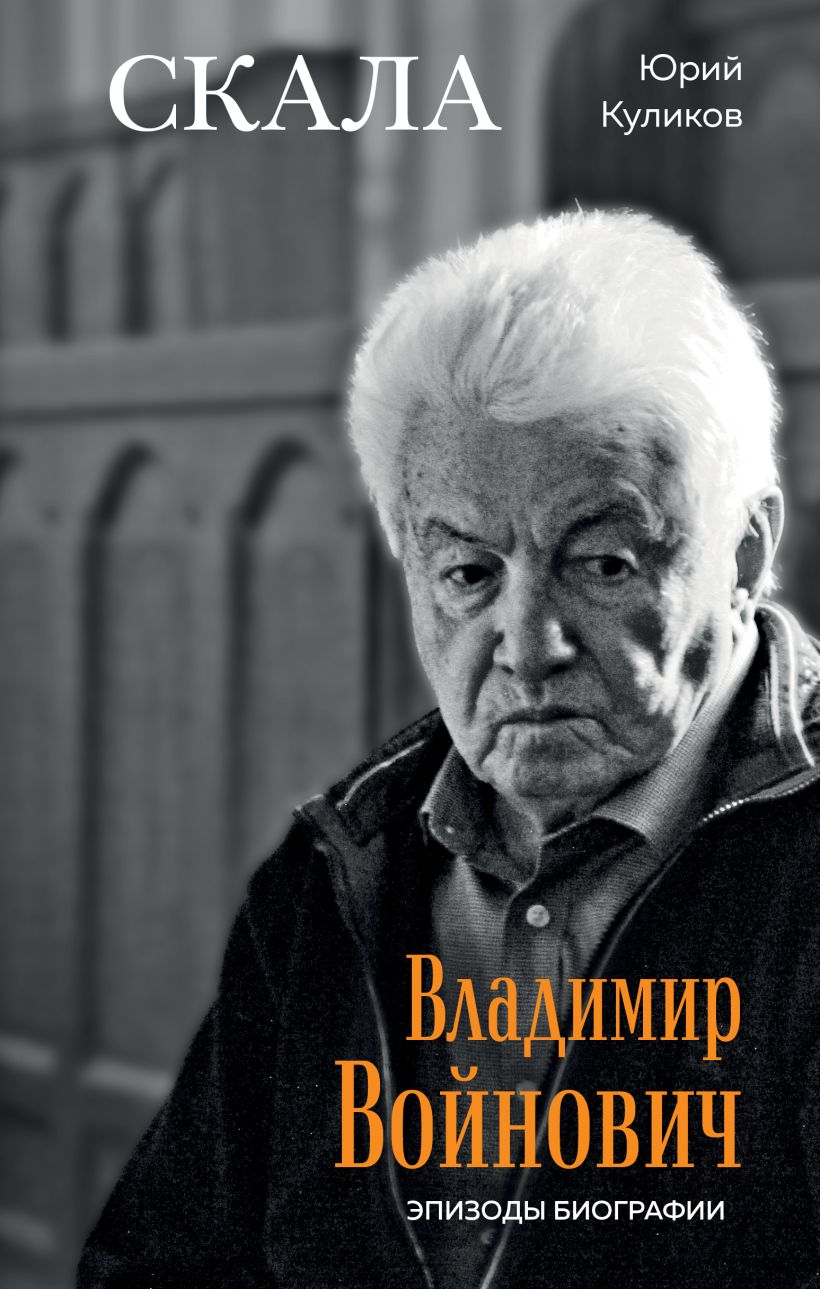
Vladimir Voinovich planned to make a career as an honest, but quite mainstream Soviet writer, but due to his temperament, everything ended up not going according to plan and turned out to be a much greater success than could have been expected. Yuri Kulikov’s new book “The Rock” is dedicated to the life and creative path of this wonderful writer - we publish a small excerpt from it.
All of us, since February 24, 2022, have found ourselves in the face of advancing barbarism, violence and lies. In this situation, it is extremely important to preserve at least the remnants of culture and support the values of humanism - including for the sake of the future of Russia. Therefore, the editors of Gorky will continue to talk about books, reminding our readers that there is still a place for thought and fiction in the world.
Yuri Kulikov. Rock. Vladimir Voinovich: biography episodes. M.: Eksmo, 2026. Contents
The birthplace of “Chonkin” is topographically determined: Moscow’s Razgulyai Square, next to bus stop number three. From this point in the summer of 1958 a powerful message of space was sent. All of Voinovich’s previous attempts to write prose had failed, but here he had an epiphany. He told his American friend, Russian scholar John Glad, how he stood and drank soda: “and the woman who sold this water talked to another and told her that she had a difficult life, she had a son who was a hooligan, and there was no government. If only there was a father, but he died in the war. He was a colonel. I looked at her like that - and I’ve seen women like this - and I thought: you’re lying, you didn’t have any husband, at least he wasn’t a colonel. I imagined a biography of a woman who met a soldier on the eve of the war, and when the war began <...> all communication between them was broken, and she continued to imagine who he was. She has already forgotten him. She had a child, she herself no longer properly remembered the father of this child and imagined his biography. I wrote such a story, but it was rather weak, although with an interesting plot, I think. But I didn't have a hero yet. This was the heroine. Then I wrote other things, wrote the story “We Live Here,” and kept returning to this idea. But who really was this person she imagined so much about, and what really happened to her? And I thought that it was a soldier like that... And suddenly I remembered an incident when I myself served in the army, in Poland. I was once walking through the territory of our military camp and saw a strange picture: a horse harnessed to a cart was walking, but there was no rider, then I looked down - it turns out that there was a soldier lying down between the wheels, he had caught his foot on the reins, and the horse was walking so slowly, dragging him along the pavement, and he was lying there and did not show any desire to free himself from this situation. And then I saw this soldier. He walked around with his head bandaged, and I asked someone who it was? And they said to me: "Don't you know? This is Chonkin." That's all. I knew nothing more about this soldier. Then he died under some strange circumstances, and his image remained in me like this.”
Voinovich ran to the hostel and in a narrow vestibule, putting a felt boot that served as a table on his knees, he wrote “The Colonel’s Widow” (the story has long been lost. - Yu. K. ). I read it to my drunk neighbor Lekha, who sniffled. “What are you doing?” - “I feel sorry for grandma. We also had one in our village who wrote letters to herself. And then I ordered a portrait - as if with my husband.” Thanks to drunk Lekha, here it is, the ending.
(Letters from a hero to a fictional character are not a new technique. In Gorky’s story, had Voinovich read it by that time? - “Boles”, the unfortunate, lonely Teresa asks her neighbor to write letters to Boles and answers from him: “What then?” she said offendedly. “He’s not here, he’s not!” <...> But I want him to be... Am I not a man like everyone else? Of course, I... I know... <...> No, but as if there is!
Voinovich approached Chonkin from afar. In addition to “The Colonel’s Widow,” he wrote, but apparently did not publish anywhere, the story “Forced Landing”: “The jet plane, having crushed half a hectare of buckwheat, stopped twenty meters from Yegor Zubov’s last hut. The collective farmers who quickly came running looked with curiosity at the winged car spread out on the ground.” The story is rather weak, interesting only as an approach to the “barbell” - a future novel that begins in June 1941, also with a forced landing, but in a different way: “Bold, Nyura turned her head to the left and fell face down again. The scary bird really existed. She stood not far from Nyura’s vegetable garden, her large green wings spread wide.
“Get lost!” - Nyura mentally ordered and wanted to make the sign of the cross, but it was uncomfortable to cross herself while lying on her stomach, and she was afraid to get up.
And suddenly it was as if an electric shock pierced her: “So this is an airplane!” Indeed. Nyura mistook an ordinary U-2 plane for an iron bird, and a motionless propeller seemed to her with a lopsided beak.
Having barely crossed Nyura’s roof, the plane descended, ran across the grass and stopped near Fedka Reshetov, almost hitting him with its right wing.
Fedka, a red-haired big-faced brute, better known by the nickname Shoulder, was mowing the grass here.
The pilot, seeing Plechevyi, unfastened his seat belts, leaned out of the cockpit and shouted:
“Hey man, what kind of village is this?”
By evening, a sentry, Ivan Chonkin, was sent to the broken plane. This is where his adventures began. The novel, conceived as a lyrical pastoral of Ivan and Nyura, under the influence of circumstances and observations, gradually turned into a satirical story. The novelist was told (and not only by his bosses): “Well, that’s not possible. Many people died in the war, and you laugh.” He fought back: “I don’t laugh at the death of people, but I laugh at some of the idiocy of life.”
In Novy Mir, one of the explanations for the refusal to publish was this: “Once upon a time,” said deputy editor-in-chief Alexander Dementyev, “in 1930, I was traveling on a ship with Czech teachers. They asked me what I had read from Czech literature, what was my favorite book, I answered: “Svejk” by Hasek. They began to be indignant: “Schveik” is an insult to the Czech people. So I, probably, now [reading the manuscript of “Chonkin”] experience the same feeling as those teachers. I understand that I’m wrong, but I can’t overcome it in myself.”
In Prague, I asked my longtime friend from Literaturnaya Gazeta, Vitaly Moev, who has lived in the Czech Republic for decades: “How do the Czechs look at Jaroslav Hasek today?” - “In my opinion, it’s very askew. It seems like he disgraced the nation. This is a curious circumstance. The first time a Prague doctor told me about this: “They found a good writer! He disgraced the whole nation. He made us look like some kind of fools.” And then I heard this more than once. It seems to me that because of this, the Czechs reacted well to Jiri Menzel’s film based on “Chonkin” (the director’s opinion: “Schweik did a disservice to my people. He instills cynicism and cowardice in people.” - Yu. K. ), they say, we are not alone, well, the Russians are the same! Something that could not be felt anywhere - neither in Poland, nor in Bulgaria. And here this note is present thanks to Schweik.”
Was it not this note that the Czech Jana Klusakova, V. Havel’s translator, caught at a meeting with M. Gorbachev, when in April 1990 she sent Voinovich a letter: “Your Chonkin! I haven’t felt such pleasure, such pleasure over a written translation for a long time. I was sorry that there were fewer and fewer pages left until the end - can you imagine? In a word, I found myself in your surprisingly relevant and “Czech” novel. When I read it for the first time, I laughed so hard I woke up my children. This is the case when I think: this is exactly how I would like to write if I were a writer.” (A few months later, Klusakova, at the request of director Menzel, completed the translation, “and with such enthusiasm that it was free.”)
“Chonkin” was read by many in Russia (only in the magazine “Yunost” in the perestroika eighties - after twenty-five years of ban - the first book was published in a circulation of 3,100,000 copies), there is no need to repeat it in detail. Briefly: in the village of Krasnoe, I repeat, the U-2 made an emergency landing; the most neglected soldier, Ivan Chonkin, was sent from the military unit to guard it. They detached and forgot, Ivan had to think about arrangement. Savvy and handy, he settled down - next to the postwoman Nyura, having previously moved the plane to her garden. The right person in the household, and Nyura’s nights are more pleasant. Gradually I became acquainted with the whole village, closest of all with the storekeeper Gladyshev, the local Lysenko, who is busy with innovative experiments - he is trying to develop PUX, a hybrid of potatoes (tubers below) and tomatoes with the opportunistic name “The Path to Socialism”.
Maybe Chonkin would have been remembered in his unit, but there’s a war here and he has no time. And as luck would have it, Nyurka’s cow entered Gladyshev’s experimental field, crushing and devouring the exclusive PUX. The vengeful Lysenkoite, don’t be a fool, knocked in the right place, and from there an armed detachment was sent to neutralize the enemy, which Vanya arrested, “chaining” in the cellar. Seeing how serious the enemy attack was, they sent a regiment against the “Chonkin gang”, overcame the resistance with difficulty, tied up Ivan and put him in a cell, where they skillfully framed him as Prince Golitsyn, a contender for the Russian throne, thrown into the rear by the Germans for a rebellion. The news reached Stalin and Hitler, Chonkin was ordered to be captured/rescued, only he disappeared into the unknown where... For the reader familiar with the book, I will remind you of several characteristic quotes, and for those who have not yet seen the anecdote novel (such a definition of the genre is a trick, a hint that the thing is not serious), perhaps they will serve as a temptation to pick up the book.
“Red Army soldier of the last year of service, Ivan Chonkin, small, bow-legged, in a tunic bunched under his belt, with a cap pulled down over his big red ears, and with his windings slipping, stood at attention in front of the company sergeant-major Peskov and looked at him in fear with eyes sore from the sun.”
“Yes, comrade captain, he’s a slob,” the foreman readily explained and put Chonkin down again. - Get down! He’s already finishing the service, but he hasn’t learned how to greet. Leave it alone! Instead of giving the honor as expected, he puts his fingers outstretched to his ear and walks not at a marching pace, but as if on a walk.”
“And what an absurd figure this is! - you say indignantly. “Where is the example for the younger generation?”
“Now he is not just Chonkin, whom you can easily approach, slap on the shoulder <...> or, for example, spit in the ear. Now he is a sentry - an inviolable person.”
“He [Nyurka] is instead of a housewife... Nyurkin puts on an apron and walks around like a woman, doing housework, yes. I haven’t seen it myself, but people are chattering that he even cross-stitches napkins.”
“...an alarming thought was born that he was wasting his time here, that no one needed him and no one would be sent for him. He had not previously thought about any special purpose for himself, but still had no doubt that someday he would be asked for something.”
“In the ancient times described by the author, there existed everywhere an Institution that was not so much military as militant. For a number of years, it waged a war of extermination against its own citizens <...> One says what is necessary, and the other says what is not necessary. You will talk all you need, you will have everything you need, and even a little more. If you talk all that you shouldn’t, you’ll end up where you need to <…> This institution worked on the principle: beat your own so that strangers will be afraid.” The head of the Establishment was Captain Afanasy Milyaga; what distinguished him from other people was that he always smiled. He smiled a sweet, pleasant smile.” (When Voinovich wrote to Milyag, he kept in mind the secretary of the joint venture, Yu. Verchenko, and the editor of the army newspaper, Colonel Grushetsky, whom he met in Khabarovsk: “I knew two people who always smiled, in all circumstances.”)
“[Milyaga] was never particularly zealous <...> realizing that on the invisible front it is just as dangerous to be a striker as to be a lagging behind.”
The leaders of the area “came to the conclusion that Chonkin was most likely the commander of German paratroopers who landed in the area to disorganize the work of the rear <...> An infantry unit removed from the echelon leaving for the front was sent to eliminate Chonkin’s gang (the so-called Chonkin, it was said in secret documents).
“And I [the hidden enemy of Zapyataev] wrote all sorts of nonsense [Where it should be], but everyone believes. About one, for example, he said that on the opening day of the Bukharin trial he left the house with tear-stained eyes. I didn’t write why he was crying <...> But they took him.”
Prosecutor: “...we have individuals who, out of stupidity or intentionally, spread various malicious rumors, well, of course, we imprison such people. For slandering our system, our society, our people, but this cannot be said - for nothing. Also?"
“Then there was some kind of gibberish: difficult times... difficult international situation... confrontation between two worlds... you can’t sit between two chairs... you need to determine which side of the barricades you’re on...”
“This was the life of a society of tall and red-cheeked people who only think about how to collect unprecedented harvests, weld more steel and cast iron, conquer the taiga, and at the same time sing joyful songs about their fabulously happy life.”
“For such naturalism, the author asks for forgiveness from the ladies, but above all from the workers of the punitive departments, who show exceptional chastity when assessing certain works of art. It is they who are most often shocked by the depiction of the shadow sides of our lives and all sorts of rudeness. “Well, this is too much,” they usually say in such cases. “What is this for? What does it teach?”
Prosecutor: “And then they still drag you to death, and you scream: for what?! I was a faithful dog! But don't be. Be human."
“A personal matter is such a thing when a large group of people gathers together in order to strangle one of their own kind in order to strangle one of their own kind, out of malice or just like that <...> it’s like a stone avalanche: if it falls on you, you can explain to it whatever you want, it will kill you.”
“In the times described, there were no hidden telephoto lenses, there were no ultra-sensitive microphones. But Pyotr Terentyevich had no doubt that somewhere (maybe in the ceiling) there is some kind of eye that sees everything, and there is some kind of ear that hears everything. And to this Ear and this Eye Khudobchenko said: look how principled I am, look what a scoundrel I am. There is no such vileness that I could not commit.”
After the disappearance of Major Figurin, “a notebook with his own notes was found: Everyone is a suspect. Suspicious is the one who is seen in something suspicious <…> Suspicion is sufficient grounds for arrest <…> Soviet power is so objectively good that anyone who does not like it in whole or in part is crazy.”
“You scream, you stomp your feet. Is this any good? And try, without being rude, try to penetrate the soul of the person under investigation, so that he himself realizes the depth of his fall and sincerely repents.”
At Milagi’s funeral: “The people became terribly excited <...> - Horse! - a woman shouted in a scandalous voice. “The horse is being buried!” <...> the Germans opened the grave and the found skull was handed over to the local history museum <...> There was also an explanatory sign with text in two languages: “The skull of the Soviet commissar Miliagi.”
“The article was scientific. It carried the idea that <...> in individual people, distinguished by the consistency of their ideological beliefs and the clarity of their worldview, anthropological changes are already becoming noticeable, which, first of all, are naturally reflected in the structure of the skull.”
“...turning a horse into a human is still half the battle,” [Gladyshev became wary]. The main thing is what kind of person - ours or not.”
“...as we know, we do not have irreplaceable skulls.”
“The head of the prison <...> placed the former secretary of the district committee in the same cell with his cow and was forced to put up with the fact that Revkin secretly sucked her milk at night.”
“Yes,” said Stalin, after thinking. “I always knew that one internal enemy is more dangerous than a hundred external ones.”
“Chonkin, waiting for the execution of the sentence, crouched on his bunk and indulged in his sad thoughts. Could it have occurred to him that at that moment Stalin, standing, was drinking to his health? <...> And, going to bed, he again began to think about Chonkin, touched, with warmth and love <...> and smacked his lips deliciously: “Chonkin! Chonkin!”
Chonkin: “... walked directly, not knowing where or why, but knowing why and from where, he walked, for the first time deliberately violating the duties of a soldier and a prisoner, for the first time evading the fate prepared for him.”