
Translated material
The future after the war
About Gael Fay's novel “Jacaranda”
After the fratricidal massacre between close nations ends, people need to continue to live. The novel “Jacaranda” by the French-Rwandan writer Gael Fay tells how difficult this task is, using the example of Rwandans, witnesses and victims of the genocide, or their children, who only learned about the monstrous details many years later. About this - in the material of Tatyana Shcherbina.
All of us, since February 24, 2022, have found ourselves in the face of advancing barbarism, violence and lies. In this situation, it is extremely important to preserve at least the remnants of culture and support the values of humanism - including for the sake of the future of Russia. Therefore, the editors of Gorky will continue to talk about books, reminding our readers that there is still a place for thought and fiction in the world.
Gael Fay. Jacaranda. M.: Phantom Press, 2026. Translation from French by Timofey Petukhov
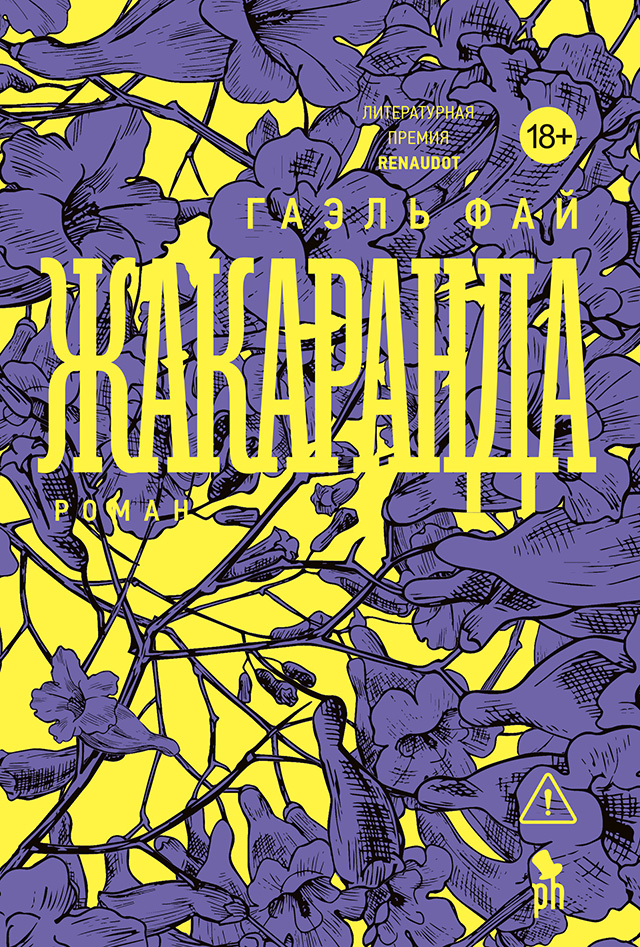
Jacaranda is a tall tree strewn with purple flowers, very beautiful, but it grows in a land of nightmares, perhaps left in the past, but who knows. In Gael Faye's novel, this tree, while significant as such, is also a double metaphor: the tree of the knowledge of good and evil and the family tree.
The novel “Jacaranda” is about a long war, enmity, genocide, and the intransigence of two peoples who differed only in their passport details; about how relatives can become strangers; about how a long-term friendship can end instantly due to the fact that a friend, it turns out, belongs to the enemy’s people, even though he himself has not done anything wrong. This is a very emotional, “heart-blooded” story of people from two worlds, two homelands of the author - France and Rwanda. A story about guilt, about unforgiveness. About emigration from a prosperous country to a disadvantaged one, from the blooming crown to the hidden roots.
I read about the 1994 genocide in Rwanda, which lasted about three months, and I knew that about a million people died then. Since I was living in France at the time, I remember the hysteria in the French press about the “sacred” sending of troops to Rwanda (Operation Turquoise ). It got to the point that the newspaper published a printout of a private telephone conversation between billionaire and politician Bernard Tapie, in which he spoke rudely about military intervention, and this was a “moral touch” - what an unpatriotic man he is - for the public, so that they would accept his imprisonment more softly (Tapie was then a hero for French football fans). France was hated in Rwanda. Macron went there not long ago to apologize, but, like Operation Turquoise, this gesture was not particularly successful.
Until 1962, Rwanda was a Belgian colony, but after gaining independence, two states were formed on its territory, Rwanda and Burundi. Gael Faye was born in Burundi, where Tutsis fled during the genocide. The Hutus are the absolute majority of the population of Rwanda, the Tutsis are a minority, which is why they could be dealt with so easily. Well, also because the world and the UN, as usual, “showed concern” while people were dying in the hundreds of thousands. The massacres began the day the plane carrying Rwandan President Habyarimana was shot down, and the Hutus blamed the Tutsis for it. The Jacaranda says that it was the Belgian authorities who introduced the division into two nations, with nationality recorded in the passport:
“So they decided that the tall and thin were Tutsi, and the short and stocky were Hutu. That Tutsis are cunning and sophisticated, and Hutus are modest and lazy. When identity cards were introduced that required ethnic identification for every Rwandan, King Musinga, who stubbornly refused to convert to Catholicism, opposed this too. Then the colonial authorities, together with the missionaries, decided to depose him and send him to the Belgian Congo.”
Although the Belgian peacekeepers arrived quickly (the genocide began on April 6), they did not save the Tutsis. In the novel it is described as follows:
“Then, on April 16, 1994, Belgian soldiers abandoned patients and many other people who had taken refuge in the hospital. I remember these images from the news: thousands with raised hands begging the Belgian peacekeepers for help, but they eventually evacuated only Europeans and Americans and their pets from a hospital surrounded by killers.”
"Jacaranda" is a largely autobiographical novel. Gaël Faye (b. 1982) is a French-Rwandan rapper, singer-songwriter and writer who received many awards in France for his first novel, “Little Country” (all about the same unhealed wound of his homeland), and the Renaudo Prize for his second, “Jacaranda.” He is a Tutsi and was born in Burundi, where his family fled from persecution, and then he himself fled to France as a teenager, and the hero of his novel named Milan (named after Milan Kundera) was born and lived in the Paris suburb of Versailles. Milan's father is French, his mother is Rwandan, who left Rwanda a long time ago and never spoke about it. No matter how hard Milan tried to ask her about her homeland, the answer was only irritation. “There is always this impenetrable wall, because of which any conversation turns into a quarrel.” An accurate observation: a person who deep down believes that he has received something that is not his due behaves like Milan’s mother, who constantly convinces herself that she is “just a Frenchwoman” and not the one behind whom the misfortune of her country lies. Such a person cannot open the bolt with which he has locked himself.
There is a funny episode in the novel: Milan’s father’s parents try to ask their daughter-in-law about her homeland and, distorting the words “Tutsi” and “Hutu”, call them tribes - as something far from a prosperous European life, in the spirit of “don’t go, children, to Africa for a walk.” And then one day in Milan’s house there turns out to be a small (as it seemed to him at first, but in fact the same age) boy from Rwanda, Claude, who didn’t know a word of French, with a fresh scar on his head. Mom explained to Milan that from now on he would live in the same room with him; when asked who it was, she answered “nephew,” and when asked if she had a sister or brother, she made an excuse: “no, distant relatives.” Milan, however, was delighted to see his “brother”. It seemed to him that his father and mother were only pretending to be a model family, and this “fake” life traumatized him endlessly. And the silent Rwanda seemed to Milan the “real” that his parents so carefully hid. So the appearance of his “brother” from there became a gift for him, and he tried in every possible way to involve Claude in various games, played him one or another music, trying to captivate him with something that did not require knowledge of the language, slept next to him on the mattress, and not in his bed, because in his sleep Claude screamed terribly - he was tormented by pain and nightmares. But soon Claude disappeared. His mother said his relatives took him back.
The novel has six chapters, six stages of Milan's life, named chronologically: 1994, 1998, 2005, 2010, 2015, 2020.
In 1994, Milan began to do poorly at school and when asked what was happening to him, he replied that it was all because of the war in Rwanda, which was talked about in the news. The teachers called his parents, and when it turned out that he had lied, his father gave him a beating right in front of his classmates, and his mother looked at him with such contempt that he “wanted to disappear forever.” His mother’s life seemed to begin anew in 1973, when she arrived in France, and before that it was as if nothing had happened—emptiness. And only when Milan accidentally overheard her telephone conversations in Kinyarwanda and spied on her, he saw that she was becoming different:
“When I watched this transformation, I was overcome by a fleeting but unpleasant feeling. A terrible feeling that there is a stranger in front of me. That I don't know anything about the woman I've lived with all my life. About my own mother."
Milan had to stay for the second year in the sixth grade, he felt humiliated, and only his girlfriend Nadezh and “brother” Claude were his outlet.
1998 Milan is 16, his parents are divorced, and he goes on his first trip to Rwanda with his mother. In Rwanda, everything seemed wild to him - the Stone Age. It turned out that Milan has a grandmother, his mother’s mother. Milan was amazed that, despite incredible poverty, Granny kept a maid. But the main thing is that Milan saw Claude again - and did not recognize him: the little boy became a slender, tall young man. “The whole long night I asked myself what I forgot here,” Milan felt like a foreign body in Rwanda. Going into town with Claude, he asked why everyone was looking at him like that. And Claude explained: “You are white.” White? "I'm mixed race." “Mestizo—that doesn’t happen,” Claude snapped. White is not the color of the skin, but the way a person carries himself, walks, and dresses. “Your mother is white too.” (How can one not recall the Soviet people who first came to the “free world” and were distinguished by precisely these characteristics, but with a “minus” sign; moreover, even within the country there was a complimentary saying “like a white man”, and it was also not about the color of the skin, which was already white - the language betrayed the self-perception of African, that is, dysfunctional, life.)
On that first visit, Milan stayed in Rwanda for longer than the expected week because his mother left for a day on “business” and disappeared for three weeks. During this time, Milan managed to get used to the new reality for him, but still returned to Paris. After studying at the university, he became a lawyer, continuing to feel the “unrealness” of his own life. The trigger for his final return to Rwanda was the opening of a photo exhibition of his fiancee Nadezh, with whom he was supposed to fly there together the next day. But at the opening, an American approached Nadezh and made her an offer to exhibit in a very prestigious New York gallery. And she chose a career - although when her mother first invited Milan to go with her to Rwanda, it was Nadezh who persuaded him to go: interesting, exotic, how can you miss this... Soon she married this American.
On his new visit in 2005, which was followed by practically moving to Rwanda, Milan did not recognize Kigali: civilization had come to the capital, good roads appeared, skyscrapers were built, and stores of world brands were opened. And he now lived in the cozy house of his mother’s friend Eusevia, and her daughter Stella, whom he had seen as a newborn, had now grown up. Since childhood, she loved to sit on the jacaranda that grew in the yard of their house, and one day she found out why this tree seemed animate to her. Through this family, Milan gradually became acquainted with the tragic history of the country. “She is the root of my tree of life,” Stella once said about her great-grandmother, whose memories she recorded on a tape recorder; they formed the basis of her school essay in the last grade. The essay was recognized as the best, and Stella was supposed to read it at the graduation ceremony, but... as always, politics intervened. The great-grandmother was the “root”, and the “trunk” was the jacaranda tree that stood in the yard. When the tree was cut down, Stella ended up in a psychiatric hospital.
Silencing the memory of past repressions, the Tutsi lived to see the genocide, and then society was divided: some, like Milan’s mother and her mother, Granny, fell completely silent, others could neither think nor talk about anything else.
“Officially, a power-sharing agreement was concluded with the rebels, but in reality, the Habyarimana regime only became embittered and prepared for the main tragedy, arming people and spreading racist ideology on the air of the new Thousand Hills radio, where Tutsis were called “cockroaches” and called on listeners to “work,” that is, kill them. Throughout the country, they stopped keeping count of the killings of Tutsis.”
All this is reminiscent of the Holocaust, as is the fact that morally and de facto the Tutsis won: since 2000, the leader of the Rwandan Patriotic Front, who, while in exile, helped stop the genocide, has become the permanent president of Rwanda. Even today they say: “Rwandans turned “their genocide” into a “profitable asset”, commemorating it on any occasion.” This is the motive that forced Milan’s mother to hide her origin, so that it would not automatically expose her in the eyes of society as “speculating on tragedy” - after all, she wants to be just a person, without any special features. It was this “conformism,” from Milan’s point of view, that devalued her life. Therefore, he went to “work through the trauma,” which did not personally affect him in any way, but made his life “unreal” - until he learned the story of his ancestors, tortured into silence.
(I remember in parentheses that at poetry festivals in Europe and Canada, where I had the opportunity to participate, poets from African countries always performed. And they, in addition to reading poetry, made accusatory speeches against the “free world”. Fair, but tiresome: the festival, the festive atmosphere, the friendship of peoples - and then there is an angry pathos, the essence of which is not known and understood by everyone. And I also remembered the story of my American translator. His parents were from the second wave of emigration, military, - fled to the USA in order to forget their origin, including the Russian language. They went into business, achieved success (like Milan’s mother from Fay’s novel) and decided that they were Americans - that’s it. And their son, born in 1945, was raised in the same spirit. He became a translator from Spanish and French, but one day he became interested in Russia to such an extent that he learned the language, visited his parents’ homeland more than once, married a Muscovite and became translator of Russian poets.)
There is an amazing episode in “Jacaranda” when it suddenly turns out that one of the characters named Sartre, Claude’s closest friend, who saved Tutsi orphans, victims of genocide, who created a “Palace” in an abandoned place for everyone who was left homeless and whom he consoled with the help of his rich collection of CDs and books, read aloud in the evenings, is a Hutu. Hutu not only by his passport, but also by his ancestors who were guilty of killing Tutsi, whom he never mentioned (there was his own “conformism”). This one word - “Hutu” - was enough to completely break off relations. Milan, who himself lived in the Palace, was shocked by Claude's reaction. After the Palace had to be returned to the owners who returned from emigration, the three of them rented housing, were an inseparable trinity for years, and suddenly - a breakup, expulsion, “get out of the apartment.” “Do you know what the main fault of all these people is for me?.. That they created a society of mistrust here for many years to come,” Claude responds to Milan’s bewilderment.
Here it is, the future after the war and genocide: those who left and those who remained, those who died and those who survived. Some try to forget everything and withdraw into themselves (like Milan’s mother); others seek to restore history (like Milan and Stella); still others, the victims, seek revenge (like Claude); the fourth go into power to denounce enemies (like Eusebius); fifths, from the enemy camp, help the victims, atoning for the guilt of their ancestors (like Sartre) - but all this does not help, although a quarter of a century has already passed. The witness, the jacaranda—the tree of the knowledge of good and evil and the family tree—is cut down. And one can only hope for the ability of an entire people to heal the traumas of the past, as the novel says on behalf of Eusevia:
“If we had not resorted to gachacha * , then it would have taken more than two hundred years to arrange a trial of all those detained. Of course, such justice has shortcomings, but it is good because it gives people back their voice, and most importantly, it puts an end to eternal impunity. And therefore it opens the way to reconciliation and forgiveness.
- Do you really believe this?
— In reconciliation and forgiveness? No... I'm one of the survivors. I saw how these people behaved. But courts are certainly needed for the next generation.