
Translated material
Like he was drunk. What is Friedreich's ataxia and why is it so difficult for people to get treatment?
A shaky gait, and then complete lack of coordination of movements, are symptoms of Friedreich's ataxia. People with manifestations of this disease can sometimes be confused with drunks, but this is hardly the most unpleasant thing that the diagnosis brings. Yuliana from the Moscow region talks about how she treats her adult son with Friedreich's ataxia and why she doesn't plan to give up. Details of the history of a rare genetic disease in modern reality are in the material “Things like this.”
 Yuliana and Alyosha Photo: from personal archive
Like he's drunk
Alexey from Ramensky district of the Moscow region is 28 years old. For more than 15 years, he has been living with a diagnosis of Friedreich's ataxia, a severe orphan disease in which the functioning of the nervous system gradually deteriorates. Now the guy moves in a wheelchair.
Since childhood, Alexey has been active - he quickly began to hold his head up, sit, and walk. “It was interesting to crawl: one leg was bent and the other was extended, but we didn’t attach any importance to this,” says Yuliana, Alexei’s mother.
Alexey’s first symptoms of the disease appeared in elementary school - during physical education, the boy’s arms and legs began to tremble strangely. Then a noticeable clumsiness appeared in his movements - such that the child often stumbled and fell. Around the same time, my vision began to noticeably deteriorate. “I sent him to the store to get eggs, and he said: “Mom, I won’t get them, I’ll break them,” recalls Yuliana.
She began taking the child to ophthalmologists and neurologists, but no one could make the correct diagnosis. The doctors said it was “teenage” and would “go away soon.” “They explained that, they say, in teenagers, muscles grow separately from the whole body, and that’s why they are clumsy,” recalls Lesha’s mother.
At the age of 13, it became very difficult for the young man to walk. Finally, after numerous MRIs and tests, doctors in Moscow, where Yuliana took her son for examination, diagnosed Alexey with Friedreich's ataxia. A genetic test confirmed the diagnosis.
After the diagnosis, Alexey began an endless series of hospitalizations - massages, therapies, therapeutic exercises. But the disease progressed quickly.
“Sometimes people would come up to him, thinking he was drunk—he had such unsteadiness in his movements. But my son always has documents with him confirming his illness,” recalls Yuliana.
Doctors tell Juliana that on average people with this disease live 30 years.
Breakdown in the gene
Friedreich's ataxia is a rare hereditary neurodegenerative disease in which the nerve cells responsible for the coordination of movements and muscle function are gradually destroyed. In the world, this disease occurs in approximately one person in 22–50 thousand. The exact number of patients with Friedreich's ataxia in Russia is unknown, since there are no such statistics in the country.
With Friedreich's ataxia, a critical breakdown occurs in the FXN gene , which is responsible for the production of frataxin , a protein necessary for the normal functioning of the nervous system and heart. A lack of frataxin leads to impaired iron metabolism and a decrease in energy production in cells. The disease is transmitted in an autosomal recessive manner : a child receives the disease only if the defective gene was passed on to him from both parents.
“The patient suffers most from the cerebellum, as well as the cervical spine and pathways of the brain,” explains Oybek Erkin-ugli Turgunkhuzhaev, a neurologist at the Burnazyan Center and a member of the board of medical and scientific trustees of the MSA United Consortium .
Throughout his career, the doctor met several patients with this diagnosis, the youngest was six years old. Most often, the disease first manifests itself between the ages of five and 25 years, although the medical literature describes cases of a later onset - after 40–45 years.
Usually the disease begins with a lack of coordination of movements.
It becomes difficult for a person to maintain balance, he begins to stumble, stagger when walking and fall more oftenAs the disease progresses, a person develops dysarthria , a speech disorder that makes it difficult to pronounce words clearly. Over time, patients experience reduced sensitivity in their legs, muscle weakness and scoliosis develop, and due to this imbalance, foot deformity appears . In addition, problems arise in the functioning of internal organs - for example, cardiomyopathy , due to which the heart gradually loses the ability to pump blood effectively, and some patients experience rhythm disturbances and heart failure.
In addition, some patients experience metabolic disorders, including glucose intolerance and diabetes mellitus . Sometimes the disease is accompanied by deterioration of vision due to atrophy of the optic nerve or decreased hearing up to deafness.
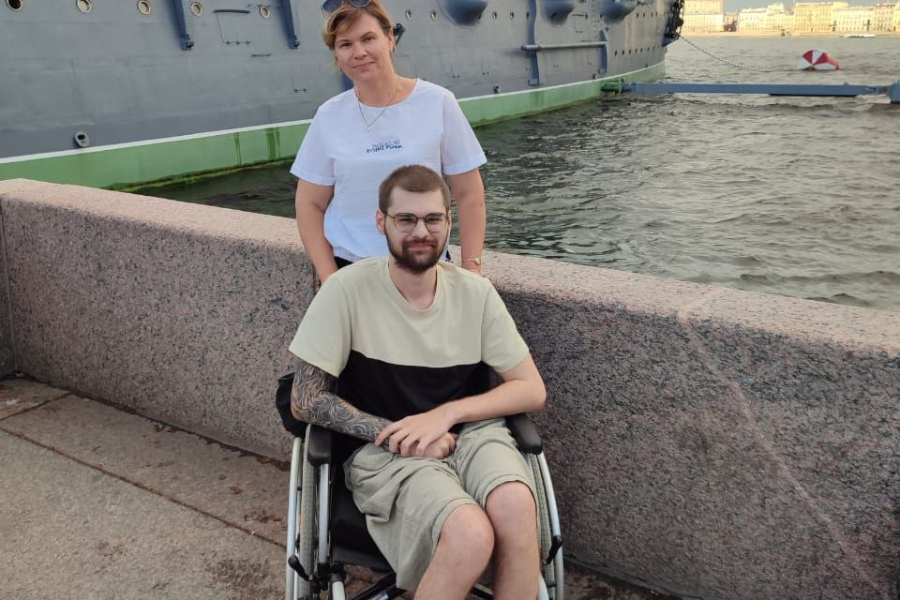 Yuliana and Alyosha Photo: from personal archive
“The patient does not feel the position of the joints, experiences great problems when moving in the dark, as well as difficulties with speech, and sometimes problems with the heart and cardiac muscle,” explains Turgunkhuzhaev.
He says patients often tell similar stories about their symptoms. For example, it is difficult to wash - when you close your eyes, a person begins to stagger, he loses his balance.
People also say that their legs are losing weight and going numb.However, complete paralysis does not occur with Friedreich's ataxia, the doctor notes. “The person moves, but does it poorly - the movements are completely unbalanced. At the same time, the patient is probably able to raise his hand and move it from point A to point B. If you support him, he can also stand,” says Turgunkhuzhaev.
Life expectancy with Friedreich's ataxia depends, among other things, on the quality of palliative care and patient support. Over time, a person loses the ability to move independently due to severe unsteadiness and imbalance, the doctor explains: “He can no longer support his body weight on a small support. To do this, you first need walkers, and then wheelchairs.”
Treatment
Now Alexey’s treatment is symptomatic - he takes medications that slightly slow down the development of the disease, and does physical therapy. Yuliana independently searches the Internet for ways to help her son. She has already managed to send him to PNF therapy courses, where, with the help of special movements, stretches and resistance, they help restore or improve the functioning of a person’s muscles. Juliana spent all her money on her son’s therapy.
“He is now not developing the cardiomyopathy that occurs in people with Friedreich's ataxia. Perhaps these activities help,” she says.
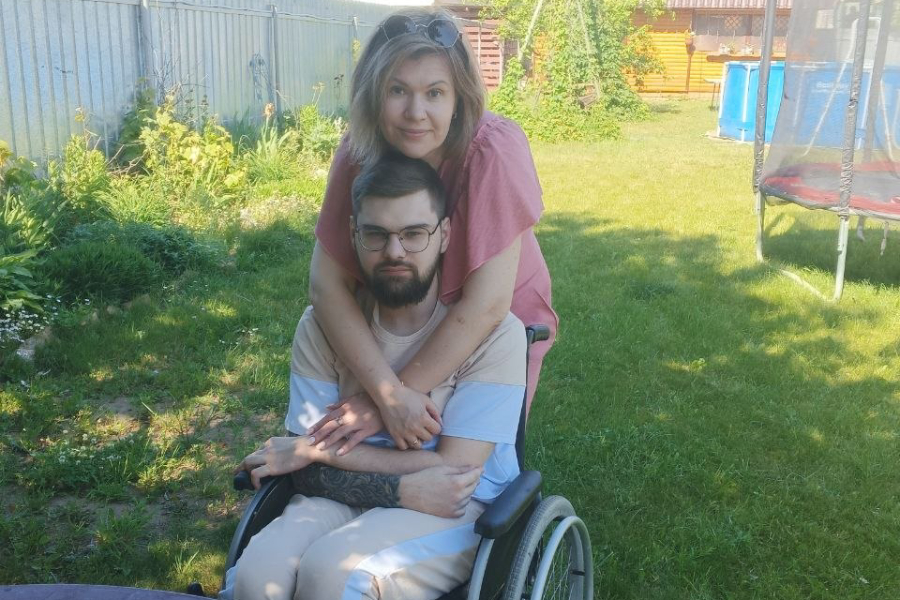 Yuliana and Alyosha Photo: from personal archive
Despite the fact that Alexey has difficulty speaking and can type slowly with one finger, he makes AI videos and applications using voice commands. He has already created a website for himself using the same method .
In 2021, they agreed to admit Alexey to the Cardiology Department of the National Medical Research Center for Therapy and Preventive Medicine for a full comprehensive examination. “And they had to see him every six months, watch the dynamics, prescribe some medications, monitor how the disease progresses, what medications help keep everything from getting worse,” says Yuliana.
At the beginning of 2022, Alexey planned to go to the hospital again, but it didn’t work out. “They told me that the coronavirus quarantine began there, and then the SVO. And that’s it, they forgot about us,” says the woman.
There is a cure
For several years now, Juliana has been monitoring the development of the drug Skyclarys - the first and so far only drug for the treatment of Friedreich's ataxia, which has undergone clinical trials and is already registered in the USA and European countries . The cost of therapy in the USA can reach 400 thousand dollars per year per patient. The drug has not yet been registered in Russia.
According to doctor Turgunkhuzhaev, Skyclarys is aimed at correcting the functioning of the damaged gene. “The drug itself cannot cure the disease, but it can slow down the process. If the disease is caught at the very beginning, the use of this drug can slow down the progression,” explains the doctor.
In 2019, Yuliana wrote to the Russian Ministry of Health asking for help in sending her son to Skyclarys trials or bringing the drug to Russia, but was refused.
“I was then planning to go to Turin with him for these clinical trials, but I didn’t get the money. Then the doctors told me: “You won’t even find a sponsor who could pay for this.” They tell me: “Wait, wait, it will come to Russia soon.” But, unfortunately, it never came to Russia,” she states.
At the same time, Yuliana does not lose hope that the medicine to treat her son’s condition will be registered in Russia or she will be able to take it to a country where the drug is already available. “Well, this is my son. I always told him: “I will do everything so that by the age of 30 you will run with me.” I have two more years,” she concludes.
The material uses links to publications on social networks Instagram and Facebook, and also mentions their names. These web resources are owned by Meta Platforms Inc. — it is recognized as an extremist organization in Russia and is banned.