Translated material
"Island of Crimea"
The 2026 holiday season was supposed to be a record one for Crimea. In March, the authorities of the annexed region promised to receive more than seven million tourists. But by mid-June, the peninsula greeted tourists with queues at gas stations, gasoline coupons and letters from local residents, in which, instead of anticipating a vacation, they said “it’s painful and embarrassing.”
In three weeks, Crimea has traveled a path that seemed impossible just a year ago: from a rear showcase of the “Russian world,” it turned into what Ukrainian Defense Minister Mikhail Fedorov called an “island” on June 17. This was done by cheap medium-range drones, methodically cutting off the supply lines of the peninsula. The Ukrainian side calls this a “logistics blockade.” Russian – “temporary difficulties”. ASTRA finds out what's really going on.
Start
The starting point can be considered the end of May. On May 19, the results of attacks on Russian logistics at a distance of 70 kilometers from the front line were shown by the 422nd separate regiment of Luftwaffe unmanned systems operating in the Zaporozhye direction. At the same time, Z-bloggers began to actively report on attacks on logistics areas connecting Crimea with the front.
On May 21, Vladimir Saldo, the Russian-appointed “head” of the occupied part of the Kherson region, imposed restrictions on the movement of civilian trucks on the R-280 Novorossiya highway - and compared the situation to the blockade of Leningrad, calling it “cynical barbarism.” The comparison, frankly speaking, is expected - during the war years, the official language got used to manipulating history for the sake of momentary goals. Another thing is more important: the strikes were recognized at the very top of the occupation administration.
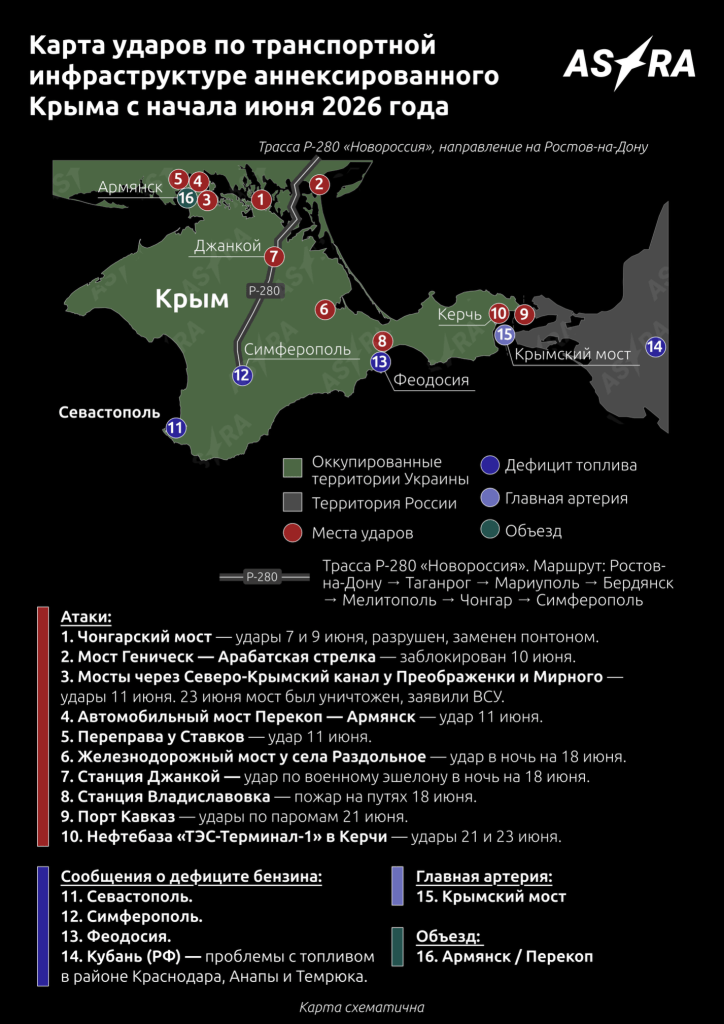
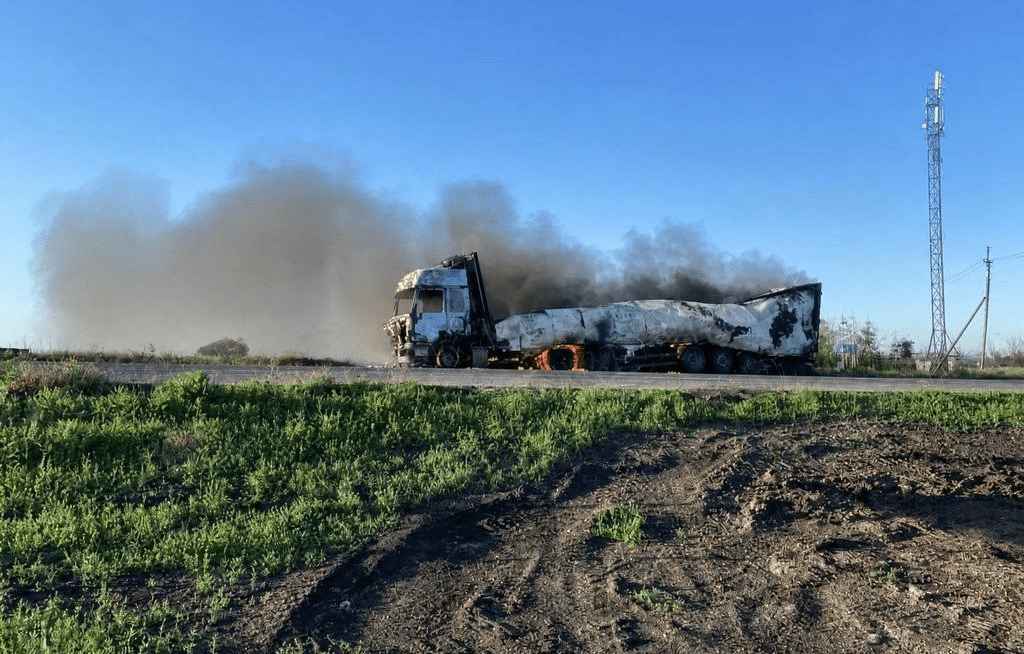
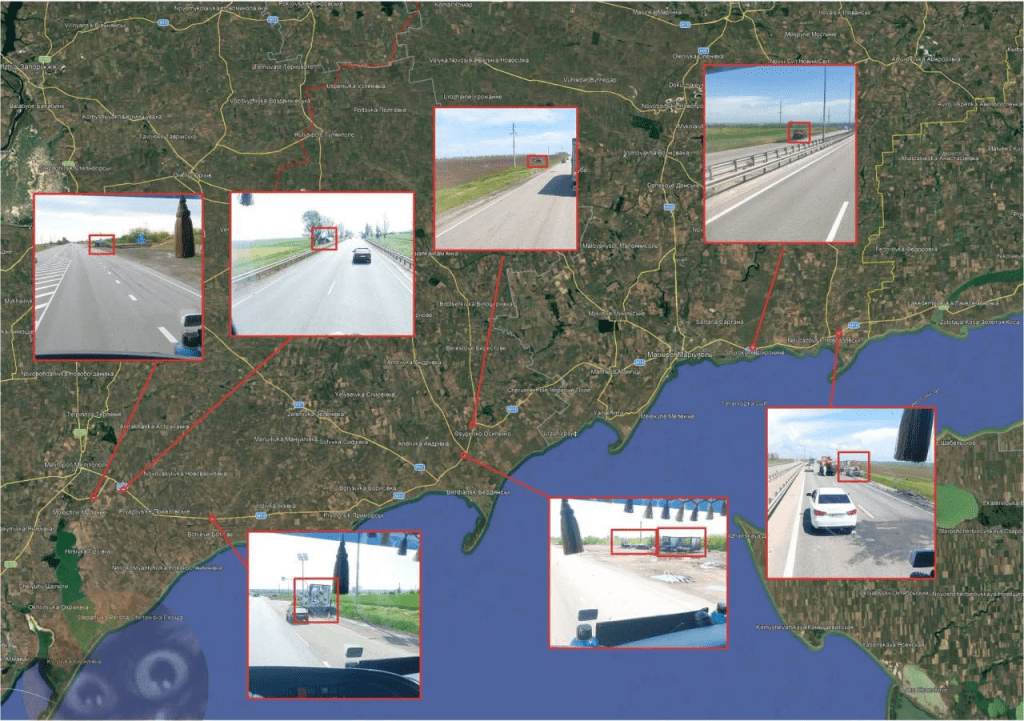
Then events escalated. The Ukrainian Unmanned Systems Forces (USF) concentrated their attacks on that same R-280 route, the only reliable land route connecting Russia with Crimea through Rostov-on-Don, Mariupol, Berdyansk and Melitopol. This road was used to supply the peninsula and to groupings of troops in the south.
From the first days of June the attacks switched to bridges. On the night of June 7, drones of the 1st separate assault regiment and the Code 9.2 unit damaged the bridge at Chongar, the shortest crossing between Crimea and the mainland of the occupied territories. Traffic through the Dzhankoy checkpoint was blocked. On June 9 the bridge was hit again; According to the head of the Ukrainian Center for Countering Disinformation, Andrey Kovalenko, this time it was destroyed - satellite images later recorded a pontoon crossing in its place. On the night of June 11, several more bridges came under attack - across the North Crimean Canal at Preobrazhenka and Mirny, a road bridge on the Perekop-Armensk route and a crossing at Stavki. On June 10, after the Ukrainian Armed Forces’ attack, Saldo reported that after examining the bridge between Genicheskaya and the Arabat Spit, specialists decided to organize traffic “in reverse mode.”
By mid-June the attacks switched from roads to railways. On the night of June 18, drone operators of the Ballista unit from the special operations forces of the Ukrainian Armed Forces disabled the railway bridge across the North Crimean Canal near the village of Razdolnoye, a key crossing on the Kerch-Dzhankoy branch. Locals reported two dozen explosions; According to the Crimean Wind monitoring channel, damage to this bridge can completely paralyze cargo and passenger traffic with the peninsula.
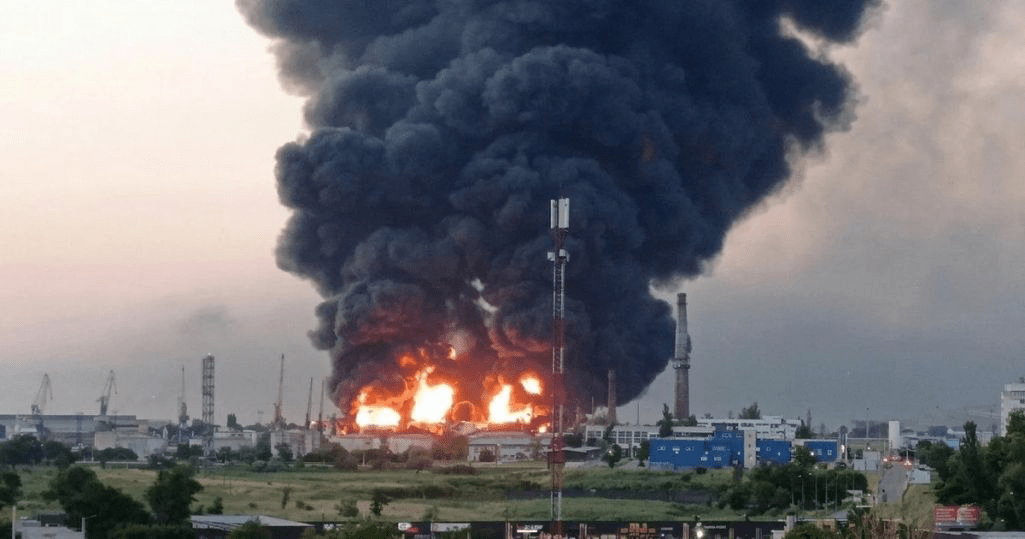
The climax came on the night of June 21. For the first time since the beginning of the campaign, Ukraine struck on both sides of the Kerch Bridge - at facilities providing sea crossing. President Vladimir Zelensky confirmed that the strikes were carried out at a distance of about 300 kilometers from the front line. On the Chushka Spit in the Krasnodar Territory, the oil terminal in the port of Kavkaz caught fire - it supplies both Crimea and the south with fuel; geolocation footage captured at least three burning car ferries. The oil depot "TPP-Terminal-1" in Kerch near the bridge and the ferry "Panagia" at the Kerch crossing also came under attack - a person died on it. Ferry service has been suspended . According to Russian data, as a result of the attacks on Crimea and Kuban, four to five people were killed and almost 30 were injured.
If earlier roads and railways were under attack, now Ukraine is also attacking the third and last channel - the sea one. There is not a single supply route left in Crimea that is not under threat.
Against this background, on June 22, the “authorities” of Crimea announced the suspension of the admission of children to children’s camps. Later, a video appeared in which the woman claims that she “received a call from the Ministry of Education of Crimea and was informed that absolutely all shifts to children’s camps were canceled this year.”
Why the Novorossiya highway is an Achilles heel
To understand why attacks on one road could call into question the supply of an entire region, we need to remember geography. Crimea has three routes of communication with Russia: the Crimean Bridge, sea ferries and a land corridor through the occupied territories - the same R-280.
Since January 2026, the passage of all trucks weighing more than 1.5 tons, as well as hybrids and electric vehicles, has been prohibited on the road part - formally for the sake of unloading the bridge and safety. Because of this, heavy cargo, including tankers, went to the Novorossiya highway. According to Ukrainian analysts, traffic on the railway part of the bridge is also limited, although this has not been officially announced. Ferry service is limited and also under threat. Columns on the Crimean highways have nowhere to hide: flat steppe, straight road, everything can be seen from the air.
The detours through Armyansk and Perekop, which are recommended by the occupation authorities, are approximately 130 kilometers longer than the main route and are closer to the front line.
Technology: a drone that identifies its target itself
The main question is how were relatively cheap drones able to do what missile strikes could not achieve? The answer is that the technology itself has changed.
Ukraine has switched to so-called “middle strikes”—mid-range drone strikes against targets at operational depth, 25–200 kilometers from the front line. But the key thing is not the range, but what appears inside the drones. Russian electronic warfare has learned to jam the radio channel between the drone and the operator, and the answer was autonomy: the drone carries the guidance system within itself.
According to the Ministry of Defense of Ukraine, drones with AI are already actively used at the front. The technology is described as follows: the neural network on board analyzes the video stream, distinguishes the silhouettes of military equipment and performs automatic target acquisition when it recognizes the desired object. If the target is an air defense position, the AI itself identifies the launcher or radar and corrects the dive. Such systems - from the companies The Fourth Law and Vyriy - according to their developers, have been working stably at the front for six months to a year and hitting targets even with active interference.
It’s important to make a caveat here, which is often missed by both Russian propaganda and the panicked messenger users we encountered while working on this material. The drone does not “decide who to kill.” According to the American Center for Strategic and International Studies (CSIS), the use of AI is partial: the target is assigned by a human operator, and the neural network brings the drone to it in the last section, when communication is lost. In addition, AI helps distinguish real equipment from decoy targets. The drone hits a target that has already been selected by a person.
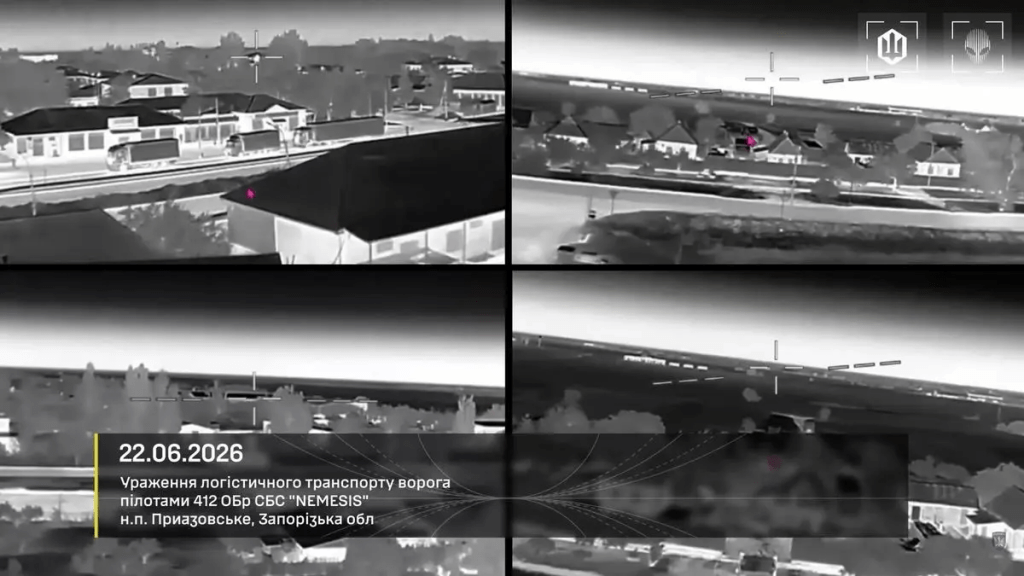
But in the chats of motorists traveling to Crimea, this subtlety is lost - and a completely different fear is born.
“If the drone considers you a threat - due to the fact that the jeep plus the trailer - it may fly. No one knows what AI will shoot in the head,” writes one of the participants in the “Road to Crimea” chat. This popular image of an automatic drone deciding the fate of a car on the highway is not true, but it reflects how the threat of drones is felt “from below.”
Another innovation relates to the time between receiving a target and striking. Ukrainian drone operators now receive commercial satellite imagery of Russian objects directly to their phone or tablet—within 15 minutes of shooting. Previously, the data underwent a centralized check in Kyiv, which took hours or even a day, and during this time the targets had time to move. Behind the new product is an agreement between the Armed Forces of Ukraine and the Vantor consortium, which owns a fleet of 10 satellites in low-Earth orbit. According to developers and test participants, this reduced the time from detection of a Russian object to impact by 90%.
What's on earth: coupons, canisters, queues
Crimeans felt the result of the blows to logistics in the most direct way - through the gas tank.
From May 30, a limit was introduced on the peninsula: no more than 20 liters per person. From June 4, gasoline and diesel began to be supplied primarily to municipal and emergency services, public transport, security forces, as well as civil organizations, but also using pre-purchased coupons. The largest networks of thermal power plants and ATAN stopped selling coupons to individuals. The Russian-appointed “head” of annexed Crimea, Sergei Aksenov, switched to manual control of fuel distribution and promised to resolve the issue “within a month.”
However, on June 21, Aksenov said that there was no more fuel at gas stations in Crimea and coupons also no longer worked.
View this post on Instagram
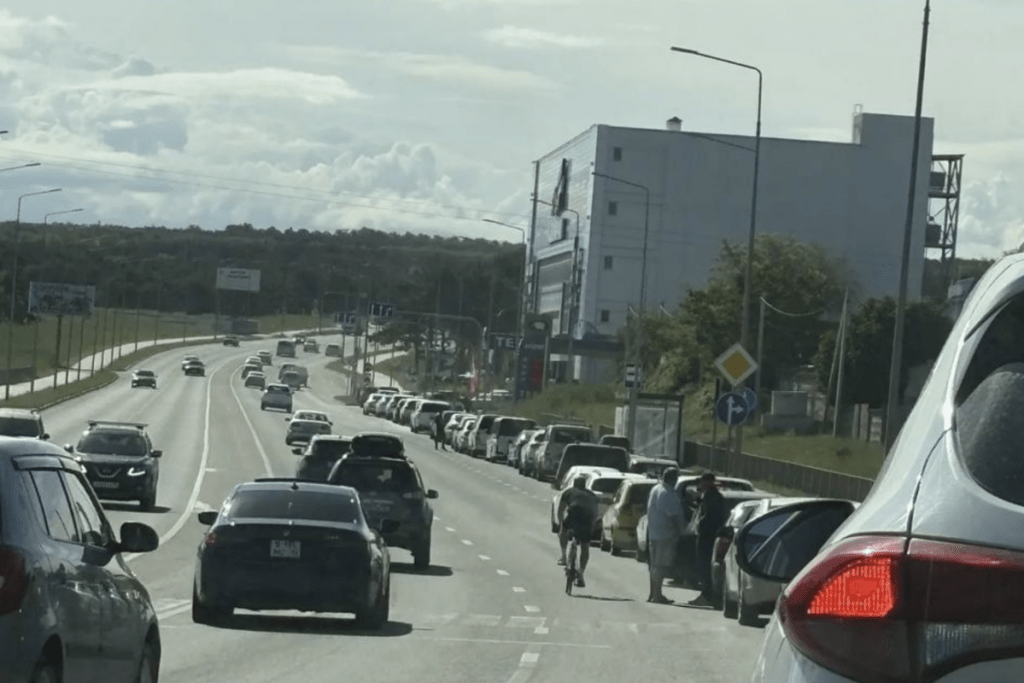
What it looks like in reality can be seen in the chats. “Whoever plans to go to Sevastopol, keep in mind: there are no 95, 92 at all. There are queues, but there is no gas. People gather in anticipation of a miracle. There are no coupons for sale either,” is a typical message from early June. Motorists plan their routes like a military operation: “On the M4 to Temryuk, spend the night, fill up a full tank plus a couple of cans, and early in the morning to the bridge.” Queues are forming at the Crimean Bridge - Rosavtodor reminds that you can carry no more than 100 liters for personal needs.
The crisis has spread to Kuban: residents of Krasnodar, Anapa and the Temryuk region - the closest to Crimea - complain that gas stations are empty because Crimeans go there for gasoline. Kuban Governor Veniamin Kondratyev called this an “artificial rush” due to the “situation in neighboring regions.” The Russian Ministry of Energy turned out to be more honest: it admitted that “fuel and energy enterprises are faced with an increase in enemy air attacks, which leads to temporary difficulties with fuel supplies in the southern regions.”
On June 15, individual refineries were allowed to lower the quality of fuel so as not to worsen the shortage on the domestic market. However, to one degree or another, restrictions on the sale of gasoline have already been introduced in 23 regions of the country.
In the local chat “ChP-Simferopol”, where there are many commentators loyal to the Russian authorities, disappointment is increasingly breaking through the usual rhetoric.
“We voted for the stability and development of Crimea, but ended up with nothing. Before 2014, things were calmer and there were no drones flying overhead. And now the banks are lined with barbed wire, prices are rising, I’m keeping quiet about gasoline. Five years of stupid fuss,” writes one of the participants. Another: “I would like to know when the fuel problem will go away? I'm interested in a specific date. Or, as usual, do you need to be patient a little? And then you’ll get used to it.”
The tourist season, on which the peninsula had pinned its hopes, fell apart. According to tour operators, from May 24 to June 6, 79% of bookings in Crimea and 71% in Sevastopol were canceled. “It’s how you have to love Crimea in order to want to go there on vacation under all the current conditions,” says an ironic participant in a chat with local motorists.
However, the picture is not clear-cut. By the twentieth of June, the first signs of stabilization in retail appeared. Feodosia resident Alexandra (name changed) told ASTRA that the acute phase seems to have passed.
“A week ago there was a problem with fuel - they sold it using coupons, and then the coupons ran out. But in the last week, gasoline has been available for free sale at many gas stations, with restrictions - no more than 20 liters, no cans. There aren’t really any queues, the one I was in, I walked through in 10 minutes. In general, as usual in the summer.” At the same time, Carolina (not her real name), whose family remained in Crimea, told ASTRA that she could not come to her parents - “neither by car nor by train.” “Mom herself asks me not to go, although I would go - this is still my home,” she says.
Most of all, she is worried about a close relative who regularly travels through the occupied territories, in the Mariupol region: according to him, during the day they are already hitting the highway, and any cars, not just fuel tankers, come under attack. “It can't help but frighten. I'm incredibly worried about my family."
The fuel shortage, according to Caroline, has restructured the entire logistics of everyday life. The car has become a “luxury”: her mother now gets to work and carries her youngest child on buses, which rarely leave the village, and it’s hardest for those who have a car to earn money - “every working day is a quest to find gasoline.” At the TES and ATAN network gas stations, according to her, in the last two weeks there have been queues for 3-8 hours for 20 liters of gasoline; Those who could, refueled at private gas stations, where fuel is about 50% more expensive. After Aksenov’s order, gas stations stopped altogether: “They are looking for gasoline through friends.” It also affected food - people were frightened to buy sugar, flour and cereals, prices for fruits, vegetables and medicines became more expensive.
Is the goal a blockade?
Another question is whether what is happening can be called a blockade. It’s worth being precise here, because the word is readily used by both sides for opposing purposes.
SBS commander Robert Brovdi (“Madyar”) himself, who announced the establishment of “fire control” over the transport arteries of Crimea, nevertheless refrained from triumphalism. According to him, traffic on the P-280 highway in two weeks fell from 11,000 to 6,500 cars per day, and trucks from 3,800 to 1,100, that is, by 71%. But he made a reservation : “A traffic collapse is not a blockade. However, the current “diet” imposed on this first land corridor, the blood artery of the occupation group, is sensitive and effective.”
The head of the Conflict Intelligence Team, Ruslan Leviev, to whom ASTRA turned to for an assessment, considers statements about “full control” and “isolation” to be an exaggeration. “The experience of this war shows that at a distance of more than 20 kilometers it is almost impossible to achieve complete fire control of the road - this requires a much larger number of drones. Fire control means that at any given time you have one or two drones circling over the road,” he explains. Hitting objects is pressure; a real blockade means that there is virtually no chance of passing through unnoticed.
Leviev cites occupied Kherson in 2022 as an example: then there were fewer crossings across the Dnieper than there are routes to Crimea now, the Antonovsky Bridge and the Kakhovka Hydroelectric Power Station dam were regularly hit by HIMARS, and there were battles on the right bank - and still Russian troops held out in the city until November.
“A complete break is not happening and is unlikely to happen. But this pressure seriously aggravates all the problems - both with fuel and with food in stores: ordinary civilian trucks also come under attack. People will obviously not die of hunger or dehydration. But it will be difficult,” says the expert.
That is, it is more accurate to speak not of a blockade, but of a methodical suffocation: routes formally exist, even something passes along them, but the flow is compressed to a level that does not cover the needs. Military analysts call this a “logistics lockdown.” It is important that such a threat cannot be removed with a single counterstrike: it is necessary either to massively suppress the drones (which Russia has not yet achieved - autonomous guidance bypasses the jammers), or to move the front so that the route leaves the radius of the “middle strikes”.
If the attack on Crimea has little effect on the troops, then why all this? Leviev’s answer diverges from the intuitive “they are preparing a landing party” or “strangling the front.”
“This has practically no effect on the troops. Only the Kherson, Stepnogorsk and Orekhovsk directions depend on Crimea and the land corridor - far from the most active sectors of the front. And the war of 2026 does not require large reserves of fuel; the technology is used very limitedly,” he says.
According to him, the goal of the campaign is different: “To make Crimea uninhabitable - I put this in quotes, exaggerating, but it’s easier to understand the goal as we see it. Put pressure on society, on the population, on the economy of the region. Potentially - to reduce the rating of the authorities before the upcoming elections in the fall. It’s not for nothing that Zelensky recently wrote about United Russia’s ratings.”
There is also a paradox that Leviev points out: the difficult situation in Crimea may even work into the hands of the Kremlin. “Russian propaganda will certainly try to use this in its arguments: look what the Ukrainian government is doing, it actually hits you, leaves you without electricity, water, fuel. This is the true face of the Kyiv regime.” The population will be told that “these are the times, we need to be patient.”
How will Russia respond?
The Russian response so far boils down to manual control and promises. Аксенов регулирует топливо вручную, на сайте Минтопэнерго заработала интерактивная карта АЗС с наличием бензина по муниципалитетам. По данным провластного издания «Взгляд» , на трассе «Новороссия» развернуты новые комплексы РЭБ и FPV-перехватчики «Елка». Украинский военный эксперт Сергей Бескрестнов предполагает, что ВС РФ начнут сопровождать автоцистерны мобильными огневыми группами. Зафиксированы случаи предполагаемой маскировки военного транспорта под гражданский.
Левиев предупреждает: предсказать, что именно придумают для противодействия, невозможно, но очевидные шаги уже идут — сетки вдоль дорог, глушилки на машинах и против спутников Starlink, маскировка под гражданский транспорт. Адаптация, по его словам, на этой войне в среднем занимает 3-4 месяца, а давление на коридор началось в начале мая. Многое зависит и от того, хватит ли Украине дронов: «Масштаб географии войны заставляет выбирать приоритеты. Если возникнет срочная необходимость перенаправить ресурсы на другое направление, допустим Купянское, это может привести к быстрому снижению интенсивности ударов по коридору».
Его прогноз на 2-3 месяца: «дальнейшее ухудшение положения, но без реальной изоляции», вплоть до экстренных мер вроде гуманитарных колонн МЧС с топливом и продуктами. И зеркальный ответ России: рост ударов по грузовикам, в том числе гражданским, в приграничных областях Украины: это уже происходит и, по его оценке, станет более массовым.
Тем временем министр обороны Украины Федоров обещает превратить полуостров «в остров», а Бровди советует российским логистам присмотреться к объездным дорогам: «Сибирь — ваша тыловая база». За риторикой — простая и неприятная для Москвы арифметика: один из главных символов путинского правления впервые за одиннадцать лет оказался в положении, когда его снабжение зависит от того, рискнет ли частный водитель бензовоза выехать на трассу, которую сверху просматривает дрон, умеющий отличать цель от фона.
Автор: Семен Владимиров