
Translated material
The morality of freedom and the morality of sacrifice
We live in a world where people adhere to completely different Codes, and they are unlikely to be able to understand each other

Drawing: Pyotr Sarukhanov / Novaya Gazeta
Stories of moral ups and downs of people - these stories are perhaps the most interesting thing connected with our existence. The main food of myth, world literature, cinema. On the one hand, it’s an eternal topic. On the other hand, there is a huge diversity in the context of times, cultures, circumstances.
For example, there is nothing more boring and ordinary than the moral decline of a person during a dictatorship. It happens so easily and naturally that it begins to be perceived as the norm. "The banality of evil." And, on the contrary, moral strength and perseverance in such times is one of the most worthy spectacles and states that is available to a person.
But let's talk about falls. Even in similar circumstances, people fall for different reasons. In his reflections on today’s everyday life in one famous country, our friend Dmitry Bykov* notes that:
“...the current abominations are being committed out of good will and with maximum spiritual comfort, as well as with full awareness of the immorality of all these denunciations and rejoicings.”
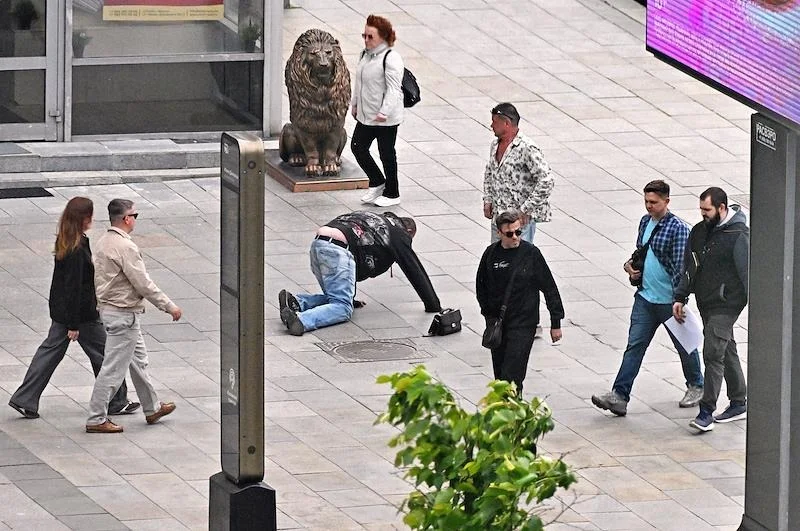
What is meant here by “baseness” is quite obvious: a person looks at what the powerful and dangerous of this world, power, want, and diligently corresponds to these desires. Surrenders himself to power.
Such a person becomes not a subject, but a performer, a subject. And the “lowest thing” is that he accepts his renunciation of his own will, his independent picture of the world, his citizenship with pleasure and zeal. Some take a special initiative and bring to the authorities the names of those who do not agree to be subjects.
As Bykov says, all this is not explained by a simple desire to “deflect the blow from oneself, to be in time earlier.” This is not simply an adaptation forced by dangerous realities. “Not me!” - like Orwell's Winston in 1984. This, according to Bykov, is a special type of human realization, “the ecstasy of fall,” - an attempt in this way to “get” energies into one’s own incomplete, meager existence. With full awareness that from a moral point of view this is precisely a fall and “baseness”.
* * *
Yes, all this is true if we assume that there is only one, universal moral code over people. Generally speaking, the Christian-Kantian code, where we talk about freedom, about “thou shalt not kill” and about the fact that every person is an end-in-himself, and never a means. Then those who practice the “ecstasy of the fall” and the “banality of evil” know within themselves that they have crossed the line and taken the “dark side”. This is if Tertullian was right and, indeed, by nature the soul of every person is “Christian.”
But if we assume that Christian-Kantian morality is not universal for all people, that there are other codes according to which a person’s fall before power is not a fall at all, but, on the contrary, a great ascent?
* * *
The most archaic set of moral principles dates back to the tribal times of mankind. There is still no individual as an independent unit, no ideas about the world and life that would differ from those shared by the entire tribe. The land outside the tribal land is either a threat or a new opportunity for hunting and plunder. Either way, this is a dark, hostile land. Everything is permitted in relation to it and its inhabitants.
And on the contrary, the land of one’s tribe is absolutely sacred. One’s own land, which means not so much a territory as one’s own society, community. Society is sacred, first of all, and this priesthood is held together by three things: ritual, taboo and leader. These are inviolable things, without them society cannot stand, - this is what both the leaders and the priests of the revered gods say. Therefore, violation of taboos, disrespect for ritual, disobedience to the leader - everything will be punished. One of the most frightening, almost on par with death, is expulsion from the tribe. A person who is declared an outcast essentially ceases to be considered a human being. He is a degenerate, displeasing to both people and gods.
Every tribal resident is constantly accompanied by two feelings: a sense of duty for the correct execution of the entire prescribed order of things and a feeling of guilt, which, like some inner voice, constantly whispers that the execution was still not correct enough.
Each individual is under the constant supervision of these feelings - which, in fact, constitutes his moral code.
The Code convinces the individual that his life only in a small part belongs to himself, but above all to the clan, the gods and the leader. He owes them, his very existence is a continuing act of debt to them. And guilt for the fact that he will never fully pay his debt. This is basically an unpayable debt. However, there is one remedy that most satisfies strict creditors. The remedy is called sacrifice.
* * *
In all archaic communities, not yet familiar with philosophy and abstract universal ideas, sacrifice was the central part, the pillar of moral existence. Everything related to the theme of sacrifice was, by default, endowed with sacred and moral characteristics.
On the one hand, both individuals and the community as a whole felt themselves to be potential victims. First of all, a victim of fate, which seemed to be a merciless force, for some unknown reason, throwing a person into this world and at any moment ready to destroy him. This developed fatalism and submission to circumstances - if this is fate, then there is no point in grumbling and resisting. On fatalism, human communities were able to endure the most odious dictatorships of their authorities for centuries - it was a kind of sacrifice that people paid to fate. More precisely, your ideas about fate. And in almost all archaic societies, the most obvious fateful force seemed to be the power of earthly power. Sacrificial submission to fate and authorities - this was the basis of moral reliability.
Submission puts the world in order, preventing it from completely becoming chaos. Why is this not a virtue?
On the other hand, the victim does not necessarily have to be members of society who respect fate and power. The victim can be replaced, i.e. redirect the payment of moral debt. And everyone who in one way or another stands out from the social whole begins to fall into the category of victims - everyone who violates or could potentially upset the balance of relations with fate and power, i.e. pretends to be an outcast.
In this way, two goals are achieved at once: society gets rid of elements that disturb it, and fate, i.e. power, receives its food and, as loyal subjects hope, is satisfied for a while. Maintaining balance, or, in other words, feeding into power those who might upset it, is the moral duty of anyone who values the tranquility of the whole.
However, if within society there are no longer those who can become sufficient victims for power-fate, the neighboring tribe becomes it. But the war that has begun has an absolutely justified, moral character for loyal subjects. For they are convinced that all this is done for only one thing - to preserve the whole. And the “whole” for those who are truly, responsibly moral is by no means the whole world, but it is their tribe with their leaders, gods and beliefs.
* * *
Reading this short sketch about ancient tribal morality, is there anyone who does not recognize the realities of our present day? Yes, for many centuries people have lived knowing very well about the gospel instructions, much less about the Kantian moral imperative and imagining something about the Universal Declaration of Rights and Freedoms. But the archaic heritage has not disappeared anywhere. When the thin layer of civilization and culture shakes, this heritage comes out and declares itself as if nothing else had ever happened. And then the concepts of moral failure, sin, karma stop working in the minds of the majority, but only the perception of the blind and ruthless force emanating from fate remains. And the desire to cling to this power.
We probably live in a world where people who come from different moral codes will never understand each other.
Roman Shamolin
FROM THE DISCUSSION OF NOVAYA GAZETA PARTICIPANTS
“There is no need to analyze meanings that are not originally inherent in these people”
“The topic of “shamelessness” is a sea for lengthy philosophical and journalistic essays. But I want to draw attention to only two aspects of this topic of "shamelessness."
The first aspect is the cultivation of the “charm of evil” through the means of mass cinema art.
Since the 1990s, in Russian cinema, and not only in Russian, the image of the hired killer has been widely cultivated, propagated and even popularized. The image of a killer who will kill anyone, anywhere for decent money received under a murder contract, and will never experience any remorse, because conscience is superfluous.
For example, the killer Danila Bagrov in Balabanov's dilogy "Brother", the leader of bandits with the same bandit friends - Sasha Bely in the TV series "Brigada", etc. etc. There are countless of them - these hired killers and thugs.
Russian society in the 1990s, in the 2000s and in later times, especially the younger generation that had not yet fledged its roots, was constantly and deliberately instilled through cinematic means that killing for money is normal, and this is quite in the order of things. After all, all these movie killers are so darling and sweet!
Why should we be surprised now that many years later, adult men do not consider it shameful to be mercenaries?.. They consider themselves “Danil the Crimson” and “Sasha the White”, moreover, no public morality puts pressure on them, because society initially did not condemn hired killers, but, on the contrary, admired and were fascinated by their numerous cute images in the movies. The image of a killer has been literally glorified for many decades, gradually corrupting society, and especially the younger generation.
Thus, many Russian men grew up with the “charm of evil” - in the person of Danila Bagrov, Sasha Bely and his friends, as well as the charming and sympathetic French killers Leon and Nikita and numerous Hollywood killers, no less handsome.
Instead of morally condemning such a craft as the “hired killer,” society, weak-willed and without resistance, fell under the magic of the “charm of evil.”
And now we are all reaping rich fruits.
The second aspect is the initial shamelessness of all propaganda.
At all times of the existence of propaganda, in ANY country, propaganda has always been characterized, first of all, by its outright shamelessness: a complete lack of morality, ethics and very often even basic common sense.”
“Bykov’s characterization, like his other texts, is colorful and talented from the point of view of literary creativity, but if you look at it in order to understand the reasons for what is happening using the example of not only Norkin, but also other propagandists, they simply follow certain guidelines and work out the budget, and it’s a matter of skills; They do not apply any moral criteria to their activities, because they treat it as a work process, receiving amounts that they consider adequate for the tasks performed.
The most cynical position, which does not justify them, but to take it seriously and analyze the meanings that, in principle, are not inherent there, is somewhat strange, no matter how immoral, immoral, unscrupulous the characters under discussion act, their main approach and criterion is money, and not intelligence, honor, conscience or anything else.
For a person to try, even in a difficult situation and conditions of insurmountable circumstances, to maintain his own dignity, it must be; not education, not the skills of public speaking and working on television, but dignity, these people don’t have it, they think in other categories, therefore in a healthy society they should not work at all in the media or have some kind of limited audience considered marginal, but alas.”