
Translated material
"Fatal Eight". Chapter from Maxim Kruglov’s book “Paul Thomas Anderson: Master of Phantom Thread”
On June 24, the Zamoskvoretsky Court of Moscow sentenced former Moscow City Duma deputy and deputy chairman of the Yabloko party Maxim Kruglov to seven years in a general regime colony in the case of disseminating “fakes” about the Russian army. Even before his arrest, Kruglov decided to write a book about his favorite director, Paul Thomas Anderson. He continued working on the text in the pre-trial detention center.
We are publishing a chapter from Maxim Kruglov’s book “Paul Thomas Anderson: Master of Phantom Thread,” dedicated to the director’s debut feature film, “The Fatal Eight,” 1996.
"Fatal Eight". Fight with Rysher. Fatal luck
Filming of Fatal Eight (Sydney) was completed in 28 days. Anderson managed to attract rising Hollywood stars Gwyneth Paltrow and Samuel L. Jackson, Philip Seymour Hoffman and John C. Reilly. Philip Baker Hall played in his film by default: the main role was written specifically for him. PTA is literally the youngest person on set. All the actors involved in the filming process (except for Gwyneth Paltrow) are older than him, but follow his instructions: everything goes professionally and smoothly.
The film begins with a reference frame to the short film “Cigarettes and Coffee” (the same cafe “Jacks coffee shop”. This is a real cafe and it still works). Near the cafe we see the main character (John C. Reilly) virtually on the side of the road in every sense, and from somewhere behind the camera a black figure approaches him, like a rock. This composition immediately declares to the viewer what the story will be about: before us is the story of a little man who comes face to face with his destiny. The hero has a choice - to take the chance that life gives him, or... However, in fact, he has no choice.
An ominous shadow looms over the hero, and we see in the reflection the owner of this shadow - Sidney from the short film “Cigarettes and Coffee”, an adviser to the crime boss from “Midnight on Time” (Philip Baker Hall).
“Do you want a coffee or a cigarette,” Sydney says to the hero, referring us to the message of the short film - no matter what is going on in your life, take a break and let everything that needs to happen happen.
The camera eagerly captures close-ups of the characters as they meet. Sidney makes his first glance directly into the lens, directly at the viewer, thereby establishing contact with him, taking his attention into his power. Now Sidney is in charge, he solves your problems, trust him. And we trust him, the bait is swallowed.
It is interesting that the main character, John, like the viewer, looks at Sydney through cigarette smoke, emphasizing some of the ritualism of what is happening at the cafe table.
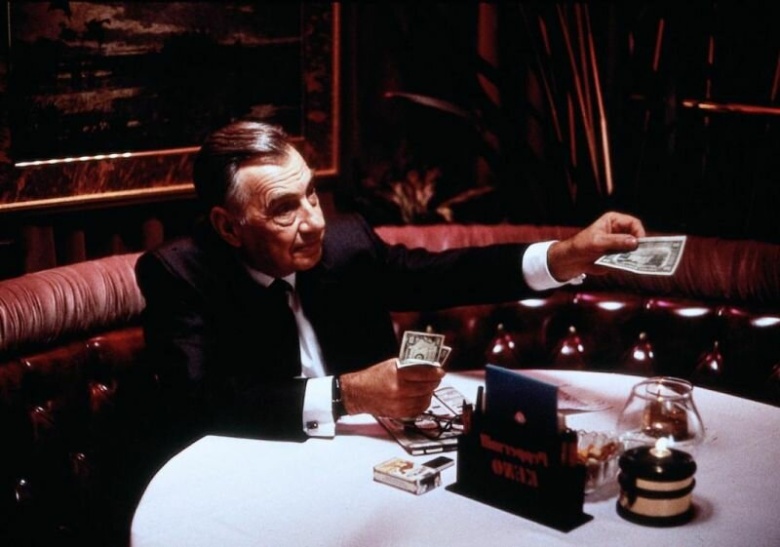
Still from the film Fatal Eight (1996, Paul Thomas Anderson)
Sidney, the gatekeeper, invites the hero on a journey, a classic device of fairy-tale dramatic structure (like Gandalf from The Lord of the Rings, who chose Frodo as the chosen one who must sacrifice himself to save Middle-earth), but the peculiarity of PTA's direction is that he involves in his journey not so much the main character, but the viewer.
After diving into the backstory, the shot switches and we see both men in a cafe. Outside the window there is desert and semi-abandonment, a dim sky and a feeling of emptiness, purgatory. In the foreground the composition is almost symmetrical, in the background there is a lopsided road sign: this gives a feeling of instability, disturbed balance - “something will go wrong.” The movement of the camera begins to take the viewer on a journey, as does John, he agrees and goes on his way.
In the car, a chat begins between the characters (much like Tarantino’s in “Pulp Fiction”, a tribute to the techniques of the times), the characters talk on a distant topic, a relationship develops, their mutual sympathy begins. John says the phrase: “Shit happens,” and the story is about it.
In the scene in the casino, where the heroes come to earn the money necessary to solve the problem, the PTA film camera begins to draw the depth of space: from the depth to the hero, from the middle plan to the close-up, we always follow the hero, approach him and start moving again - from the depths of the cinema hall to the hero, getting a sense of volume, the materiality of space, we understand how it works and how time flows in it thanks to the dynamic, ragged editing. Amazing music by Jon Brion and Michael Penn plays, background and engaging, like David Lynch.
While John is learning to make money by playing blackjack according to his teacher’s scheme, PTA fills the space of the frame with references, including to his previously created film world: a newlywed couple appears before us, the bride plays with the groom’s money, as in his short film.
John wins money, he delightedly asks Sydney his fate - what's next, and then we understand that this is not a story about money - we look at the hero from top to bottom, as if lowering him to the ground - not everything is so simple. The first hint of what exactly Sidney's role is in John's fate appears when the hero, inspired by his first victories, fastens the Velcro on his sandals - he looks like a child, and Sidney looks at him like a fatherly patronizer.
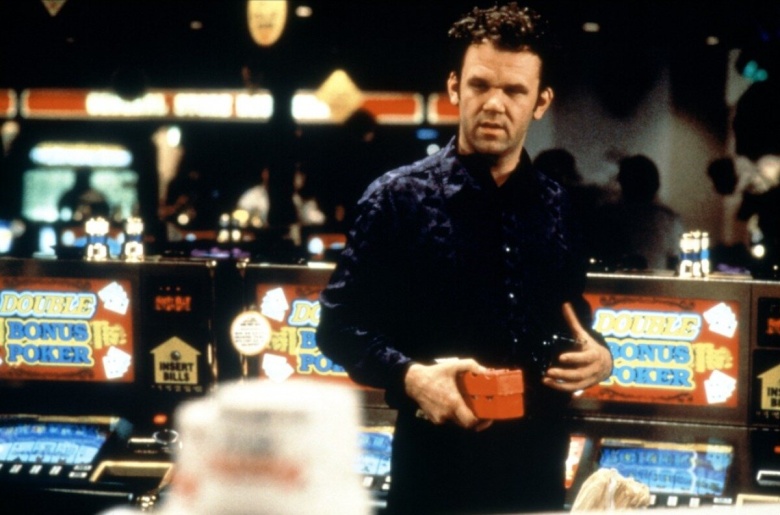
Still from the film Fatal Eight (1996, Paul Thomas Anderson)
Two years pass. For the first time, PTA uses her signature camera movement - she follows the characters, moving from one to another, changing direction, as if reminding the viewer of the depth of the space into which he has plunged.
We are introduced to a new character, Clementine (Gwyneth Paltrow). From her conversation with Sydney, we learn where the story goes next: Sydney asks, she answers - just like it happened with John. And then PTA refers us to the idea of his short film about the vicissitudes of fate: Sydney hands Clementine 20 bucks. Next comes Jimmy, played by S. L. Jackson, he reminds us of a typical gangster, an antagonist who immediately makes it clear that he is the one who will influence the development of the conflict. Jimmy knew John's father, but Sydney cuts the conversation short, maintaining a sense of suspense, the tension of a crooked road sign somewhere deep in the plot. It is worth noting that in the second round of plot development, PTA rhymes its own moves: conversations, acquaintances, cigarettes and coffee, a feeling of instability of the balance of power. Sidney the father, Clementine the child, Jimmy the rock.
Later, Sydney talks about his family situation - he has a son and a daughter, and he is divorced; they have not communicated for a long time. Helping new children for Sidney is atonement for her mistakes in front of her own children. To some extent, in the early work of PTA, this topic of atonement for the mistakes of parents will be raised more than once.
And so, when all the roles are defined, all the plot lines are set, PTA brings the characters, and with them the viewer, to the point of no return - the scene in the motel. John takes hostage Clementine's client (she works part-time as a prostitute), who has not paid her back. It is important to go back one scene, in which the brilliant Philip Seymour Hoffman appears briefly - he plays against Sidney at dice. In this game, the same Fatal Eight appears, which can either bring good luck or end the fate of the hero. Point of no return, fate, rock. At the motel, Sidney's "children" threw out their Fatal Eight and the "father" has a choice - not to interfere with their fate and let the consequences happen or take the blow on himself. Sydney makes her choice - this choice is the message of the PTA. Each of us is the existential choice that we make in our “motel”.
The dialogue between Sydney and John is interesting. Sydney asks John all the same questions that appear in the viewer's head: why, why, what the hell? And the more he asks them, the more absurd the situation becomes. Life is absurd. Tragedy is inevitable. But that’s not what’s important—what’s important is the choice you make, and it’s what defines you as a person. Sidney makes his existential choice, he decides to help these children whom he already considers his own. According to the original script, he will pay for this, but this scene, at the will of the producers, will not be included in the final cut of the film. PTA naturally understands how life works and puts these laws into its stories. (He would later correct himself by excluding the participation of producers from his stories).
John and Clementine get married. After the wedding ceremony, the newlyweds are announced: “Now you are Finnigan.” This surname was not mentioned earlier in the film; its etymology, according to one version, comes from the words “kind” and “bright”. Everything dark and evil was taken upon themselves by their father, Sidney.
Sidney sends the newlyweds on a romantic escape while he himself is left to await the inevitable. And his destiny appears before him - Jimmy. While they are talking to the car, the wheel of fortune is spinning, with the word “Luck” in the frame. But the conversation is not fun at all. Jimmy and Sydney move into the apartment. The disposition is familiar: table, cigarettes, conversation. This time Sidney sits and listens, and his rock in the person of Jimmy speaks. The past caught up with him. Again money appears, it, the bill, as an operator of human relations. The same amount of 6 thousand dollars appears, which John voices at the beginning of the film. Rhymes as consequences. Sydney agrees to pay off his debts. In the money transfer scene, PTA uses another important technique for itself - the image of a long corridor, like a claustrophobic tunnel, signaling hopelessness. Sydney calls her children and says goodbye. The wheel of fortune appears again, the dice game returns, and the Fatal Eight appears again. In the producer-approved ending, Sydney dispatches Jimmy, a ruthless scene that shows the hero in all the glory of his dark side. But, as already mentioned, according to the PTA's plan, Sidney was supposed to die almost by accident, at the hands of the same hostage whom he freed at the motel. Are the prizes that the wheel of fortune gives out random?
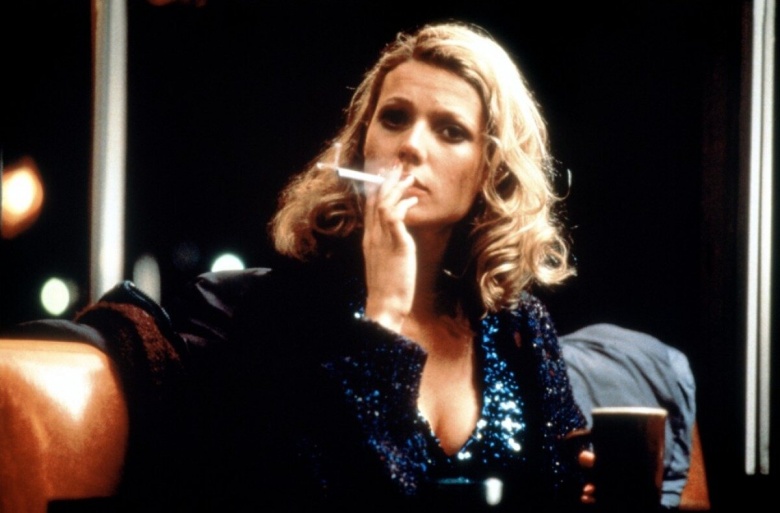
Still from the film Fatal Eight (1996, Paul Thomas Anderson)
The producers did not include important episodes in the film, without which it is clearly missing several elements.
Here are just some of the scenes written in the script, filmed but not included in the final edit: Sydney's flashbacks from his criminal past, a conversation with John's father and his murder, an unsuccessful attempt by a drunken Sydney to talk on the phone with his wife.
And finally, the main one. According to the original PTA script, the scene in the hotel with the taking of a hostage has the most fatal significance for Sydney - which was illustrated by the tragic ending, as a consequence of what happened in that hotel; in the final version it turns out that that scene does not receive any semantic continuation. Namely, she is the middle point, the most important and turning point of the film. The balance of elements is disrupted, with the result that the second half of the film does not follow from its main turning point, the decision made. Who knows what the “Fatal Eight” would have looked like if the young PTA had had the opportunity to edit everything according to his own vision. We also don't know what it would have looked like if the studio had edited everything themselves—it ended up being a bit of a compromise.
The story of the film's production stopped at its middle point: first, people from the film studio took over editing the film and redid almost everything, horrifying Paul.
After some time, he said : “If you are a young director and you are offered money for your film, of course you will take it. So - don't! Don't do this without checking all the terms and conditions. And if the conditions are crap, refuse!” In another interview, he continues : “Of course, at 23 years old, I myself would not have followed this advice...”
The story turned out to be dramatic. Young Paul immediately did not have a good relationship with the producer, Englishman Robert Jones. Even during filming, he suggested not filming too long scenes - Anderson did not agree. As a result, the PTA banned Jones from the editing room altogether. According to Jones himself, "Anderson considered any involvement a hindrance" and instructed the editor not to show anything to him. One day, when he came into the editing room to ask a question, the editor immediately turned off the monitor. Jones was furious: “I wasn’t allowed to see anything. In other films they would have gotten him fired for this. He had a contract. He had no right to the final cut.”
Indeed, I didn't. But he was not going to make any compromises either. It all ended with Anderson himself being prohibited from appearing in the editing room, he was removed from all processes by Rysher director Keith Samples, and the studio itself began editing the picture. They edited a shortened version of the film with an alternative ending, changing the title, music and sequence of scenes.
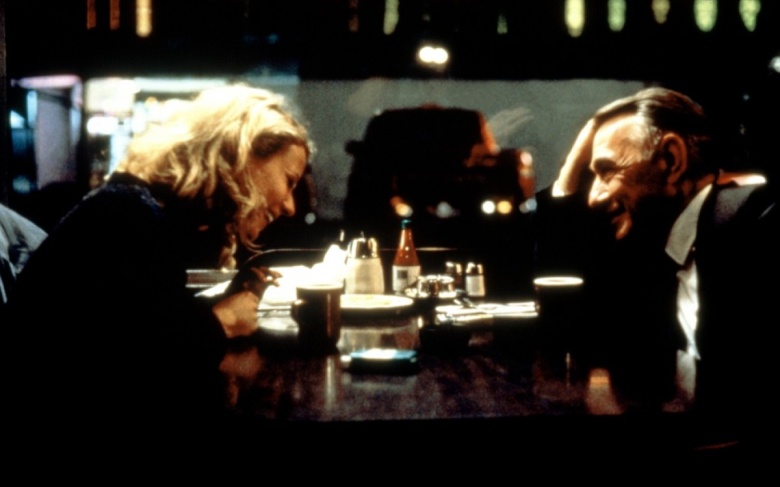
Still from the film Fatal Eight (1996, Paul Thomas Anderson)
PTA fought for his film: he managed to edit his version. In late 1995, Sundance Festival organizers receive two different copies of Fatal Eight for the 1996 festival. One belonged to Rysher Entertainment, and the second to Anderson. (Anderson himself insisted on the title "Sydney", but its change to "Hard eight" (in Russian translation "Fatal Eight") became final.) The film was accepted, and Michelle Sutter, a friend of PTA from Sundance Lab, insisted that Paul's version be shown. History repeated itself in Cannes: the studio sent its version of the film, Anderson sent hers. Festival director Gilles Jacob told studio representatives that he would never in his life show the producers' version to the detriment of the director's; he is always on the side of the directors.
The PTA version of the film was shown in the Un Certain Regard section, and the reviews were so good that Rysher made a compromise.
Anderson recalls: “When Cannes saw my cut of the film, they invited him to the Un Certain Regard program. This was very important. I called Rysher and said, "Look, I know it's your property, but I took my dub work print, sent it to Cannes, the film was accepted - it would be a huge mistake if you didn't give me some money and let me finish the film." They, of course, refused. First of all, they were not going to let me go, they were not going to let me carry him. And I didn’t want to drag myself to the fucking Grand Palais with my duplicate copy, so I said : “Let me take the original negative.”
As a result of all the disputes and battles, faced with the problem of finding a distributor, the film was released in a compromise version: the studio was unable to completely re-edit it, but insisted on changing the title and deleting some scenes. The film "Sydney" began to be called "Fatal Eight" (the director was told that Sydney is a city in Australia, and there is nothing about Australia in the film).
Never again in his life will Paul allow studio producers to interfere with his work: the principle of the right to final cut will become unshakable for him.
As a result, at a cost of $3 million, “Fatal Eight” grosses only 250 thousand at the box office (the studio did not invest in its production). The film did well critically and was shown at Cannes and the Sundance Film Festival, but the only major award show for The Fatal Eight was the Independent Spirit Awards, where the film was nominated in five categories, including Best Debut Film.
“If the poor performance of my film somehow helped them go bankrupt, then I’m glad,” Paul later said , commenting on the closure of the studio. - This is a very difficult memory. It almost finished me." To quote from the other side of the conflict: “Hard Eight was a hell of a traumatic experience,” says Jones, Rysher's producer. “It took me a long time to get over all this.” (After this story, Jones was forced to return to England, where he eventually headed the British Film Council).
The experience of fighting with the studio over his film would stay with Anderson for the rest of his life, developing in him an unyielding negotiating style and a paranoid manner of comprehensively controlling every step in film production.
However, the failure with "Sydney" did not prevent anything. Even before the film was released, Paul was noticed in the industry and invited to work. The pre-premiere excitement helped him sign a contract with New Line Cinema for the next film, the script of which was already ready.