
Translated material
“Now I’m part of the line, part of the ship.”
How Irkutsk residents stood in traffic jams for gas for a week and organized themselves
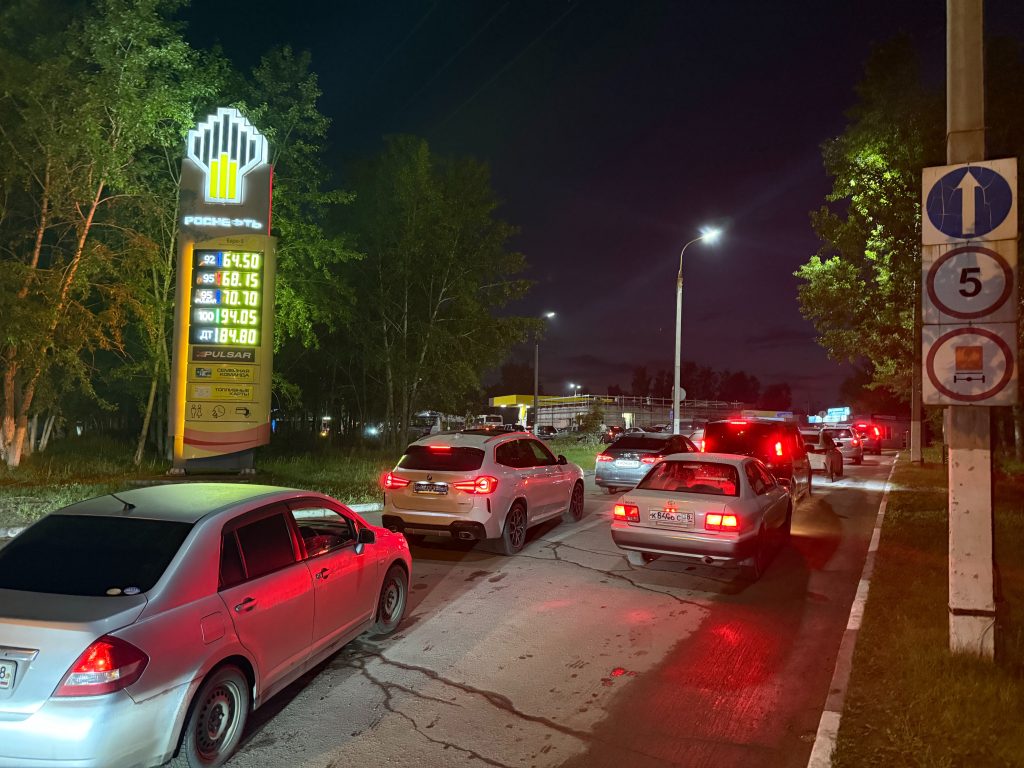
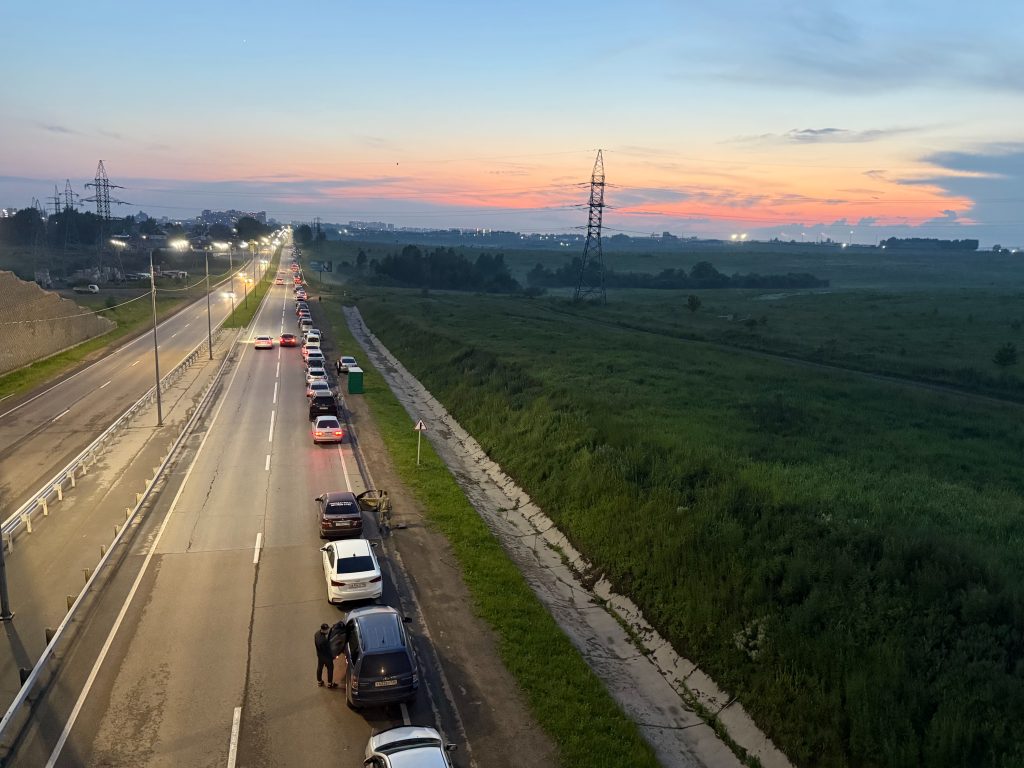
At five o'clock on Saturday morning there was a long line of hundreds of cars along the side of the road on Shiryamova Street in Irkutsk. The drivers deliberately left them here overnight in order to return in the morning, when gasoline would be delivered to the nearest Rosneft gas station. Since June 22, Irkutsk residents have been queuing at gas stations. At first they waited for several hours, but by the end of the week they began to stay overnight or spend half a day in line. The record is 18 hours. On Sunday, Governor Kobzev introduced a high alert regime in the region due to a gasoline shortage.
This text was prepared by the publication "Potok"
“It’s nonsense that the whole city will run out of gas”
On Saturday afternoon, an ambulance left Baikalsk, 150 kilometers from Irkutsk. The car was carrying a woman in labor who was going into labor. Next came a blue pickup truck with a barrel of gasoline on board: the ambulance would not have been able to refuel on the road - there were hours-long queues at gas stations along the highway, or there was simply no gasoline.
There was no time to take the woman to Irkutsk - the child was born on the way. In Baikalsk, where 13 thousand people live, there is not a single maternity hospital. The next day, in the neighboring town of Baikal, Slyudyanka, all test tubes ran out; the supplier’s car simply could not deliver them - there was no gasoline.
The first complaints about the lack of fuel in the region appeared in mid-June. 95-grade gasoline went out of stock at KraisNeft gas stations, and restrictions were introduced there—up to 50 liters per person. Rosneft limited the sale of gasoline in its network on June 18. Since June 22, queues appeared at gas stations, and pouring gasoline into cans was prohibited. The price of gasoline at some gas stations has increased from 65-70 rubles to 135-140 per liter.
The governor of the region, Igor Kobzev, explained : “There are interruptions throughout the country. In the west, oil refining facilities were disabled by Ukrainian Armed Forces drones. Many regions, including us, are forced to switch to manual operation: we determine the volume of fuel for each recipient individually.” The post was later cleaned up to remove references to the link between drone attacks and gasoline shortages.
Over the course of the week, the situation became critical: if at the beginning of the week people stood in line for 2-4 hours, then by the middle it was already 6-8 hours. At all gas stations, except Rosneft, there was either no gasoline or it was quickly running out. By Friday, gasoline remained only at gas stations of the Rosneft network, which has its own oil refinery in the Irkutsk region - ANKhK. But, according to a Stream source close to the regional government, 60% of the limit “has been ordered to be sent to Moscow.”
The New People party created a Telegram chat “Where to upload”, which 34.1 thousand people joined in a few days. In it, drivers told which gas stations had gas and how long they spent in line. Residents also learned about fuel through the website “ Where is the gasoline?” "or in the comments in 2GIS.
On Thursday, June 25, Governor Igor Kobzev urgently flew to Moscow to report on the deficit. He met with Deputy Chairman of the Russian Government Alexander Novak, but when he returned, he said nothing about how the crisis would be resolved.
At first, Irkutsk residents refused to believe that the situation was serious; they thought it would quickly normalize. Architect Zorikto Bagdaev says he laughed at those standing in line. But soon he himself fell into this line and “went through the five stages of acceptance.”
"At first you're like, 'Bullshit, it can't be that we're running out of gas all over the city. It's just panic. I'll drive as usual.' Then you start getting hysterical: "What kind of circus is this? What are you doing?" Well, and then you stopped at a gas station, internally agreed to stand for 20 minutes, you stand for 40, moved only 3 meters and you already begin... to feel depressed. You didn’t have time to pick up your child from kindergarten, your wife from work, you’re late for something, making arrangements, interrupting meetings. Well, that’s it, now comes the acceptance part. Now I’m part of the line, part of the ship,” Zorikto laughs.
“And you are still talking nonsense that this is because of alarmists with canisters”
Irkutsk resident Ekaterina hoped to stand in line for a couple of hours in the evening. She and her husband arrived at Rosneft near their home at 20:30. When I saw a two-kilometer line, I realized that they wouldn’t refuel by midnight.
While in line, Ekaterina and her husband chatted, played backgammon, and watched a long-delayed film. Sometimes other cars came to the line and brought water and food to people. The couple refueled six hours later - by three o'clock in the morning. They were glad that they arrived in the evening and not at night: by eight in the morning there were many more cars in the same queue.
“We accepted everything quite calmly. We joke with my husband and somehow bear with everything positively, but, of course, we are very tired. Considering where our country is moving by leaps and bounds, the situation is quite expected; it is unlikely that things will get better,” says Ekaterina.
But if gasoline runs out in Bratsk, it will not be possible to remain positive - Ekaterina’s father lives in this city, for whom it is vital to go to the hospital every other day. He's on dialysis.
By the end of the week, the queues became kilometer-long, and people spent the whole night or half a day in them. Marketer Ekaterina went to get gas with a friend - the girls thought they would stay until the evening. But by 21 o'clock there was still half a kilometer to the gas station. We didn’t drink water on the way, so as not to want to go to the toilet. The next day, June 26, dry closets were placed in the same line by order of the mayor.
A resident of Irkutsk with the nickname Natalie posted a video on social networks of a line of cars on Sunday. She refused to stand in it on June 28 because she estimated it would have taken 20 hours. Natalie captioned the video: “And you are still talking nonsense that this is because of alarmists with canisters. This is because of the state, which is crap.”
Stuck in the middle of the country
At 4 a.m. on June 26, traveler and blogger Vlad Povelikin arrived at a gas station in Irkutsk. I drove along the line of cars for a couple of minutes. He could not stop - he had too little gasoline left.
Povelikin left Nizhny Novgorod on a motorcycle in early June and should finish in Kolyma. Going on the road, he knew about problems with fuel in Crimea, but did not expect to encounter them in Siberia. Somewhere near Krasnoyarsk I noticed that 92nd and 95th gasoline had disappeared from many gas stations along the highway. Then I realized that cheap gasoline remained only at Rosneft and Gazprom gas stations, and after Krasnoyarsk, gas at Gazprom either disappeared or became more expensive. He hoped to refuel in Irkutsk, but here everything turned out to be even worse than in the neighboring region.
There was no choice: Vlad drove up to the pump and began asking the drivers to let him go ahead. But no one wanted to let us through - people had already stood for several hours, and were afraid that the gasoline was about to run out.
The girl nevertheless helped the traveler - she let him go ahead, and Povelikin poured ten liters into the tank. There was no gasoline needed, so I took what I had. At a gas station in the Listvyanka area, near Lake Baikal, the queue was even longer - 150 cars. Later, an acquaintance of his said that he stood for eight hours at a gas station in Kultuk and did not eat anything during this time.
Povelikin moved on and, all the way to Magadan, plans to ask people to let him pass ahead or pour gasoline. He can’t stand in lines for 6-8 hours on a motorcycle - he simply won’t make it across the road.
“I found myself in a hopeless situation. Now I am in the middle of the country. It’s equally difficult and expensive for me to go back or forward,” says Povelikin. His friend now has serious doubts about whether to go to Altai, although he has been preparing for this trip for a year.
The gasoline crisis at the height of the holiday season is forcing many to change their vacation plans. There are very few tourists on Olkhon, which is crowded at this time of year, and there are no usual queues for the ferry. There are much fewer cars in the city itself.
“People greeted everything with some kind of understanding, but then it will cause negativity, aggression towards the management,” Povelikin shares his observations. — Because there are no specific dates, no clear proposals. For example: “Guys, there will be interruptions throughout the week, after which it will be possible to refuel at such and such gas stations, we will provide.” And everything that is uncontrollable causes negativity, misunderstanding and loss.”
“It felt like the bridge was shaking”
Due to the shortage, a shadow gasoline market immediately emerged in the city, organized by “outbidders.” They sold gasoline at a higher price and offered home delivery. At the beginning of the week the price was from 150 rubles per liter, at the end it increased to 350 rubles.
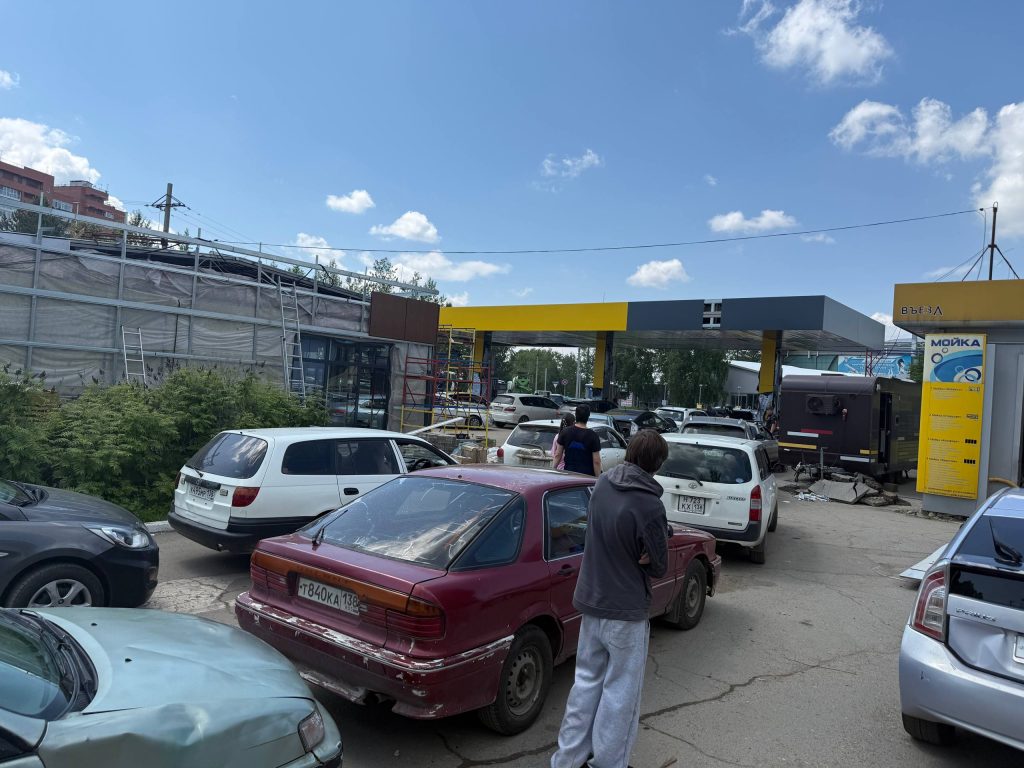
The “outbidders” were blamed for creating queues. One of the residents posted a video of several men pouring gasoline into cans and even water bottles. According to her, they took 40 minutes to refuel because the car was filled with cans. However, it is prohibited to pour gasoline into cans. It is unknown where the gas station employees were at that time.
Irkutsk resident Viktor Bezdenezhnykh also stood at the gas station for an extra hour because of the people who were filling the cans. The limit per person was 50 liters, but some people went in groups of several people and filled up full or poured it into cans when the gas station employees left the pumps. “They said: someone in the family needs gas, someone has an inefficient car, someone has lawn mowers and other small things,” says Victor.
One of the participants in the “Where to Fill Up” chat suggested lynching the outbid buyers: “Put an advertisement that I will buy gasoline, and beat those who sell them in the face!”
Throughout the week, the townspeople themselves had to manage the queues—there were no traffic police officers or other law enforcement officials in the queues at many gas stations.
On June 26, Irkutsk resident Kristina Makarenko went to her mother’s birthday from the Irkutsk microdistrict of Novo-Lenino to the village of Karluk. Her grandmother and 8-year-old brother were sitting in the car with her. They ate almost nothing at home - they expected to get there in 40–50 minutes. But because of the queue at the gas station, a traffic jam formed on the road, in which Christina was stuck for six hours.
The line to the gas station took up two lanes of the road, no one was regulating the traffic jam - the traffic police officers were not on site. Christina called the duty station, but no one answered the phone.
“Everyone screams, swears, in this situation they get into accidents and touch each other. On the Innokentyevsky Bridge we stood so tightly that we could feel the bridge shaking,” recalls Christina.
Three hours later, stuck in traffic, her car stalled—the battery couldn’t handle the air conditioning. Christina called her father, an auto mechanic, and asked her to pick up her grandmother and 8-year-old brother from the stuffy car. Christina herself wanted to wait for the tow truck.
Christina's father arrived and drove the car outside, breaking all the rules. “By the end I was already in tears, it was scary how we violated and drove into oncoming traffic. But dad explained that if we get up and stall, the tow truck won’t come. It just physically won’t get there, because at 22:30 the traffic jam had not dissolved at all. Upon arrival, the leg that had been holding the brake pedal all the time was shaking,” says Christina.
Christina reached Karluk by 11 pm. The car now needs to be repaired - the radiator and battery need to be replaced.
Viktor Bezdenezhnykh stood in line three times. On the first day - four hours, and on the third, Sunday - already 15 hours. The third time he went with a friend, they stood in line by midnight. In line we met other drivers and several hours passed quickly.
At five in the morning Victor went to bed and slept for two hours. By this point, the gas had run out and the line was an hour and a half long. By 14:30, Victor arrived at the gas station, having stood there for 15 hours. But when it was his turn, his gas tank came loose. Victor was asked not to hold up the line and pull over to the side of the road. At that moment the traffic police team arrived. They asked for documents, and it turned out that Victor was 17 years old, he drove without a license - he was just studying at a driving school. Five reports were drawn up against him, but he never filled up with gasoline.
“The situation is sad: there are resources, but they are not going to us”
A week later, residents of Irkutsk began to adapt to the fuel crisis. After several hours in queues, some citizens switched to bicycles, buses or walk.
Beauty salons and entrepreneurs began jokingly offering gasoline as a gift for signing up for a service, or talking about their willingness to receive gasoline for work. Restaurants are looking for “couriers on horseback,” and citizens suggest changing the name of the Yandex.Go taxi application to “Yandex.Go-Go”—taxi on horseback.
Gasoline shortages are already affecting business. The director of the private road transportation company Avtosib, Elena Rekhitina, said that they only have enough gasoline for 7-8 days.
People criticize local authorities. Irkutsk representative of the Yabloko party Pavel Kharitonenko in his telegram channel recalled that oil is produced in the region and one of the largest oil processing enterprises is located in the region - the Angarsk Petroleum Chemical Complex, “which should more than meet the region’s need for fuel and lubricants and calmly send surpluses to other regions.”
According to Kharitonenko, it is the Irkutsk region that is experiencing a shortage, because the oil refining monopolist in the region, the Rosneft company, provides fuel only to its gas stations, removing competitors from the market. “Why can’t the governor deal with this? And everything is very simple: he was put here by Moscow in uncontested elections and works for Moscow bosses, and not for the residents of the region,” Kharitonenko wrote.
Irkutsk residents began recording appeals to the authorities on Instagram* and launched a petition. Irkutsk “mystical practitioner” Olga made a tarot spread of the fuel crisis: “The layout is sad. We'll have to save money. There are resources, but they don’t go to us, but to other people, higher up, because they need it more.”
“The main reason for what is happening is war”
Only a week after the crisis began, on June 27, Governor Igor Kobzev published an appeal to residents. He said that the authorities plan to reduce the rush within 10-14 days. He cited insufficient fuel shipments to gas stations in the region and an “artificial rush” as the reason for the shortage. To solve the problem, he said, the authorities are “working with the Russian government, federal departments and the Rosneft company.”
According to Kobzev, Rosneft has the opportunity to allocate additional volumes of fuel for the region and the authorities are trying to make sure that the company can sell gasoline, including to independent gas stations. At the same time, operational services provide fuel separately. Later, Rosneft increased the volume of fuel for the region by one thousand tons per day. However, some independent gas stations have stopped selling gasoline to individuals. The DBK network no longer sells 92-grade gasoline and supplies fuel only to organizations under government contracts.
On June 28, authorities introduced a high alert regime in the Irkutsk region to prevent an emergency. Now it has been announced only in Crimea, where gasoline is not sold to private individuals at all.
Gasoline shortages occur in almost all regions of the country, but the situation is different everywhere. According to RBC, restrictions have been officially introduced in 20 of them, although at the beginning of the week there were five such regions. “This means that there is a crisis and we have entered its acute phase,” notes Russian economist Sergei Aleksashenko and adds that the crisis will continue in July.
“We must understand and accept that the main reason for what is happening is war. While the war is going on, attacks by Ukrainian drones on Russian refineries will only increase,” says Aleksashenko. Judging by information reports, since the beginning of May, 25 oil refineries have been damaged by Ukrainian strikes, but the government does not say what kind of damage they caused; the depth of the crisis can only be judged by indirect signs.
According to Rosstat and the Ministry of Finance, oil refining fell by 15% last spring. The production of gasoline, diesel fuel and aviation kerosene is falling. At the same time, gasoline production in Russia was on average 5–10% higher than domestic consumption, but gasoline exports fell sharply.
Russia's reserve gasoline reserves will last for three weeks, even if all factories shut down. Aleksashenko is confident that we are not talking about a total shortage of gasoline; the main problem now is the lack of flexible logistics and the exchange market. Historically, the regions were divided between large companies and the base oil storage facilities belonged to them. These oil suppliers were tied to specific refineries. Due to drone strikes at refineries, suppliers have started to have problems, and they do not understand how long to enter into contracts for supplies from other regions. The authorities, in turn, cannot manage the logistics of the refinery, but can only “either prohibit or allow” something.
“But people need help now”
Meanwhile, residents of Irkutsk continue to queue for gasoline.
“Yesterday at 8 am (Sunday - Potok) I drove past the Rosneft gas station, stopped, and walked towards the crowd. Everyone is tired, exhausted. I asked if I needed something. She gave the boys water, nuts, painkillers. I’m on a diesel engine, it’s easier for me...,” said Maria from Irkutsk.
The day before, she was towing a stalled sedan along the highway in her car - the driver ran out of gas and did not make it home. “Drived... The guy offered money, but she refused,” says Maria.
By June 28, Irkutsk residents began to take not only food and water, but also guitars and hookahs with them during traffic jams. У властей попросили организовать подвоз еды и воды, выставить медицинские посты, а не ограничиваться биотуалетами.
В воскресенье возле АЗС в Чите умер 43-летний мужчина. «Вот сейчас, по сути, небольшое ЧС. И где действия? В случае ЧС ничего не могут сделать? А если, не дай бог, произойдет страшное ЧС — что, все будут только выражать озабоченность, проводить совещания? — пишут иркутяне в соцсетях. — Туалет поставили — это без хейта. But this is not enough. Надо воды налить. За месяц до выборов увидим, как все красят бордюры, появляется какая-нибудь лавочка с фамилией депутата, дворы с табличкой — это вам подарок от депутата. А людям сейчас помощь нужна».
В понедельник очереди на заправках Иркутска немного уменьшились. Пробки к «Роснефти» на улице Байкальской, где люди раньше оставались на ночь, сократились в 2-3 раза — до полутора часов ожидания. На въезде в заправку круглосуточно стоят сотрудники ГИБДД и регулируют движение.
В понедельник полицейские задержали четырех «перекупов». Один из них — 20-летний парень, продававший бензин по 250 рублей. На всех, заливающих топливо в канистры, тоже обещают составлять административные протоколы.
*Instagram признан экстремистской организацией в России и заблокирован