
Translated material
New Russian elite
Meduza found more than a thousand war participants who have already received positions in the Russian government system. Big study
Putin constantly repeats : participants in the war with Ukraine are the new Russian elite. He says that the authorities will “continue to rely” on those who “returned from the Northern Military District” - it is from them that the state allegedly intends to form the “managerial corps.” Meduza decided to check how these statements compare with reality. It turned out that at least a thousand participants in the Russian invasion of Ukraine have already received a variety of government and government-related posts. This process is growing: there are more and more “veterans” in government agencies. However, as a real career elevator, “SVO” was able to be effectively used primarily by those who already had access to power.
How many participants in the invasion are currently in power?
Systematic promotion of “North Military District veterans” to government bodies has been observed since the beginning of 2024. It was then that Putinlaunched the “Time of Heroes” personnel program (read more about its results below).
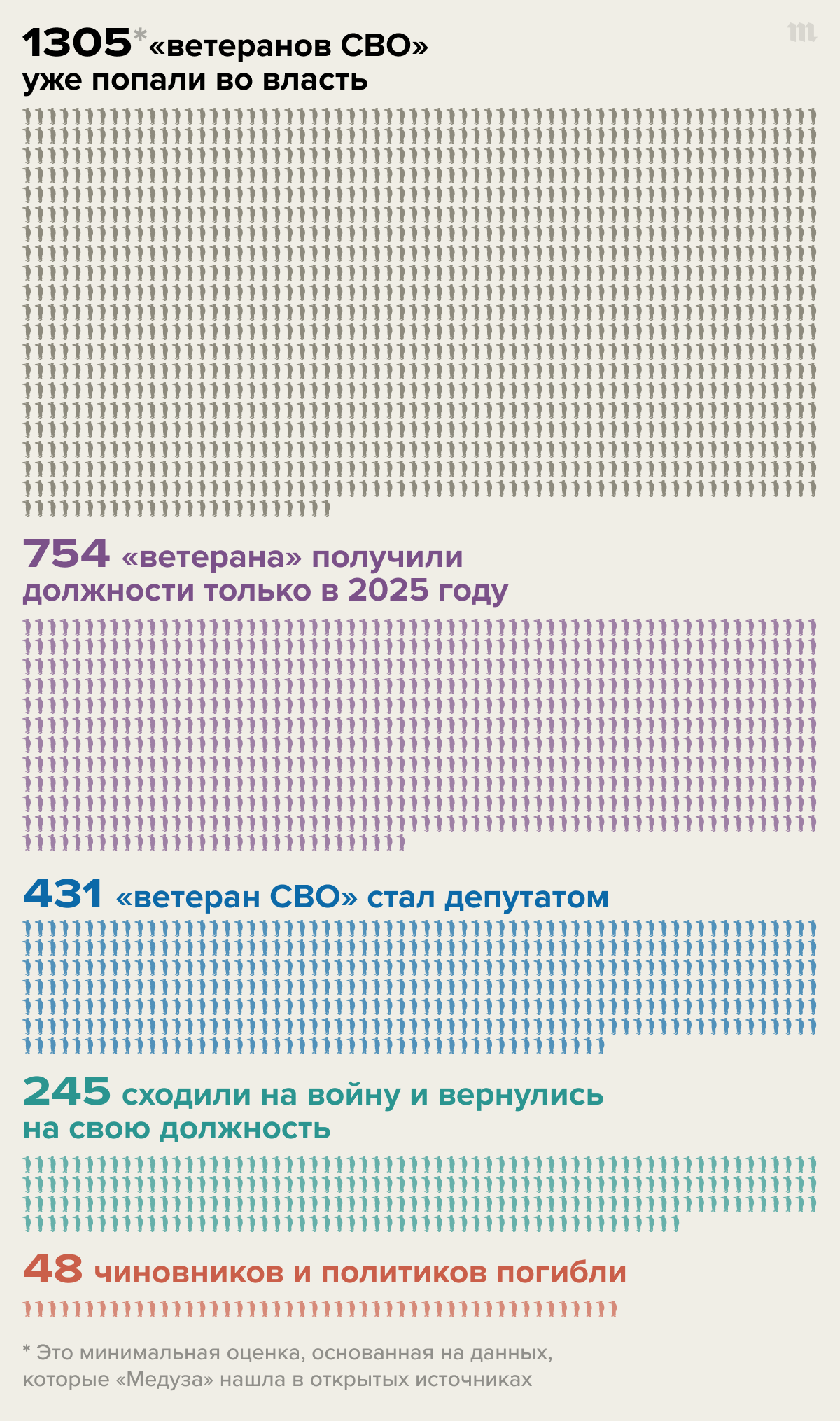
In June 2026, Meduza, using open sources, compiled a database of 1,305 war participants who, after the SVO, either won local or regional elections, or received appointments to government structures and public organizations with significant government participation (a typical example: the Knowledge Society ). In total, they filled 1,311 positions (some held several positions after returning from the war).
What we thought
We collected information from open sources: federal and regional media reports, websites of government bodies, election commissions, parties, pages of personnel programs like “Time of Heroes,” public lists of deputies and websites of state-run organizations. The database includes all identified war participants who received or retained a position, mandate, or near-state public role (for example, a position in a state-affiliated NGO).
To search and initially process the data, we used AI tools: with their help, we found references to war participants in the news and collected information about their names and positions. All data has been double-checked manually. We made sure that the people who ended up at the base at least formally participated in the war.
This is not an exhaustive database. In Russia there is no open state register of war participants who received positions or mandates. At the same time, there is only fragmentary information in the press about many appointments and municipal elections.
This is the minimum estimate. Not all “veterans” are mentioned in open sources. The real number of war participants who ended up in government and near-government structures is obviously much higher. Only local deputies from United Russia, according to its chairman Dmitry Medvedev, were approximately one and a half thousand who returned from the war. We managed to find only 432 deputies.
This difference is easy to explain. In 2023–2025, 2,131 mandates were distributed at the regional level in the Russian Federation, and about 110 thousand more at the municipal level. You can’t find information about all of them on the Internet: in remote areas there may simply not be a consistently updated website with a list of deputies. In addition, election commission documents do not always indicate whether a candidate participated in the war. Political parties that boast about the victory of “North Military District veterans” in the elections also do not always indicate their names. For example, in the Stavropol region, according to United Russia, 47 participants in the war received mandates, but we were able to find the names of only 12 of them.
However, even an incomplete array of data shows the scale of what is happening. War participants actively receive mandates as municipal and regional deputies, positions in administrations and ministries, governors’ offices and state funds, schools and universities, veterans’ organizations and “patriotic projects.”
This process is accelerating. If in 2023 there were only 45 such appointments, and in 2024 - at least 201, then in 2025 - at least 754. And from January to May 2026 - at least 311.
In which regions are there the most “Northern Military District veterans” in power?
Appointments are distributed unevenly across the country. The leaders are: Moscow region - 76 , Bashkortostan - 41, Tatarstan - 37 , occupied Crimea and Sevastopol - 30 , the same number in the Samara region, in Yakutia - 29 , in the Novosibirsk region - 28 . Another 26 were in the Voronezh region, 25 in Dagestan, Chelyabinsk and Irkutsk regions, 23 each in the Krasnodar Territory and Tyumen Region.
In the regions of Ukraine occupied by Russia after 2022, there are fewer such appointees: in the DPR - 16 , in the LPR - 15 , in the Kherson and Zaporozhye regions - 4 each.
If we take into account not only new appointments, but also cases when officials or deputies temporarily went to war and then returned to their positions, the picture changes. The Moscow region retains leadership - 81 cases, and the front-line Belgorod region comes in second place - 54 .
This is mainly due to the activities of the volunteer detachment “BARS-Belgorod” (read more about this and similar units in which people associated with the authorities like to “fight” below). It was there, for example, that the Belgorod vice-governor Alexander Lorenz, the head of the Gubkinsky urban district Mikhail Lobaznov, the head of the Krasnogvardeysky district Galina Rudenko and the former deputy of the Belgorod regional Duma Sergei Popov served .
The latter, already in BARS, himself submitted his resignation - after he was accused of going on vacation abroad during the period when he was allegedly in the service.
The recruitment of war participants into the system of power is structured in completely different ways. Thus, in the Moscow region (74 out of 76) and Tatarstan (31 out of 37), the majority of appointments are related to the municipal level: most often we are talking about local-level deputies and other lower-level positions.
In other regions, the role of the executive branch is more noticeable. For example, in Yakutia, most appointments relate to the government of the republic, regional ministries and municipal administrations. In Khanty-Mansiysk Autonomous Okrug, a significant proportion of war participants receive positions in public, veteran and other government structures.
The Tambov region is not among the leaders in recruiting “northern military district veterans,” but its example shows how the promotion of war veterans can be part of a broader process of changing the management team in the region.
After participating in the SVO, two managers from the Krasnodar Territory received the main positions in the region: Evgeny Pervyshov became the governor, and Valery Karasev (served in the FSB for more than 20 years, and then joined Pervyshov’s team) became the head of the regional government apparatus. Before his appointment to the Tambov region, Pervyshov worked for many years in Krasnodar and was the mayor of the city, and in 2021 he became a State Duma deputy. He volunteered for war in October 2022 and served in the elite BARS “Cascade” detachment. Pervyshov explained his decision by saying that he was allegedly so inspired by the trip to the hospital to see the wounded soldiers that he decided: he needed to be close to them. He spent less than a year at the front, returned in the summer of 2023 - and soon received a promotion.
Did they all get positions precisely because of their participation in the war against Ukraine?
At first glance, the number of appointments confirms the official rhetoric of the Kremlin: participants in the war have begun to come into power en masse. But data from the Kremlin shows that we are not talking about a real “social lift from the front”: a significant proportion of appointees were connected with the state even before the war.
Among the 1,305 people who received appointments or mandates after participating in the war, 447 already had experience working in state or municipal structures (another 245 went to war and then returned to their old position; we do not take them into account in new appointments). 303 has a professional military background. 98 worked in law enforcement agencies. These categories overlap (that is, the same person can have both military and management positions on their resume), so the final tally comes out as follows: at least 848 of the 1,305 had a professional background similar to the civil service before the war.
Thus, “SVO” has become a career elevator - but primarily for those who already have power: former officials, deputies, municipal employees, career military personnel, security officials and people associated with regional elites. Regular military personnel are still a noticeable minority among those who find themselves in government agencies.
Even the Russian authorities cautiously admit this. The head of the Presidential Administration for Public Projects, Sergei Novikov (who is also one of the main censors of Russian culture), said at the end of 2025 that “tens of thousands” of war veterans are unemployed. Moreover, initially state media reported, with reference to Novikov, about 250 thousand unemployed war participants - but later these messages were edited.
“Northern Military District veterans” from various regions also complain that it is difficult for those returning from the war to get a significant position. One former war veteran from Khanty-Mansi Autonomous Okrug complained directly to Putin in May 2025 that after returning from the front he could not find work, despite promises from the authorities. In a conversation with journalists, he argued that the real appointments to leadership positions are given to “the right people.”
How do “veterans” get positions? Do they just give it to them?
There are several main ways.
The first is through the “Time of Heroes” program and regional analogues. Thus, at least 446 people from our database received appointments. This is the most public mechanism through which war veterans are prepared for public office. The programs involve selection, training, mentoring, internships and further employment in government or government-related organizations. The logic is the same everywhere: select war participants, prepare them for work and help them get a position.
It was after this program that Evgeniy Pervyshov (already mentioned above) became the first “veteran of the Northern Military District” to head the region.
The second way is to participate in elections, primarily municipal and regional. This is another obvious way to show that the participants in the war are “going to power.” Such chairs provide public status, but rarely real influence.
The third is the continuation of an existing career. For some appointees, war becomes not a way to get into power, but an additional accelerator for advancement within it.
Here are some examples.
- Since February 2020, Georgy Andreev has served as Deputy Minister of Innovation, Digital Development and Infocommunication Technologies of Yakutia. In August 2024 he went to war, and less than a year later, in May 2025, he became the Minister of Entrepreneurship, Trade and Tourism of the republic. In the same Yakutia, Leonid Aleksandrov, who for many years headed the largest regional cooperative for the processing of fish products - the Yakut fish factory - after participating in the war, was appointed deputy minister of finance of the republic.
- The story of Andrei Murzin , the son of the former Minister of Economic Development of the Chelyabinsk Region, Vice-Mayor of Chelyabinsk Elena Murzina, developed in a similar way. Before the war, he was engaged in business and worked in public structures. Then he went to the front and, after being wounded, showed up in personnel programs for “veterans.” In 2025, Murzin ran for the Chelyabinsk parliament, and in May 2026 he received the post of Deputy Minister of Economic Development of the Chelyabinsk Region.
There are not many women among the “veterans of the Northern Military District,” but for some of them, participation in the invasion also helps them build a career. In particular, former assistant to the Novosibirsk City Council deputy Yulia Adybaeva received her own mandate after six months in the war. And the head of the “Time of Heroes” Maria Kostyuk, even without directly participating in hostilities, became the governor of the Jewish Autonomous Region in 2024.
Such a career elevator can also work for people from states (and quasi-states) that are “friendly” to Russia. Abkhazian official Alias Avidzba volunteered for the Russian-Ukrainian war in 2022, after which, at the request of the Ministry of Foreign Affairs of Abkhazia, he received Russian citizenship on an accelerated basis. The following year he became an adviser to the Russian Minister of Education. And in May 2026 he returned to Abkhazia as an assistant to the president.
A separate question is whether the officials leaving for the “SVO” are really fighting. According to the observations of z-military correspondents (they periodically describe what is happening more objectively than official propaganda), most often we are talking about formal participation - for example, they are simply located at the unit’s location at a relatively safe distance from the front.
The concept of “deputy battalions”, also known as “laundering battalions”, has become widespread in the army - formations where officials and politicians usually “serve” who want to demonstrate loyalty to their superiors or make amends for some offense.
Often this role is played by specialized volunteer units - BARS (detachments that are formed from reserve servicemen who have signed a contract to serve in the mobilization reserve) - through which officials can receive the status of “SVO participant”, although they have not even been to the front.
The story of 33-year-old Nikita Kushnarev, who became a deputy of the municipal formation of the Shchepkinsky rural settlement of the Aksai district of the Rostov region back in 2021, is indicative. From November 2022 to March 2023, Kushnarev was in the BARS detachment, and he was directlyaccused of serving fictitiously. Despite this, after his return, Kushnarev began to advertise himself as a participant in the hostilities. He also calls himself a businessman and the author of the book “How to become a deputy without money and connections” (unfortunately, it has not yet been published).
BARS fighters enter into a special volunteer contract with the Russian Ministry of Defense, usually for a period of up to a year; Moreover, previously there was also a service option for three months - now advertisements offer options only for six, eight and 12 months.
By law, volunteers, unlike mobilized and contract soldiers, can return home upon expiration of the contract. In reality, this is not always the case: for example , volunteers from the Alga detachment, who signed a contract for six months, were not allowed to go home, and even a class action lawsuit did not help them. Moreover, a criminal case was later opened against one of the applicants, Anton Samoilov, for leaving his unit without permission; he received six years in prison (after appeal - 5.5 years).
Volunteer deputies have no problem returning home. In total, according to Meduza’s calculations, at least 113 active officials served in BARS units. 22 of them received a new position after service, 91 retained their previous post. 30 people who served in these units are on party lists as potential candidates from United Russia and the Communist Party of the Russian Federation in the upcoming elections at various levels in 2026.
Some officials - primarily after the announcement of mobilization in the fall of 2022 - publicly stated that they were “going to the Northern Military District,” although there was no confirmation of their appearance at the front. For example, the Vice-Governor of Kamchatka Sergei Mironov received a summons; Later it turned out that he was going to Donbass not to fight, but to deal with housing and communal services, but in the end he never made it to the “new regions”. Novosibirsk deputy Yaroslav Frolov himself announced in the fall of 2022 that he had decided to volunteer for the SVO, but he was never seen during the war .
Another BARS-like option is "Akhmat" (also known as "Tiktok troops" because its commanders like to make beautiful videos of their service). This is a system of units within the Russian Guard and the RF Armed Forces, created or trained in Chechnya. “Akhmat” includes not only residents of Chechnya, but also volunteers from all over Russia. In official publications, the unit is called multinational and open to those interested from a wide variety of regions.
Among the people associated with Akhmat, there are those who received new appointments after participating in the war, and those who retained their previous positions.
General Apti Alaudinov himself, who leads the Akhmat special forces, became one of the main speakers in the Russian army during the war - and in 2024 he received the post of deputy head of the main military-political department of the Russian Ministry of Defense.
State Duma deputies Adam Delimkhanov and Akhmed Dogaev participated in the SVO as part of the Akhmat units and retained their mandates. The first deputy chairman of the government of the Trans-Baikal Territory, Marat Mirkhaidarov, signed a contract with Akhmat, spent several months there, was injured and returned to work in the regional government (in March 2025, he resigned - in his words , due to “trauma” received during the war).
Other regional politicians are also associated with Akhmat. The former head of the Chita administration, Alexander Sapozhnikov, after serving in the Akhmat special forces, was elected to the Legislative Assembly of the Trans-Baikal Territory. The head of the Sretensky district in the same region, Alexey Zakurdaev, who served in Akhmat for about four months, retained his previous municipal position after returning. And in the Belgorod region, regional Duma deputy and chief physician of the regional hospital Roman Protsenko signed a contract with Akhmat, on the contrary, after receiving the mandate.
In total, Meduza found 18 holders of public positions who served in Akhmat or related units. 10 of them received new positions after service, another eight retained their old positions. Кроме того, есть восемь потенциальных кандидатов в депутаты разного уровня (три — в Госдуму, два — в региональные парламенты, три — в муниципальные), которые тоже служили в «Ахмате» или в связанных с ним подразделениях.
Помимо возможности сохранить старую должность или получить новую, есть еще одна причина, подталкивающая чиновников к участию в войне: это способ избежать уголовного преследования.
По данным генпрокурора РФ Александра Гуцана, в «зоне СВО» на март 2026 года проходили службу как минимум 1100 осужденных по коррупционным статьям. По состоянию на весну 2025-го на фронте находились около 100 осужденных политиков или госслужащих (включая силовиков), однако их точное количество неизвестно.
Бывают сложные случаи. Депутат Государственного собрания Башкирии Алексей Локотченко отправился на войну в феврале 2024-го и даже получил два ранения. В декабре того же года, пока он был в отпуске, его задержали по обвинению в «посредничестве во взяточничестве в особо крупном размере». В марте 2026-го суд приговорил его к 10 годам лишения свободы.
Ирония в том, что Локотченко оказался в тюрьме за то, что обещал другому человеку помочь избежать уголовного наказания — через оформление фиктивного контракта с Минобороны РФ.
Кто-то из чиновников погиб на войне?
Да, несмотря на распространенность «депутатских батальонов», некоторые российские политики и чиновники по-настоящему участвовали в войне. Есть и погибшие.
24-летний муниципальный депутат из Санкт-Петербурга, военный по образованию, Павел Кочанжи был убит на фронте в августе 2023 года. Бывший глава костромского райцентра Игорь Устюжанин погиб на «СВО», отправившись туда вместо восьми с половиной лет колонии за коррупцию.
К февралю 2025-го «Север.Реалии» насчитали как минимум 32 погибших на фронте представителя российской власти. Согласно анализу «Медузы», уже после публикации «Севера» в открытых источниках появлялись сообщения еще как минимум о 16 таких случаях. Таким образом, минимальная оценка — до 48 погибших.
Во власти уже тысяча «ветеранов СВО». Они на что-то могут влиять?
Два высокопоставленных региональных чиновника рассказали «Медузе», что военных обычно назначают на должности, которые не связаны «с серьезными бюджетными потоками и серьезной работой».
«Это должности, связанные с молодежью, патриотическим воспитанием либо взаимодействием с такими же ветеранами. Еще вариант — безопасность. Звучит солидно — глава департамента, замминистра или даже целый министр. Но накосячить по неопытности не получится», — заявил один из них.
Близкий к администрации президента РФ собеседник «Медузы» добавил, что «молодежно-воспитательная траектория» и карьера «по линии взаимодействия» с другими участниками «СВО» — «самая рабочая в исполнительной власти» для вернувшихся с войны.
Это подтверждает анализ открытых данных. Участники войны занимают самые разные кресла, от выборных должностей и постов в исполнительной власти до позиций в общественных, ветеранских, образовательных и «патриотических» структурах. Почти половина новых назначений, мандатов и публичных ролей приходится на муниципальный уровень: 656 из 1311 . Федеральных должностей — 85 , региональных — 570. Отдельный небольшой, но показательный блок — образовательные учреждения. Всего таких назначений 20. Среди них девять директоров школ , колледжей и техникумов, шесть замдиректоров , а также преподаватели и другие похожие должности.
Самая частая роль для вернувшихся с «СВО» — депутат. Муниципальные и региональные депутаты используются как главное публичное доказательство того, что в России, как и обещал Путин, формируется «новая элита» из «ветеранов». Но их реальные возможности весьма скромны.
Близкий к администрации президента РФ собеседник «Медузы» прямо называет депутатские кресла для участников войны «хорошим средством отчетности» перед президентом, которое используют губернаторы и руководство «Единой России»: «Ни зарплаты, ни полномочий — особенно на уровне небольших городов и сел. Но гордое звание депутата имеется».
«Медуза» нашла 559 человек с новыми или сохранившимися мандатами после участия в войне. Большинство относятся не к федеральной политике: 384 — муниципальные депутаты, 160 — региональные.
Депутатов Госдумы — 15, причем 10 из них просто сохранили уже имевшиеся кресла — якобы после участия в войне: это Дмитрий Саблин, Александр Бородай, Олег Колесников, Виталий Милонов, Виктор Водолацкий, Олег Голиков, Адам Делимханов, Ахмед Догаев, Дмитрий Савельев и Юрий Швыткин .
Евгений Первышов, уходивший на войну в статусе депутата Госдумы, досрочно сложил полномочия после назначения губернатором Тамбовской области, Сергей Сокол стал председателем Верховного совета Хакасии, Дмитрий Хубезов — зампредом правительства Республики Алтай.
Если считать только новые мандаты, таких депутатов 432: 316 муниципальных и 115 региональных. Новых депутатов Госдумы, как упомянуто выше, пока нет, зато есть три новых сенатора, назначенных после участия в войне: Алексей Кондратьев , Юрий Нимченко и Амыр Аргамаков (еще один сенатор Алексей Наумец сохранил свой пост). Сенатор Виктор Бондарев после объявления мобилизации подавал рапорт на имя тогдашнего министра обороны Сергея Шойгу с просьбой отправить его на войну, но факт его участия в боевых действиях подтвердить не удалось.
Назначения в исполнительной власти устроены иначе. Тут речь идет не о символическом представительстве, а о настоящей работе внутри управленческой системы.
В России уже есть два губернаторских кейса: это уже упомянутые Евгений Первышов , ставший губернатором Тамбовской области, и Александр Шуваев , назначенный врио губернатора Белгородской области. Также среди новых назначений — 14 заместителей губернаторов или зампредов региональных правительств. Региональных министров — 12, их заместителей — 25, глав муниципалитетов и мэров — 26.
Основная масса назначений «ветеранов СВО» приходится на средний уровень управления: департаменты, управления, аппараты губернаторов, администрации регионов и муниципалитетов. Но такие должности тоже дают доступ к реальным управленческим решениям: распределению бюджетов, госпрограммам, кадровым назначениям, региональной социальной политике, образованию, молодежной политике, «патриотическому воспитанию», муниципальному управлению, поддержке самих «ветеранов СВО» и взаимодействию с федеральным центром.
Неудивительно, что эта часть системы остается наиболее закрытой для «людей с улицы», и никакие «ветеранские» статусы не делают ее более проницаемой. Среди 358 человек в исполнительной власти 130 раньше работали в государственных или муниципальных структурах, 157 имели профессиональный военный бэкграунд, 38 — силовой.
Иными словами, среди тех, кто получает не просто публичный статус, а управленческие полномочия, особенно велика доля уже давно встроенных в систему людей.
В ближайшее время военных во власти станет еще больше?
Судя по уже запущенным программам, власти не рассматривают продвижение участников войны как временную кампанию. Вокруг них строится новая кадровая и идеологическая инфраструктура. Государство формирует публичную норму: поездка на фронт подается как условие политического доверия и основание для карьерного продвижения.
Власти объясняют это тем, что война якобы обеспечивает ее участников особым управленческим опытом: умением командовать, действовать в экстремальной ситуации, брать на себя ответственность и выполнять задачи в жесткой вертикали. Важен и символический аргумент: участники войны, по версии государства, имеют моральное право говорить о патриотизме, воспитании молодежи и служении стране. Поэтому их продвигают не только в органы власти, но и в общественные палаты, ветеранские фонды, образовательные учреждения и «патриотические проекты».
Назначенные на сентябрь 2026 года выборы увеличат число «ветеранов СВО» во власти. «Медуза» нашла 1326 человек, которые заявляли об участии в выборах или прошли через партийные праймериз как участники войны. Из них 152 уже получили другую публичную должность после участия в «СВО», то есть совсем новых лиц — 1174. Основной лифт для них — «Единая Россия»: на сайте ее предварительного голосования можно обнаружить 1172 потенциальных кандидата на выборы разного уровня; партия сама всячески подчеркивает их присутствие.
Как заявлял председатель «Единой России» Дмитрий Медведев, победителями праймериз (речь о выборах всех уровней) стали 480 участников «СВО». Сколько из них реально будут участвовать в выборах, пока непонятно — партии пока не утвердили кандидатов.
Если говорить именно о выборах в Госдуму, речь идет почти о сотне кандидатов. По подсчетам «Медузы», первые места в праймериз по региональным спискам в Думу и одномандатным округам заняли 47 человек. «Коммерсант» ранее сообщал, что в списки «Единой России» планируют включить 70 участников войны. Однако на съезде партии 28 июня утвердили сразу 90 кандидатов из числа «ветеранов СВО».
Один из участников войны, глава штаба провластного детского движения «Юнармия» Владислав Головин попал в верхнюю пятерку федерального списка. Там же — вместе с министром иностранных дел Сергеем Лавровым, мэром Москвы Сергеем Собяниным и детским омбудсменом Марией Львовой-Беловой — оказался и «военкор» Евгений Поддубный.
Как ранее отмечала «Медуза» со ссылкой на источник в руководстве «Единой России», власти стараются, чтобы военные кандидаты в депутаты Госдумы были «максимально предсказуемыми для Кремля». «Надо показать президенту новую элиту, — говорил политтехнолог, работающий с политическим блоком АП. — И постараться, чтобы она была без ПТСР».
После публикации материала в него было внесено уточнение: нам удалось найти еще одного депутата — «ветерана СВО».
Корреспонденты «Медузы» при участии спецкора Андрея Перцева и отдела «Разбор»