Date
Author
Дарья Таланова; Екатерина Иванова
Source

Preserved copy
Translated material
Cellophane world. “New Europe” has studied ten thousand book bestsellers in Russia starting in 2021. We tell you what was left on Russian shelves after the war, censorship and sanctions

“New Europe” has studied ten thousand book bestsellers in Russia starting in 2021. We tell you what was left on Russian shelves after the war, censorship and sanctions
The Russian book market has changed greatly during the war years: banned writers and hundreds of publications on “extremist” topics disappeared from the shelves, the demand for domestic fiction increased, and the cost of books soared. We studied more than ten thousand bestsellers from large chains and publishing houses and found out what is happening in the book market, how bans and economic difficulties affect stores and what publishers are afraid of.
Over the past four years, serious changes have occurred in the book market: strict censorship, the first criminal case for publishing activities, the departure of foreign copyright holders and an increase in the cost of books. All this has hit publishing houses hard economically and has inevitably affected what books are now published and read.
Loading...We studied the bestseller ratings of 11 major book chains and publishers - more than ten thousand books in total. To visualize the changes we found, we selected 30 typical books in 2021 and 2026. We invite you to compare these two shelves. The main trend in the book market is increased censorship. Most of all, bookstores and publishing houses fear criminal prosecution, especially for “LGBT propaganda.” Over the course of several years, almost all famous works that contain an LGBT line have disappeared from the top sales lists (for example, novels by Leigh Bardugo, which were censored). For many popular authors, access to the Russian book market is blocked by the status of a foreign agent. Bookstores are required to wrap literature under their authorship in film and label it 18+. During the war, 29 best-selling authors were recognized as foreign agents and terrorists (including one of the best-selling ones, Boris Akunin). Now their books are practically not in the top sales lists. Reader preferences have also changed. Since 2022, dystopias have appeared in the top sales (“Fahrenheit 451”, “1984”), as well as texts about totalitarianism, Nazism, wars and repression - this is how people look for answers and express their position with the help of books. More escapist fiction is also gaining popularity. Over six years, its share has grown in most bookstores: fiction books now account for more than half of bestsellers. The absolute leader is “The Sorrow of Satan” by Maria Corelli. New stars of domestic fiction, such as Viktor Dashkevich and Nastasya Renzhina, have appeared on book shelves. In 2026, every sixth best-selling book is a work of fiction by a Russian author. Among non-fiction literature, the demand for books about Russia - the language, history, folklore and traditions of the country - has increased. In the top is the book “Slavic Myths” by Alexandra Barkova. A special patriotic genre has also appeared - new trench prose, that is, literature about the “SVO”. However, he never became popular. Of the 650 “anti-Ukrainian works” from the register of the State Committee for Television and Radio Broadcasting of Ukraine, only six were included in the ratings at least once. The most successful is “Storm Z. You have no other us” by Daniil Tulenkov. Not only the range of bookstores has changed, but also the prices. Since Covid, the median price of bestsellers has doubled, with price increases accelerating after 2022. Now a paper book from the bestseller list will cost on average more than a thousand rubles, compared to 590 rubles in 2021–2022.In April, law enforcement officers detained the general director of Russia's largest publishing house Eksmo, Evgeny Kapyev, and several other top managers. They were subsequently released without charges, but on an undertaking to appear. Testimony against the leaders of Eksmo, as TASS reported , was given by employees of Popcorn Books, which was part of the Eksmo-AST holding.
The persecution of book publishers began a year ago, in May 2025, with searches of employees of Popcorn Books and Eksmo. It was Popcorn Books that back in 2021 released one of the most discussed domestic novels of recent years - “Summer in a Pioneer Tie”, and in 2022 - the sequel “What the Swallow is Silent About”.
Security forces detained about ten people on suspicion of “LGBT extremism.” Three of them were included in the register of extremists and terrorists and were under house arrest for almost a year, before the plea deal was publicly announced in May 2026. In January 2026, Popcorn Books announced its closure. The “ Book Publishers Case ” - under this name the persecution will go down in the history of Russian literature - was brought to court on June 11. Two weeks later, the ex-director of the publishing house was given a 4-year suspended sentence.
Even before the arrests, Russian bookstores began to receive entire lists of books that publishers were asking to withdraw from circulation.
First of all, censorship affected literature that mentioned LGBT relationships or the non-heterosexual orientation of a character, even a minor one. As a result, almost all popular books disappeared from the bestseller rankings: in 2022, 11 works were in the top sales, now there are three. And those are in positions 500–1000.
In December 2022, as the Agency writes , the first major wave of book seizures took place due to the entry into force of a law banning “LGBT propaganda.” Then literary columnist Sergei Lebedenko published a list of 40 books, which Eksmo-AST sent to stores with a request to “postpone.”
In 2024, a list of 257 books, as journalist Alexander Plyushchev wrote in his Telegram channel, was received by the Megamarket marketplace. LGBT propaganda was even seen in the works of Haruki Murakami, Stephen King, Fyodor Dostoevsky and Plato. Books with the indicated ISBNs disappeared from the site, and the list is still considered unofficial - just one of the options for what could be removed from sale. There have been many such lists of unknown authorship circulating in the book blogosphere. In May 2025, almost immediately after the initiation of the “publishers’ case,” a new wave of censorship began. Then Eksmo sent stores a list of 50 books from Popcorn Books and Individuum with a demand to “recycle” them or return the remainder.
At the same time, as the BBC found out , another list of 37 titles was sent to bookstores. In the same month, one of the St. Petersburg stores shared with Bumaga a list from the Samokat publishing house: 23 books, including a comic book about the history of feminism and the diary of a teenage girl who, along with her family, is fleeing shelling. Such lists became commonplace: first one publisher or another sent out requests to return or dispose of certain books.
In July 2025, Vestka discovered that the Yandex Books service had deleted at least 110 books. Only 28 of them were on LGBT topics, the rest were about feminism and sexuality. Among them are “Sexual Life in Ancient China,” the work of the philosopher Michel Foucault and the history of the creation of contraceptives. Yandex Books responded that the rights to these books had expired, but listed only three of them as an example. The service representative did not answer the blogger’s clarifying questions.
In total, the Agency identifies at least five waves of book seizures. According to media estimates, in January-March 2026 alone, at least 34 book titles were removed from bookstores on the initiative of publishing houses.
“My experience of communicating with publishers shows that they are very neurotic, very depressed, very disoriented,” says literary critic Galina Yuzefovich in an interview with the “Wind” project. - Popcorn was such a lamb to the slaughter. They chose to roll him into the asphalt to scare everyone else. Yes, it works, despite the fact that everyone seems to understand that this is not something that will happen to everyone now. In any difficult life situation, a publisher immediately jumps out and laments: “Do you want it to be like in the Individual?” This is almost an intra-industrial saying for any remark,” she adds.
Until 2022, this list included only the display of Nazi paraphernalia, the presence of extremist materials in the register (not the same as participation in an extremist movement) and participation in the activities of undesirable organizations. There were significantly fewer undesirable organizations, and there was no practice in relation to books under this article. LGBT propaganda was prohibited for audiences under 18 years of age.
In June 2026, the Ministry of Digital Development and publishers warned about the risk of seizure of up to 15% of library collections, RBC writes , citing the department’s report. And in some municipal libraries, withdrawals can affect up to 70% of books. The reason is censorship laws, primarily against undesirable organizations and foreign agents.
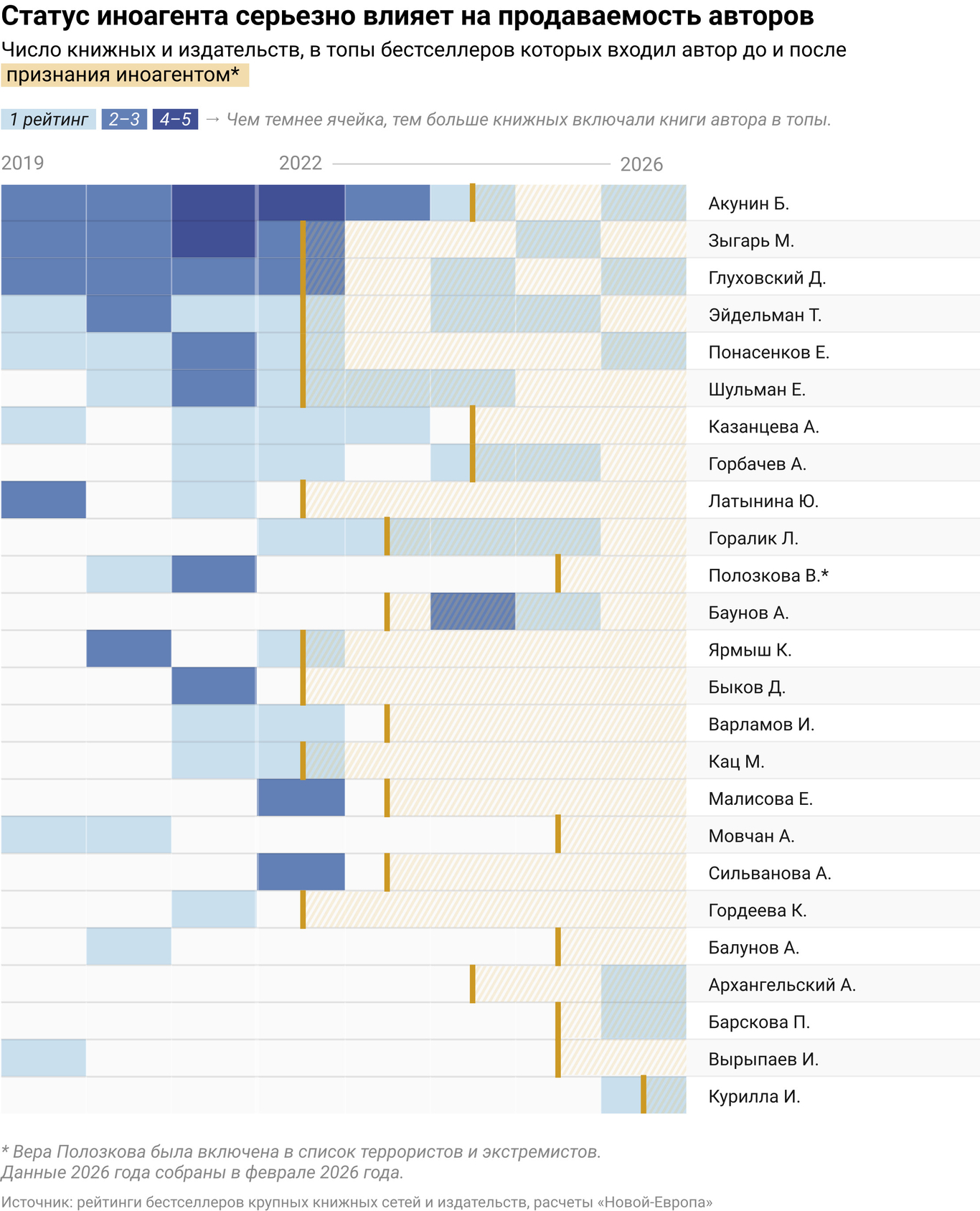
Viktor Shenderovich became the first writer - a “foreign agent”, on the eve of the war, in December 2021. With the beginning of the invasion, the practice became widespread. In the first year, the register of foreign agents was supplemented by Dmitry Glukhovsky, Mikhail Zygar, Dmitry Bykov, Tamara Eidelman, Yulia Latynina and others, as well as Bookmate, a company associated with Popcorn Books, personally Bookmate director Andrey Baev and Alexey Dokuchaev, the then head of Popcorn Books. In 2024, the Ministry of Justice recognized Boris Akunin as a foreign agent, and six months later the writer was sentenced to 14 years in a terrorism case.
Of the 29 foreign agents whose books were included in the bestseller ratings at least once, the most popular are Boris Akunin, Dmitry Glukhovsky and Mikhail Zygar. They entered the top list along with the classics of Russian literature and stayed there for more than one year. After 2022, their sales fell sharply. Censorship is working: books by foreign agent authors have almost disappeared from the bestseller ratings. Their books also began to be confiscated from libraries.
From the Wayback Machine service, where you can find saved copies of web pages, we downloaded the bestseller ratings of 11 major book chains and publishers: Book24 (the rating page has been available since 2016), Alpina Press (since 2021), AST (since 2018), Bookvoed (since 2024), Labyrinth (since 2009), Litres (since 2024), MIF (since 2008), “Subscription Editions” (since 2017), “Respublika” (since 2017), “Read City” (since 2012), “Eksmo” (since 2020).
Moreover, almost always only the first few pages of the rating were available on the Wayback Machine. So we uploaded book titles, author names and prices. We also downloaded the current ratings of these bookstores as of February 2026 with similar data.
To unify book titles (for example, the book "War and Peace" might be listed as "War and Peace. Volume 1" or "War and Peace: Volume I") and author names, we used the saiga_llama3_8b model. Also, using this model, we added information about the author's country. Next, using another model - gemini-2.0-flash - we added the genre of each work.
To calculate the change in the share of genres, we identified for each book its highest rating for the year (if a book took fourth place in the Litres rating and fifth place in the Bookvoed rating for 2026, then we assigned it fourth position for 2026). Since the download depth of sites and the size of ratings differ depending on the period and book, we limited our data to books with a position of up to 50.
In September 2025, the Russian Book Union published rules for the sale of books by such authors: they cannot be placed face down, the cover must be marked 18+, or the entire book must be wrapped in opaque paper. For violating the rules, the bookstore faces a fine of up to 500 thousand rubles.
At the same time, a ban on educational activities came into force, and it affected not only teaching, but also non-fiction books. In recent years, lists of foreign agent writers have increasingly included authors who study political, social, anthropological and historical topics: Nikita Smagin (“Iran to All”), Ksenia Luchenko (“Good Intentions”), Ivan Kurilla (“Americans and Everyone Else”).
If a foreign agent's book does not fall under the prohibition of educational activities, its publication is completely legal. But harsh sales rules negate the author’s prospects in working with a publishing house. Many people prefer to publish in tamizdat, that is, abroad: this is what Boris Akunin, who has his own publishing project, does, Nikita Smagin, Dmitry Bykov and many other authors.
Books published before the author was recognized as a foreign agent sometimes remain on sale for some time due to inertia. Therefore, even after being assigned the status, some authors still make it to the top of book networks.
In the first year of the invasion, the popularity of classic books with an anti-war message soared, for example, the works of Remarque and “The Dawns Here Are Quiet” by Boris Vasiliev, as well as literature about the Third Reich (“In the Garden of Monsters”, “Mobilized Nation”, “Notes of the Third Reich”) and Soviet repressions (the best-selling of them was Eugenia Ginzburg’s book of memoirs about camp life - “A Steep Route. Chronicle of the Times of the Cult of Personality”).
Purchasing anti-war literature became a way to express dissent. Russians began to buy collections of pacifist articles by Leo Tolstoy with the telling title “I Can’t Be Silent,” as well as “The Story of a German,” where the author Sebastian Hafner discusses, among other things, the fate of a “good German” under the dictatorship, or books in which a falling rocket is depicted in blanks.
“People in 2022 wanted to understand how we got to this life. This led to a great demand for highly social journalism and all sorts of books about the Third Reich. And now, in my opinion, we see, on the contrary, a very sharp rollback towards something so comforting and escapist,” says Galina Yuzefovich.
Fiction became “consolation”. According to the All-Russian Book Rating for the first half of 2025, 52% of books in the top 50 were fiction—8% more than a year ago.
Since 2021, the share of fiction has noticeably increased in most of the bookstores we downloaded. At the same time, the popularity of non-fiction has dropped noticeably.
Currently the top sellers are “The Sorrow of Satan” by the 19th century English writer Maria Corelli and “If All the Cats in the World Disappear” by the modern Japanese author Genki Kawamura. The philosophical story about accepting death has come at the right time, although it was published before the war.
Fiction is also growing due to love prose. Back in 2024, this trend was talked about in “Read City” - then sales of sentimental literature increased by a record 39% among all genres.
In 2026, the main works of this theme were the classics “A Night in Lisbon”, “Wuthering Heights”, “Pride and Prejudice”, “The Postwoman” by the young Italian writer Francesca Giannone, the modern 18+ novel “Kissing a Shadow” by Navessa Allen, the romantic fantasy “The Irresistible Desire to Fall in Love with Your Enemy” by Bridget Knightley and a collection of modern books in the genre of youth literature "Love in Arden City" by Sophie Henry.
In 2021–2022, the top best-selling authors, along with Viktor Pelevin, Vladimir Nabokov and Leo Tolstoy, included Boris Akunin, Dmitry Glukhovsky and Mikhail Zygar. Now they are actually banned, but in recent years new stars of modern fiction have appeared on bookstore shelves: Viktor Dashkevich (a series of books about a sorcerer in an alternative Russian Empire), Nastasya Renzhina (“Grandma Told You to Sit Quiet”), Svetlana Tyulbasheva (“Forest”).
Since 2019, bookstores have noticeably increased sales of domestic fiction—the average share of contemporary Russian works has increased from 10 to 15%.
As the general director of the Alpina publishing house told Forbes in 2022, those who left the Russian market accounted for about 70% of the books. “Import substitution” of authors is ripe in the book industry, since in the last years before the war there was already a demand for domestic literature, Galina Yuzefovich explained to Vetru. If earlier authors, for example, of youth literature, had to take foreign pseudonyms (Anna Jane, Antonina Crane, Una Hart), then in Covid times the trend has changed: Slavic fantasy, books about ourselves, based on Russian events or in a “native” setting familiar to the reader, have become popular.
But publishing houses were conservative: it was safer to take a popular foreign author, knowing that he was liked by readers in other countries, although this did not always mean his constant success in Russia.
“If it weren’t for the wave of sanctions, we would never have gotten [in the top sales list] either Dashkevich, Tyulbasheva, or “Grandma” [“Grandma Told You to Sit Quiet” by Nastasya Renzhina],” Yuzefovich sadly notes.
— In a word, it would be better, of course, if Russian authors were found, supported and promoted not due to external pressure or as a result of restrictions.
But I would say that this is one of the very few positive trends in the Russian book market,” the critic concludes.
Demand is growing not only for literature by Russian authors, but also for literature about Russia in general. According to major publishing houses and bookstores, immediately after the invasion began, Russians' interest in topics of history and military affairs increased sharply. This is also evidenced by the results of a survey of the book service “Strings”. Its larger competitor Litres is also seeing a peak in the popularity of books about Russian traditions (including “Orthodox cooking”) and literature about Moscow.
According to our data, books about the history and traditions of Russia entered the top popular genres for the first time in 2021 and are still there. Сейчас одна из самых продаваемых работ этой тематики — «Славянские мифы» Александры Барковой.
Другие популярные жанры — фэнтези и прочий фикшн, психология, мотивационная литература.
Книг про «СВО» уже так много, что они сформировали целое направление в современной российской литературе. Государство всячески поддерживает новую окопную прозу: уже не первый раз премия «Главкнига» награждает работы про войну. По итогам 2025 года лауреатом стал Евгений Журавли с «Линией соприкосновения», а в прошлом году — Даниил Туленков с романом «Шторм Z. У вас нет других нас».
Эта работа вынесла книгу Туленкова в топы бестселлеров в 2024 году, где она находится до сих пор. Но по-настоящему популярным жанром новая лейтенантская проза, в отличие от произведений ветеранов Великой Отечественной, пока не стала.
Впрочем, не стоит ставить знак равенства между книгами о войне и провоенными книгами. Текст Туленкова Юзефович характеризует как «абсолютно антивоенный по своему настроению»: «Это антивоенная позиция воевавшего человека, который это всё посмотрел близко и возненавидел так, как никакой либерал не способен возненавидеть».
Конечно, это не значит, что «Шторм Z» читают те, кто выступал против войны в феврале 2022 года. Чтение той или иной книги — это не форма присоединения к позиции автора. Интерес к Туленкову Юзефович объясняет так: «Там грубая, страшная окопная правда, не украшенная никакими рюшами патриотизма, — вот она читателю интересна, потому что это такой способ буквально вложить перста в живые разверстые раны. И она хорошо продавалась: 30 тысяч тиража абсолютно честного».
В реестре антиукраинских произведений, который регулярно обновляет Госкомитет телевидения и радиовещания Украины, на февраль 2026 года находилось 650 книг. И только шесть из них хотя бы раз попадали в топы по продажам:
Из книг, что не включены в украинский реестр, в списки бестселлеров попадали «Феномен украинского голода 1932–1933» Ивана Чигирина (в рейтинге «Лабиринта»), «Штурм Бахмута. Позывной “Констебль”» Александра Савицкого (Литрес), «ЧВК “Вагнер”. Chronicle: Donbass. Сирия» Николая Андреева («АСТ» и Book24) и «В начале было слово — в конце будет цифра» Маргариты Симоньян («Буквоед»).
Книгу Маргариты Симоньян в июле 2025 года издательство «АСТ» представило со стартовым тиражом 45 тысяч. К январю 2026-го суммарный тираж с допечатками насчитывал уже 100 тысяч экземпляров .
В пяти магазинах «Читай-города» первая партия книг якобы была раскуплена за 10 минут , а на данный момент счетчик покупок встал на 42 тысяч экземпляров (у них, вероятно, один счетчик на двоих с « Буквоедом », иначе трудно объяснить одинаковую цифру у двух магазинов). Несмотря на кажущуюся огромную популярность книги, на Livelib , где не первое десятилетие собираются оценки пользователей, прошедших регистрацию, средняя оценка опустилась ниже 3,5, а количество прочитавших на момент написания текста составляло 97.
В ноябре 2025 года РИА «Новости» со ссылкой на Россотрудничество заявило, что Симоньян за свой счет отправила книгу в Русские дома по всему миру. Русский дом сделал ошибку, спутав общий тираж с отправленными книгами (88 тысяч штук), но настоящую цифру так и не предъявил . На фотографиях на сайте Россотрудничества десятки книг на полках, а отправились экземпляры в 23 страны, от Чили до Туркменистана.
Спрос может быть также вызван огромным медиаприсутствием Маргариты Симоньян и административным ресурсом, в рамках которого возможны премиальные выкладки, широкая реклама, а также целевые закупки, как в Русский дом, в библиотеки по всей стране, независимо от читательского спроса. Насаждение подобной прозы в школах и библиотеках активно лоббируется .
В мае эту книгу внесли сначала в лонг-, а потом и в шорт-лист до этого очень респектабельной премии «Большая книга». Причем в длинный список внесли задним числом . Среди цитат книги из списка десяти лучших российских произведений в 2025 году можно найти такое: «Альфа Омега тоже улыбнется, от чего по его лицу солнечным зайчиком запрыгает ямочка».
В первом квартале 2026 года тираж книг упал на 26% по сравнению с тем же периодом 2025 года. Это рекорд минимум за шесть лет — хуже, чем в коронавирус, который книжники вспоминают с ужасом: в 2021 году на фоне пандемии в России выпустили на 19% книг меньше. Еще один обвал случился в первом квартале 2023-го — на 23%. Эти цифры шокировали индустрию, уже привыкшую к тому, что тиражи сокращаются, а новых авторов брать страшно: вдруг инвестиции не окупятся.
Изменились и цены на книги. Со времен ковида медианная стоимость бестселлеров выросла в два раза, при этом рост цен ускорился после 2022 года. Сейчас бумажная книга из списка бестселлеров будет стоить в сетевых магазинах и независимых книжных в среднем чуть больше тысячи рублей.
Главная причина — рост стоимость производства книг. Сразу после введения санкций стало понятно, что на отечественном рынке катастрофически не хватает сырья: не было в нужном объеме самой разной бумаги, красок и даже ниток для сшивания книжных «тетрадок». Со временем стали сказываться инфляция и сокращение тиражей: чем меньше тираж, тем больше себестоимость отдельной книги, а рисковать большими тиражами новых авторов издательство не может.
Владимир Харитонов, технический директор издательства Freedom Letters (тамиздат, печатается в Латвии и других странах), уточняет: «Цены на книги повышаются уже давно (что связано прежде всего с сокращением тиражей) и дополнительно разогнались в ковид». Он отмечает также, что далеко не все сырье удалось «импортозаместить»: «Восстановить полностью ассортимент не получилось, потому что заменить хорошую бумагу из Европы (прежде всего Финляндии) своей не вышло. Но научились делать свою офисную, на которой по преимуществу и печатают теперь».
Пострадали отдельные рынки, говорит он:
«Не очень получилось и с плотной бумагой для высококачественной цветной печати (это детская литература) — она тоже вся покупная, в том числе через третьи страны.
Очень сложно с оборудованием: новое только китайское (а это не всегда надежная работа), а старое ломается, ждать замены приходится долго — везут через третьи страны. Некоторые издательства до сих пор умудряются заказывать печать и везти тиражи из Европы, в том числе из Латвии. На цены это всё положительно, конечно, не влияет. И они будут расти и дальше».
Разные издательства прогнозируют удорожание книг в 2026 году еще на 10–20% для конечного покупателя, но медианный рост будет, скорее всего, на уровне 15%: резких скачков не будет, считает эксперт. «Если, конечно, чего-то внезапно не случится с экономикой в целом», — добавляет Харитонов.
Из-за дороговизны книг в розничных магазинах читатель вынужден переходить на маркетплейсы, где книги значительно дешевле. В 2025 году, по данным «Эксмо-АСТ», доля маркетплейсов среди каналов продаж печатных книг достигла 57,8%. Также продолжает расти популярность цифрового формата: по итогам 2025 года, как сообщил на пресс-конференции гендиректор «Эксмо», продажи электронных книг выросли на 45%.
Увеличение доли маркетплейсов в долгосрочной перспективе, как ни парадоксально, отучает читателя от покупки бумажных книг. Розничные магазины — это место притяжения, которое продвигает не только и не столько книги, сколько саму привычку чтения, в том числе в небольших городах. Потребителю, особенно покупателю детской книги, важно посмотреть книги «вживую», оценить печать. К тому же государственный контроль ассортимента в сотнях разных магазинах осуществить труднее, чем в крупной онлайн-сети и на маркетплейсе.
В своем канале Евгения Рыкалова, издательница и владелица книжного «Искатели» в Смоленске, описала меры, которые могут помочь независимым книжным, вроде релиза новинок на маркетплейсах через полгода после книжных, но такие меры издательства не поддержат.
Наоборот, маркетплейсы, скупающие книги большими объемами, в короткой перспективе выгоднее издательствам. В итоге и условия для них куда лучше, в том числе закупочные цены. Розничному магазину дешевле взять книгу на том же маркетплейсе и потом перепродать ее в своем магазине, чем идти на предлагаемые издательством условия . В такой ситуации конкуренция проиграна заранее.
Люди менее активно читают во всем мире. Это общая тенденция, которая иногда сдерживается отдельными феноменами типа буктока — популярностью бумажных книг в ТикТоке. Но нынешняя государственная политика РФ беспощадно усложняет жизнь книжным издателям. Книги становятся дороже, их покрывают огромными дисклеймерами про наркотики или иноагентство, страницы приходится закрашивать черными чернилами или менять сюжетные арки персонажей в угоду цензуре — всё это действует удручающе на книжную отрасль.
Весь этот комплекс ограничительных, цензурных и экономических мер ложится на издательства и книжные магазины финансовыми издержками. По описанию экспертов и редакторов, в феврале — марте 2026 года работы над новинками в издательствах и продажи в магазинах встали, потому что вся отрасль искала в уже вышедших книгах запрещенку, а потом клеила на нее дисклеймеры, вносила правки в макеты доптиражей, отзывала книги из продажи и так далее.
«Издатель заплатил денег за то, чтобы ему изуродовали обложку, заплатил за целлофан и маркировку 18+, и это сбило его продажи еще к тому же. Потому что 18+ и упаковка в пленку снижают продажи объективно. Книги становятся дороже, они становятся неудобнее. Для читателя они требуют каких-то дополнительных издержек, они несут в себе риски для издательства», — говорит Юзефович «Ветру».
Книжные магазины должны прошерстить склады, а издатели — изучить все верстки своих изданий, которых может быть несколько сотен тысяч. Отчасти это делается с помощью ИИ: система отмечает разные уровни опасности каждой книги и выделяет подозрительные фрагменты для редактора, а он принимает окончательное решение. Такая же логика действует для рукописей, приходящих редакторам от начинающих авторов, или переводов.
В ноябре гендиректор «Эксмо» Евгений Капьев шутливо жаловался , что ИИ относит к наркотикам слово «пиво», подтверждая участие искусственного интеллекта в цензурировании книг.
Эти проверки проводятся, потому что другой вариант — это вручную пролистывать и проверять книги, как это делают в книжных магазинах, поскольку ни перечни издательств, ни Российского книжного союза не могут быть исчерпывающими.
Некоторые наименования издательство просит книжные отозвать из продажи или запаковать по правилам (в зависимости от статьи, которую «нарушает» книга), некоторые — забирает из магазинов, цензурирует, возвращает на рынок. Если тираж закончился, то перед отправкой на доптираж опять же вносятся правки по согласованию с автором там, где это возможно.
Иногда цензуру отмечают черными полосами: первыми это сделал, кажется, «Эксмо», одним из лидеров по черным полосам стала книга о Пазолини «Умереть за идеи». По данным «Осторожно, новости» она на 20% состоит из черных прямоугольников .
Некоторые читатели покупают ручки с белыми чернилами и вписывают недостающие строки в книги от руки: в фандомах разных книг всегда найдется человек, который заглянет в оригинальную версию и переведет для всех.
Иногда авторы не знают о цензуре своих книг, особенно если это касается зарубежных писателей. Так, британский писатель Джейк Кристофф сообщил , что «АСТ» не стало согласовывать с ним купюры, внесенные в текст.
«Сказать, что я был в ярости, когда узнал об этом, — это ничего не сказать. Я понимаю, что политическая ситуация в России сложная и нестабильная для диссидентов и что Владимир Путин может многое контролировать. Но я не живу в России, и он меня не контролирует», — написал он и выложил бесплатно на своем Patreon вырезанные фрагменты текста, которые перевел на русский язык за свои деньги.
Издатели перестраховываются и ставят 18+ и клеят «наркотические плашки» во всех спорных случаях. Подобная маркировка автоматически влечет за собой отмену льготного НДС в 10% , предусмотренного для книжной продукции без подобных возрастных ограничений. Редакторам приходится закладывать в цену книги НДС в 22%.
Евгения Рыкалова в сентябре отмечала : «Главное, что отличает книжный магазин в России, — пленка. Так много затянутых в пленку книг я не видела нигде».
И это было еще до вступления в силу наркотических поправок. «Красивая и очень тактильная индустрия облачается в целлофан», — писала она.
В такой ситуации особенно важной становится поддержка независимых книжных читателями. И именно читатели закрывают штрафы розничных магазинов за ЛГБТ-пропаганду в не запрещенных еще вчера книгах. И именно читатели помогают закрыть долги, когда бизнес всё-таки прогорает: из уважения к книготорговцу, который проиграл битву с цензурой, экономическим кризисом и маркетплейсами в темное время.
Визуализация данных: Ксения Сторожева