
Translated material
"He lived only in a fevered imagination." Bloggers talk about the “spirit of Anchorage”
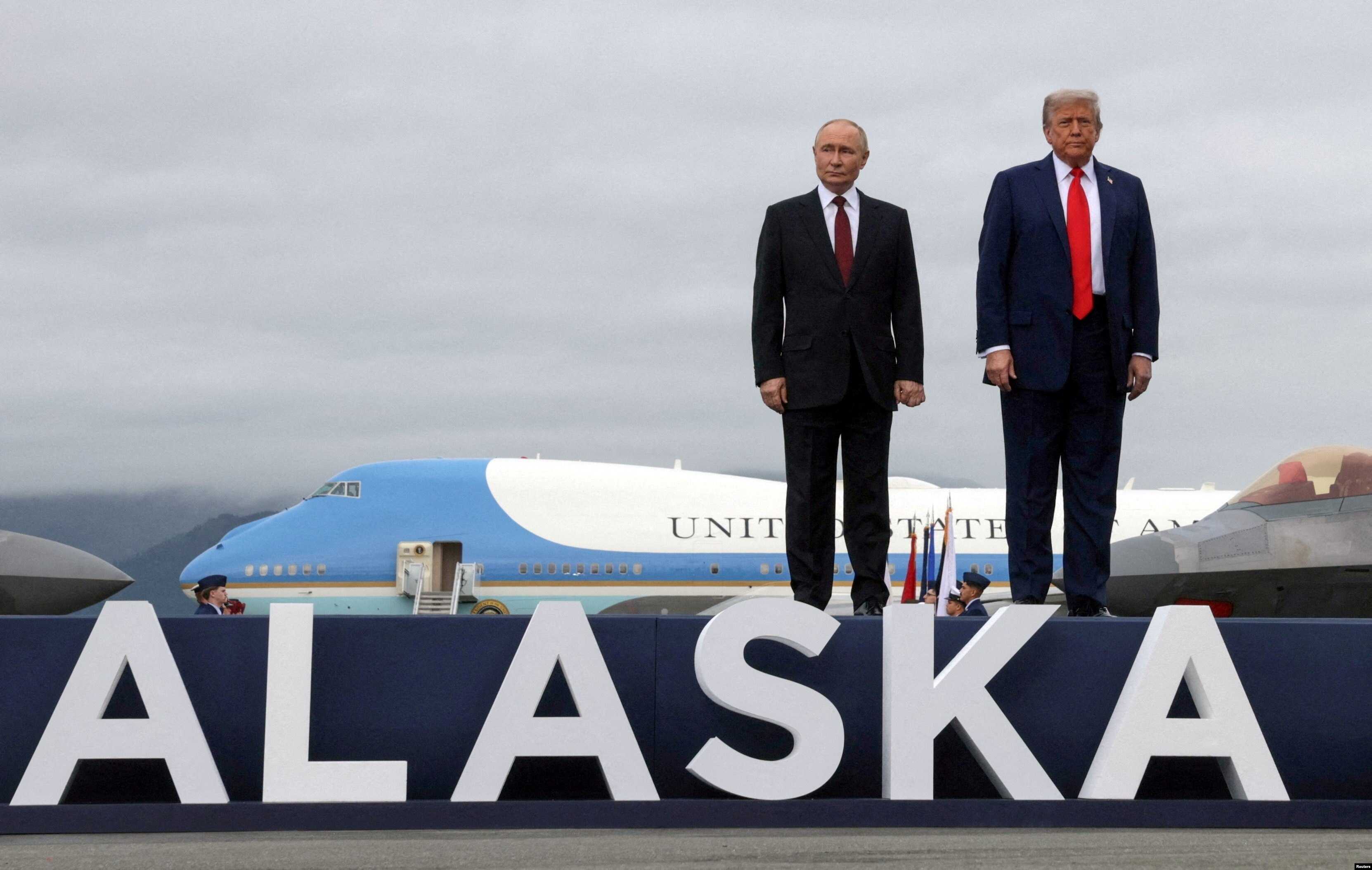
On Sunday, June 28, Ukrainian Foreign Minister Andriy Sibiga wrote on the social network X: “Reality clearly shows: if the “spirit of Anchorage” existed at all, then it is certainly dead.” Sibiga commented on statements about the “spirit of Anchorage” as in recent weeks Moscow has increasingly referred to certain agreements that the United States and Russia allegedly reached during last year’s meeting of the presidents of both countries in Anchorage, Alaska. Russia claims that the framework for agreements to end the war in Ukraine already exists, while US Secretary of State Marco Rubio refutes these claims.
Bloggers are discussing what the "spirit of Anchorage" is, trying to predict what to expect in the future - due to the fact that all parties involved in negotiations to end the war in Ukraine admitted that there were no concrete agreements at issue in Alaska. During the Russia - US summit on August 15 last year, no documents were signed.
Spirit of Anchorage.
There are many mysterious entities in international politics.
There is international law. There are security guarantees. There are red lines. There are concerns.
And now the Spirit of Anchorage has appeared. This is a very interesting phenomenon.
Almost no one has seen Anchorage itself. Nobody really knows what exactly was agreed upon there. Each side tells its own version. But the spirit remained. And now a big diplomatic struggle is unfolding around him.
The situation is reminiscent of an old church dispute about the nature of the Holy Spirit.
Only instead of theologians, presidents, foreign ministers and Bloomberg analysts speak.
Some claim that the Spirit of Anchorage exists. Others believe it exists but misunderstand it. Still others hope to perform an exorcism. And still others pretend that there never was any spirit.
Europe, meanwhile, decided to return to the big game.
In recent years, she resembled a passenger in a car who sat in the back seat for a long time, and then suddenly leaned between the seats and told the driver that now was the time to sharply turn the steering wheel. And preferably at speed.
The logic is simple.
If there is a certain negotiation process, then Europe must become its main participant.
If there is a possible compromise, then an alternative compromise must be proposed.
If there is an agreement, then it is necessary to discuss the possibility of revising it even before it is implemented.
Otherwise, why does diplomacy exist at all? After all, diplomacy is the art of finding new solutions to problems that have not yet had time to create old solutions.
The fight for influence over Trump is especially touching.
Now it seems that the entire Western world is engaged in a kind of spiritualistic practice.
One group of participants is trying to summon the Spirit of Anchorage. The other is trying to drive him out.
Trump himself at this time resembles a medium who is not entirely sure what kind of spirit he evoked several months ago and whether he evoked it at all.
Therefore, everyone carefully watches his every word.
If he remains silent, this will be a signal. If he speaks, this will also be a signal. If he says one thing, the market will draw conclusions. If he says the opposite, analysts will explain that this is exactly what he meant from the very beginning.
Modern diplomacy has generally reached amazing heights.
In the past, states discussed territories, armies, and treaties.
Now they are increasingly discussing interpretations of interpretations of interpretations.
Reality is gradually giving way to metaphysics. Is there an agreement? Unknown. Is there an obligation? Controversial
Reality is gradually giving way to metaphysics.
Is there an agreement? Unknown.
Is there an obligation? Debatable.
Is there a spirit of agreement?
Now this is a serious question.
That's why European diplomats go to Moscow.
Moscow diplomats send signals to Washington. Washington sends signals back. After which everyone gathers and discusses the meaning of the previously sent signals. From the outside it may seem that no one is agreeing with anyone.
But this is a wrong impression. In fact, everyone constantly agrees on how the lack of agreement should be understood.
The main problem is that each side is sure that time is on its side.
Europe believes that the situation is changing in its favor.
Moscow believes that time is working in its favor.
Kyiv thinks the same.
Washington periodically considers several mutually exclusive things at once.
The result is a unique diplomatic construct.
Everyone is waiting for someone else to be the first to recognize the new reality. But no one wants to admit it themselves.
It's like four people standing at a closed door, convinced that the other three have the key.
The particular tragedy of the situation is that all parties are simultaneously talking about peace and at the same time preparing for a scenario in which there will be no peace. Each new initiative is presented as a step towards de-escalation.
After which plans are published in case of further escalation. And no one sees a contradiction in this. Because contradiction has long been the main principle of international politics.
But the most interesting thing remains the Spirit of Anchorage.
It has long ceased to be a diplomatic agreement.
He has become a political ghost. Everyone talks about him. Everyone refers to him. Everyone is trying to use it to their advantage. And no one can present it to the public.
Perhaps one day future historians will open the archives and find out what really happened.
But it won't be that interesting.
Because the real power of diplomatic ghosts is not that they exist.
The problem is that people begin to behave as if they exist.
And this, as history shows, often turns out to be much more important.
“There was no agreement in Anchorage” The “spirit of Anchorage”, which Moscow loves to talk about, turned out to be an odor from Putin’s suitcase. pic.twitter.com/sIILLRn6LI
— Val Michel (@VALMICHEL7) June 27, 2026
The spirit of Anchorage has completely died. Or rather, he lived only in the fevered imagination of an elderly Russian dictator.
US Secretary of State Marco Rubio has already stated that there were no agreements, no ghosts in Alaska)) according to Rubio, only a proposal was made there. But it never became an agreement.
That is, it is already clearly clear that the White House has finally changed its position on the war in Ukraine. And the Russian side really doesn’t like this position. This was confirmed by Lavrov, who said that Russia does not understand the changed position of the United States and that it now needs to be thought about. Well, think, think))
French President Emmanuel Macron also announced a change in the position of the American leadership. He noted that for the first time the United States approved a text stating that it is no longer a neutral mediator in the Russian-Ukrainian war. It says that the United States supports the territorial integrity of Ukraine, provides military assistance, helps with energy and imposes sanctions against Russia. By the way, yesterday the United States renewed sanctions against Russian oil. So much for the spirit of Anchorage)))
Here's the perfect combination:
Harry Potter and the Spirit of Anchorage
The spirit of Anchorage has died
He looked like a wandering ghost of communism
Putin gave an interview today and announced important news: “no agreements were reached” at the meeting with Trump in Anchorage. But Russia, he said, still agreed to compromises. Which ones are unknown.
For a year and a half, the Kremlin lived in the “spirit of Anchorage.” The spirit hovered over the negotiation process, filled it with meaning and gave Moscow the moral right to reproach Washington for disrupting certain agreements - which Putin himself now says did not exist.
Secretary Rubio responded briefly: there was no agreement in Anchorage. Dot.
Ukrainian Foreign Minister Andrei Sibiga summed it up best: “The Russians love to talk about the ‘spirit of Anchorage’. As with any spirit, no one knows exactly what it is. But the Russians believe in it - and believe that everyone else should believe too. The reality shows one thing: if this spirit existed at all, it is dead. Any peace plan developed without the participation of Ukraine is doomed to become a spirit and disappear.”
Any peace plan developed without the participation of Ukraine is doomed to become a ghost and disappear
Ryabkov disowned the phrase “spirit of Anchorage”
The word “impulse” turned out to be closer to him
Deputy Foreign Minister of the Russian Federation Sergei Ryabkov said that he never spoke about the “spirit of Anchorage,” a Vedomosti correspondent reports.
“I don’t summon spirits, I don’t engage in table-turning. I never spoke about the spirit of Anchorage. I spoke at one time about impulse, I did not use the word “spirit”,” he said.
In May, Russian Presidential Aide Yuri Ushakov also disowned the formulation.
Press Secretary of the Russian President Dmitry Peskov said that the “spirit of Anchorage” is a set of mutual understandings between Russia and the United States on the conflict in Ukraine, which was discussed by leaders Vladimir Putin and Donald Trump in Alaska on August 15, 2025.
On May 22, Ryabkov, commenting on the relevance of the formulation “spirit of Anchorage,” told Vedomosti that it does not matter what this process is called in the United States. According to him, the main thing remains to maintain the mood at the highest level in Russia and the United States to continue “constructive work in the Ukrainian direction.” vedomosti.ru
The "spirit of Anchorage" has faded. Possibly after airing. The United States did not issue an entry visa to Deputy Foreign Minister of the Russian Federation Alimov to participate in the discussion at the UN. The case is unprecedented, since the States did not give a visa to anyone to work at the UN. Fidel Castro, for example.
And here the entire Deputy Minister of Foreign Affairs of the fraternal Russian Federation did not receive a visa! Apparently, the Americans decided that the stench regularly emitted at the UN building in New York by the Russian representative Nebenzey was more than enough. Don’t sit at meetings wearing gas masks, my word...
But seriously, the Americans made this diplomatic demarche just a few hours after a telephone conversation between US Secretary of State Mark Rubio and Russian Foreign Minister Lavrov. The latter became so outraged in this conversation that he threatened to kill American diplomats in Kyiv. No more, no less.
Moreover, Putin’s stable, in its stupidity, published a summary of this conversation on its website: “On instructions from the President of the Russian Federation V.V. Putin, S.V. Lavrov officially conveyed to the American side the information that... The Armed Forces of the Russian Federation are launching systematic and consistent attacks on facilities located in Kyiv, used for the needs of the Armed Forces of Ukraine, and on the centers for making relevant decisions. ... The United States, along with other states, having representative offices in Kyiv, it is recommended to ensure the evacuation of their diplomatic personnel and other citizens from the Ukrainian capital."
The fact that this death threat is addressed specifically to American diplomats follows from the fact that Putin and Lavrov did not issue such public “recommendations” to their Chinese friends.
The reaction of the Americans, as we see, was almost lightning fast. There can be no talk of any withdrawal of the American diplomatic mission from Kyiv. Mr. Alimov is free. He can hold discussions with Simonyan in Moscow or Sochi, but definitely not in New York.
However, this diplomatic demarche appears to be just the tip of the cracking iceberg of US-Russian relations. Their honeymoon is coming to an end.
On the same day, it became known that the Americans gave consent to Poland to produce missiles for the Patriots.
At the same time, according to Spiegel, Washington made it clear that it would maintain nuclear deterrence in Europe, and in the event of a major war it would come to the aid of its European allies. The latter, represented by the German-Dutch armed forces, will soon deploy a 60,000-strong group near the borders of Russia and Belarus.
Under these conditions, the speaker of the Russian Duma, Volodin, again threatened the world with nuclear Armageddon. True, it’s somehow sluggish. Maybe something happened to the voice?
A liar for life. To believe this is not to respect yourself. Vedomosti. June 4, Putin: Ukraine is not ready for the compromises that were agreed upon in Anchorage. Vesti. June 28, There really were no agreements in Anchorage - Putin pic.twitter.com/9hI2jzMZoG
— ⭐️Oles Filonenko⭐️ (@FilonenkoOles) June 28, 2026
About "spirit"
Since childhood, as long as I can remember, I have heard about the “spirit” of negotiations from Soviet propaganda.
Remember: “the spirit of Reykjavik”, “the spirit of Helsinki”? Today we often hear about the "spirit of Anchorage." Here, for example, are a few quotes (I apologize for the authorship). Putin: “We felt that very “spirit of Anchorage” - pragmatic, without unnecessary emotions, aimed at results. This is the spirit of people who understand the value of real agreements, and not just political declarations.” Or Lavrov: “In diplomacy, sometimes the “spirit of negotiations” weighs more than the letter of the protocol. If there is trust and a common understanding of goals, then the spirit of the meeting itself leads us to the right decisions.”
But you say: Western politicians also use this expression. Yes, but, as far as I know, in the Western political tradition, “the spirit of...” has slightly different functional connotations and is more often associated with a value foundation. When partners talk about the “spirit of NATO” or the “spirit of the EU,” they most likely mean meeting democratic standards, not just meeting technical points.
Since we have understood the differences, I propose to “dig” into the Russian interpretation. It seems that for the Russian diplomatic school, appealing to the “spirit” of the meeting is not just an expression, but a thoughtful instrumental method that performs several important functions in their foreign policy.
Here's how it works, let's say, "under the hood".
This term perfectly fills the vacuum in the absence of signed documents or written agreements
Let's probably start with the historical tradition. This is an ingrained habit of Cold War "high diplomacy" that emphasizes the USSR's status as an equal partner of the United States. When Putin uses this term, he implies that he is still playing in the “major league” and is conducting conceptual conversations about the fate of the world.
Also, this term perfectly fills the vacuum in the absence of signed documents or reached written agreements. When negotiations end without concrete agreements being signed (as often happens in complex conflicts), the Kremlin needs to demonstrate to internal and external audiences that the visit was a success. In this case, “spirit” is an ideal substance that cannot be verified by facts. If there is no agreement, then there is a “spirit of mutual understanding” that allows you to interpret the results as you wish.
At the same time, this is also a diplomatic “trap” for a partner. Russians invoke “spirit” to impose certain moral obligations on their opponents that do not exist on paper. What are we hearing from the Russians now, after the meeting in Anchorage? "This is contrary to the spirit of our agreement." That is, this is an attempt to accuse the other side of “unfair play,” even if nothing was formally violated.
And ultimately, this may be an element of psychological compensation. An appeal to the “spirit” is often used when Russia’s position is objectively weakening. When real concessions cannot be achieved, diplomats focus on the “spirit of constructive dialogue.” This allows us to save face: they say that we did not retreat under pressure, but “reached mutual understanding in the spirit of mutual respect.”
It is interesting that if the Soviet “spirits” fixed parity with the United States, the current ones are only trying to disguise the loss of control.
The conclusion is simple - we continue to cut this rock.
This is the spirit of Anchorage pic.twitter.com/n8oVEU5GuT
— Team of Zina Portnova (@Zn_Portnova) June 29, 2026
In my opinion, these photos (we’re talking about photos from a short meeting between Donald Trump and Vladimir Zelensky on June 16 on the sidelines of the G7 summit - Note RS) are cooler than all the ceremonial photos from state visits. I can imagine how jealous the putler is coming from. He cannot afford to talk to Trump like this, between meetings, at a summit with the world’s highest political elite, about issues that concern him, as Zelensky does. He belongs there. And ours was thrown out from everywhere. Our stump with an arrest warrant will be remembered by the spirit of Anchorage until the grave.
Spirit of Anchorage. Sixty years ago, the Beatles made a brief stop in Anchorage on their way to Tokyo. The reason for the change in route was a strong typhoon. The musicians spent the night of June 27-28, 1966 at the Anchorage Westward Hotel (now called the Hilton Anchorage). Local radio then announced unexpected guests, and several hundred music lovers crowded around the hotel in the hope of seeing their idols. In vain.
Evening Newsletter - Subscription widget compact Read Freedom on Telegram Make Freedom a priority source on Google  Install the Mobile application
Radio Liberty