
Translated material
Neither Captain Ivanov. Dmitry Bykov* starts racing on carriages
On June 26, at the age of 73, Sergei Ivanov, the former defense minister, head of the presidential administration and deputy prime minister who competed with Dmitry Medvedev to succeed Vladimir Putin in 2008, died. Writer Dmitry Bykov takes a principled and compassionate look at Sergei Ivanov’s path from the KGB Higher School to the VTB United League, the organization that announced his death.
“Like these wreaths, several thoughts born of this death stand and do not disperse,” Pasternak wrote to Fadeev after Stalin’s death; the death of a tyrant is at least capable of causing a few thoughts in the poet. Ivanov, of course, is not a political figure of that caliber - but I’m not Pasternak either, so the proportion is respected, and several thoughts caused by Ivanov’s death seem to me worthy of publication.
It’s already interesting that there are several of them: when a large-scale, but not particularly significant event takes place, which billions are waiting for (yes, it happens, large-scale in consequences, but insignificant in essence), there will be only one thought: “Finally, thank God!” Although it is possible that Russia, with its ability to mourn any past and compromise any future (it seems that these abilities are interconnected), will also cry for Putin: at least in the desire for his departure - in any form - many were united, who after him would completely quarrel.
Thomas Mann - this German Pasternak, not particularly loved by Pasternak precisely for this symmetry - was deeply right when, in an extensive afterword to Doctor Faustus (A Novel of a Novel), he formulated:
“Hitler had one special quality: he simplified feelings, causing an unshakable “no”, a clear and deadly hatred. The years of struggle against him were a morally beneficial era.”
There is no doubt that this - and only this! — in terms of the Putin era, it is morally more beneficial than the bloody chaos that will follow. It will come. It will inevitably come. You know that. Therefore, there is nothing, nothing.
Sergei Ivanov, due to his biography, is a much smaller figure, and he managed to sin less - precisely because at some point Vladimir Putin was afraid to make him his successor. He forgot about the great proverb “It is better to lose with a smart person than to find with a fool.” I will note right away that the stable idea of Sergei Ivanov’s intelligence and high professionalism seems to be not supported by anything - if he were smart in the true sense of the word, he would have lived a different life with different results; but apparently Ivanov’s mind was rather pragmatic, mechanical. In such a mind the saving Cincinnatus thought “What, exactly, am I doing here?” cannot come. (“Why am I lying like this?”) - and therefore he first graduated from the KGB Higher School, then turned out to be Putin’s comrade-in-arms, then a successor, then a failed successor - and finally a retiree who quietly lived out his days in invisible positions. If he were smart in the highest sense, he would immediately understand that Putin would act according to another proverb: “They will anoint you and show you, but won’t give you anything to eat,” and therefore, instead of living out your life, you would choose life. But was it too late to make such a choice in 2008?
Ivanov understood perfectly well (if he was really smart) that he was being promoted as a scarecrow - now, bear with Medvedev, otherwise he will become a hawk. I think that the reputation of the hawk was greatly exaggerated. Many are now expressing the version that Ivanov, even if he was a hawk, would have been better, precisely because he would not have allowed Putin’s return to the post to be carried out so smoothly, now finally and forever. It is quite possible that he would actually have won a second term for himself (and could have relied on the security forces or the army, in which environment he was clearly more popular than Medvedev, who was only popular on Dozhd**, and even then not for long).
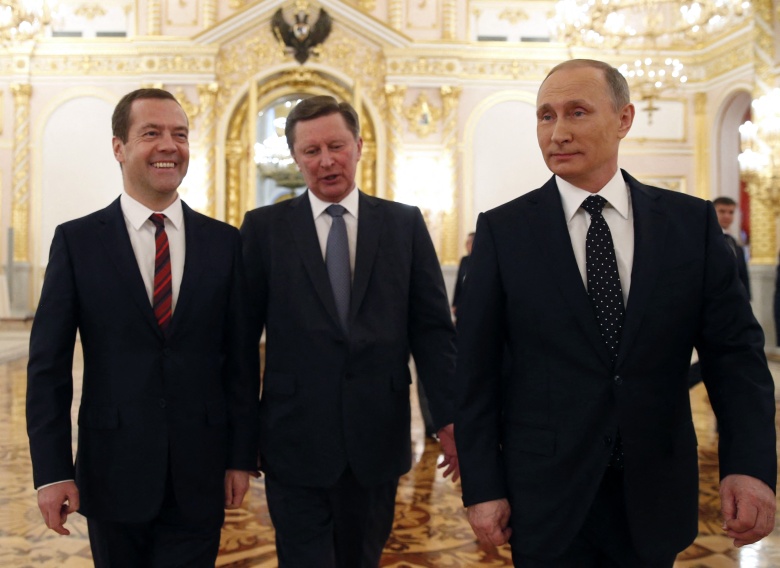
Dmitry Medvedev, Sergei Ivanov and Vladimir Putin in the Kremlin on December 3, 2015
AFP PHOTO / SPUTNIK / DMITRY ASTAKHOV
Further events branch out: the version about the possible benefit of Ivanov’s succession reminds me of the idea about the advantages of Zyuganov’s victory in 1996 - they say, it would have been a premature birth, the people were not yet ripe for full-fledged revanchism, the short-term communist revenge would have fizzled out by 2000, and then, having compromised the past and the red-brown cocktail for the second time, it would be possible to calmly move along the democratic path. But here it all comes down to the unpredictable, irrational status of the Russian first person: here both the stupid Zyuganov, who did not want to win at all, and the hypothetically smart Ivanov could feel the very messianism that poisoned Putin.
Subscribe to read in full
Subscribe to Redefine.Media to read Republic
Subscribe [You can pay with a Russian or foreign card. The subscription is renewed automatically. You can unsubscribe at any time.]
Where does the subscribers' money go?