
Translated material
Lavrov and Rubio met in Manila
On February 8, 2024, DOXA was added to the register of “undesirable organizations.”
If you are in Russia or planning to return to it, you cannot repost our materials on social networks, link to them or publish quotes.
Read more about what is and is not possible in the cards .
Russian Foreign Minister Sergei Lavrov and US Secretary of State Marco Rubio met in Manila in the Philippines on the sidelines of the ASEAN summit ASEAN (Association of Southeast Asian Nations) is the Association of Southeast Asian Nations, a regional organization uniting 10 countries: Indonesia, Malaysia, Singapore, Thailand, the Philippines, Vietnam, Laos, Cambodia, Myanmar and Brunei. Created in 1967 to develop economic and political cooperation and maintain regional security. The annual ASEAN summits also serve as a platform for world leaders to meet and negotiate international issues . According to the official representative of the Russian Foreign Ministry Maria Zakharova, the negotiations took place at the initiative of the American side and lasted about 35 minutes. Since the beginning of 2025, this is the fourth meeting between Lavrov and Rubio - they previously held talks in Riyadh, Kuala Lumpur and New York.
What was discussed at the negotiations?
Following the negotiations, the Russian Foreign Ministry reported that the parties had a “detailed exchange of views” on a wide range of bilateral and international issues. One of the main topics was the war in Ukraine. According to the Russian Foreign Ministry, Lavrov told the American side about “the real state of affairs on the line of combat contact,” spoke out against further arms supplies to Kyiv and confirmed Moscow’s readiness for a “political and diplomatic settlement.” The Foreign Ministry also stated that Russia remains committed to the proposals put forward by the American side at the summit of Vladimir Putin and Donald Trump in Anchorage.
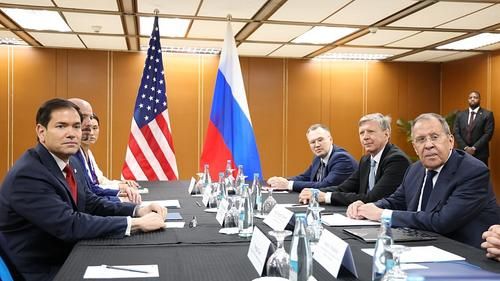
Marco Rubio and Sergei Lavrov at a meeting in Manila, July 23, 2026
Press service of the Russian Foreign Ministry
Marco Rubio, in turn, called the conversation “good and frank,” but stressed that there is no point in expecting the war to end soon. According to the Secretary of State, the negotiation process, which began after the summit in Anchorage, has actually reached a dead end. “The negotiations in Anchorage failed, we need to come up with new ideas,” he said. Rubio noted that previous proposals were unacceptable for Ukraine, so “new ideas and new concepts” are needed to continue the dialogue.
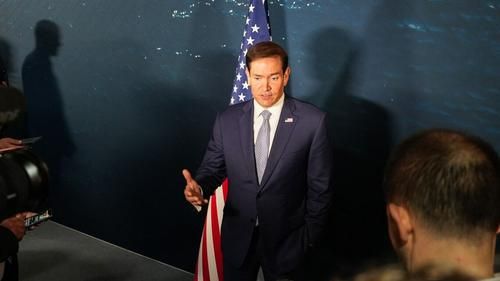
Marco Rubio makes a statement following negotiations with the Russian delegation
Mateo S. Melendy / Official State Department
The Secretary of State added that Washington is ready to continue searching for a compromise solution and, if necessary, offer its own settlement options. He also stated that the United States is open to further contacts with the Russian side. According to Rubio, Donald Trump still considers ending the war one of his foreign policy priorities, and the United States remains the only country capable of mediating negotiations.
What else did you have time to talk about?
In addition to the war in Ukraine, Lavrov and Rubio discussed the situation in the Persian Gulf, the work of the diplomatic missions of Russia and the United States, the development of interparliamentary and cultural ties, as well as the possible resumption of cooperation between Roscosmos and NASA. Following the meeting, the parties agreed to continue contacts through foreign affairs agencies, including within the framework of international organizations.
On the eve of the negotiations, Lavrov said that he intended to discuss with Rubio Donald Trump’s statements about the possible advancement of the peace process, as well as proposals that, according to Moscow, were put forward at the summit in Anchorage. Rubio, in turn, even before the meeting called the war in Ukraine one of the key topics of the negotiations, but refused to answer the journalist’s question about whether Russia’s alleged assistance to Iran would be discussed.
After the negotiations, Russian Presidential Press Secretary Dmitry Peskov urged not to wait for rapid progress. According to him, it is too early to talk about a new stage of negotiations, although he called the preservation of contacts between Moscow and Washington a positive signal.
Context
The meeting between Lavrov and Rubio took place against the backdrop of a Bloomberg publication about a possible toughening of the Russian position in future negotiations. According to the agency's source, the Kremlin is no longer considering the possibility of returning part of the occupied territories to Ukraine and intends to maintain the occupied areas of the Sumy and Kharkov regions under its control, considering them as a “buffer zone.” The publication's interlocutors also claim that Vladimir Putin still expects to establish full control over the Donetsk region and associates the resumption of negotiations with achieving this goal.
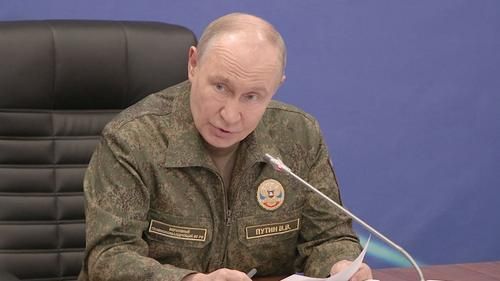
Vladimir Putin at a meeting at the point of the joint group of troops, July 4, 2026
Kremlin press service
According to Bloomberg, Moscow also abandoned the idea of territorial exchange, since it considered the informal agreements, which, according to the Kremlin, were discussed with Donald Trump during the summit in Anchorage in August 2025, to be no longer valid. Washington previously denied the existence of such agreements. In June, Marco Rubio said that only possible options for ending the war were discussed in Anchorage, but no agreements were reached. Vladimir Putin gave a similar assessment, noting that the discussion was about compromises and possible settlement options, and not about signed agreements.
Meanwhile, the fighting continues. Ukraine advocates a ceasefire along the existing front line and rejects Moscow's demand for the transfer of the remaining part of the Donetsk region. Russia, in turn, is intensifying drone and missile attacks on Ukrainian cities. At the same time, fierce battles continue for the area of Konstantinovka, one of the key logistics hubs of the Ukrainian defense in the Donetsk region. The American Institute for the Study of War (ISW) estimates that Russian troops control about 80% of the region's territory, but the institute's analysts note that even at the current pace of the offensive, the prospects for a complete capture of the region remain uncertain.