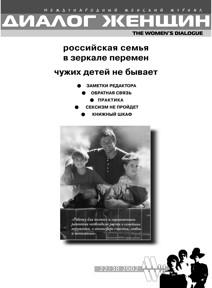
The Women’s DialogueMagazinePart of: The Women’s Dialogue "We / Мы"Independent sourceMaterialsIssuesInfoFound 25 materialsBy relevanceOldest firstNewest firstBy relevanceThe Women’s Dialogue·№ 22 (38)·05/15/2003We are different, but equalThe International Conference of Journalists of the Mass Media for Gender Equality was held in Tbilisi. It was organized by the Association of GenderMediacazaz and was held with the support of the Bureau for Democratic Institutes and Human Rights for Organization for Safety and Cooperation in Europe (OSCE BDIPC). The conference was attended by media representatives from 7 countries in Georgia, Armenia, Azerbaijan, Uzbekistan, Kyrgyzstan, Uzbekistan, Estonia.Галина ПетриашвилиThe Women’s Dialogue·№ 22 (38)·05/15/2003[Without heading]Journalist-gender, journalists-gender. “We will achieve liberation with our own hand ...” It is natural that the conversation about justice is the one whom this justice bypassed. In our case, it is natural that women raised the problem of gender equality - in particular, women from the non -governmental sector. It was from the bowels of the female and human rights movement that the “gender” impulse went.The Women’s Dialogue·№ 22 (38)·05/15/2003[Without heading]Improving Women's Rights and Responsight Parenthood in Uzbekistan Improving Women's Rights and Responsight Parenthood in Uzbekistan. International Seminars. Tashkent, Samarkand, Bukhara 2003.The Women’s Dialogue·№ 22 (38)·05/15/2003There are no other people's childrenIt leads to the fact that the eldest child is in the role of a parent in relation to the adoptive, which prevents the adopted child from taking responsibility for his actions, i.e. It prevents his personal growth. 4. Emotional rejection of the adopted child by one of the spouses or both. It leads to confrontation and is subjective to all family members as psychological discomfort. Naturally, not all mistakes can be corrected in time.The Women’s Dialogue·№ 22 (38)·05/15/2003AmericansOn which the congressman and her daughter were captured with D. Bush. For far from business costumes in which there were heroes in the photo, I concluded that the photograph was taken in a normal informal setting. I looked at the table sitting on the table with even greater interest, putting my legs on a lower table, a woman. Not - large, thin, with bright hair - she did not impress a serious politician. But, nevertheless, it was such.The Women’s Dialogue·№ 22 (38)·05/15/2003PracticeValuable historical casket. Here we met Vera de Busharan, the manager of the Open Peace program, and Natalya Dombrovskaya, the coordinator of this program, after which we began six hours of work. And since our program was called “Female Leadership”, we began our conversation with the discussion of the concept of leadership. We talked about who can become a leader and how we (young girls who have already achieved something in life) become more effective managers, real leaders in their field.The Women’s Dialogue·№ 22 (38)·05/15/2003Gender media measurement“Gender Media Dimension”, Almaty 2002. The study was conducted by the Feminist League of Almaty with the support of the Soros-Kazakhstan Foundation. The publication was supported by the OSCE representative office in Kazakhstan. Media: consumers and manufacturers of products. Gender preferences and differences.The Women’s Dialogue·№ 22 (38)·05/15/2003Art - Therapy is great!In adolescence, I was fond of art, and did not consider it therapy. In college, art became my main object and I began to realize the need to draw when I wanted to emotionally calm down. Most of my art classes took place in the family, and more specifically, with my brothers, who were adopted from different countries - Paraguay, Russia, as well as in my homeland in Puerto Rico. Since one of my brothers was adopted in Russia, a Russian doctor from his orphanage stopped visiting us for a week.Эмили Мерц*The Women’s Dialogue·№ 22 (38)·05/15/2003"Women's innovative projects" 10 years!“We/we” congratulates colleagues, friends and associates and wishes them success, victories and inspiration. As well as continuing joint work. East - West: “Women's Innovative Projects” Men's innovative projects (completely - ROO “East -West: Women's Innovative Projects”), his leaders - Galina Grishina, Natalya Babich, Alla Denisova, the chief editor of the Woman +magazine, Irina Rylnikov, many people know in Russia.The Women’s Dialogue·№ 22 (38)·05/15/2003PracticeThe lamity of the journalists themselves. Over the past years, the Association of Journalists and the Union of Journalists of Russia conducted consistent educational and educational work in the field of gender education, in particular, national competitions, conferences and seminars on the problem. At the same time, experience showed that in order to overcome gender stereotypes and sexism in the media it is necessary to conduct wide media campaigns.The Women’s Dialogue·№ 22 (38)·05/15/2003Editor notesEvery summer, especially so hot as it turned out now almost throughout Russia, is a real headache for many women (and men). Where to send children from the city? How to find the opportunity to relax ourselves - not very expensive and at the same time with comfort? How to find a vacation for the whole family? Perhaps the last is the most difficult.Ваша Надежда АжгихинаThe Women’s Dialogue·№ 22 (38)·05/15/2003Appeal of the expert group of the project “Combating discrimination on the basis of gender in the media:“ No sexism! ””The prosecutor’s office of the Russian Federation systematically monitor the passage of cases related to discrimination on the basis of gender, in particular, the case related to the termination of the radio broadcasting of the only female radio station “Nadezhda” (No.The Women’s Dialogue·№ 22 (38)·05/15/2003Socialization of children without parental care, in the Samara regionThe current stage of social services for family and children in the Samara region begins in 1991. In September 1991, the executive branch begins to actively implement a socio-economic policy aimed at preventing negative and the development of positive social phenomena.Т.Н. Штейн, Т.Ю. КлимешоваThe Women’s Dialogue·№ 22 (38)·05/15/2003The plan of the actions of non -governmental organizations for the prevention and reduction of the scale of children's homelessness, neglect and social orphanageIn the last decade, due to the prevailing adverse socio-economic conditions and the crisis state of society, the scale of childhood homelessness, neglect and social orphanhood has catastrophically increased. There are different assessments of the scale of children's homelessness and neglect: from 150 thousand to 5 million (N.A. Shakhina). According to the study under the leadership of academician RAEN N.M. Rimashevskaya, in Russia there are about 2.8 million street children.The Women’s Dialogue·№ 22 (38)·05/15/2003House of a child in MoscowFor three months of my life in Moscow, I worked in the child’s house on the outskirts of the city. I learned about the system of orphan houses and met staff. Children move from group to group and change educators when they grow up, and if their health or behavior change. Although the system disappointed many educators, those who withstood it served as a source of inspiration for me. I visited each group, spending about two weeks in each.Previous12NextShow more