
Оригинал материала
Double the dead
Federal mortality data suggests at least 64,000 Russian soldiers have died fighting in Ukraine
On June 27, Russia’s Federal Statistics Service (Rosstat) published the country’s annual mortality data for 2023. Like that of the previous year, the new data shows a sharply elevated excess mortality rate among young men relative to the situation before Russia’s full-scale invasion of Ukraine. Last year, Meduza and journalists at Mediazona worked with Tubingen University statistician Dmitry Kobak to estimate the Russian military’s total losses in 2022. The new Rosstat data allows us to continue the analysis. According to the 2023 numbers, excess male mortality didn’t just remain high last year — it nearly doubled compared to 2022.
How we use all-cause mortality data to estimate military deaths
The demographic data Rosstat published online on June 27 includes Russia’s total number of deaths in 2023 broken down by gender, age, and region (including Crimea but not the other Ukrainian regions annexed by Russia). The method we use to estimate Russian military deaths based on these numbers was developed by statistician Dmitry Kobak and his colleagues in 2023. Among other things, it effectively eliminates the impact of COVID-19, which contributed significantly to the overall number of deaths in Russia in 2022, especially among older age groups. By isolating the excess deaths among men that were not a result of the pandemic, we can determine the approximate number of combat-related deaths.
We began by calculating the ratio of male deaths to female deaths in each age group while accounting for existing long-term trends. Men in Russia have always had a higher mortality rate than women in almost all age groups — and this isn’t unique to Russia. In the years before the full-scale war in Ukraine, however, this ratio was steadily decreasing, primarily due to a reduction in mortality rates among men. The trend was especially strong among young people, whose deaths are less common overall and mostly result from external rather than natural causes. After Russia launched its 2022 invasion of Ukraine, however, the male-to-female mortality ratio surged.
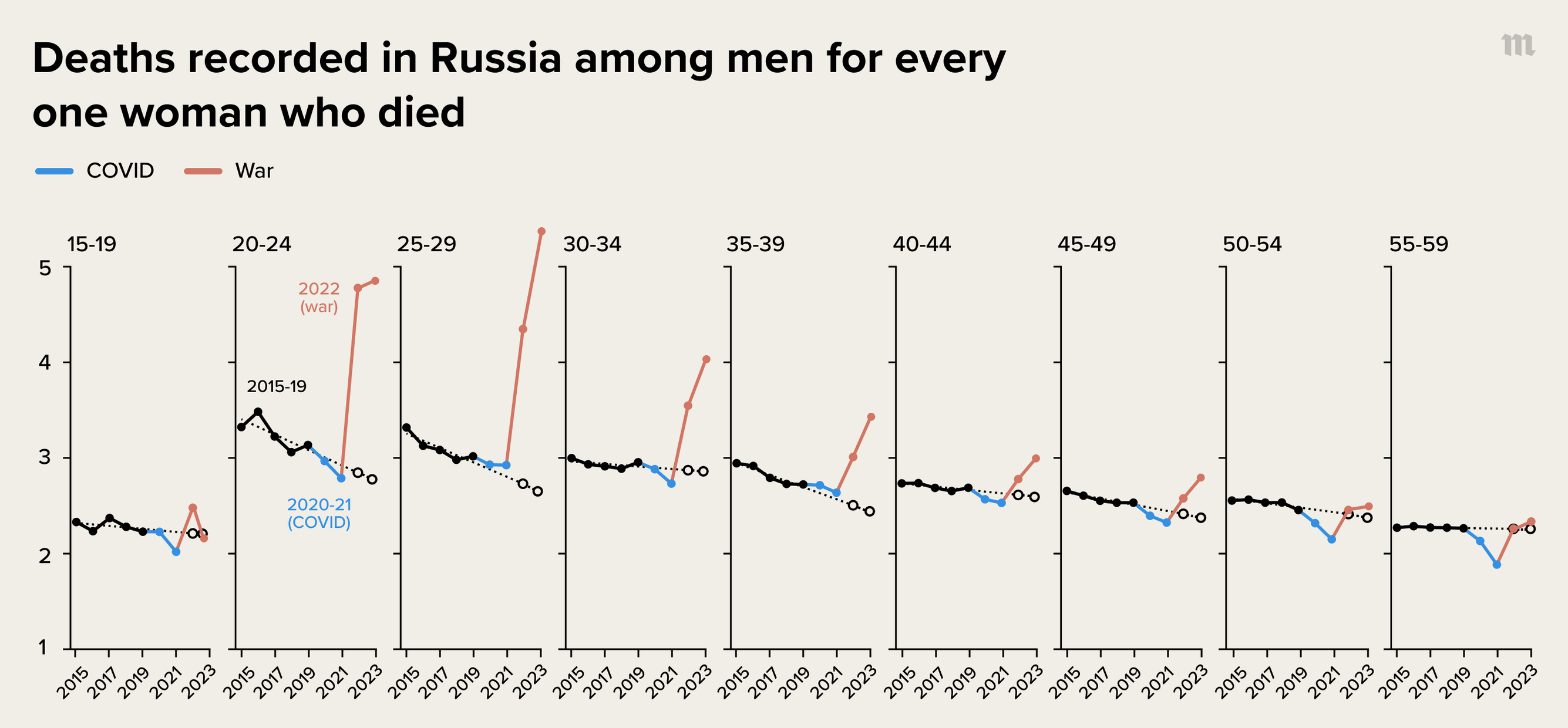
Because women have been almost completely absent among the military deaths confirmed by Mediazona and BBC News Russian, mortality among women can be used as a “benchmark” for calculating the expected number of deaths among men. To do this, Kobak and his co-authors use the long-term trend of the male-to-female mortality ratio to predict what it would be in a given year without the war. They then multiply this ratio by the current number of deaths among women that year. The difference between the actual number of deaths among men and the number we would expect in a hypothetical scenario where there is no war gives us the excess mortality rate for men.
The results of these calculations, conducted a year ago by Kobak and his co-authors with the data from 2022 and again this year using the data from 2023, indicate:
- 24,000 excess deaths among men in 2022 (with a 95 percent confidence interval between 22,000 to 26,000)
- 40,500 excess deaths among men in 2023 (with a 95 percent confidence interval between 39,000 and 42,000)
- 64,000 excess deaths among men over both years (with a 95 percent confidence interval between 61,000 and 67,000)
The highest number of excess deaths over this two-year entire period was among men ages 35–39. This group had nearly 17,000 excess deaths — approximately one quarter of all of the excess deaths among Russian men. The biggest increase between the two years was among men ages 25–29: excess mortality in this group nearly doubled compared to expected levels.
What’s new in this data? And how does it compare to other military death calculations?
The calculations based on the new Rosstat data generally confirm other estimates of Russia’s military deaths calculated by Meduza and Mediazona based on records from Russia’s National Probate Registry. In the last update to these calculations, we estimated Russia’s total losses in the full-scale war up to the end of 2023 at between 66,000 and 88,000 people, with the figure most likely around 75,000.
This is somewhat higher than the 64,000 deaths that the Rosstat data suggests. The discrepancy could be due to a number of factors:
- The estimates based on Probate Registry data involve a degree of randomness, as the registry records inheritance cases, not deaths, and there are a number of reasons a person might choose to file an inheritance claim or not.
- The composition of Russia’s military personnel may have changed in ways that our model based on the Probate Registry failed to compensate for. We took into account changes in the age distribution of soldiers as well as their previous military affiliation (for example, the large influx of prisoners in 2023 and the sharp decrease in the proportion of career military personnel in 2022). The military’s makeup has undergone numerous changes throughout the course of the war, however, and our model cannot identify and compensate for all of them. For example, we have no information about the differences in the income level or property of the soldiers going to war today compared to two years ago.
- Rosstat may have excluded some “military” deaths from this dataset and instead included them in the statistics for Russia’s “new regions” (the Kremlin’s term for the Ukrainian territories Russia has annexed). There have been isolated cases that suggest this practice exists, but there’s currently no reliable data on how widespread it is.
It’s worth noting that one of the conclusions of our analysis based on Probate Registry data was recently confirmed by previously unreleased Wagner Group financial documents obtained by Mediazona. We estimated that the total number of deceased prisoners from June 2022 to July 2023 was approximately 16,000 individuals. Taking into account random error, this coincided closely with the figure listed in Wagner Group’s documents: 17,251.
Explainer by Meduza. Translation by Sam Breazeale.