
Оригинал материала
Another map redrawn in blood
Six consequences of the six-week war for Nagorno-Karabakh
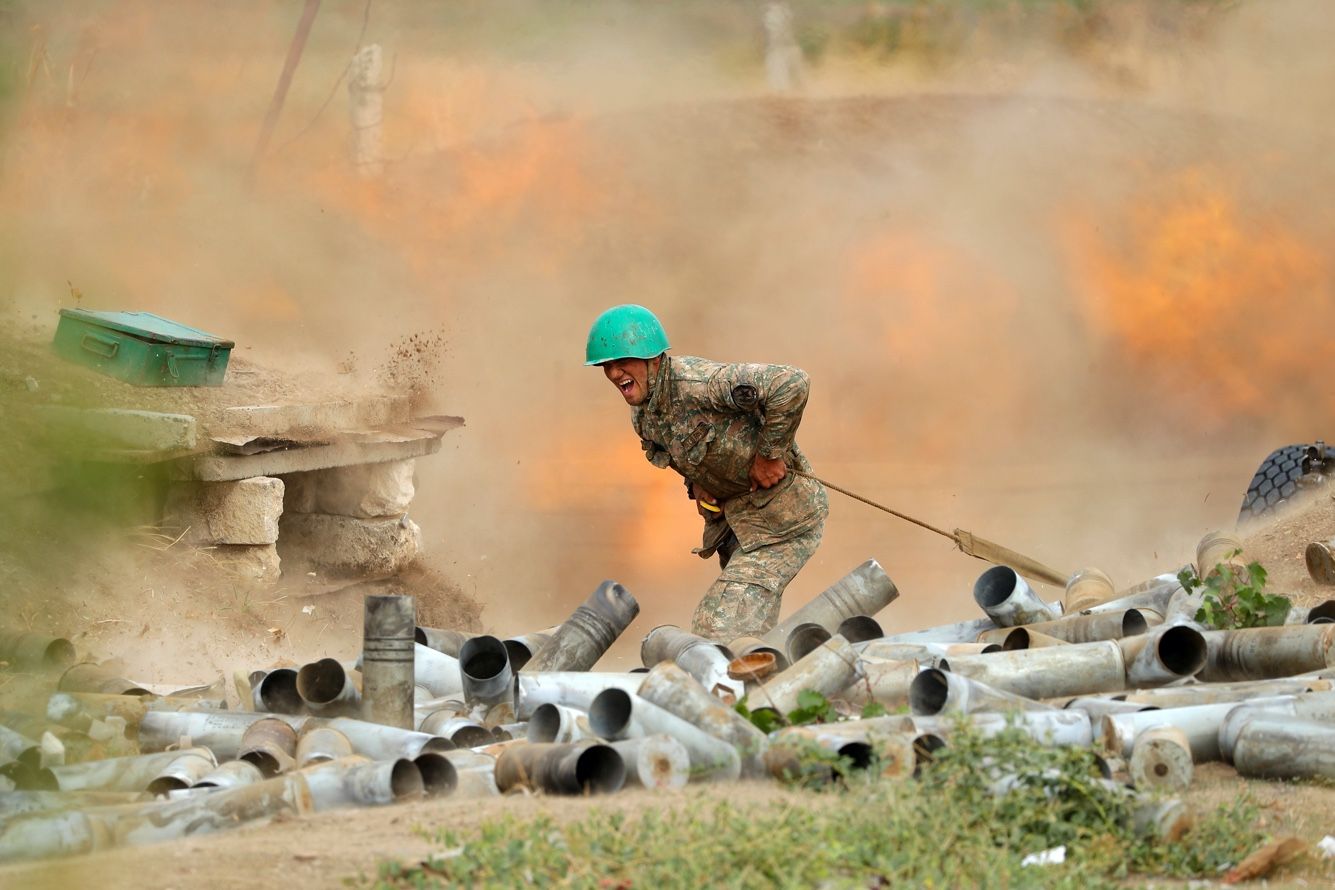
Russia’s peacekeeping mission in Nagorno-Karabakh, the ethnically Armenian breakaway region of Azerbaijan where thousands of civilians and soldiers have died in recent weeks of fighting, has released a map detailing the operation ahead, clarifying many of the territorial ambiguities of the truce between Yerevan and Baku announced on November 10. Judging by the map, the situation in Karabakh will revert mostly to the conditions in place before the first modern war between Armenia and Azerbaijan in 1991: Azerbaijan will deploy artillery to the hills of Shusha, just a few miles from Karabakh’s capital city of Stepanakert, and the breakaway republic itself will be cut off essentially from Armenia. The safety of the region’s ethnic Armenians remains in question, given that the presence of Russian peacekeepers is guaranteed for only five years. Additionally, for the first time in history, Baku has gained a ground corridor to its western exclave in the Nakhchivan Autonomous Republic. Many political questions in Nagorno-Karabakh nevertheless remain unanswered. Meduza reviews the six-week war and tries to explain who won the most: Azerbaijan, Russia, or Turkey?
The six-week war in Nagorno-Karabakh lasted from September 27 to November 10, 2020. Exact losses remain unknown, but several thousand combatants were reportedly killed on both sides. Hundreds of civilians are believed to have died in the fighting, as well.
The new trilateral agreement between Russia, Armenia, and Azerbaijan
Earlier this month, the Armenian Army suffered heavy losses in southern Nagorno-Karabakh. By November 7, Azerbaijani troops seized control of Shusha, a strategically vital city located more than 1,600 feet above and just nine miles south of Stepanakert, Karabakh’s unofficial capital. Shusha also had enormous symbolic value for Karabakh’s separatists (read more about this by clicking on the map below).
Just as it captured Shusha, the Azerbaijani military also cut off the main road to the west that connects Armenia to Karabakh. Armenian Prime Minister Nikol Pashinyan says it became clear after these events that his people risked losing the entire Karabakh territory. As a result, Pashinyan agreed to what he describes as a “painful” settlement with Azerbaijan, brokered by Russian President Vladimir Putin.
- According to the trilateral agreement, Armenia surrenders not only the southern territories claimed by the breakaway Nagorno-Karabakh Republic (which Azerbaijan recaptured during the six-week war) but also two districts in the north that it didn’t lose in combat. During the Soviet era, when Nagorno-Karabakh was an autonomous region and an ethnically Armenian enclave inside the Azerbaijan Soviet Socialist Republic, these areas were not part of the region, but Armenian combatants seized them in 1993. Before these events, the districts were home mostly to ethnic Azerbaijanis who subsequently became refugees. In the past 25 years, these northern areas have remained only sparsely populated.
- Under the new truce, Armenian Karabakh still exists, but its boundaries have radically contracted and its political status is mentioned nowhere. In a national address after the settlement was announced, Azerbaijani President Ilham Aliyev said, “I offered [the Armenians] autonomy, but they wanted independence. Karabakh is ours!”
- Pashinyan confirms that he initially rejected these terms a month earlier when Baku proposed the surrender of southern and northern territories claimed by the Karabakh Republic that were not part of the region during the Soviet era. Armenia’s prime minister says he refused to capitulate in early October before military defeat was apparent. In particular, the loss of two cities — Hadrut and Shusha — made it apparent that the fight against Azerbaijan had become hopeless.
- When Russia announced that it would deploy peacekeepers to patrol Nagorno-Karabakh’s boundary, it was unclear which boundary the settlement recognized. The confusion owed to Azerbaijan’s decision in 1992 to expand its western regions (particularly the Kalbajar District, seized by Armenian forces in 1993 and due to return to Azerbaijani control by November 15, 2020) at the expense of Nagorno-Karabakh’s other territory. If the new truce were based on Baku’s post-1992 administrative divisions, it would have reduced the breakaway Karabakh region to almost nothing (the boundaries would look like this). According to the map released by Russia’s peacekeeping mission, however, the trilateral agreement uses the old Soviet demarcations (meaning that Armenia’s withdrawal isn’t quite as drastic as it might have been).
- Nevertheless, Armenian Karabakh managed to save less than a third of the territory it controlled before September. These lands will now rely on roughly 2,000 Russian peacekeepers for protection. Moscow’s mission in the region has a five-year lifespan with the potential for extensions if neither Yerevan nor Baku withdraws from the settlement within the next 4.5 years.
- Almost immediately after the truce was announced, President Aliyev revealed that Baku also intends to invite Turkish peacekeepers to participate in the Karabakh truce, though the Kremlin has described Ankara’s role in far more limited terms, arguing that Turkey is sending observers, not peacekeepers, who will monitor compliance with the ceasefire from a joint center on Azerbaijani territory outside Karabakh.
- Still inhabited predominantly by ethnic Armenians, the self-declared Nagorno-Karabakh Republic has no formal status under the new settlement and it loses its contiguous border with Armenia, with the entire Lachin District falling under Baku’s control by December 1. Russian peacekeepers will guard the Lachin Corridor, however, to preserve Armenia’s connection to Nagorno-Karabakh, and Azerbaijan has pledged not to impede the movement of people or freight along this road.
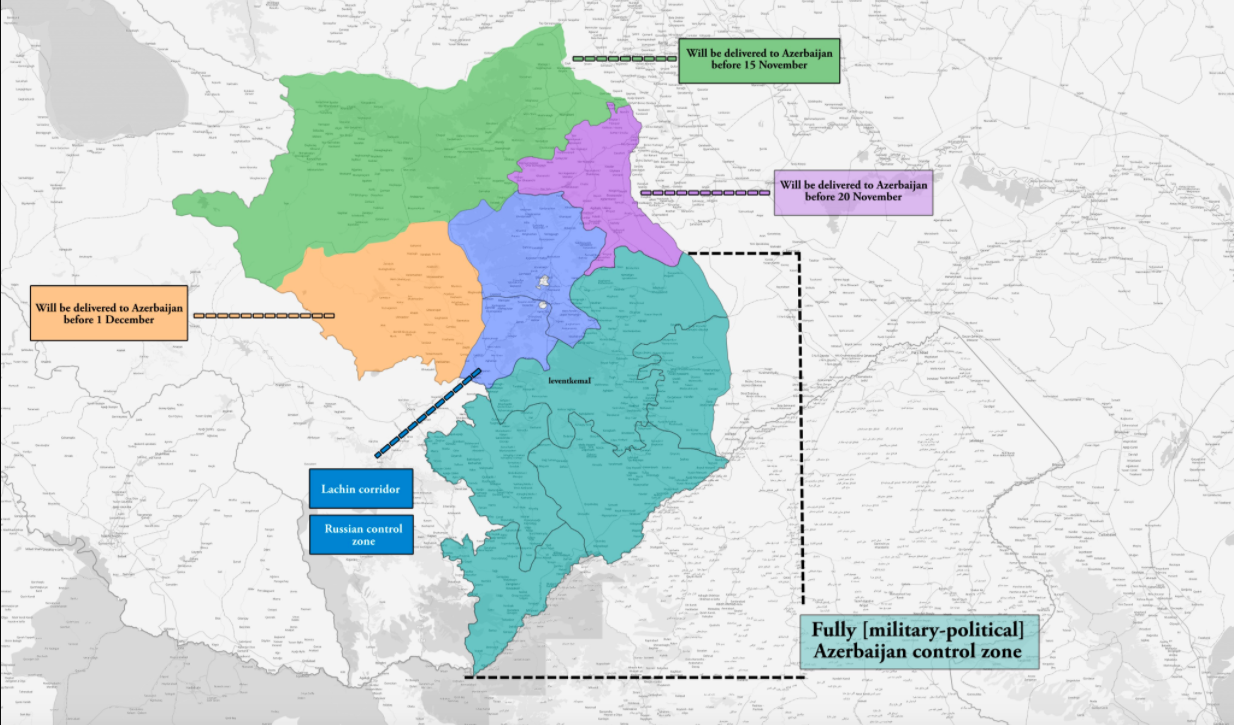
In exchange for permitting the continued existence of a compact Armenian Karabakh (without formal status, guarded by Russian peacekeepers), Azerbaijan effectively gained territory in Armenia itself, winning a transportation corridor from the mainland to its western exclave, the Nakhchivan Autonomous Republic, which has a small shared border with Baku’s close ally, Turkey. Border guards from Russia’s Federal Security Service will protect the corridor through Armenia.
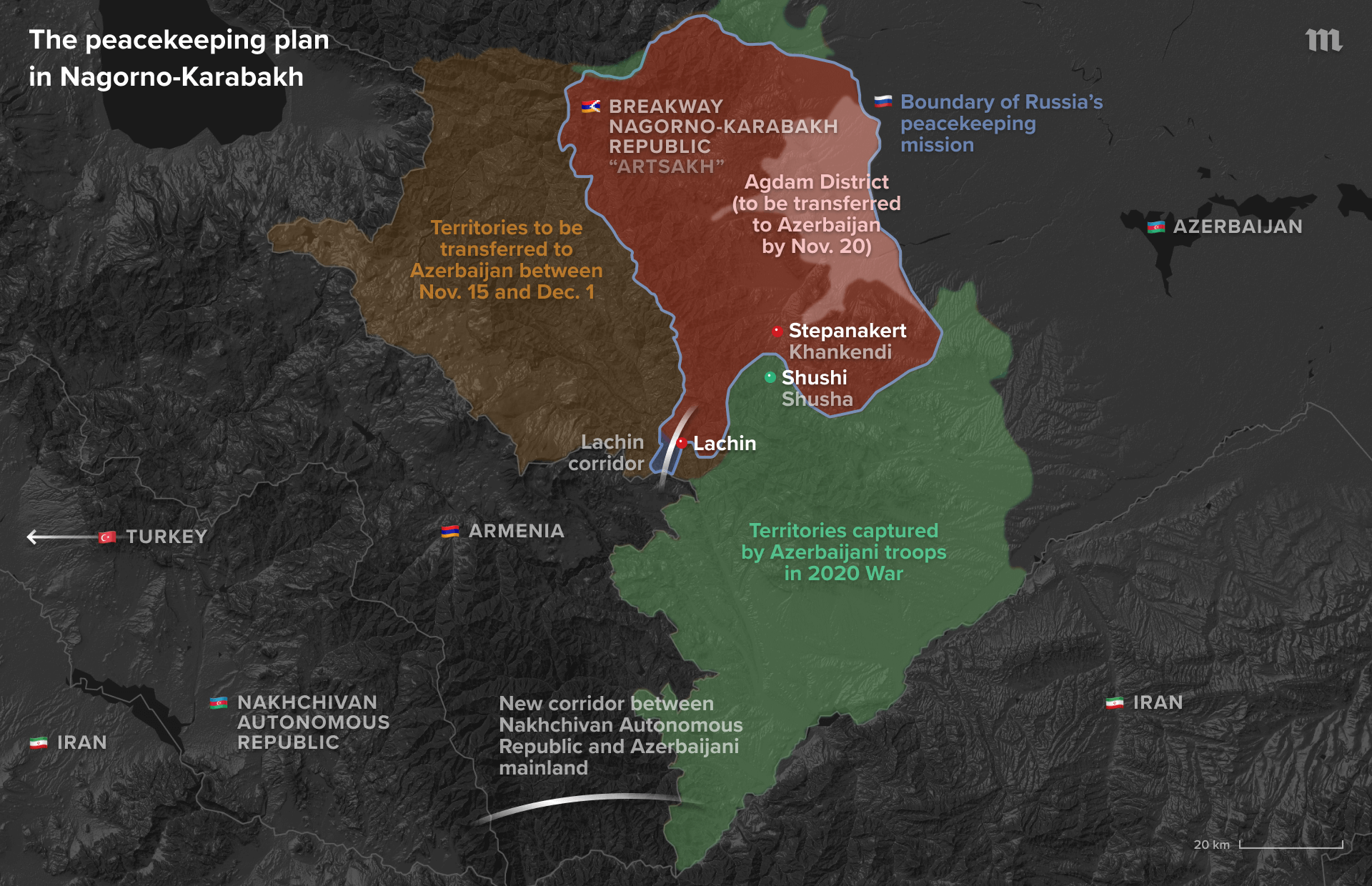
Karabakh separatists seized the Agdam District in the summer of 1993, capturing significant ammunition supplies and military hardware abandoned by the Azerbaijani Army. After November 20, 2020, when the Agdam District is returned to Azerbaijani control, Russian peacekeepers will likely redeploy to the west.
Stepanakert (Khankendi).
The breakaway Nagorno-Karabakh’s capital city is named after Stepan Shaumian, a prominent Bolshevik revolutionary in the Caucasus whom Baku blames for mass murdering ethnic Azeris during the Russian Civil War. Azerbaijan calls the city Khankendi, meaning “village of the khan.” Following the November 2020 truce, the city will be within the Azerbaijani military’s artillery range. An estimated 50,000 people still live here.
Shushi (Shusha).
The city of Shusha (known to Armenians as Shushi) plays an important role in the historical memories of both peoples. Shusha was the capital of the Turkic Karabakh Khanate in the 17th and 18th centuries. In March 1920, during an earlier war between Armenia and Azerbaijan, Azerbaijani troops captured the city and killed several hundred, perhaps several thousand, local Armenians. In 1992, soldiers from the self-declared Nagorno-Karabakh Republic seized Shusha and expelled its ethnic Azerbaijanis, who by then comprised a majority of the city’s population. In November 2020, Azerbaijan retook it.
Boundary of Russia’s peacekeeping mission.
Russia has pledged 1,960 soldiers with small arms, 90 armored personnel carriers, and 380 vehicles and other special equipment. After November 20, 2020, when the Agdam District is returned to Azerbaijani control, Russian peacekeepers will likely redeploy to the west.
Lachin Corridor.
This mountain pass has been Armenia’s key route to the Karabakh region since Armenian troops seized the city of Lachin in 1992. Under the November 2020 settlement, the corridor will be demilitarized and monitored by Russian peacekeepers.
Kalbajar District.
The Kalbajar District was one of the last areas captured by Armenian forces during the Karabakh war in the early 1990s. These gains granted the breakaway Karabakh Republic a long contiguous border with Armenia, where a mountain road was constructed to supplement the Lachin Corridor.
The other safe corridor.
The exact route of the corridor from the Azerbaijani mainland to the Nakhchivan Autonomous Republic remains unclear. The pathway is strategically significant for Baku, as it connects the Azerbaijani mainland to its western exclave. For the past 30 years, access to the region has been limited to air travel or border crossings from Iran and Turkey. Border guards from Russia’s Federal Protective Service will monitor this corridor.
Nakhchivan Autonomous Republic.
There were armed clashes in this area during the Russian Civil War following the Bolsheviks’ rise to power. After the war, the Bolsheviks joined the region with the Azerbaijan SSR. For Azerbaijani President Ilham Aliyev’s family, the autonomous republic carries special symbolic value: Aliyev’s father, Heydar Aliyev (who established Azerbaijan’s modern-day police state), was born in Nakhchivan and revived his political career there, after the USSR’s collapse.
Ambiguities remain
The status of Armenian territory in Karabakh
Defeat on the battlefield and losses imposed under the settlement make it unclear how the unrecognized Nagorno-Karabakh Republic’s state administration will continue to function as it has for the past quarter-century. The trilateral agreement says nothing about sustaining or terminating the administration’s operations, and Yerevan will find it far more difficult to support Karabakh’s local government now that the region has been separated from Armenia.
For the same reasons, the future of the Karabakh Army remains in doubt, given that Armenia will now find it far harder to transfer military hardware through territory under Azerbaijan’s political control (albeit fenced off by Russian peacekeepers).
Humanitarian concerns
Under the November 2020 settlement, the region’s territorial demarcations have returned almost exactly to what they were in 1991. Thirty years ago, ethnic Azerbaijanis constituted the majority of the population in the areas around the Karabakh Autonomous Region (including in Shusha) that are now returning to Baku’s control. The new trilateral agreement allows these individuals to return to the homes they had to abandon, but the fate of the ethnic Armenians who since settled these towns is unresolved. Even the Armenians within the unrecognized Karabakh Republic’s boundaries could be pressured to leave.
During the six-week war, many people living in the breakaway Karabakh Republic fled to Armenia. Even with Russian peacekeepers on the ground, returning home won’t appeal to everyone. As in 1991, there are again Azerbaijani artillery guns deployed in the hills above Stepanakert, just a few miles from the city’s residential neighborhoods. The region’s lifeline to Armenia has been cut off, and nobody knows if Russian soldiers will still be around in five years to protect the population from another Azerbaijani assault. In the face of these dangers and uncertainties, a significant number of Armenian refugees may stay away, despite the formal assurances offered in the November settlement.
Armenians also fear the loss of cultural artifacts in the Karabakh region
The war has endangered sites like the Dadivank monastery and the ruins of Tigranakert, located in districts of Karabakh that will now return to Azerbaijani control. Armenians recognize these places as important remnants of their ancient heritage and worry that Baku might destroy this evidence of Armenian culture’s long history (just as satellite photos suggest Azerbaijan destroyed an ancient Armenian cemetery in Nakhchivan). On the other hand, the leadership in Baku has denied such plans and long argued (however questionably) that its ancestors among the Caucasian Albanians were, in fact, responsible for landmarks like the Dadivank monastery.
The Russian peacekeeping mission’s lifespan
In 4.5 years, Azerbaijan will be able to demand the withdrawal of Russian peacekeepers, allowing it to resume its stated aim in the region: “a final solution to the Karabakh issue.” (Yerevan and Moscow will also have the right to end the peacekeeping deal, but it’s unlikely that either state would seek to unfreeze the conflict in the foreseeable future.)
There are some indications that Azerbaijan plans to stick with the settlement and Russia’s peacekeepers for more than five years, too. President Aliyev says he personally insisted on the ground corridor to Nakhchivan — something the Azerbaijani mainland hasn’t had for 30 years. The construction of a new road through the Lachin Corridor, meanwhile, also suggests planning on a time horizon well beyond five years. The new passageway will bypass Shusha, unlike the current road that runs along the city’s outskirts.
Political expediency, however, might override any economic incentives for maintaining the new status quo. The settlement’s meaning and implementation now rely chiefly on how the truce is interpreted by three men: Vladimir Putin, Ilham Aliyev, and Turkish President Recep Erdoğan (who apparently played an active role in the ceasefire negotiations). In the next five years, these leaders could change their minds about the Karabakh resolution. Before 2025, some of these men could even lose power.
Turkey and Russia: everybody’s a winner
By openly aiding Azerbaijan and achieving a joint victory, Turkey has strengthened its influence in the Caucasus and throughout the “Turkic world,” proving itself to be a decisive, effective ally. Some military experts have also pointed out that Ankara’s intervention demonstrated the feasibility of successfully “unfreezing” an old conflict using modern weaponry and tactics, which could have profound repercussions across the former Soviet Union, where dormant hostilities abound.
The implications of the six-week war pose a threat to Russia’s foreign policy in its “near abroad,” where the Kremlin has gained tools of coercion by intervening to freeze conflicts in exchange for military bases and peacekeeping zones.
On the other hand, however, freezing a conflict and deploying peacekeepers is exactly what Moscow has achieved in Nagorno-Karabakh with the November 2020 settlement.
- Russia is conducting its peacekeeping mission independently and has prevented Turkish soldiers from entering the remaining Karabakh territory. Additionally, the Kremlin achieved this truce without the involvement of its OSCE Minsk Group co-chairs, France and the United States, which objected to Russia negotiating a settlement on its own.
- By deploying peacekeepers to Nagorno-Karabakh, Russia has essentially created a military base on Azerbaijani soil. Carnegie Europe senior fellow Thomas de Waal has observed that Russia secretly spent the last several years preparing for a scenario like this (known informally as the “Lavrov Plan”), where Moscow introduces peacekeepers in the region just as Armenia withdraws its troops.
- Unless there is a radical shift among the decision-makers in Moscow before 2025, the Kremlin is likely to exploit every ounce of influence it has over Baku to keep its peacekeeping mission in Karabakh beyond the initial five-year timeline. Despite Azerbaijan’s close ties to Turkey, the need to maintain a good relationship with Russia was clearly enough to pressure Baku into ending its military offensive just a few miles shy of Stepanakert.
- Europe and the U.S. might find themselves working alongside Russia to keep the conflict frozen in order to prevent a human rights catastrophe against Karabakh’s remaining Armenians. For example, France has already demanded the resumption of high-level international talks about the region’s status.
- With five years to catch its breath, it’s even possible that Armenia might rebuild its military before 2025 to the degree that Azerbaijan would find it too costly to renew its pursuit of a “final solution” in Karabakh.
- Following the six-week war, Armenia’s need to accumulate greater military power will bind it to Russia more closely than before. With a larger contingent of soldiers in Armenia and the deployment of servicemen in Nagorno-Karabakh, Moscow will also be sending more military resources to and through Armenia.
Other political analysts argue that Russia and Turkey both made gains in the Karabakh War, acting more as allies than adversaries. In other words, the six-day war was part of a joint project by Moscow and Ankara to overhaul the Middle East, Northern Africa, and the Caucasus. Yes, there’s still rivalry here (in both Syria and Libya, Russia and Turkey have repeatedly found themselves on opposite sides), but Putin and Erdoğan have operated most effectively when they agree on spheres of influence and cooperate to squeeze out other would-be players, whether it’s Iran, the European Union, or the United States.
Text by Dmitry Kuznets. Map design by Yarik Maximov.
Translation by Kevin Rothrock