
Оригинал материала
Elusive jabs
Meduza digs into official claims that millions of Russians were already vaccinated against COVID-19 by mid-January
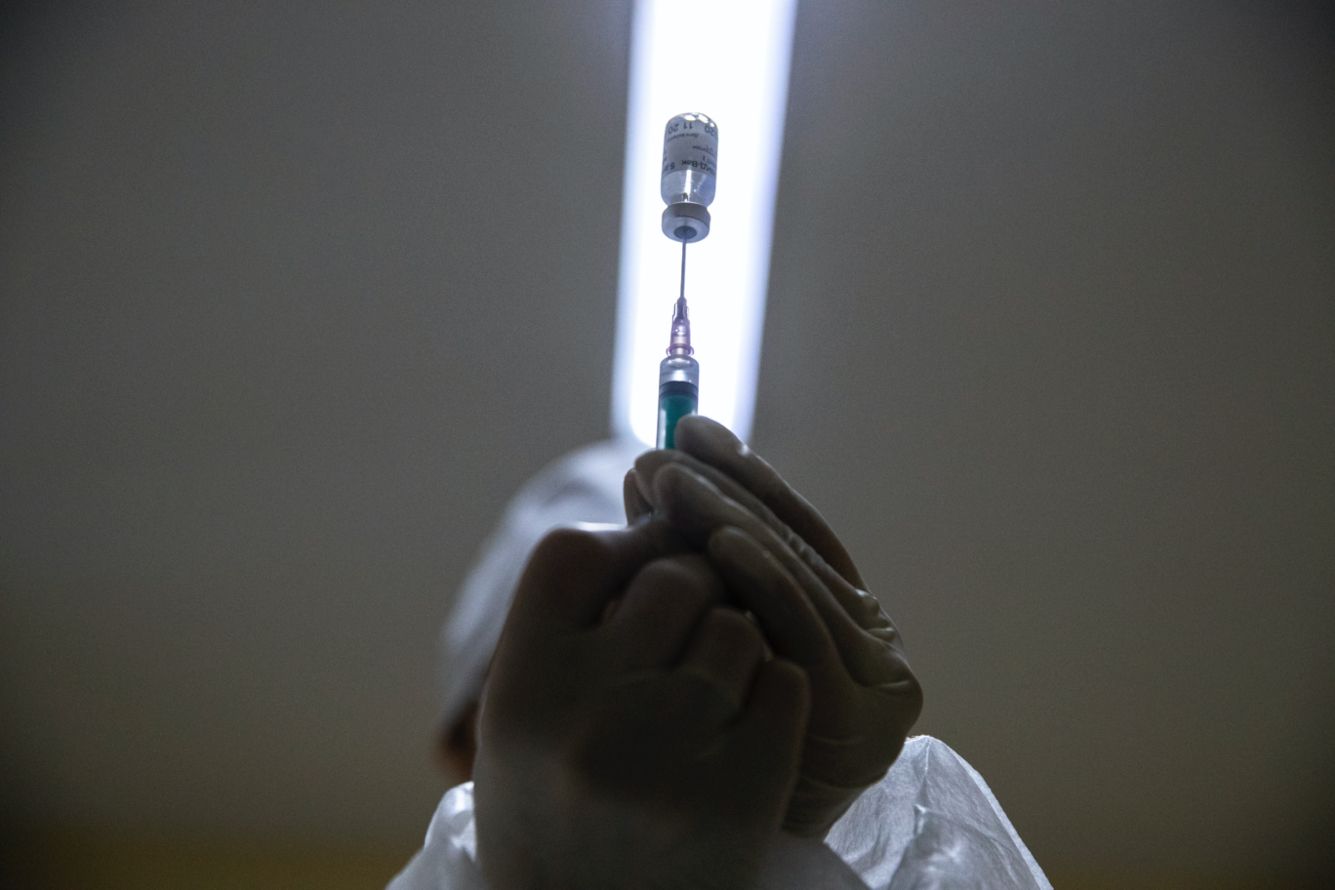
Vladimir Putin called for a transition from “large-scale” vaccinations to “mass” vaccinations to begin on January 18. In other words, the vaccines are now supposedly available to everyone in Russia without restrictions. But dramatically increasing the vaccination rate will be difficult — the government is still having trouble supplying vaccines to rural areas, as well as convincing people that it’s safe to take. It’s also unclear how many people have been vaccinated already — government officials haven’t published any official statistics, and no one seems to have any accurate data. The most commonly cited statistic comes from the Russian Direct Investment Fund (RDIF), which claimed in a press release that a total of 1.5 million people have been vaccinated. However, the RDIF hasn’t revealed where these data came from or what it’s based on, and it hasn’t been confirmed by any other sources. At the same time, according to the RDIF, the exact same number of doses of “Sputnik V” — one and a half million — had been produced and put into circulation in Russia by the beginning of 2021. Meduza set out to determine the real scale of vaccination in the country — and to find out why there are no reliable data.
This story was originally published on January 14, 2021, in Russian.
How many Russians have been vaccinated?
This is unclear publicly (and maybe even privately to federal officials). Government data on the number of vaccinations given haven’t been disclosed; there are only fragments of information (some of them older than others) from several dozen regions and a couple of government agencies.
Multiple officials told Meduza that aggregated data about the number of vaccinations given would soon appear on the Russian government’s official COVID-19 website, but it’s unclear exactly when this will happen. Russia’s Health Ministry, which is responsible for collecting vaccination information, still hasn’t given consent to the data’s publication.
While all Russian medical facilities that give vaccinations enter the data into a central registry, only the Health Ministry has access to the total data about the vaccinations. However, according to a source close to the vaccine’s developers, there’s a lag in the data (the source didn’t specify how long). Additionally, the registry does not include data on vaccinated employees from several government agencies that carry out vaccinations themselves.
The Russian Direct Investment Fund (RDIF), which reported that 1.5 million people in Russian had been vaccinated already, has not disclosed the source of this information. According to an RDIF representative, the data was provided by the Health Ministry. He declined to say whether this number includes people from other countries who received the Russian vaccine (for example, people from Belarus or Argentina).
“It’s hard to take this [report] seriously. You definitely can’t collect information about where the vaccine went, because it’s classified. One and a half million is roughly the number of vaccines that were released into circulation,” said a source close to the Health Ministry.
“The RDIF and Gamaleya [the research institute that developed the vaccine] don’t have access to the registry; their only role is quality control. The number of doses named by the RDIF is the number of doses that have been released into circulation, which isn’t equal to the number of people who have been vaccinated. The number of vaccinated people doesn’t correspond to it, and nobody knows that number yet,” said a source close to the vaccine developer.
According to information obtained by Meduza, the number of doses released into circulation is consistent with the number produced by Russian companies, and most of the doses were produced in late 2020 at new facilities and at higher capacities than before.
In mid-December, there were about 300,000 doses in stock, produced by both the Gamaleya Center and a Moscow company called “Generium.” Then doses made by a St. Petersburg company called Biokad arrived on the market. A Biokad representative told Meduza that 1.1 million doses had been released by the end of the year, including both of the vaccine’s necessary components. According to a source in the federal government, almost 1.5 million people had been vaccinated by late 2020.
Home many doses went to rural areas?
In early January, Russian health minister Mikhail Murashko cited the same number, 1.5 million, saying that that was the number of doses that had been delivered to Russia’s rural areas (including everywhere except for Moscow and St. Petersburg). He also claimed that 800,000 people had already been vaccinated — nearly half of the number provided by RDIF a week later. However, this number was also questionable, and couldn’t be confirmed by any available sources.
According to open data analyst Alexander Dragan, who collected all of the available reports from across Russia, 111 thousand people have been vaccinated.
- Areas with warehouses of ready-made vaccines are in the lead: Moscow (no data has been published since the end of December, when, according to Mayor Sergey Sobyanin, 50,000 people had been vaccinated), St. Petersburg (13,700 people vaccinated as of January 11), and Moscow oblast (18,000 people vaccinated as of January 13).
Update: After this story was originally published, Mayor Sobyanin announced that the capital had already vaccinated 140,000 people by January 14.
- The rest of the country is doing much worse (only 6,000–7,000 people have been vaccinated in Krasnoyarsk Krai, Krasnodar Krai, and Sverdlovsk oblast).
- About 2,000 people have been vaccinated in Kaliningrad Oblast, according to a local government source.
- In the last few days, these regions have reported that shipments of the vaccine — several thousand doses at a time — continue to arrive.
Alexander Dragan used anecdotal evidence to extrapolate vaccination rates for the rest of Russia. According to him, about 300,000 people were vaccinated through the Health Ministry from the beginning of the vaccination campaign to the second ten-day period of January 2021. This is significantly less than the number of people from “high-risk groups” who were supposed to be vaccinated during the “large-scale vaccination” period; medical workers alone make up about 1.8 million people.
But these data might be incomplete. A significant portion of vaccine doses is administered not through the Health Ministry, but through other federal agencies and large state-owned companies. In addition, as one official told Meduza, people who get vaccinated under these programs are not included in the Health Ministry’s registry of vaccinated people. The register doesn't include people who are subject to the personal data protection law — police officers, Investigative Committee employees, National Guard members, FSB agents, Prosecutor’s Office employees. The other departments aren’t covered by that law, because they belong to the private health care system. They’re technically supposed to submit their data to the Health Ministry, but so far they haven’t,” said Meduza’s source.
- The Defense Ministry launched its vaccination program in late November. One hundred thousand people were supposed to be vaccinated by the end of the year, and a total of 400,000 people were supposed to be vaccinated eventually. On December 10, the Ministry reported that 10,000 soldiers had already been vaccinated. Since then, no consolidated data about the vaccination campaign has been reported. It is known that at the end of 2020, ten thousand soldiers were vaccinated in the Central Military District, one of Russia’s five military districts; it’s therefore highly unlikely that the total number of vaccinated soldiers exceeds 100,000.
- On January 13, Russian Railways informed Meduza that vaccinations of its employees began on December 23. The company would not report the number of people who have already been vaccinated, but spokespeople confirmed that 1,200 doses had been delivered to departmental clinics in Moscow, and 400 had been delivered to departmental clinics in Kaliningrad.
- Representatives of the Russian National Guard, which also began its own vaccination campaign in December, did not respond to Meduza’s questions.
- The Federal Medical and Biological Agency (FMBA) is leading several vaccination programs — for groups ranging from cosmonauts and other Roskomos employees to members of the Russian national football team. However, it’s unlikely that the number of people vaccinated under these programs even reaches the hundreds. The FMBA did not respond to Meduza’s questions.
- In addition, some vaccine doses are delivered under commercial contracts, although these only number in the hundreds, as well. The “Medsi” clinic network reported to Meduza that they had vaccinated 653 people as of January 13. Similar numbers were reported by the other — few — clinics that give commercial vaccinations.
In other words, while not all vaccinated people are included in the Health Ministry’s registry, it’s unlikely that the number of people not recorded is more than 100 thousand.
It’s also possible that officials are including foreigners in the count; the “Sputnik V” vaccine has been sent to Argentina, Belarus, and a number of other countries. In Argentina alone, more than 150,000 people have been given the first dose.
Is this a lot of people?
Trackers keeping count of the number of people vaccinated in various countries use the same data provided by the RDIF: 1.5 million doses released into circulation. Compared to other countries, this is a decent number; if it’s correct, Russia is one of the five countries with the highest numbers of vaccinated people (after the United States, China, Great Britain, and Israel).
In terms of the number of vaccinated people per capita, this would put Russia in 11th place, putting it ahead of most countries in the EU. But if the real number is actually somewhere between 300,000 and 500,000, Russia doesn’t compare as well (especially per capita). This would put Russia closer to Argentina (where the government buys vaccines from Russia) and lower than most EU countries.
Why can’t Russia vaccinate people faster?
Vladimir Putin, announcing the new stage of vaccination (“mass” vaccination instead of “large-scale” vaccination), named what he sees as the main advantage of the Russian vaccine: it’s relatively easy to manufacture and transport. “It’s already obvious that the Russian vaccine, as we thought earlier but now we see in practice, is the best in the world,” he said. “Thank God it doesn’t require any extreme conditions, such as having to be stored at -50 or -70 degrees Celsius [-58 to -94 degrees Fahrenheit] [as is the case for the vaccine made by Pfizer and BioNTech, currently the world’s most popular]. Our vaccine is much simpler and more effective.”
But sources familiar with the vaccine-handling process told Meduza that there are difficulties with the transportation and storage of the Russian vaccine. “Sputnik V” must be kept and transported at a consistent temperature of -18 degrees Celsius [roughly zero degrees Fahrenheit]. “We didn’t have freezing facilities, so they had to be built all across the country,” said a source close to Russia’s Health Ministry.
News site Fontanka has described the difficulties as “unmanageable”; Immunotechnology, a subsidiary of Sberbank and the only government-sanctioned vaccine supplier to rural Russia, has faced major difficulties in its search for refrigeration equipment capable of consistently maintaining the necessary temperature at all stages of storage and transportation.
As a result, the United States established a process for distributing the Pfizer vaccine, which requires storage at -94 degrees Fahrenheit, before Russia was able to distribute “Sputnik V” on a wide scale. In the U.S. and other countries, the vaccine is stored and transported in dry ice; in Russia, there simply aren’t enough plastic containers that can withstand such cold temperatures, according to Fontanka.
In addition, the authorities had difficulty determining how many doses to send to each region. “There’s a method of determining how many people need to be vaccinated: you have a correction coefficient, which is associated with the current morbidity level, and another coefficient associated with the availability of a sufficient number of vaccination points. It’s a counting problem with a lot of parameters. If the chief epidemiologist believes that more vaccines are necessary, the local government has enough authority to create additional vaccination points and argue to the Federal Health Ministry that it needs more. If the region is proactive, it organizes the process and knocks out more vaccines,” said a source.
According to a source from the regional government of one of Russia’s northern regions, vaccine deliveries are falling short of public promises from federal authorities; only small batches — several hundred to several thousand doses — are being sent, and they’re arriving later than promised. “So far, it’s mostly doctors and medical personnel who are being vaccinated, with mass vaccination still very far off,” claimed the source, who says the authorities are now promising to deliver larger batches of the vaccine in February.
And then there’s another serious problem facing officials — vaccine skepticism. A source from the local government of one of Russia’s northern regions told Meduza that local residents are in no hurry to get vaccinated. “Even after vaccinations became open to everyone, only a few thousand people wanted to get vaccinated.”
How many people need to be vaccinated? And why rush?
Mass vaccination can have two main goals.
The first is to stop an epidemic. But because the Russian authorities haven’t been able to set up a mass vaccination program quickly, it’s possible that Russia won’t achieve this goal — instead, the epidemic could come to an end in Russia not because of vaccinations, but because a large enough portion of the population has become immune by contracting with the virus directly.
In theory, the epidemic should end once the population has reached herd immunity. At that point, the virus won’t have enough “susceptible” targets — people who aren’t immune — to be able to spread exponentially. There are two ways to become immune: getting infected with the virus and getting vaccinated.
According to Meduza’s estimates (see below), 35–40 percent of Russia’s population had been infected and become immune by late December 2020.
How did we calculate this?
It is difficult to calculate exactly how much of the population would need to be immune to coronavirus to achieve herd immunity. It depends on the value of R₀ — the virus’s initial ability to be transmitted from person to person (this number can also be thought of as the average number of people to get infected by one infected person until the infected person recovers or dies). The problem is that this initial property is almost impossible to determine because, from the very beginning of the epidemic, both the government and citizens themselves tried to reduce the virus’s transmission rate, “distorting” the statistic.
One of the world’s purest “experiments” occurred in the Amazon, where the epidemic spread with almost no countermeasures until 60–66 percent of the population was infected. This puts R₀ between 2.5 and 3. The epidemic didn’t end there; infections continued even after herd immunity was reached, but every day saw fewer of them.
It’s possible to calculate the rough proportion of people who became immune to the virus by getting infected in Russia. To do this, you need to know the real number of people who died after getting coronavirus. Official data alone won’t cut it; in Russia, as in other countries, deaths from coronavirus are underestimated. However, the number of death certificates issued by registry offices can be used to calculate so-called excess mortality between April and November, providing a fairly accurate estimate of deaths from COVID-19. According to these data, as of November (the last month for which data is available), Russia came in third place in the world, after the United States and Brazil. In total, between April and November 2020, excess mortality amounted to about 242,500 people. All (or almost all) of these details were due to coronavirus.
Excess mortality from April to November was six times higher than the official death rate from coronavirus. If the same ratio has persisted, then another 140,800 people died in Russia between December 1 and January 13, putting the total number of deaths since the start of the pandemic at 383,300. If we assume that the case mortality rate (CFR, the ratio of the total number of deaths to the total number of people infected, including asymptomatic carriers and undiagnosed cases) is not much different from the rate calculated in China and other countries at different stages of the epidemic (0.66 percent), then the total number of deaths (383,300) should correspond to 57 million infected and immune people. This is a little less than 40 percent of the Russian population.
It’s important to note that the number of deaths can be used to calculate the number of people infected not today, but 20-22 days ago, since that’s the amount of time it takes, on average, for an infected person to die.
The same method can be used to calculate the number of daily infections in Russia: by the end of December, 430,000–440,000 Russians were coming in contact with the virus every day. If the infection rate continues at the same rate, herd immunity will be reached in 70 to 90 days. It’s unlikely that Russia’s vaccination campaign will reach the scale necessary — hundreds of thousands of people per day — to achieve earlier herd immunity in such a short time.
However, if the government fulfills its promises, the vaccination effort will get a substantial push in the coming weeks. Governors are currently talking about supplying several tens of thousands of doses to Russia’s middle region by the end of February. At this rate, it would be possible to vaccinate just more than 100,000 people throughout the country every day.
The second goal of mass vaccination is to reduce the number of deaths and lighten the burden on the healthcare system. Every million vaccinations (if you believe the vaccine developers’ claim that the vaccine is 100-percent effective in preventing severe cases) will reduce the number of deaths from coronavirus by more than 6,000. The effect will be even more significant if high-risk parts of the population — especially the elderly — are vaccinated. And the faster the government scales up its vaccination campaign, the more it will reduce the negative consequences of the epidemic.
Story by Dmitry Kuznets, Svetlana Reiter, Anastasia Yakoreva, and Farida Rustamova. Edited by Valery Igumenov.
Translation by Sam Breazeale