
Оригинал материала
Unwelcome changes
Russia’s Health Ministry plans to overhaul its cancer care system. Despite criticism, the new regulations take effect in January.
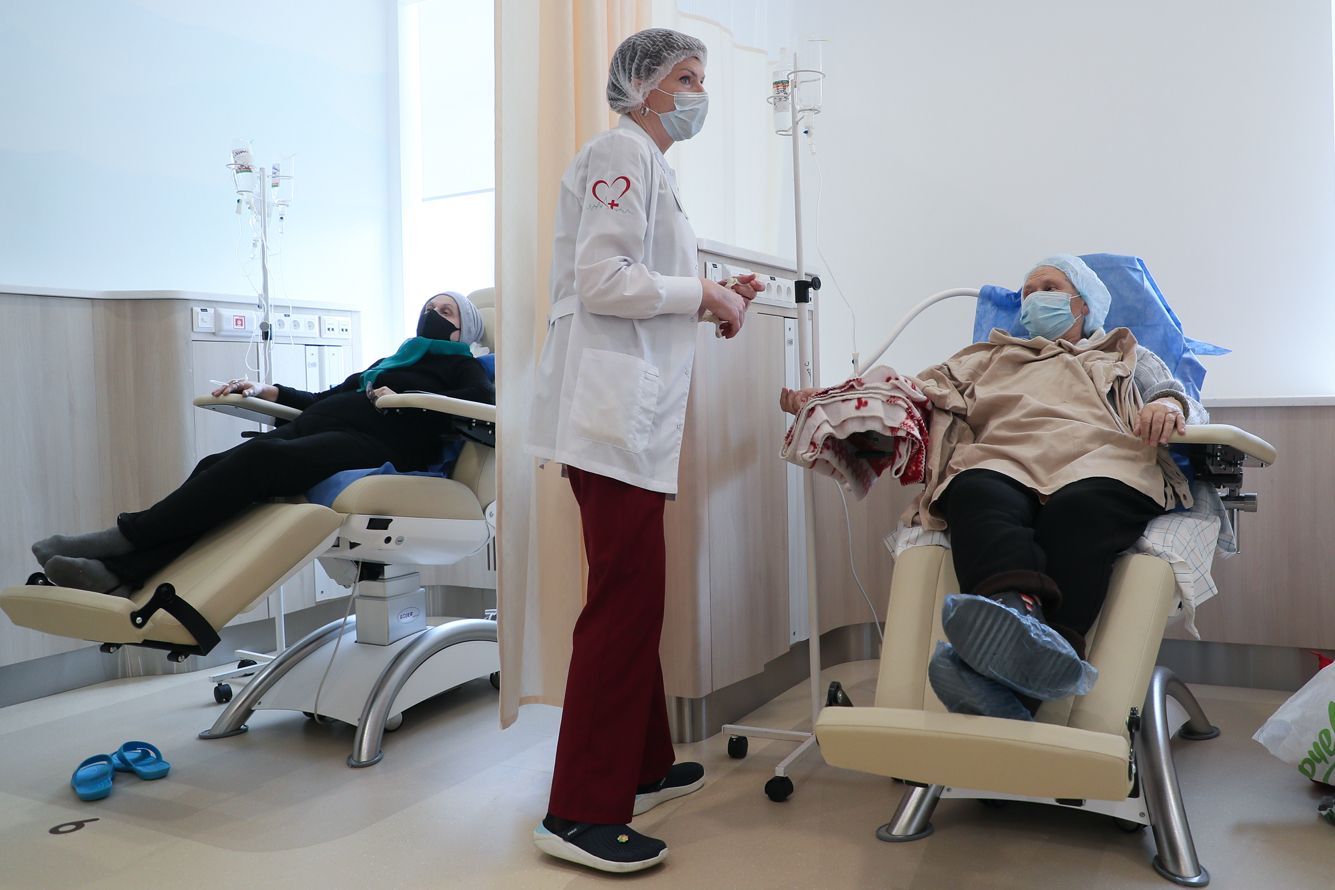
On December 20, 2021, Russia’s Health Ministry proposed a series of changes to adult cancer care practices. These new procedures will take effect in the new year. The previous plan to overhaul cancer treatment was received poorly by the medical community, prompting Deputy Prime Minister Tatyana Golikova to order revisions. However, experts say that none of the Health Ministry’s proposed changes address physician’s most substantive criticisms.
Why are the changes to cancer care being criticized?
The new directive is set to take effect from January 1, 2022. Criticism from civil society centers around three issues:
- Medical facilities with relatively few hospital beds will no longer be allowed to treat cancer patients — even though here is little evidence that the number of beds is associated with the quality of medical care;
- In all likelihood, patients will no longer be able to receive free medical care outside of their region of residence, due to of overly rigid guidelines on where patients are to be sent for treatment depending on the severity of their illnesses;
- Most medical facilities won’t be allowed to offer cancer care, even if they have the requisite number of hospital beds. A facility will only be able to craft treatment plans if they have a surgical ward (where malignant growths are treated), an anti-inflammatory drug clinic, and a radiotherapy department.
A substantial number of facilities that currently provide cancer care will not meet the new requirements. As a result, patients will have a more difficult time obtaining treatment.
These issues were raised in a letter to Deputy Prime Minister Tatyana Golikova penned by two experts: Grigory Potapov, the head of pharmaceutical company Pharmstandard and the deputy chairman of the Government Council for Social Issues, and Ekaterina Shergova, the head of the charitable foundation Podari Zhizn (“Give Life”) and a member of the same government council. (The letter was obtained by Meduza.)
Similar concerns (along with many others) were raised in a resolution from a roundtable conducted in the summer of 2021 by Vmeste Protiv Raka (“Together Against Cancer”), a nonprofit organization that supports other anti-cancer initiatives.
This is the second time that Deputy Prime Minister Tatyana Golikova has instructed the Health Ministry to make changes to Russia’s cancer care system. According to the trade publication Vademecum, the ministry refused to assemble a working group to formulate the changes. Effectively, the Health Ministry only formally complied with Golikova’s order and never actually consulted with those who openly criticized the new practices and wrote letters opposing them.
The revisions to the directive, published on December 20, do not address any of central concerns critics raised.
The Health Ministry’s proposed changes — and why they won’t help
The Health Ministry plans to make four new changes:
- Oncologists and hematologists will no longer be the only doctors able to diagnose cancer — now, any specialist (say, an endocrinologist) will be able to make the diagnosis.
- Standards for radiotherapy wards will be changed to remove a per-capita equipment requirement (for example, the current regulations mandate one superficial radiotherapy device for every 800,000 people in a facility’s service area).
- Biological samples for research and diagnosis will be sent to both a clinical diagnostic laboratory and a anatomical pathology department — currently, they are only sent to the latter.
- If a patient has a disease included on a special Health Ministry list, physicians will not be obligated to consult with the staff of a National Medical Research Center in developing a treatment plan — currently, this is merely a recommendation.
The list
- Malignant neoplasm of the thymus gland (thymus)
- Malignant neoplasm of the heart, mediastinum and pleura
- Malignant neoplasm of bones and articular cartilage of the extremities
- Malignant neoplasm of bones and articular cartilage of other and unspecified sites
- Mesothelioma Kaposi's sarcoma
- Malignant neoplasm of peripheral nerves and autonomic nervous system
- Malignant neoplasm of the retroperitoneal space and peritoneum
- Malignant neoplasm of other types of connective and soft tissues
- Malignant neoplasm of the placenta
- Neoplasms of an undetermined or unknown nature of the female reproductive organs
- Malignant neoplasm of the testicle
- Malignant neoplasm of the eye and its adnexa
- Malignant neoplasm of the meninges
- Malignant neoplasm of the spinal cord, cranial nerves and other parts of the central nervous system
- Malignant neoplasm of the adrenal gland
- Gastrointestinal stromal tumor, benign
- Gastrointestinal stromal tumor, without further specification
- Gastrointestinal stromal sarcoma
- Germ cell neoplasms
- Primary neuroendocrine skin cancer
- Large cell neuroendocrine cancer
- Carcinoid tumor
- Mixed adenoneuroendocrine carcinoma
- Neuroendocrine cancer, not further specified
- Atypical carcinoid tumor
Missing is any mention of the hospital bed requirement, or the excessive requirements for medical facilities, or the possibility of receiving treatment outside of one’s home region.
Meanwhile, medical advocacy organizations consider these changes either pointless or harmful.
For instance, National Medical Research Centers are federal institutions that usually handle complex medical cases. The Health Ministry wants to enable doctors to create treatment plans for rare diseases without consulting with these facilities. “Such a loosening [of the rules] is fundamentally misguided, since these illnesses are among the most rare and must at least be supervised by organizations that have high-levels of expertise in these areas,” argued the nonprofit Vmeste Protiv Raka in a statement seen by Meduza. The foundation’s president, oncologist Bakhodur Kamolov, thinks that oncologists from regional medical organizations will continue to refer such patients to National Medical Research Centers, simply because these institutions have more experience treating rare diseases.
The fact that physicians besides oncologists and hematologists can now diagnose cancer isn’t particularly impactful, says lawyer Polina Gabay, vice-president of Vmeste Protiv Raka and the founder of the law firm Faculty of Medical Law. “Though the diagnosis can be made by an endocrinologist or whomever, they will not be able to determine the future course of treatment,” she explains. Similarly, changing the requirements for radiotherapy wards “is meaningless and pointless, and the hospital bed capacity requirements haven’t been lifted,” the expert says.
Specialists believe that the goal of the new directive is to concentrate oncological care within narrowly-focused institutions under a strict hierarchy, with control over patient flows and budgets. In this sense, nothing has changed. “None of the most crucial issues raised by the professional community were taken into account,” laments Polina Gabay. “Now a cancer patient can only start to get help [by going to] an outpatient cancer center. They’re blocking the [many of the entry points to the healthcare system]. The desire to exclude many working clinics from the oncological care system, liquidate primary care departments, and open these outpatient cancer centers in cooperation with head oncologists — all of this not only violates the patient’s right to receive affordable care, but also artificially restricts competition, violating the rights of medical organizations as economic entities. They just want to bring everything under their control.”
Story by Daria Sarkisyan
Translation by Nikita Buchko