
Оригинал материала
The Real Russia. Today.
13 days of full-scale invasion
Monday, March 7, 2022
Dear readers, Meduza’s newsletter has been missing in action since Russia launched a full-scale invasion of Ukraine. We have maintained around-the-clock coverage of the war on our website (find our live transmission here), and we’re finally resuming this missive. What follows is not just the latest from Russia and Ukraine but also some highlights from our reporting over the past two weeks. Please note that the authorities are now blocking our website in Russia, and we’re turning to you, our global audience, for financial support.
In today’s newsletter
- Two new podcast episodes: Featuring Dr. Faith Hillis to discuss Ukrainian history, and Maximilian Hess to talk about the likely fallout of Western economic sanctions against Russia
- Stories from Ukraine: On the ground in Lviv, the history of the Donbas, early days in Odesa, and life along the old contact line
- The situation in Russia: Charting public support for the war, Putin’s embrace of unreality, life under sanctions, the new banality of evil, the legality of Russia’s new ‘treason’ concept, and fired for speaking out
The Naked Pravda 🎧
Putin vs. Ukrainian history (24 min)
On February 21, Vladimir Putin delivered a nearly hour-long televised lecture on Soviet history, describing what he clearly believes are the flimsy foundations of Ukrainian statehood and arguing that the government in Kyiv owes its territory today to the supposed generosity of the Bolsheviks, particularly Vladimir Lenin.
To assess this presentation of Ukrainian and Soviet history, Meduza spoke to Dr. Faith Hillis, a professor of Russian history at the University of Chicago, where she specializes in 19th and 20th century politics, culture, and ideas, exploring specifically how Russia's peculiar political institutions — and its status as a multiethnic empire — shaped public opinion and political cultures.
Russia’s looming financial collapse — a return to the 1990s or 1918? (28 min)
In the days since Vladimir Putin ordered a full-scale invasion of Ukraine, the Western world has imposed crippling economic sanctions on Russia designed to force extreme costs on the Kremlin for its aggression. In the Biden administration’s words, the measures will “weaken the Russian defense sector and its military power for years to come and target Russia’s most important sources of wealth.”
Russian economy expert and Foreign Policy Research Institute fellow Maximilian Hess says he worries that the looming financial collapse in Moscow could resemble 1918 more than the 1990s. He joins this week’s episode of The Naked Pravda to explain what he means.
Feature stories from Ukraine
Meduza reports from the ground in Lviv, western Ukraine’s waypoint for hundreds of thousands of refugees (12-min read)
Hundreds of thousands of Ukrainian residents fleeing Russia’s invasion have traveled to Lviv, a city near the Polish border that was previously home to about 720,000 people. Lviv has experienced air raid sirens, but it hasn’t seen active fighting on the scale seen in cities further east. Some displaced people have decided to stay there in hopes of waiting out the war. Others have continued onward to EU countries: Poland alone has received more than 885,000 people, according to the UN Refugee Agency. Journalist Andrii Ianitskyi was among those who fled rocket attacks in Kyiv for the relative safety of Lviv. Meduza asked him to explain how the city has become a place of refuge for people from all over Ukraine.
How has eight years of war changed Ukraine’s Donbas? Meduza asks human rights expert Varvara Pakhomenko. (25-min read)
On February 24, 2022, Vladimir Putin launched a full-scale invasion of Ukraine, under the pretext of defending two unrecognized, Kremlin-backed “republics” in the country’s east. Before this, since it began in 2014, the conflict in Ukraine’s eastern Donbas region had waxed and waned, resulting in thousands of casualties on both sides. To find out more about life in the Donbas over the past eight years, Meduza turned to human rights and humanitarian law expert Varvara Pakhomenko, who was part of the UN mission in Ukraine from 2016 to 2018 and went on to work as the country director for Ukraine for the humanitarian organization Geneva Call.
The early days of Russia’s invasion through the eyes of Odesa’s residents (12-min read)
Odesa was among the first cities hit on February 24, when Russia began its full-scale invasion of Ukraine. The city has been continually shelled since the outbreak of hostilities. Prior to announcing the invasion, Vladimir Putin vowed to punish those responsible for the bloodshed at Odesa’s Trade Unions House in 2014. Now, Odesa residents are seeking safety in bomb shelters and are enlisting in territorial defense groups. In a report for Meduza, local journalist Mikhail Shtekel shares stories of the early days of the fighting in Odesa from the people living through it.
American Brendan Hoffman captures eight years of life along the contact line in eastern Ukraine (12-min read)
War came to Ukraine’s Donbas region in the spring of 2014, after some residents in the country’s east refused to accept the revolutionary change of power in Kyiv. In April of that year, pro-Russian protesters in Donetsk, Luhansk, and Kharkiv declared the formation of “people’s republics” independent from Ukraine. Kyiv quickly regained control of Kharkiv, but a full-fledged war broke out in the Donetsk and Luhansk regions, with Russia providing explicit and tacit support to the “people’s republics” — including in the form of material and military aid.
The “hot” phase of the conflict formally ended with the signing of the Minsk agreements in February 2015, although clashes and shelling continued. For seven years thereafter, the conflict seemed “frozen” — a common phenomenon in global politics. Throughout this period, American photographer Brendan Hoffman captured both civilians and combatants who found themselves on different sides of the conflict. Meduza shares his snapshots here.
Reporting and analysis on Russia’s domestic situation
Sociologist Alexey Bessudnov shares five charts that help explain how to read the Kremlin’s survey data on support for the war in Ukraine (4-min read)
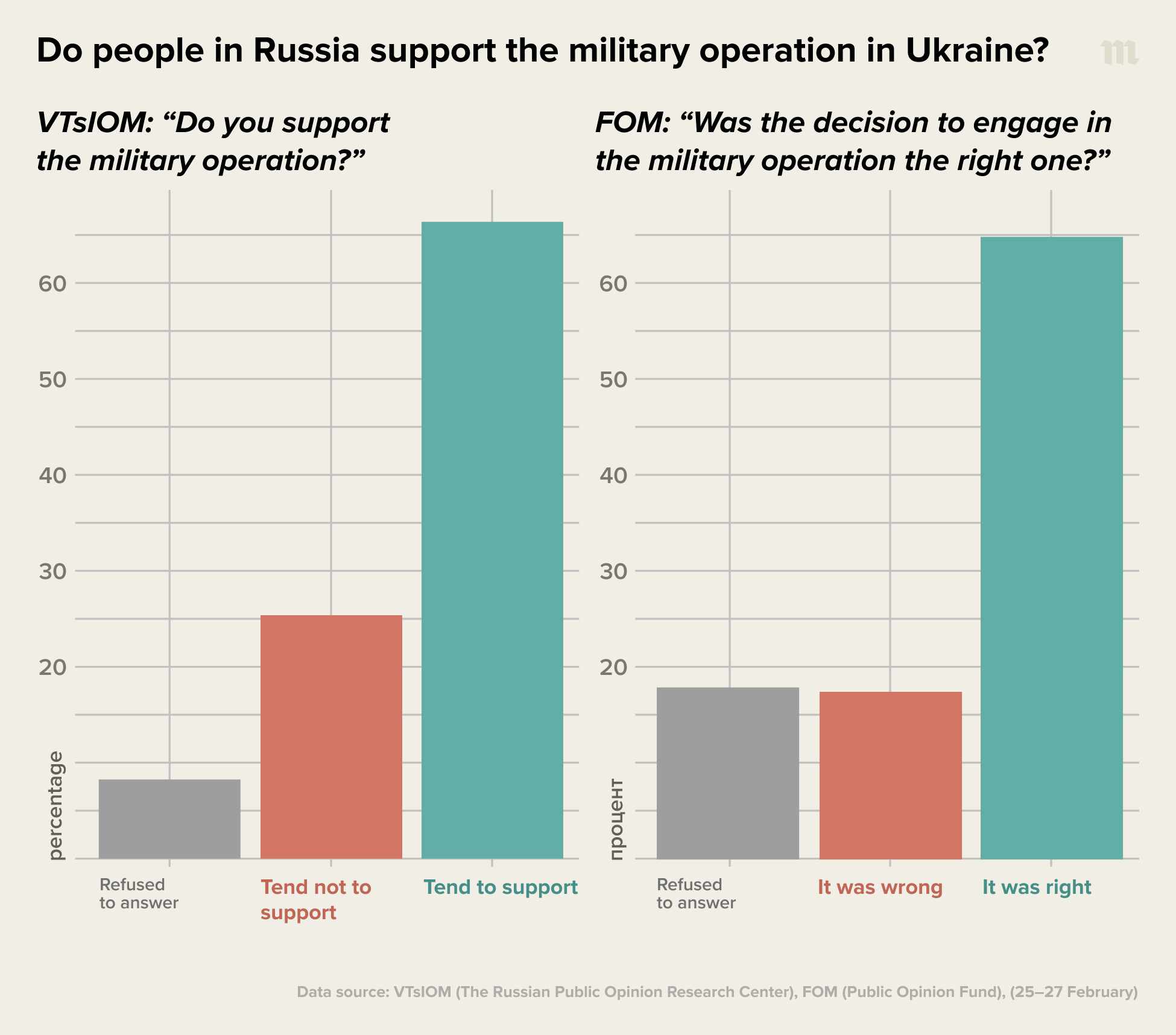
According to opinion polls from VTsIOM (the Russian Public Opinion Research Center) and FOM (the Public Opinion Fund), more than 60 percent of Russians support the “special military operation” in Ukraine. But those results should be taken with a grain of salt: the same polls show that millions of people are opposing the war. Also, among the young residents of big cities who rarely watch television and get most of their information from the Internet, the war’s opponents are actually the majority. Exclusively for Meduza, University of Exeter sociologist Dr. Alexey Bessudnov offers the following analysis of the VTsIOM poll.
Putin’s last stand: How to lose a war simply by starting one (9-min read)
How did this war with Ukraine even become a possibility? According to Meduza’s Ideas editor, Maxim Trudolyubov, the answer to this question can be found in the political alternate “reality” developed in Russia in recent years on the basis of lies, manipulation, and the production of fakes. This “reality” had seemed so crudely constructed that it was impossible to imagine anyone in charge (especially those who created it) to believe it seriously. As it turns out, however, somebody does believe it. His name is Vladimir Putin.
Meduza readers on how Western sanctions — and Russia’s response measures — have changed their lives (9-min read)
Russia’s invasion of Ukraine resulted in harsh sanctions from the West. The ruble exchange rate crashed, several Russian banks have been cut off from SWIFT, and the Central Bank’s foreign exchange reserves are blocked. We asked Meduza readers what effect sanctions — and Moscow’s response measures — have already had on their lives, and what they plan to do going forward. Here’s what they told us.
Sociologist Grigory Yudin demonstrated against the invasion and ended up in the hospital. He says we’re living in a new era. (14-min read)
On February 24, Russia began a war with Ukraine. On that same day, protests broke out all over Russia. It is difficult to call them mass demonstrations in any real sense, although ultimately almost 6,500 people were arrested (in Russia, street gatherings of this type are practically forbidden, with the authorities persecuting even individuals who picket alone). Sociologist Grigory Yudin, too, was arrested and ended up hospitalized following an anti-war protest in Moscow. Meduza special correspondent Svetlana Reiter discussed with Yudin why it doesn’t make sense to call protests in Russia “small” — and why he thinks scholars have to take a principled stand.
Russia’s Attorney General says providing ‘assistance to foreign states’ constitutes treason. What does this mean for anti-war advocates? (3-min read)
On February 27, the Russian Attorney General’s Office promised to “make legal determinations” in the event that any Russian citizen provides “assistance to a foreign state to the detriment of the security of the Russian Federation” during the war with Ukraine. The agency stressed that providing any such assistance will be considered state treason, which carries a punishment of 12 to 20 years. Meduza asked lawyer Ivan Pavlov, head of the human rights group Department One, to explain what this means for Russians who speak out against the war in Ukraine.
Artistic director Dmitry Volkostrelov publicly opposed Russia’s invasion of Ukraine. His anti-war stance cost him his job. (3-min read)
On March 1, Dmitry Volkostrelov lost his job as artistic director of Moscow’s Meyerhold Center for theater and culture. A day earlier, the Meyerhold Center’s director, Elena Kovalskaya, resigned in protest over Russia’s invasion of Ukraine. According to Volkostrelov, he was offered the “chance” to resign voluntarily — when he refused, Moscow’s Culture Department fired him without cause. In an interview with Meduza, Dmitry Volkostrelov recounts the circumstances surrounding his dismissal.
Yours, Meduza