
Translated material
Functionality with owls
Despite the protest of the townspeople and the architectural public, the building of the Taganskaya telephone station was demolished in Moscow. The laconic design of constructivist construction did not satisfy the experts of the Moscow City Highway: according to representatives of the commission that refused to recognize the object as a monument, the building is a model of “non -functional functionalism” . As constructivism, he lost his functionality and what comes to him to replace, we will try to understand from the history of demolition.
Narrow vertical checks that go to the facade are designed with the calculation of lighting that does not overheat equipment; For employees, a separate block was provided. But to work the telephone station, a whole building is no longer required, and the site is located on a prestigious Pokrovsky Boulevard - the fate of the building has been solved.
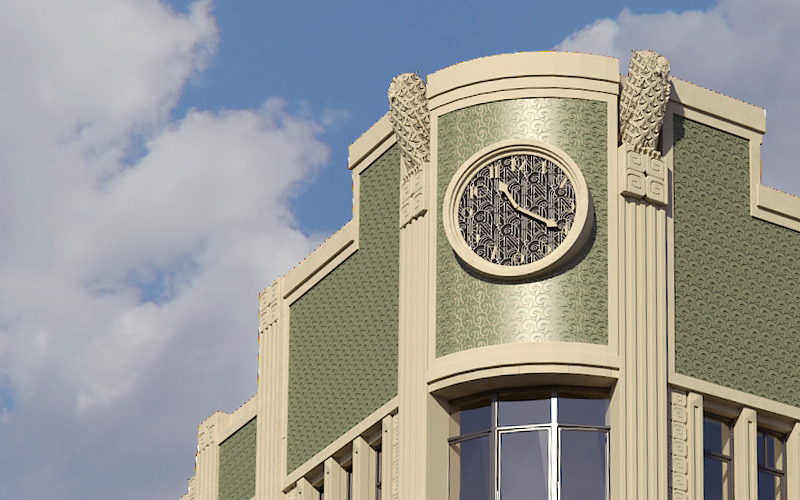
At first, however, it was a question of adaptation: in 2012, the Urban Planning and Earth Commission approved a partial re-profiling of telephone stations under the hotel. By that time, the MGTS company had already got rid of 195 buildings belonging to it, selling their financial corporation Sistema. They soon forgot about the adaptation: in 2015, the ATC was demolished on the Serpukhov Val, and a draft apart-hotel in the form of a seven-story chest with decorative owls and parking arose on the site of the Taganskaya station.
But the problem is global - Moscow does not have a clear strategy for maintaining heritage, where it would be formulated, what, why and how we retain.
The monument of the original building of 1929 was refused - constructivism in the consciousness of the layman (and the Mosgornovy Commission) is still associated with a faceless box, so Marat Khusnullin calls to leave a couple of quarters "as a monument of what cannot be built." But the problem is global - Moscow does not have a clear strategy for maintaining heritage, where it would be formulated, what, why and how we retain. The concept developed by the Moscow City Council in 2011 as part of the Moscow Culture program can hardly act as a strategic vision - it is written in a bureaucratic language, poses a number of problems, but does not contain neither regulation mechanisms, nor approaches to work with heritage. And most importantly, the concept does not imply joint actions of state bodies and public organizations - thus, the public is not allowed to make the most important decisions for the city. By the way, unlike other subprograms, the concept of the Moscow City Council has not been updated since then.
Accordingly, you can recall as much as you like that world practice knows a considerable number of examples when a change of function gave a new life to the construction - if there are holes in the legislation and in the absence of working mechanisms, the interests of the owner occupy a decisive place. Now the monument from the point of view of the investor is evil. An exception is the industrial fund, which was learned to adapt to modern needs. Nevertheless, the main part of commercial real estate in Moscow is reproduced according to established schemes and does not imply the preservation or renovation of historical objects located in the territory.
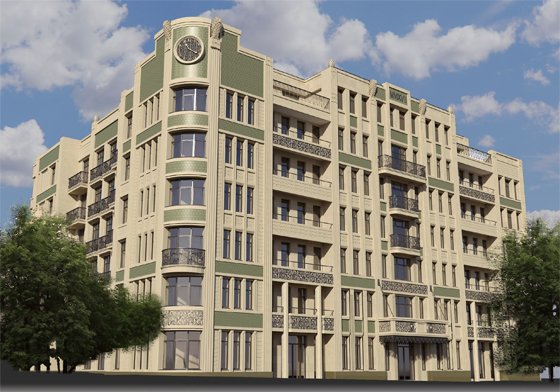 © “Leader-Invest” Project of the Apart-Hotel “Residence on Pokrovsky Boulevard” on the site of the building of the Taganskaya ATS, Arch. "Mesonproekt"
The aesthetic equivalent of the interests of the owners multiplied by the tastes of officials is the provincial-domed Luzhkov style that flooded the capital in the 1990s and early 2000s. The stylistics of colonial postmodernism struck many post -Soviet countries with the arrival of the market, but it most vividly proved herself in the recent transformation of the Center for the Macedonian senior senuine , where pseudo -historical fantasies were already brought to complete absurdity, and the genuine heritage was ignored. It is no secret that the choice of the new image of the capital of Macedonia was determined under the influence of the taste of the prime minister of the country, and the whole world has already become laughed over ridiculous statues. In Moscow, this frenzied market-chin-chin architecture with the departure of Yuri Luzhkov seemed to have reached positions, but, as we see, it would not be even an hour: the demolition of the constructivist quarter of Pogodinskaya with the construction of an elite complex in the best traditions of the Luzhkovsky era. Moreover, the taste preferences of the capital's leadership also apply to other areas of city life: Yuri Mikhailovich fought with a tram, and Sergei Semenovich annoy the trolleybus wires. One thing is interesting - what will the city remain with?
So, the functionality in the Moscow situation means clearing the place for commercial housing with the replacement of the history of her Erzatsa. This is quite in the logic of the speculative economy of modern development, aimed not at social needs, but to multiply capital by building elite residential complexes, offices and shopping centers. Obviously, the luxury apartments, if their appearance is not regulated in any way, will arise everywhere, and which only the owls we will not see. But what if the interests of developers and tastes of officials will finally win? Imagine for a second how a new reality will look.
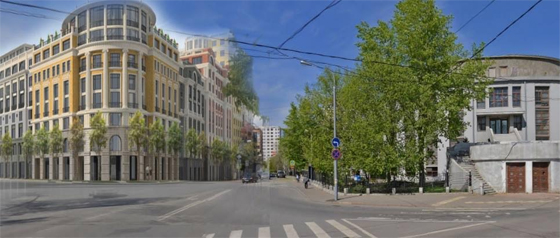 The Donstroy project on the site of the Pogodinskaya quarter, the installation of Alexandra Selivanova
In the continuation of the Luzhkov concept of Moscow as beds for the crop, the place of social and cultural objects is occupied by projects that promise the greatest financial benefit. From the samples of the Soviet avant -garde, Melnikov’s house has been preserved - foreigners are taken there, despite the emergency state, postcards with lost buildings are also sold here. In elite complexes, erected in a short time, a third of the area is populated - the rest is on resale, so the new buildings look non -residential. Architects, pleasing to the taste of officials, compete in the pretentiousness of the facades. Stalin's skyscrapers multiply. On the site of the Shukhov tower, an office block rises, the burnt library of INION is compensated by the shopping center. The privatization of public functions continues - former Soviet cinemas combine supermarket and parking. Metro stations do not arise where there is demand, but where the development of territories is agreed. The semantic gap between the center and the periphery progresses: the center is replete with entertainment, and the sleeping areas where 80% of the population live, monofunctional and dull.
Stalin's skyscrapers multiply. On the site of the Shukhov tower, an office block rises, the burnt library of INION is compensated by the shopping center.
The belt adjacent to Moscow is built by monstrous quality with high -rise buildings. Trade centers replace public space. This rupture is enhanced by a physical break: the outskirts are cut off from the city with transport forces, the roads are not connected, but shared. The cash flows saved on social facilities are redirected to the construction of overpasses, the tentacles of which dissect these areas from the inside. Fragmentation reaches the limit when the city ceases to be a single system and breaks up into closed cells, where the life of a citizen passes. Experts are engaged in advising developers how to get around the law. A special application shall notify the missed public hearings, expired votes and decisions adopted behind closed doors. You can send a petition to maintain the existing state of things.
Isn't it too gloomy picture? However, it should be noted: much of this is inherent in not only the Russian capital. Now the former mayor seemed to be a prosperous London, the charismatic Boris Johnson, during his reign, mercilessly criticized for the indulgence of developers, the demolition of municipal housing and the rise in public transport. But if in Britain the JARDIAN influential newspaper is a handle of criticism of the authorities, then the Moscow public was very surprised when a couple of city publications supported the attempt to save the ATS building.
There are also changes - they are mainly associated with the transfer of focus of attention from development in the territory of public use. Just six years ago, in 2010, Peter Palych Biryukov personally swept the street tables of the cafe, commenting quite sincerely: “We are not in Europe-we are in the ass.” Today, the city hall website reports: the number of summer verandas has grown by 25%. For some time we have been creating a comfortable environment, a convenient city and respect a pedestrian. We are cultural people. Let's try a little more and make it in such a way that in a comfortable city to destroy constructivism for the sake of low -quality fake under the old days it would be embarrassing and not notable.