
Translated material
"Work contrary to what they demand"
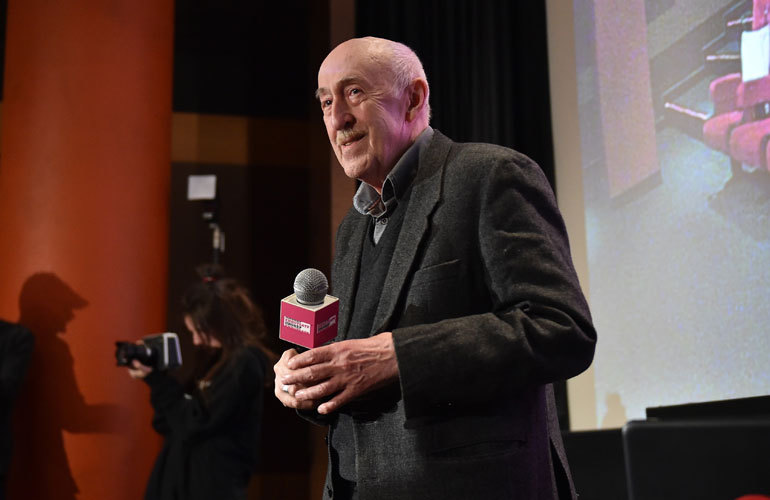
- In the Winter Song, everything is mixed up: time, relationship, dogs; The thiefs on the roller rollers travel along the streets of Paris, stole bags and even a violin, helping a lover simple to like the young violin. All your heroes are in a hurry somewhere, and we always see them on the way ... But what are they looking for?
- I shot a parable about the existence of the world inaccessible to us, which is the result of our actions. Each person’s action changes life. After perfect mistakes, we are able to blink the most important thing. For example, a man walks along the street, suddenly a door to the Garden of Paradise opens in the wall, he meets an important person there, but does not stop and hurries on. The thieves steal bags not only for profit: so they protest against the bourgeois society in which they grow, against the police and the visible order. In the picture, even when a person falls under the rink, in the literal sense becomes papier-mash, this is perceived by others as misfortune, the problem that needs to be solved, and a crushed person, at the request of the doctor, is stuck under the door, as if not noticing a person in him. This movie is built on old musical forms of the sonata, counterpoint and symphony of human relations - friendship, fidelity and forgiveness. For me, a picture of how our bourgeois, unhappy, sometimes unpleasant life in which we are all alone flows. I want someone to breathe with me about this.
- In the Winter Song there is no protagonist, whose story can be followed. We cannot read the history of human relations linearly, linger in one time. The picture begins with the execution of an aristocrat during the French Revolution. The conflict between the classes, between people who live in different worlds, will be reproduced in all the scenes of the film. After the revolution, you throw the viewer on the battlefield and in front of the TV screen, transmitting military operations, then conflicts on the streets of Paris ...
- I wanted to show how we have long been watching the outrages around us, including historical ones. There are two heroes in the Winter Song - old people, one of them is a former Viscount, he has no means to keep the castle, and the state blows the building. This person does not live in his time, it is with time that he has a conflict, he is fighting against the society in which he ended up. It is always difficult to trace the history of human relations, it is never collected in one time. My picture is not about how Maria loved Pierre, Anna - Ricara, and Richard fell in love, for example, Mary, - I call dramaturgy. And I will never engage in such drama. The film, which is built with the help of such a dramaturgy, is uninteresting to watch a second time. You will not read Voltaire once to understand the “candidate”? There you have to return to the material. To understand chaos, we must return by the time of its origin.
Today it is very important what Mikhail Afanasevich Bulgakov said: Remember, Satan came to destroy everything, but remained out of work, because everything has already been done. For God's sake, do not watch this film, thinking: what will happen next? Then there will be interweaving of strange events, this picture should be watched twice, such as, for example, films of Boris Barnet or Jacques Tati.
- Speaking about the chaos of life: did you have such moments when an accident helped your directorial plans?
- When I shot the “Butterfly Hunt”, I had a philosopher Pyatigorsk on my site. Sasha Pyatigorsk - my comrade, we had a company: Mesb Mamardashvili, Sasha Pyatigorsk and me. Then Pyatigorsk left, like a Jew, to London, and we were not allowed anywhere. He was arranged by a trial lecture cycle in Oxford. He began to tell in very bad English about Buddhism, Brahmanism, and the British know this by heart. But Sasha was so pretty that he was listened very carefully. When he finished and said: "Is there any questions?" - He was asked: "How is your surname written?"
One of his acquaintances said then: “You know, Sasha, I will lead you to the tailor, you need to sew a tweed jacket like everyone else.”
In short, when I needed Maharaja, who came to the French province to his friend, Count, I suddenly remembered Sasha’s specialization, and everything coincided - a thoughtful accident came out.
- You generally like to work with unprofessional actors ?
- The main thing is that I do not really like working with celebrities. These are people who are doomed to be slaves of the public and every time to do the same thing. Although there was one celebrity: in the film "Gardens in the fall" Michel Piccoli played an old lady. My favorite unprofessional elderly lady, whom I wanted to shoot, said: "I can’t walk, my legs are stubborn, sorry, Otar, I can’t." I came to Piccoli and said: play the lady. They tried on a suit for him, a wig and photographed. Then the lady said: "My God, how to look like my mother."
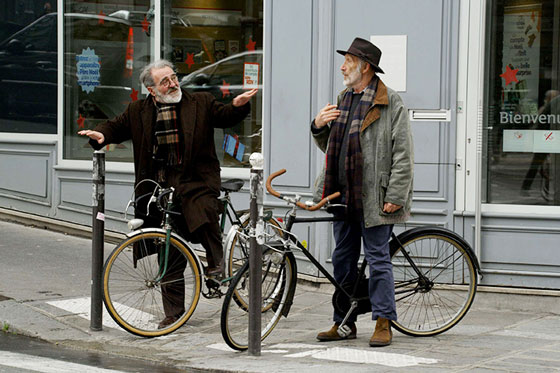 Frame from the film "Winter Song"
- And you yourself had to be in a situation of the “philosopher who became an actor”, to master other professions, except for directing?
- Certainly! I studied at VGIK. He shot his debut film "April", but he was laid on the shelf, and I could not defend myself right away. VGIK is not to blame for anything, forbade Goskino. One film, then one more - about flowers. I began to shoot the film "Chugun" and went to the factory for this. It was such a trick. Under the poor unhappy Nikita Sergeevich Khrushchev, the idea arose in the state to combat abstractionism, with the improper reflection of socialist reality, they said that we "do not know life." I decided to “find out life” in the most disgusting place and went to the domain workshop: there is dusty, hot, poisonous. I worked there for 18 months with great pleasure. The position was called "Gornova", there were only four people. Gornova open the cage, gives the slag to drain, throws out the slag, then begins to flow cast iron, it must be directed along the gutters into the wagons. Then these wagons were brought to the steelines, and they made bad steel. Then it turned out that the workers had no right to leave the work: they were recruited from the peasants, they took their passports. It was practically that were serfs. I myself had to turn to a high local authorities at a metallurgical plant to return my passport. After that, I took off the "cast iron", he again did not come to the court. They told me: “If you shot this about Italian workers, everything is in order, this cannot be removed about Soviet workers.” Then Grisha Chuhrai appeared, a laureate of the Lenin Prize, a very decent person, a front -line soldier. It’s not that he went against the party line or pierced the wall with his forehead, but he did what he wanted, within the framework of the permitted. Then even Gerasimov could not take responsibility and issue a diploma for the film, which forbade Goskino. Grisha Chuhrai, like a laureate, could and wrote a review of Cast iron.
I did not have enough experience at the factory, and I decided to become a professional fisherman in Batumi. The ship’s team immediately decided that I was a spy. They sold the fish to the left: they caught, stood on a raid near the shore of the resort center, launched the siren, and all sorts of feluins immediately sailed to them. For a kilo of caught fish, the plant paid them four kopecks, and they sold one large fish to the left for three rubles! Of course, they excited and began to think who he had come. Suddenly it turned out that none of them could swim except the captain. And if the network is wound on a screw, especially at night? The captain cannot leave the ship. So he helped them out, dived with a knife in his teeth and cut off the tackle; A terrible night.
- After such help, you were accepted for your own?
- Yes, I gathered the team’s meeting - because they locked me in a kubrick when they traded fish. I say: what is it? Everyone knows that you are selling fish, what do you think, I will knock on you? They believed that I was some kind of loser, attached to them. But I checked: the head of the port was then called Shalva Joseliani, and I said that he had come according to the blat. He told them: you know where I came from, from which family!
- You became a professional fisherman and Gornov in Georgia, and how did you become a professional director in France?
- I was literally lent to the French producer. I didn’t even have a contract with him, as a Soviet citizen, I had no right to sign such agreements. The producer signed a contract with Goskino. I came to France to take off the "favorites of the moon", the producer decided that I was Zulus, the devil came from where. He began to explain to me: “These are rails, a cart is placed on them, these are lighting devices, we have it.” I answer: "The rails are poor, what are you chewing?"
- But now in France you are perceived as a European director?
- Yes, but they don’t want to watch. The people - that is, children from 13 to 22 years old - does not go. They go to what they are used to. The trouble is that those to whom these films are addressed also do not go to the cinema, they were disappointed in the cinema, for them this is a chewing gum that should not be wasted on. The other was the era of Jean Vigo, although before going to the screens it was cut by producers. The only copy of Atalanta is stored in the State Film Fund. Rene Claire, Abel Hans, Jacques Tati - this is the era!
- You say that your films usually do not watch, but how did the audience perceive “and became light”? For the sake of this picture, you were looking for a local tribe in Africa without European influence.
- For them, it was an exotic, an illiterate French viewer does not understand anything, he does not even have a shadow of the concept of what a thought is, a metaphysics regarding the phenomenon of life. They were ruined by television and Hollywood. But since the film was shot in Africa, then it is interesting to them.
In Africa, I was looking for a tribe where there would be decent people; I was disappointed in everything. I did not even know what I would do: the European invasion of Africa corrupted them, they lost their culture of life together. Local tribes can no longer live only beliefs and rules, they began to cheat, earn money. I traveled a lot of places; Somewhere there were revolutionaries, terrible crooks, as relying among revolutionaries. I'm about to leave and stumble upon a small village, they greeted me there:
- Are you from afar?
- Yes, I'm very far away.
-Would you like to drink Coca-Cola?
“Do you have anything stronger?”
Then I sat with them, organized a meeting, told everything about what they would do; These were people who respect the elders, raise children well, roughly speaking, they did not lose their main values. I shot the picture contrary to their ideas about the rituals, I imposed mine to them so that it was tactful. They believed in the possibility of such rituals. For example, in order to make some decision, I put in a circle of women and men. The ladies decided something and sent the messenger to the men with the news, a little boy. They don’t do that, but they liked it.
- You are talking about an illiterate viewer in France, but what does he lack?
- First of all, the pre -war era took with her all the crumbs of the rules of social behavior. The idea that people read, what scandals after exhibitions of the impressionists were shook the academy. How many people today know in France why crazy Van Gogh or Cezann appeared? Soon there will be no one to talk with Gaugen! Does this viewer know how Nizhinsky and Diaghilev ended up in Paris? Culture permeated the whole life of man. It was equally important to own the culture of using absinthe and understand the "mulece rouge." All European values disappear, I found the crumbs, and I have to collect them for my work. On the other hand, my cinema is possible only among these cultural values: I can not work either in India, in Persia, in Morocco, and even more so in Mexico.
- Almost every new film is marked by prizes in Locarno or Cannes. Do festival awards help to find money for a movie?
- No. This is not just that we have in the days of Stalin: there were guerroll directors, they sat in a working cabin with an order. In France, it is indecent to wear an order; What am I, I will put on myself a Maltese cross or the Order of a Foreign Legion? Only the president wears such things there. Although Shirak distributed these crosses of the honorary legion to the left and right. Even ours: this is such a game of the heads of states - to recognize another head of state. True, I am talking about state awards, but festival prizes also do not particularly help me.
- At the beginning of the conversation, you recalled "Masters and Margarita." I heard that you do not approve of the adaptations of literary works - and especially Bulgakov.
- The very concept of "film adaptation" is criminal and shameful. It is good to have such a screenwriter as Bulgakov, but you also have to have a conscience. Bulgakova should read and enjoy how it is written. And having replaced the characters of Bulgakov with specific actors, you deprive the viewer of the opportunity to try on the Bulgakov text on yourself, for his imagination - he will imagine all these actors, as in all the adaptations of Anna Karenina and War and Peace. For me, in all these film adaptations, the most important thing is omitted, only intrigue and conflict remained. Hugo did such things, horror! Almost all of his things were filmed - “Ghana of the Icelander”, “the man who laughs”, “Cathedral of the Parisian Mother of God”. These squeezes sound disgusting, nothing main is told. Gyugo has long chapters-leading about human nature, about the ugliness that surrounds us-about the bitterness that a person who lives life is aware of. In the cinema, you can not get involved in villainy and constantly insist that the beast all the time: this is not so.
- In the “Winter Song” there are also a lot of reasoning about the outrages around us. It seemed to me that in your new film there are many hints of lack of understanding and the slightest connection between a person and the structure of power. It was as if the state is deaf, and the language of the people become marginal layers of society - thieves, poor, losers.
- Around there is chaos. Russia and Georgia are plundered, the disgusting category of the oligarchs appeared, and with them the category of officials appeared, who, perhaps, tremble, but lost fear. The official - this has always been a shameful activity, starting with Gogol's Dead Souls. Sobakevich said: they are all bastards, one decent person is a prosecutor, and even that pig. Any administration commits actions irreversible to the inhabitants of a country; Some then correct their mistakes. The English administration somehow managed to gently leave its colonies, leave India, from Australia, New Zealand and Canada. The Spanish administration was forced to leave Argentina and Mexico. And the French reserved the islands, because these small peoples, lost in the ocean, are drunk and perish, as on Easter Island, is justified pressure.
The Russian administration has never been a gentlemanly starting with Ivan Kalita - and the tradition continues. Peter I cut through the window to Europe, but this did not help, Nicholas I came, who sent all the thinking intelligentsia to rot to Siberia, and Nicholas II simply shot dogs and raven, in any case, this gave him pleasure. Thank God, he did not shoot people. I'm not talking about Stalin.
It is best to work contrary to what they are required of you, contrary to the erroneous attitude of the state - so I would like to call my younger colleagues to this.